Quick Info
| Field | Information |
|---|---|
| Species | Smilodon fatalis — Carnivora, Felidae |
| Period | Pleistocene, approximately 2.5 million–10,000 years ago |
| Genus named | 1842, by Peter Wilhelm Lund |
| Key fossil site | Rancho La Brea, Los Angeles, California |
Quick Answer:Smilodon was first described scientifically in 1842 by the Danish naturalist Peter Wilhelm Lund based on fossil material recovered from cave deposits in Brazil. The genus name derives from Greek words meaning “knife tooth,” a reference to its elongated saber-like canines. Although the genus was first recognised in South America, the most important source of Smilodon fossils is Rancho La Brea in California, whose rich deposits have yielded thousands of specimens and transformed understanding of this iconic Ice Age predator.

The first Smilodon fossils were not discovered in California but in cave deposits of southeastern Brazil. Decades later, the fossil-rich asphalt seeps of Rancho La Brea would produce an unparalleled record of the genus, making Smilodon one of the best-documented large predators in the fossil record. The history of its discovery spans two continents and nearly two centuries of scientific research.
How Was Smilodon Discovered?
Smilodon was first formally described in 1842 by the Danish naturalist Peter Wilhelm Lund, who conducted extensive excavations in the cave deposits of Lagoa Santa, Minas Gerais, Brazil. Lund’s work revealed a diverse fossil fauna and led to the scientific recognition of what is now known as Smilodon populator, the largest species within the genus.
The name Smilodon is derived from the Greek smilē (“knife” or “chisel”) and odōn (“tooth”), a reference to the animal’s distinctive saber-like canines. The name remains one of the most descriptive genus names in vertebrate palaeontology.
The North American species, Smilodon fatalis, was described later from separate fossil material. The specific epithet fatalis derives from Latin and is commonly translated as “fatal” or “deadly.” Subsequent discoveries across North and South America expanded the known geographic range of the genus and established Smilodon as one of the most widespread saber-toothed cats of the Pleistocene.
The La Brea Tar Pits: The World’s Most Important Smilodon Fossil Site
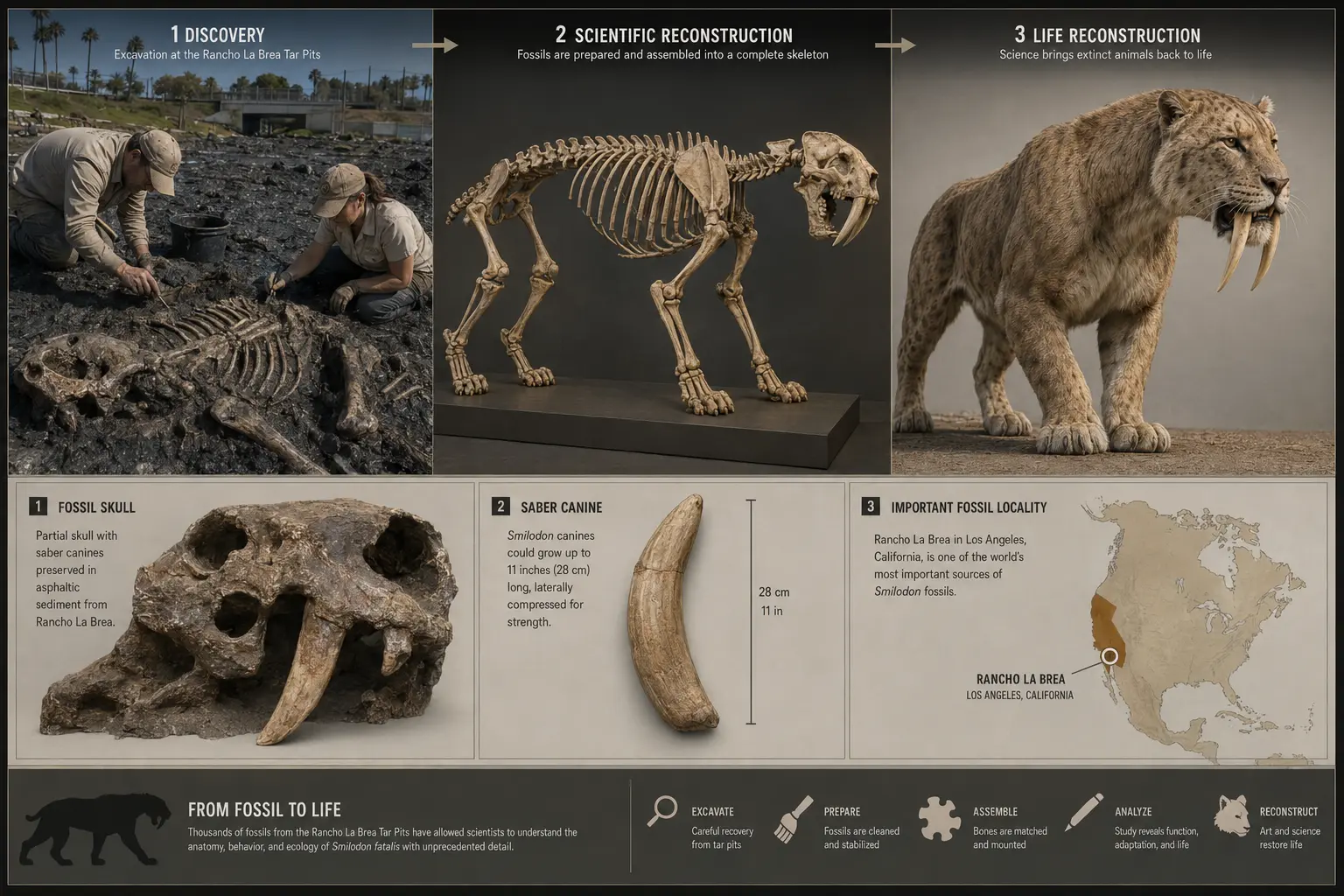
The Rancho La Brea asphalt seeps in present-day Los Angeles, California, constitute the most significant source of Smilodon fossils ever discovered. Systematic scientific excavation began during the early twentieth century, although fossil bones had been recovered from the area decades earlier. The exceptional abundance and preservation of material recovered from La Brea have made Smilodon fatalis one of the best-studied extinct predators in the fossil record.
The deposits formed when petroleum seeped naturally to the surface, and lighter components evaporated, leaving sticky asphalt traps. Herbivores that became trapped attracted predators and scavengers, which in turn also became ensnared. Over thousands of years, this process created an unusually rich accumulation of Late Pleistocene vertebrate fossils.
Scale of the La Brea Assemblage
Rancho La Brea has yielded tens of thousands of Smilodon fatalis specimens representing numerous individuals across a broad range of ages. No other fossil locality has produced a comparable sample of a saber-toothed cat. As a result, much of what is known about the anatomy, variation, pathology, and ecology of Smilodon is derived from La Brea material.
The assemblage spans much of the Late Pleistocene and provides an exceptional record of predator-prey communities during the final stages of the Ice Age. The abundance of specimens allows researchers to examine population-level patterns that are rarely accessible in extinct large carnivores.
What La Brea Has Revealed
The La Brea fossils have transformed scientific understanding of Smilodon. Studies of skeletal injuries have documented individuals who survived severe trauma, providing insights into behaviour and life history. Dental wear patterns, stable-isotope analyses, and comparative anatomical studies have contributed to reconstructions of feeding ecology and habitat use.
Because the sample includes individuals of different ages and conditions, researchers have also been able to investigate growth, variation, disease, and injury frequencies at a level rarely possible for extinct mammals. Few fossil sites anywhere in the world provide such a comprehensive view of a single large predator species.
South American Discoveries
Although Rancho La Brea dominates the scientific literature, the South American fossil record is equally important for understanding the evolutionary history of the genus. Fossils of Smilodon populator, the largest known species, have been recovered from numerous localities across Argentina, Uruguay, Brazil, Bolivia, and Chile.
Particularly important discoveries have come from the Pampean region of Argentina and the cave deposits of Brazil, where well-preserved skulls, jaws, and postcranial skeletons have provided critical information about anatomy, body size, and geographic distribution. These fossils demonstrate that Smilodon occupied a wide range of habitats across South America during the Pleistocene.
The earliest recognised species, Smilodon gracilis, is known primarily from North America and helps document the evolutionary history of the genus before the appearance of the larger and more specialised S. fatalis and S. populator. Together, fossils from North and South America provide a nearly continent-wide record of one of the most successful saber-toothed cats in evolutionary history.
Naming History and Taxonomy
The genus Smilodon is currently represented by three widely recognised species: Smilodon gracilis, Smilodon fatalis, and Smilodon populator. These species differ in body size, geographic distribution, and certain aspects of skeletal anatomy, although the precise relationships among populations remain the subject of ongoing research.
The first species described was Smilodon populator, based on fossil material recovered from Brazil and studied by Peter Wilhelm Lund during the nineteenth century. Subsequent discoveries across North America led to the recognition of S. fatalis and S. gracilis, expanding the known diversity and geographic range of the genus.
Smilodon belongs to Machairodontinae, the extinct subfamily of saber-toothed cats. This group included a variety of specialised predators such as Homotherium, Megantereon, and Xenosmilus. Advances in comparative anatomy and cladistic analysis have progressively refined the understanding of the evolutionary relationships among these taxa, although some aspects of machairodont phylogeny remain unresolved.
Ongoing Excavation and Research
Rancho La Brea remains one of the world’s most active and scientifically important Ice Age fossil sites. Excavation, preparation, and analysis continue under the stewardship of the Natural History Museums of Los Angeles County, with new specimens and associated environmental data regularly added to the collection.
One of the most significant recent discoveries was Project 23, a large-scale salvage excavation initiated during construction work in Hancock Park in 2006. The project recovered numerous fossil-bearing deposits containing vertebrates, plants, insects, and other organisms, providing new insights into Late Pleistocene ecosystems and environmental change.
Research on Smilodon continues to evolve as new analytical methods become available. Recent studies have explored biomechanics, growth and development, feeding ecology, stable-isotope signatures, and population structure. Advances in imaging technology and geochemical analysis continue to reveal details that were inaccessible to earlier generations of researchers.
As a result, the discovery of Smilodon is not simply a historical event but an ongoing scientific process. New fossils and new methods continue to refine the understanding of one of the most iconic predators of the Ice Age.
Related and Contemporary Species at Major Fossil Sites
- Canis dirus (dire wolf) — One of the most abundant large carnivores recovered from Rancho La Brea and a frequent ecological associate of Smilodon fatalis.
- Panthera atrox (American lion) — A large North American felid that shared Late Pleistocene ecosystems with Smilodon and is represented within the La Brea fossil assemblage.
- Arctodus simus (short-faced bear) — A giant bear of North America and one of the largest terrestrial carnivores known from the Pleistocene.
- Mammuthus columbi (Columbian mammoth) — A characteristic herbivore of North American Ice Age environments and part of the broader fauna represented at Rancho La Brea.
- Megatherium americanum — A giant South American ground sloth that lived alongside Smilodon populator in portions of South America during the Pleistocene.
Frequently Asked Questions
Where was Smilodon first discovered?
Smilodon was first described scientifically from fossil material recovered from cave deposits in Lagoa Santa, Minas Gerais, Brazil, by the Danish naturalist Peter Wilhelm Lund in 1842. These discoveries established the genus and marked the beginning of the scientific study of one of the most distinctive predators of the Pleistocene. The North American species, Smilodon fatalis, was recognised later from fossil material discovered elsewhere in the Americas.
How many Smilodon fossils have been found?
Tens of thousands of Smilodon fossils have been recovered from sites across North and South America, making the genus one of the best-represented large predators in the fossil record. The vast majority of specimens come from Rancho La Brea in California, whose exceptional preservation and abundance of material have provided an unparalleled record of anatomy, variation, pathology, and ecology.
Note: Species boundaries within Smilodon and the evolutionary relationships among saber-toothed cats remain active areas of research. Current classifications reflect the best available evidence but may be refined as new fossils and analytical techniques become available.
Conclusion
The discovery history of Smilodon spans nearly two centuries of palaeontological research, from the cave deposits of Brazil explored by Peter Wilhelm Lund to the extraordinary fossil assemblages of Rancho La Brea in California. Although the genus was first recognised in South America, it was the unparalleled abundance of material from La Brea that transformed Smilodon into one of the best-studied extinct predators in the world.
Today, fossils from sites across the Americas continue to provide new insights into anatomy, ecology, behaviour, and evolution. Far from being a closed chapter in scientific history, the study of Smilodon remains an active field of research, demonstrating how discoveries can continue to reshape understanding of even the most famous prehistoric animals.
References
Primary Historical and Taxonomic Sources
Lund, P.W. (1842). Blik paa Brasiliens Dyreverden för sidste Jordomvaeltning. Det Kongelige Danske Videnskabernes Selskabs Skrifter.
Books and Monographs
Stock, C. & Harris, J.M. (1992). Rancho La Brea: A Record of Pleistocene Life in California. Los Angeles: Natural History Museum of Los Angeles County.
Peer-Reviewed Literature
Van Valkenburgh, B. & Hertel, F. (1993). Tough times at La Brea: Tooth breakage in large carnivores of the Late Pleistocene. Science, 261(5120), 456–459. https://doi.org/10.1126/science.261.5120.456
Databases and Institutional Resources
La Brea Tar Pits. About the Tar Pits. Natural History Museums of Los Angeles County.
Paleobiology Database. Smilodon occurrence records.
Featured Museum Collections
Museum-quality paleoart and educational poster
collections based on evidence-informed prehistoric
Life reconstructions.