Quick Info
| Field | Information |
|---|---|
| Species | Smilodon fatalis — Carnivora, Felidae |
| Period | Pleistocene, approximately 2.5 million–10,000 years ago |
| Locomotion type | Ambush predator |
| Running specialization | Power and acceleration rather than endurance |
| Evidence base | Limb proportions, skeletal biomechanics, and comparative anatomy |
Quick Answer: The maximum running speed of Smilodon fatalis cannot be determined directly from the fossil record. However, its robust limbs, powerful forequarters, short tail, and stocky build indicate an ambush predator adapted for short bursts of acceleration rather than sustained high-speed pursuit. Most researchers interpret Smilodon as relying on stealth, close-range attacks, and physical strength rather than long-distance chases.

The question of how fast Smilodon could run is best approached through anatomy. Although no direct measurements of speed exist, the skeleton provides strong evidence about how the animal moved and hunted. Nearly every aspect of its body plan points toward explosive power and prey restraint rather than cursorial specialization.
How Fast Was Smilodon?
No direct measurement of Smilodon‘s running speed is possible. Unlike some extinct animals represented by trackways, no fossil evidence currently allows stride length, gait, or top speed to be reconstructed directly. As a result, estimates of maximum speed are necessarily speculative.
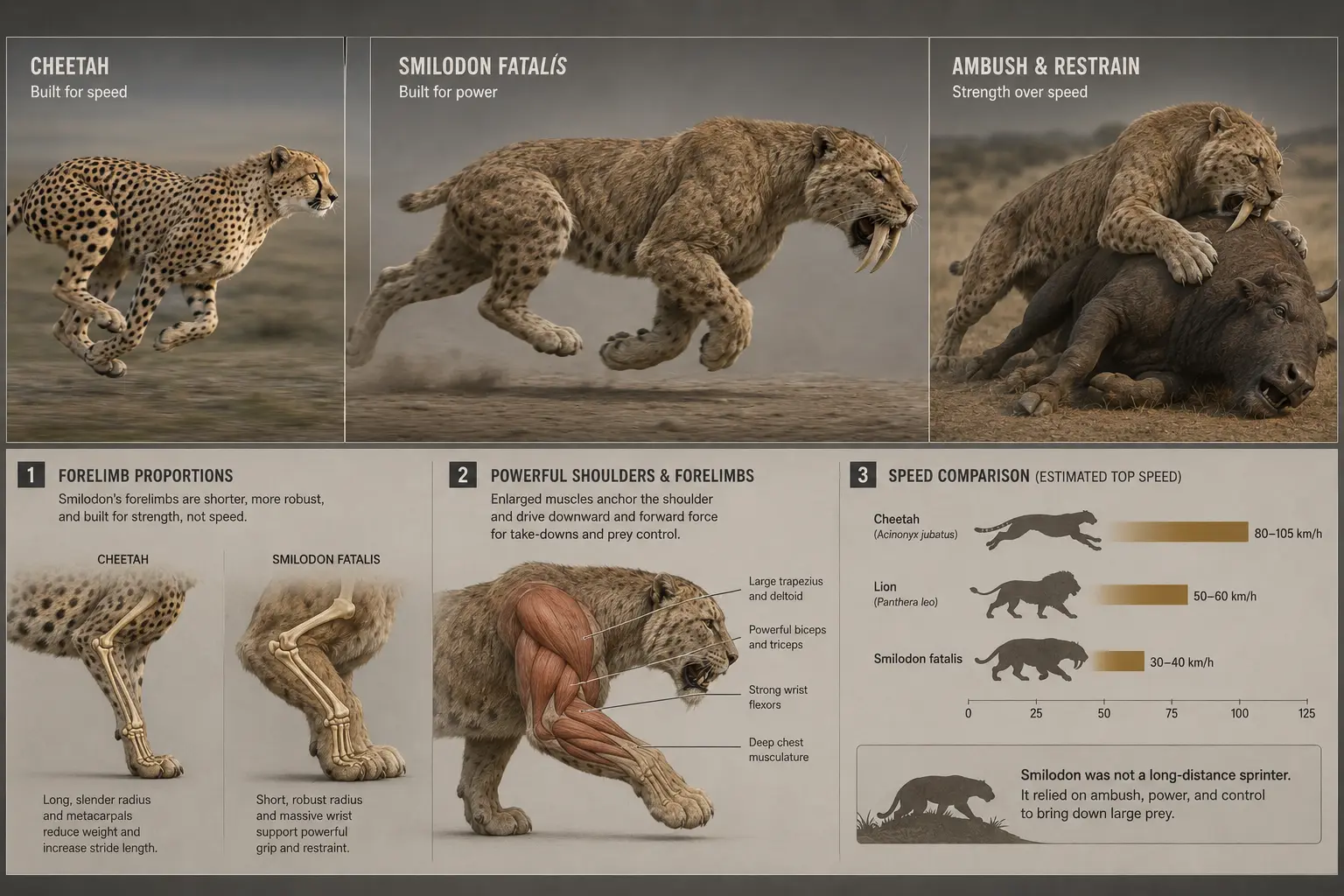
What can be evaluated with greater confidence is locomotor capability. The limb proportions and overall body plan of Smilodon fatalis differ markedly from those of highly cursorial predators. Its forelimbs were exceptionally robust, the hindlimbs relatively short, and the tail much shorter than those of modern pursuit specialists. These features suggest an animal optimised for short-range acceleration, grappling strength, and prey restraint rather than prolonged running.
Most palaeontologists therefore interpret Smilodon as an ambush predator that relied on stealth and close-range attacks. While it was undoubtedly capable of rapid movement over short distances, its anatomy does not support the interpretation of a long-distance pursuit hunter comparable to a cheetah or other cursorial carnivores.
Limb Proportions and What They Reveal
The skeleton of Smilodon fatalis preserves several anatomical features that provide insight into its locomotor abilities.
- Exceptionally robust forelimbs — The radius, ulna, and associated muscle attachment sites indicate unusual upper-body strength compared with living large cats. These adaptations are consistent with restraining large prey and absorbing substantial forces during close-range encounters.
- Relatively short hindlimbs — Compared with pursuit specialists, the hindlimbs of Smilodon were proportionally shorter and more heavily built. This anatomy likely reduced maximum stride length and limited sustained running performance.
- Short tail — Unlike the long tails of modern pursuit predators, the tail of Smilodon was comparatively short. Long tails act as dynamic stabilisers during rapid turns and high-speed running; the reduced tail length suggests that extreme manoeuvrability at speed was not a primary selective pressure.
- Power-oriented body plan — The overall skeletal design emphasises strength and stability rather than the lightweight construction associated with high-speed pursuit predators.
Taken together, these features support the interpretation of Smilodon as a predator adapted for powerful close-range attacks rather than prolonged chases across open terrain.
Ambush vs. Pursuit: What the Evidence Supports
Smilodon was an ambush predator, not a pursuit specialist — this is the consensus position based on functional morphology. Comparison with modern felids reinforces the interpretation. Lions and tigers, which are ambush-to-short-pursuit hunters, have limb proportions more similar to Smilodon than do cheetahs, which are dedicated cursors. The cheetah’s proportionally long distal limbs, flexible spine, and lightweight build contrast at every point with Smilodon‘s stocky, heavily muscled frame.
Biomechanical modelling by Meachen-Samuels and Van Valkenburgh (2010) demonstrated that Smilodon fatalis forelimb bones were disproportionately robust — consistent with generating and absorbing the forces of restraining large, struggling prey. This finding supports the interpretation that Smilodon prioritised overpowering prey at close range rather than running it down.
Speculatively, Smilodon may have used vegetative cover to stalk prey to within a short charge distance, launching a rapid acceleration before deploying its forelimbs to pull prey down. This is a reasonable inference from morphology and comparison with modern ambush felids, but it is not directly evidenced in the fossil record.
Comparison With Other Pleistocene Predators
Smilodon fatalis shared its North American range with predators of varying locomotion styles. Panthera atrox, the American lion, likely had a similar ambush-to-short-pursuit capability. Canis dirus, the dire wolf, was a pursuit predator adapted for sustained running across open terrain — a fundamentally different strategy. Homotherium serum, a contemporary machairodont, had proportionally longer hindlimbs than Smilodon, suggesting a more cursorial hunting style within the sabertooth lineage itself.
Niche partitioning between these predators likely involved locomotion strategy as one axis of ecological separation. Full predator comparisons are covered in the Smilodon vs Dire Wolf post.
Related and Contemporary Species
- Panthera atrox (American lion) — similar ambush-to-short-pursuit build; likely comparable speed range to S. fatalis [verify before publishing].
- Homotherium serum — more cursorial limb proportions than Smilodon; may have been capable of sustained pursuit over moderate distances.
- Canis dirus (dire wolf) — pursuit predator with limb proportions suited to sustained running; contrasts with Smilodon‘s power build.
- Acinonyx jubatus (cheetah) — living specialist cursor; represents the extreme opposite of Smilodon‘s locomotion strategy within Felidae.
- Panthera leo (African lion) — the closest living functional analogue for Smilodon‘s ambush-to-close-range-attack strategy.
Frequently Asked Questions
Was Smilodon faster than a lion?
There is currently no reliable way to determine whether Smilodon fatalis was faster than a modern lion. Direct speed measurements are impossible because no fossil evidence preserves stride length, gait, or running performance.
The available anatomical evidence suggests that Smilodon was less specialised for high-speed pursuit than modern lions. Its robust forelimbs, relatively short hindlimbs, and stocky build indicate a predator adapted for ambush and close-range prey restraint rather than prolonged chases. While Smilodon was undoubtedly capable of rapid acceleration over short distances, its exact top speed remains unknown.
Note: Speed estimates for Smilodon are based on biomechanical modelling of skeletal proportions and carry significant uncertainty. No trackway evidence is currently available to independently verify these figures. Details reflect current scientific consensus but may be revised as new evidence emerges.
Conclusion
Smilodon fatalis was built for power rather than endurance. Its robust forelimbs, relatively short hindlimbs, reduced tail, and heavily muscled frame all point to a predator specialised for ambush hunting and close-range prey restraint.
Although its exact running speed cannot be determined, the available anatomical evidence consistently indicates that Smilodon was not a pursuit specialist. Instead, it appears to have relied on stealth, rapid acceleration, and physical strength to overpower large prey. The skeleton reveals an animal optimised not for covering long distances at high speed, but for winning a brief and violent encounter at close range.
References
Peer-Reviewed Literature
Anyonge, W. (1996). Locomotor behaviour in extant and extinct large carnivores. Journal of Zoology, 239(1), 141–151.
Meachen-Samuels, J. & Van Valkenburgh, B. (2010). Radiographs reveal exceptional forelimb strength in the sabertooth cat, Smilodon fatalis. PLOS ONE, 5(7), e11412. https://doi.org/10.1371/journal.pone.0011412
Books
Turner, A. & Antón, M. (1997). The Big Cats and Their Fossil Relatives: An Illustrated Guide to Their Evolution and Natural History. New York: Columbia University Press.
Featured Museum Collections
Museum-quality paleoart and educational poster
collections based on evidence-informed prehistoric
Life reconstructions.