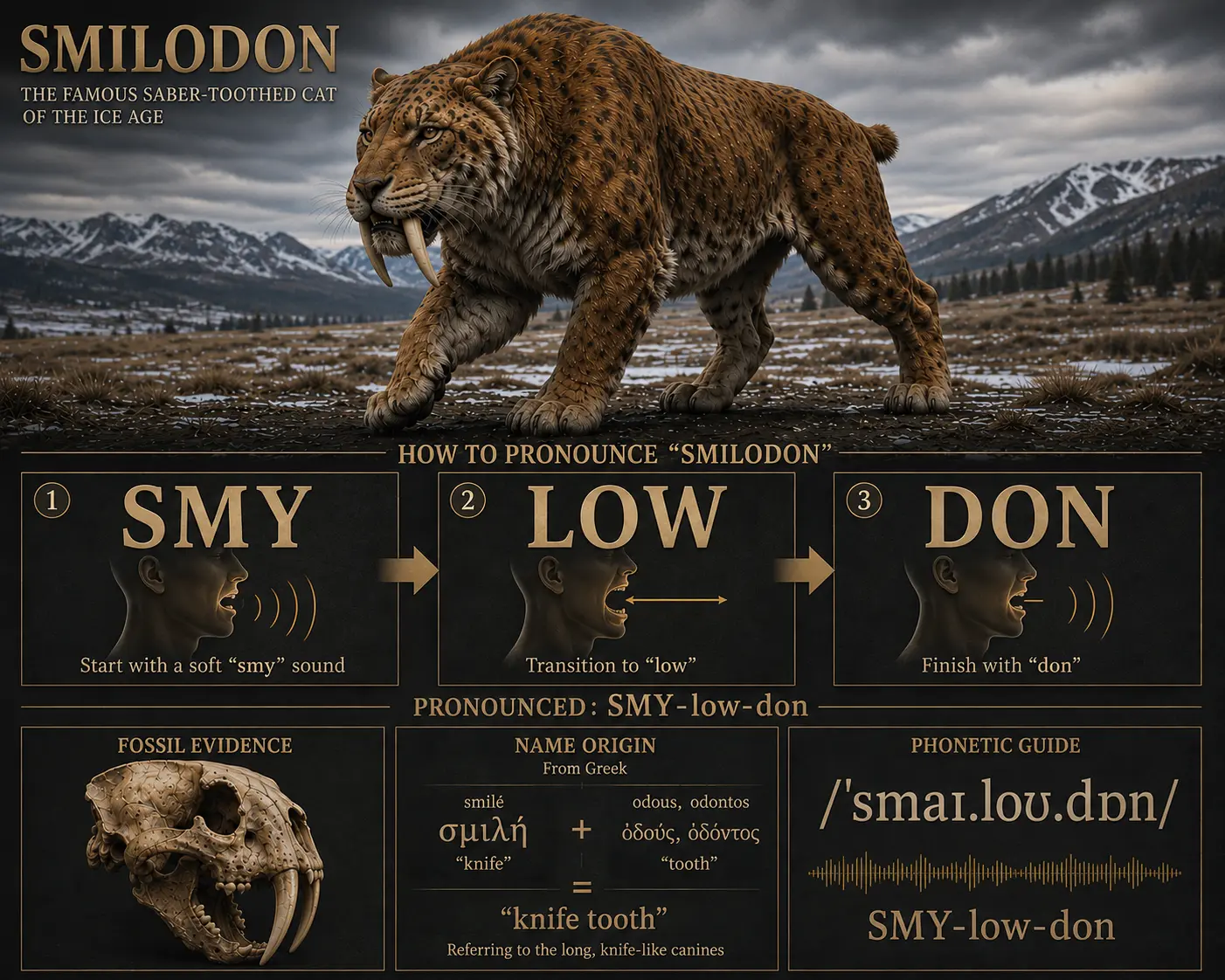
Quick Info
| Field | Information |
|---|---|
| Genus | Smilodon |
| Family | Felidae |
| Pronunciation | SMY-loh-don |
| IPA | /ˈsmaɪ.lə.dɒn/ |
| Name Origin | Greek smilē (“knife” or “chisel”) + odōn (“tooth”) |
| Meaning | “Knife tooth” or “chisel tooth” |
Quick Answer
Smilodon is pronounced SMY-loh-don, with the stress on the first syllable. The name derives from the ancient Greek words smilē (“knife” or “chisel”) and odōn (“tooth”), a reference to the animal’s distinctive, elongated saber canines. The word contains three syllables: SMY – loh – don.

The name describes exactly what made Smilodon famous. Coined from classical Greek roots in the nineteenth century, it literally means “knife tooth” or “chisel tooth,” highlighting the enlarged upper canines that distinguish the genus from all living cats.
How Do You Pronounce Smilodon?
Smilodon is pronounced SMY-loh-don. The primary stress falls on the first syllable, SMY, which rhymes with “sky.” The second syllable is pronounced “loh,” and the final syllable sounds like “don.”
In the International Phonetic Alphabet (IPA), the pronunciation is written:
/ˈsmaɪ.lə.dɒn/
Common mispronunciations include placing the stress on the second syllable or pronouncing the opening syllable as “smill.” While variations exist in informal speech, the standard scientific pronunciation emphasizes the first syllable.
What Does Smilodon Mean?
The name Smilodon is derived from two ancient Greek words. The first element, smilē (σμίλη), refers to a knife, chisel, or carving tool. The second element, odōn (ὀδών), means “tooth.”
Combined, the name translates approximately as “knife tooth” or “chisel tooth.” The etymology is a direct reference to the elongated, blade-like upper canines that characterize the genus and inspired the popular term “saber-toothed cat.”
The genus was established in 1842 by the Danish naturalist Peter Wilhelm Lund, who described fossil material recovered from caves in Brazil. The name has remained in use ever since and is now one of the most recognizable scientific names in paleontology.
Pronouncing the Species Names
Three species are currently recognized within the genus Smilodon, each with its own scientific name and pronunciation.
| Species | Pronunciation | Name Meaning |
|---|---|---|
| Smilodon gracilis | SMY-loh-don GRASS-ih-liss | gracilis — Latin for “slender” or “graceful” |
| Smilodon fatalis | SMY-loh-don fah-TAH-liss | fatalis — Latin for “fatal” or “deadly” |
| Smilodon populator | SMY-loh-don pop-yoo-LAY-tor | populator — Latin for “devastator” or “ravager” |
Pronunciations of scientific names can vary somewhat among researchers, educators, and regions. The forms shown above represent commonly used English-language pronunciations.
Is “Saber-Toothed Tiger” the Same Animal?
Not exactly. Although Smilodon is often called a “saber-toothed tiger” in popular media, it was not a tiger and did not belong to the genus Panthera.
Modern tigers belong to the genus Panthera within the cat family (Felidae). Smilodon belonged to the extinct subfamily Machairodontinae, a lineage of saber-toothed cats that diverged from the ancestors of modern big cats millions of years ago.
Because of this evolutionary separation, “saber-toothed cat” is the more accurate common name. The term “saber-toothed tiger” survives largely as a historical and popular nickname rather than a scientific description.
Related Species Worth Knowing How to Pronounce
| Species | Pronunciation | Name Meaning |
|---|---|---|
| Homotherium | hoh-moh-THEER-ee-um | Greek for “similar beast” |
| Megatherium | meg-ah-THEER-ee-um | Greek for “great beast” |
| Panthera atrox | PAN-theh-rah AY-troks | Latin for “fierce” or “cruel” |
| Canis dirus | KAY-niss DY-russ | Latin for “dire” or “fearsome dog” |
| Arctodus simus | ARK-toh-duss SY-muss | Scientific name of the giant short-faced bear |
Learning the pronunciation of these names can make paleontological discussions, museum visits, and educational videos easier to follow, especially because many of these Ice Age animals frequently appear alongside Smilodon in discussions of Late Pleistocene ecosystems.
Frequently Asked Questions
Is it “SMY-loh-don” or “SMIL-oh-don”?
The most commonly used English-language pronunciation is SMY-loh-don, with the first syllable rhyming with “sky.” However, scientific names are not governed by a universal spoken standard, and variations can occur among educators, researchers, and regions. In museums, documentaries, and paleontological publications, SMY-loh-don is the pronunciation most frequently encountered.
Why is Smilodon called a saber-toothed tiger if it is not a tiger?
The term “saber-toothed tiger” is a popular nickname rather than a scientific classification. Smilodon was a member of the extinct cat subfamily Machairodontinae, whereas modern tigers belong to the genus Panthera. Although both are members of the cat family (Felidae), Smilodon was not a tiger and belonged to a distinct evolutionary lineage. For this reason, paleontologists generally prefer the term “saber-toothed cat.”
What does the name Smilodon mean?
The name Smilodon comes from the ancient Greek words smilē (“knife” or “chisel”) and odōn (“tooth”). Together they translate approximately as “knife tooth” or “chisel tooth,” a reference to the elongated upper canine teeth that characterize the genus.
Conclusion
Smilodon is most commonly pronounced SMY-loh-don and derives its name from Greek words meaning “knife tooth” or “chisel tooth.” The name reflects the animal’s most distinctive feature—its elongated saber-like canine teeth—and remains one of the most recognizable scientific names in paleontology.
More than 180 years after the genus was first named, Smilodon continues to be one of the best-known prehistoric mammals, and its name remains a direct reminder of the remarkable adaptations that made it one of the most specialized predators of the Ice Age.
References
A. Primary Taxonomic Sources
Lund, P.W. (1842). Blik på Brasiliens dyreverden før sidste jordomvæltning. Det Kongelige Danske Videnskabernes Selskabs Skrifter.
B. Peer-Reviewed Literature
Werdelin, L., McDonald, H.G., & Shaw, C.A. (2018). Smilodon. In C. A. Shaw & J. P. Harris (Eds.), Smilodon: The Iconic Sabertooth (pp. 25–65). Indiana University Press.
C. Monographs and Reference Works
Turner, A., & Antón, M. (1997). The Big Cats and Their Fossil Relatives: An Illustrated Guide to Their Evolution and Natural History. Columbia University Press.
Liddell, H.G., Scott, R., & Jones, H.S. (1940). A Greek-English Lexicon (Revised and Augmented Edition). Oxford University Press.
Featured Museum Collections
Museum-quality paleoart and educational poster
collections based on evidence-informed prehistoric
Life reconstructions.