
At a Glance
| Field | Information |
|---|---|
| Species | Parasaurolophus walkeri, P. tubicen, P. cyrtocristatus |
| Period | Late Cretaceous (76.5–73 Ma) |
| Length | 9.5–11 m (31–36 ft) depending on species |
| Height at hip | Approximately 2.5–3 m (8.2–9.8 ft) |
| Weight | Estimated 2,500–4,000 kg (5,500–8,800 lb) — varies by species and model |
| Posture | Habitually quadrupedal; capable of bipedal locomotion |
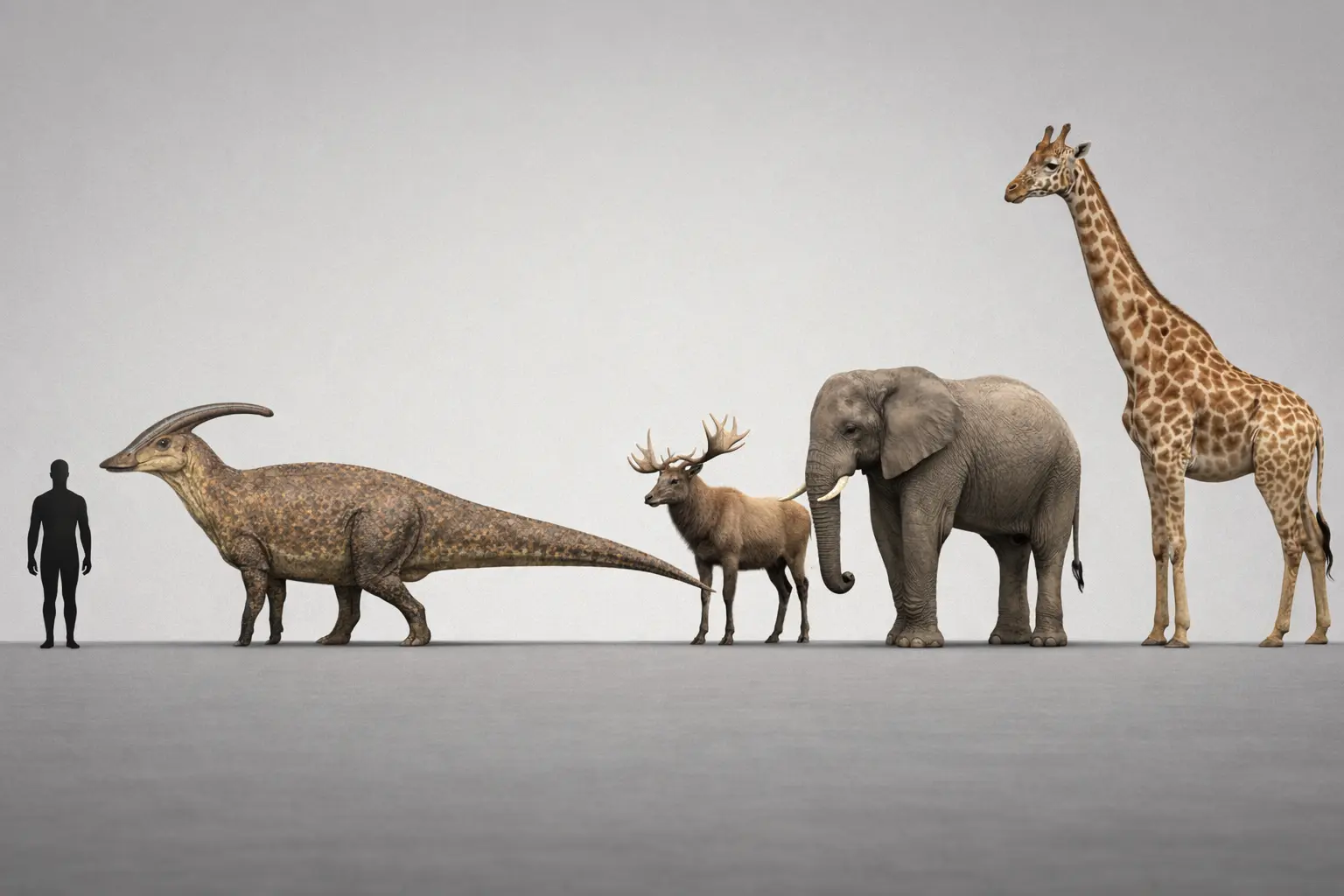
Quick Answer: Parasaurolophus was a large hadrosaur, reaching approximately 9.5–11 metres (31–36 ft) in length and an estimated 2,500–4,000 kg (5,500–8,800 lb) in weight depending on the species. It moved on four legs most of the time but could rise onto two. Its body was covered in scaly skin, with no evidence of feathers.
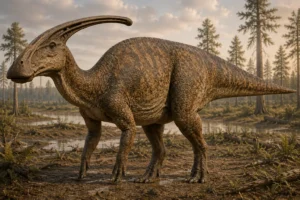
Parasaurolophus was built for endurance, not spectacle — a broad-bodied, heavily muscled herbivore whose size was its primary defence. The crest draws most of the attention, but the animal beneath it was formidable in its own right.
How Big Was Parasaurolophus?
Parasaurolophus was one of the larger hadrosaurs of its time. Length estimates vary by species, with P. tubicen from New Mexico tending toward the larger end of the range and P. cyrtocristatus being notably smaller than the other two.
Size by Species
| Measurement | P. walkeri | P. tubicen | P. cyrtocristatus |
|---|---|---|---|
| Estimated length | ~9.5 m (31 ft) | ~10–11 m (33–36 ft) | ~7.5–8 m (25–26 ft) |
| Estimated weight | ~2,500–3,500 kg (5,500–7,700 lb) | ~3,000–4,000 kg (6,600–8,800 lb) | ~2,000–2,800 kg (4,400–6,200 lb) |
| Crest length | Up to ~1.8 m (5.9 ft) | Similar to walkeri | Shorter, curved |
Biomechanical estimates for weight carry significant uncertainty — body mass reconstruction depends on assumptions about soft tissue distribution that cannot be directly observed from bone alone. All figures above represent current modelled ranges, not fixed values.
Size in Context
At its largest, Parasaurolophus was roughly comparable in length to a large modern school bus (approximately 11–12 m / 36–40 ft). In weight, it was broadly similar to a large African elephant (Loxodonta africana), which reaches 4,000–5,000 kg (8,800–11,000 lb) — though the comparison is approximate given the uncertainty in dinosaur mass estimates.
Posture and Locomotion
Parasaurolophus was not a strictly bipedal or strictly quadrupedal animal. Fossil evidence — including trackways and skeletal proportions — indicates it moved on all four limbs during normal locomotion, with the forelimbs contacting the ground via a hoof-like pad on the hand.
Bipedal posture was likely used for feeding at height and possibly for short bursts of faster movement. The hindlimbs were substantially more powerful than the forelimbs, consistent with an animal that could shift its weight onto two legs when needed.
Tail Anatomy and Function
The tail of Parasaurolophus was long, deep, and laterally flattened — stiffened by ossified tendons running along the vertebrae. This structure served multiple functions.
Balance
The tail acted as a counterbalance to the animal’s heavy torso and neck, particularly important when the animal rose onto its hindlimbs. Without the tail’s mass and rigidity, bipedal posture would have been mechanically difficult to sustain.
Locomotion
The ossified tendons in the tail suggest it was held relatively straight and horizontal during locomotion rather than dragging on the ground. Trackway evidence from hadrosaurs more broadly supports this — tail-drag marks are absent from well-preserved hadrosaur trackways, indicating the tail was carried clear of the substrate.
Was the Tail Used for Defence?
There is no direct fossil evidence that Parasaurolophus used its tail as a defensive weapon in the manner of ankylosaurs or sauropods. The tail was not specially reinforced at the tip and lacked any obvious weapon structure. Its defensive value, if any, was incidental rather than structural.
Skin and Integument
Skin impressions associated with hadrosaurs — including closely related species — show a covering of small, non-overlapping scales in a pebbly or tuberculate pattern. No feathers or proto-feathers have been found associated with any hadrosaur specimen.
This is consistent with the broader evidence for ornithischian dinosaurs: while feather-like structures are documented in some ornithischians, the evidence for hadrosaurs specifically points to fully scaled integument. The absence of feather evidence is not proof of absence, but current fossil evidence does not support depicting Parasaurolophus with feathers.
Related and Contemporary Species
- Edmontosaurus: A non-crested hadrosaur of comparable size; skin impressions from Edmontosaurus specimens provide some of the best hadrosaur integument evidence and inform inferences about Parasaurolophus body covering.
- Corythosaurus: A crested lambeosaurine of similar build encountered in the same formations as P. walkeri; broadly comparable in size.
- Lambeosaurus: Another lambeosaurine contemporary; slightly smaller on average, providing a useful size contrast within the same subfamily.
- Gryposaurus: A large non-crested hadrosaur from the Dinosaur Park Formation; its robust build and comparable mass make it a useful size reference within the same ecosystem.
Frequently Asked Questions
How big was Parasaurolophus compared to T. Rex?
Parasaurolophus reached approximately 9.5–11 m (31–36 ft) in length, compared to T. rex‘s 12–13 m (39–43 ft). In weight, T. rex was substantially heavier at an estimated 8,000–14,000 kg (17,600–30,900 lb) compared to Parasaurolophus’s 2,500–4,000 kg (5,500–8,800 lb). The two species did not share the same time and place — that comparison is covered in full in our Parasaurolophus vs T. rex guide.
Did Parasaurolophus have feathers?
No fossil evidence supports feathers in Parasaurolophus. Skin impressions from hadrosaurs show small, pebbly scales. While some ornithischian dinosaurs had filamentous structures, hadrosaur integument evidence consistently shows fully scaled skin. Current evidence does not support a feathered reconstruction.
How did Parasaurolophus move?
Fossil trackways and skeletal proportions indicate Parasaurolophus moved quadrupedally during normal locomotion, placing all four limbs on the ground. It could rise onto its hindlimbs for feeding or faster movement. The tail was held horizontally rather than dragged, as evidenced by the absence of tail-drag marks in hadrosaur trackways.
Conclusion
Parasaurolophus was a large, robustly built hadrosaur whose physical proportions reflect a life of sustained herbivory in an environment that included large predators. Its size, posture, and integument are documented by a combination of direct skeletal evidence and inference from closely related species, giving us a reasonably confident picture of the animal, with specific mass estimates remaining the area of greatest uncertainty.
Recommended Paleontology & Natural History Books
As an Amazon Associate, Extinct Atlas may earn from qualifying purchases.
The Rise and Fall of the Dinosaurs
A compelling history of dinosaurs, tracing their origins, diversification, 200-million-year reign, extinction, and enduring legacy.
Dinosaurs and Prehistoric Life
A richly illustrated visual reference exploring dinosaurs, fossils, evolution, and prehistoric life across geological time.
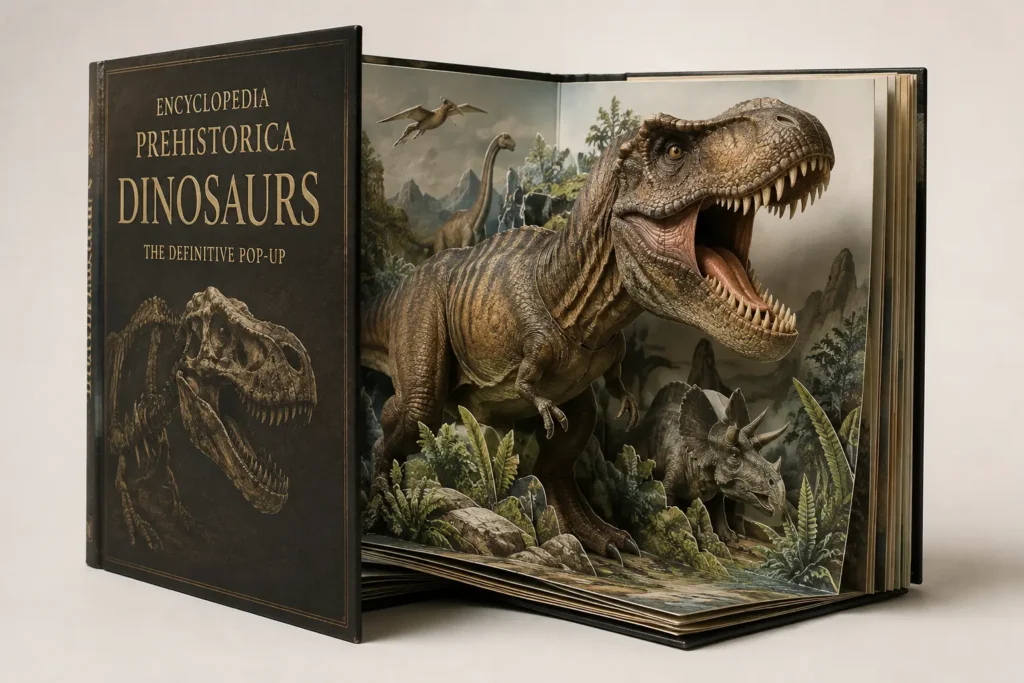
Encyclopedia Prehistorica: Dinosaurs
An interactive dinosaur book featuring spectacular three-dimensional pop-ups, particularly suited to young readers and families.
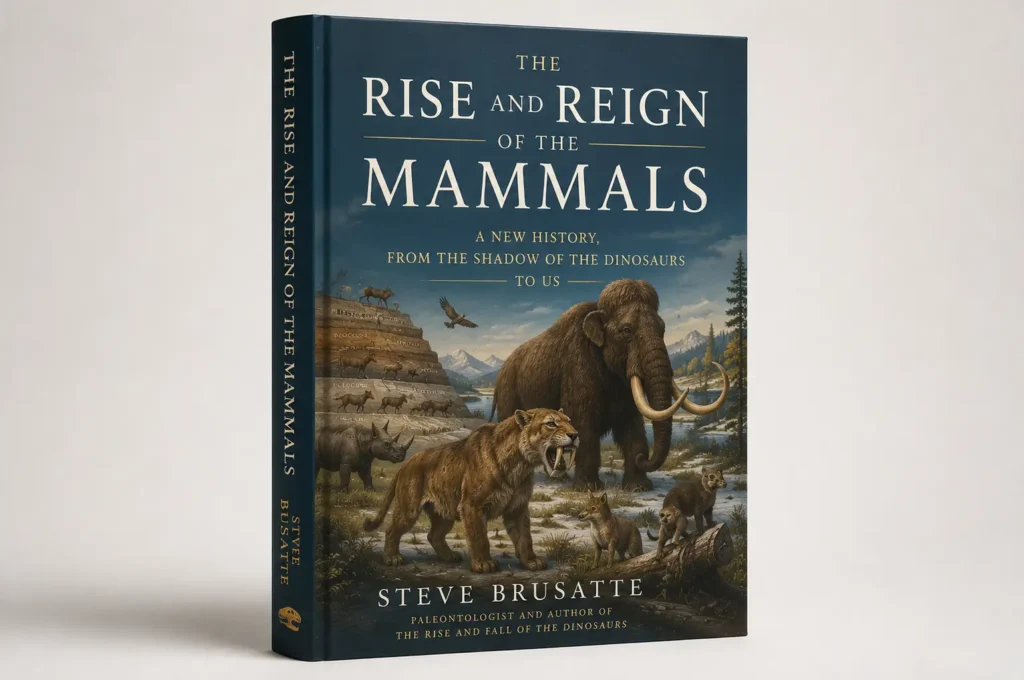
The Rise and Reign of the Mammals
A sweeping history of mammalian evolution, from their origins alongside dinosaurs through the Cenozoic and the emergence of humans.