

At a Glance
| Feature | Parasaurolophus | Corythosaurus | Lambeosaurus | Edmontosaurus |
|---|---|---|---|---|
| Crest type | Long tubular, projecting back | Helmet-shaped, hollow | Hatchet-shaped, hollow | None |
| Length | 9.5–11 m (31–36 ft) | ~9 m (30 ft) | ~9–10 m (30–33 ft) | ~9–13 m (30–43 ft) |
| Period | 76.5–73 Ma | ~77–75 Ma | ~76–75 Ma | ~73–66 Ma |
| Formation | Dinosaur Park Fm.; Kirtland/Fruitland Fms. | Dinosaur Park Fm. | Dinosaur Park Fm. | Horseshoe Canyon Fm.; Hell Creek Fm. |
| Did they meet? | Corythosaurus and Lambeosaurus: Yes. Edmontosaurus: No — separated by several million years |
Quick Answer: Parasaurolophus shared its habitat with Corythosaurus and Lambeosaurus in the Dinosaur Park Formation of Alberta, making them genuine contemporaries. Edmontosaurus lived several million years later. The most significant differences between these hadrosaurs are their crests — each with a distinct shape and acoustic signature — suggesting they may have occupied different communicative niches within overlapping territory.
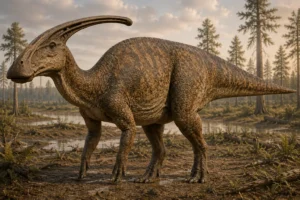
Hadrosaurs were the most diverse and abundant large herbivores of the Late Cretaceous. Comparing Parasaurolophus to its relatives clarifies what made it distinctive — and what it shared with the animals living alongside it.
Parasaurolophus vs Corythosaurus
Corythosaurus is the hadrosaur most directly comparable to Parasaurolophus in terms of ecological overlap. Both are lambeosaurines — the crested subfamily — and both are well-documented from the Dinosaur Park Formation of Alberta, meaning they genuinely co-occurred.
Crest Differences
The defining distinction is crest shape. Parasaurolophus had a long tubular crest projecting backward from the skull. Corythosaurus had a tall, rounded, helmet-shaped crest sitting upright above the skull. Both crests were hollow, formed by looping nasal passages, and both functioned as acoustic resonating chambers — but the different tube lengths and geometries would have produced distinct sound signatures.
Biomechanical modelling of Corythosaurus crests suggests higher-frequency resonance than the longer Parasaurolophus tube — consistent with the hypothesis that co-occurring crested hadrosaurs occupied distinct acoustic niches, reducing communicative overlap between species. This is an inference based on comparative modelling, not directly evidenced.
Size
Both animals were broadly comparable in body size — approximately 9–10 m (30–33 ft) in length — though individual variation and specimen incompleteness make precise comparison difficult.
Co-occurrence
Fossil evidence documents both genera in the Dinosaur Park Formation simultaneously. Whether they actively competed for the same food resources or partitioned their habitat in some way is not directly evidenced.
Parasaurolophus vs Lambeosaurus
Lambeosaurus is a second lambeosaurine contemporary of P. walkeri from the Dinosaur Park Formation of Alberta. Its crest differed markedly in shape—a forward-projecting, blade-like or hatchet-shaped structure, often accompanied by a posterior extension in some specimens.
Crest and Acoustic Differentiation
The crest geometry of Lambeosaurus differs substantially from both Parasaurolophus and Corythosaurus. Comparative biomechanical modelling indicates that these structural differences would have produced distinct acoustic properties, supporting the hypothesis that coexisting lambeosaurines occupied separate acoustic niches.
This interpretation remains inference-based on modelling and comparative anatomy, rather than direct evidence of behaviour.
Size
Size estimates for Lambeosaurus vary depending on species and specimen completeness. Most adult individuals are estimated at approximately 9–10 m (30–33 ft) in length, placing them broadly comparable to Parasaurolophus.
Occasionally cited larger size estimates are based on fragmentary or extrapolated material and are not consistently supported. As with other hadrosaurs, all size estimates are model-dependent and subject to revision with discoveries.
Taxonomic Note
Lambeosaurus comprises multiple species, and size estimates vary significantly between them. Species-level taxonomy within Lambeosaurus is an area of active research.
This is an active area of research. Details here reflect current scientific consensus but may be revised as new fossil evidence or analysis emerges.
Parasaurolophus vs Edmontosaurus
Edmontosaurus differs from the preceding comparisons in two key respects: it lacked a hollow cranial crest, and it did not clearly co-occur with Parasaurolophus in the same ecosystems.
Temporal Separation
Edmontosaurus is known primarily from the Horseshoe Canyon Formation and Hell Creek Formation, dating to approximately 73–66 Ma (latest Campanian to Maastrichtian). Parasaurolophus is known from approximately 76.5–73 Ma, disappearing from the fossil record near the end of the Campanian.
This places the two genera at the boundary between successive faunal intervals, with no well-documented evidence of ecological co-occurrence in the same formations. While a narrow temporal overlap near ~73 Ma is sometimes suggested, it is not clearly supported by current stratigraphic evidence and should be treated with caution.
Crest vs No Crest
The contrast between Parasaurolophus and Edmontosaurus is the starkest among this comparison set. Edmontosaurus had no hollow crest — it was a hadrosaurine rather than a lambeosaurine. Some Edmontosaurus specimens preserve a soft-tissue crest or comb on the skull, but this was not hollow and had no acoustic function comparable to the lambeosaurine crest.
The comparison is useful precisely because it illustrates what the hollow crest provided that a non-crested hadrosaur lacked: a built-in resonating structure for long-range, species-specific acoustic communication.
Size
Edmontosaurus was one of the largest hadrosaurs known, with some specimens estimated at 12–13 m (39–43 ft) — comparable to T. rex in length. In this respect, it was larger than Parasaurolophus, though both animals fell within the broad size range of large Late Cretaceous hadrosaurs.
Niche Differentiation Within the Dinosaur Park Formation
The Dinosaur Park Formation is remarkable for the diversity of hadrosaurs it preserves. At least three crested lambeosaurines — Parasaurolophus, Corythosaurus, and Lambeosaurus — co-occurred in the same formation. How they partitioned resources is not directly evidenced, but several hypotheses have been proposed:
- Acoustic niche partitioning: Different crest geometries produced different calls, reducing interspecies communicative interference and enabling species recognition at a distance.
- Habitat micropartitioning: Different species may have preferentially used different vegetation zones within the same broad formation area, though this is speculative and not directly evidenced.
- Dietary overlap: All three were herbivores with broadly similar dental batteries, suggesting significant dietary overlap rather than clear niche separation on food type.
The presence of multiple crested species in the same formation is itself indirect evidence that the crest served functions — acoustic, visual, or both — that were worth maintaining even in the presence of similar competing signals from other species.
Related and Contemporary Species
- Hypacrosaurus: A lambeosaurine from the Horseshoe Canyon Formation with a rounded crest; its well-documented growth series provides comparative ontogenetic data relevant to Parasaurolophus crest development.
- Gryposaurus: A non-crested hadrosaur from the Dinosaur Park Formation; its co-occurrence with crested lambeosaurines provides a useful within-formation contrast.
- Kritosaurus: A non-crested hadrosaur from the New Mexico formations that also yielded P. tubicen and P. cyrtocristatus; relevant for understanding hadrosaur diversity in the southern range of Parasaurolophus.
- Saurolophus: A hadrosaur with a solid, non-hollow crest spike; its different crest structure relative to lambeosaurines illustrates the anatomical diversity of hadrosaur head ornamentation.
Frequently Asked Questions
What is the difference between Parasaurolophus and Corythosaurus?
Both were crested lambeosaurines that co-occurred in the Dinosaur Park Formation of Alberta. The key difference is crest shape: Parasaurolophus had a long tubular crest projecting backward; Corythosaurus had a tall, rounded helmet-shaped crest. Both were hollow and functioned acoustically, but their different geometries would have produced distinct calls.
Did Parasaurolophus and Edmontosaurus live at the same time?
Not clearly. Parasaurolophus disappears from the fossil record at approximately 73 Ma, while Edmontosaurus is primarily known from 73–66 Ma. There may be a marginal temporal overlap, but they are not documented as ecological contemporaries in the same formation. Edmontosaurus also lacked a hollow crest, belonging to a different hadrosaur subfamily.
Why did so many different crested hadrosaurs live in the same place?
The Dinosaur Park Formation preserves at least three crested lambeosaurine genera co-occurring in the same ecosystem. The most supported hypothesis is acoustic niche partitioning — each species’ differently shaped crest produced a distinct call, enabling species recognition and communication without interference. Habitat micropartitioning is possible but not directly evidenced.
Conclusion
Comparing Parasaurolophus to its hadrosaur relatives reveals an animal that was distinctive in its crest but typical of its family in body plan and ecological role. The genuine contemporaries — Corythosaurus and Lambeosaurus — illuminate how multiple crested species could co-exist in the same ecosystem. Edmontosaurus, the non-crested counterpart, shows most clearly what the hollow crest provided that a simpler anatomy could not.
Recommended Paleontology & Natural History Books
As an Amazon Associate, Extinct Atlas may earn from qualifying purchases.
The Rise and Fall of the Dinosaurs
A compelling history of dinosaurs, tracing their origins, diversification, 200-million-year reign, extinction, and enduring legacy.
Dinosaurs and Prehistoric Life
A richly illustrated visual reference exploring dinosaurs, fossils, evolution, and prehistoric life across geological time.
Encyclopedia Prehistorica: Dinosaurs
An interactive dinosaur book featuring spectacular three-dimensional pop-ups, particularly suited to young readers and families.
The Rise and Reign of the Mammals
A sweeping history of mammalian evolution, from their origins alongside dinosaurs through the Cenozoic and the emergence of humans.