

At a Glance
| Attribute | Detail |
|---|---|
| Scientific name | Parasaurolophus walkeri (type species); also P. tubicen, P. cyrtocristatus |
| Pronunciation | par-ah-saw-ROL-oh-fus |
| Name meaning | “Near crested lizard” — named for its resemblance to Saurolophus |
| Period | Late Cretaceous, Campanian stage (76.5–73 Ma) |
| Found in | Alberta, Canada; New Mexico and Utah, USA |
| Diet | Herbivore — low to mid-height browsing on tough Cretaceous vegetation |
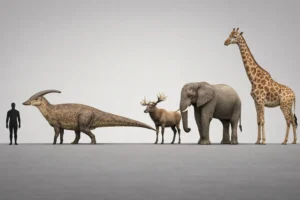
| Length | 9.5–11 m (31–36 ft) depending on species |
| Weight | Estimated 2,500–4,000 kg (5,500–8,800 lb) |
| Classification | Dinosauria → Ornithischia → Ornithopoda → Hadrosauridae → Lambeosaurinae |
Quick Answer: Parasaurolophus was a large herbivorous dinosaur of the Late Cretaceous, best known for the long hollow crest projecting from its skull. Biomechanical modelling indicates the crest is best supported as an acoustic resonating chamber for low-frequency communication. Three species are recognised, found across Alberta, New Mexico, and Utah, living approximately 76.5–73 million years ago.
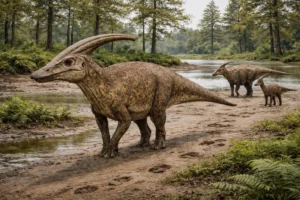
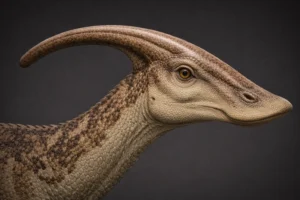
The hollow crest is what most people remember. What it concealed — a looping nasal passage capable of producing deep, resonant calls — is what makes Parasaurolophus genuinely remarkable. It was not a snorkel, not a weapon, and not a mere decoration. It was, as far as the fossil evidence and computer modelling show, a biological instrument.
The Crest: Anatomy and Function
| Field | Detail |
|---|---|
| Crest length | Up to ~1.8 m (5.9 ft) in P. walkeri adults |
| Internal structure | Continuous nasal passage looping from nostrils through crest and back to airway |
| Primary function | Acoustic resonance — biomechanical modelling supports low-frequency call production |
| Key simulation | 1997 Sandia National Laboratories CT-scan study; estimated fundamental frequencies ~30–50 Hz |
| Juvenile crest | Present but proportionally smaller and more upright — confirmed by “Joe” specimen (RAM 14000) |
The crest’s internal nasal passage is the defining feature: a tube that runs from the nostrils up into the crest, looped back on itself, and connected to the airway. Its length and geometry determined the acoustic properties of calls produced. Crest shape varied by species and changed through growth, meaning each individual likely produced a distinct sound signature across its lifetime. The full anatomy, acoustic modelling detail, species variation, and debunking of the snorkel theory are covered in our crest guide.
Size and Physical Appearance
| Field | Detail |
|---|---|
| Length range | P. cyrtocristatus ~7.5–8 m (25–26 ft) to P. tubicen ~10–11 m (33–36 ft) |
| Weight range | ~2,000–4,000 kg (4,400–8,800 lb) across species |
| Posture | Habitually quadrupedal; capable of bipedal locomotion |
| Tail | Long, deep, laterally flattened; stiffened by ossified tendons; held horizontally |
| Integument | Scaly skin — pebbly tuberculate pattern; no feather evidence |
Parasaurolophus was broadly comparable in length to a large school bus and in weight to a large African elephant — though mass estimates carry significant uncertainty. Its tail was held clear of the ground during locomotion, as evidenced by the absence of tail-drag marks in hadrosaur trackways. Skin impressions from related species show small, non-overlapping scales with no evidence of feathers. Full-size breakdown by species, tail biomechanics, and integument evidence is in our size guide.
Diet
| Field | Detail |
|---|---|
| Diet type | Obligate herbivore |
| Feeding height | Low to mid-height; bipedal posture extended upper range |
| Dentition | Dental battery — hundreds of tightly packed, continuously replaced teeth |
| Plant types | Conifers, ferns, flowering plants available in Late Cretaceous habitat |
| Feeding posture | Quadrupedal during foraging; bipedal for higher foliage access |
Parasaurolophus processed large volumes of tough plant material using one of the most effective dental systems in dinosaur evolution — a self-replacing battery of hundreds of teeth that ground continuously as the animal chewed. No direct dietary evidence, such as gut contents or coprolites, has been reported for Parasaurolophus specifically; plant preferences are inferred from the vegetation documented in its formations.
Behaviour and Social Structure
| Field | Detail |
|---|---|
| Social structure | Inferred gregarious; direct bonebed evidence limited for this genus specifically |
| Communication | Crest-based acoustic signalling inferred; low-frequency calls with long carry distance |
| Speed | Biomechanical estimates ~20–35 km/h (12–22 mph) bipedal burst |
| Primary defence | Speed and group vigilance; no armour, horns, or weapon structures |
| Evidence quality | Mostly Tier 3 comparative inference; some Tier 1 trackway evidence |
Herding is the working hypothesis — supported by the crest’s communicative function and hadrosaur bonebed evidence broadly — but direct fossil evidence for group living in Parasaurolophus specifically is limited. Its lack of armour or weaponry makes speed and group vigilance the most parsimonious defensive strategy. Evidence-based locomotion analysis and the limits of behavioural reconstruction are covered fully in our behaviour guide.
Discovery and Fossil History
| Field | Detail |
|---|---|
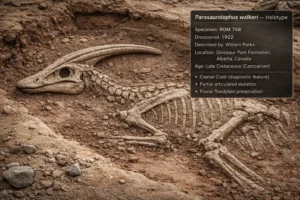
| First described | 1922, by William Parks, University of Toronto |
| Type specimen | ROM 768, Royal Ontario Museum, Alberta |
| Key formations | Dinosaur Park Fm. (Alberta); Kirtland/Fruitland Fms. (New Mexico) |
| Notable specimen | RAM 14000 (“Joe”) — most complete juvenile; critical for crest ontogeny |
| Recent find | Juvenile skull from New Mexico, published 2021 |
Parasaurolophus was named by William Parks in 1922 from a specimen collected in Alberta the previous year. A century of subsequent fieldwork across Alberta, New Mexico, and Utah has added two further species and progressively sharpened the understanding of crest development, acoustic function, and formation ecology. The full specimen record, formation context, and extinction timeline are in our discovery guide.
Parasaurolophus vs Tyrannosaurus rex
| Feature | Parasaurolophus | Tyrannosaurus rex |
|---|---|---|
| Period | 76.5–73 Ma | 68–66 Ma |
| Length | 9.5–11 m (31–36 ft) | 12–13 m (39–43 ft) |
| Weight | 2,500–4,000 kg (5,500–8,800 lb) | 8,000–14,000 kg (17,600–30,900 lb) |
| Did they meet? | No — minimum ~5–7 million year gap |
Parasaurolophus and T. rex never met. The fossil record separates them by a minimum of approximately 5–7 million years and places them in different geographic formations. The actual predators in Parasaurolophus’s ecosystem were Gorgosaurus libratus and Daspletosaurus torosus — tyrannosaurids of smaller but comparable design. The full temporal and geographic analysis, ecological predator context, and clearly labelled hypothetical comparison are in our Parasaurolophus vs T. rex guide.
Parasaurolophus vs Other Hadrosaurs
| Feature | Parasaurolophus | Corythosaurus | Lambeosaurus | Edmontosaurus |
|---|---|---|---|---|
| Crest | Long tubular, hollow | Helmet-shaped, hollow | Hatchet-shaped, hollow | None |
| Co-occurred with P. walkeri? | — | Yes | Yes | No |
| Subfamily | Lambeosaurinae | Lambeosaurinae | Lambeosaurinae | Hadrosaurinae |
Corythosaurus and Lambeosaurus were genuine contemporaries of P. walkeri in the Dinosaur Park Formation. Each had a differently shaped hollow crest, and biomechanical modelling suggests each produced a distinct acoustic signature — consistent with acoustic niche partitioning among co-occurring species. Edmontosaurus lived several million years later and lacked a hollow crest entirely. Full structured comparison across all four species is in our hadrosaur comparison guide.
Geographic Range and Habitat
| Field | Detail |
|---|---|
| Geographic range | Western North America — Alberta (Canada); New Mexico and Utah (USA) |
| Key formations | Dinosaur Park Fm.; Kirtland Fm.; Fruitland Fm.; Kaiparowits Fm. |
| Depositional environment | Coastal floodplains, river systems, and forested lowlands along the Western Interior Seaway |
| Climate | Warm, seasonally wet; subtropical to warm-temperate |
| Vegetation | Conifers, ferns, cycads, and early flowering plants |
Parasaurolophus lived along the western margin of the Western Interior Seaway — the shallow inland sea that divided North America during the Late Cretaceous. The formations that yield their fossils represent low-lying floodplain and river environments with dense vegetation, consistent with a large browsing herbivore reliant on high-volume plant intake. Seasonal variation in vegetation availability may have influenced movement patterns, though migratory behaviour in Parasaurolophus is speculative and not directly evidenced.
Classification
This is an active area of research. Details here reflect current scientific consensus but may be revised as new fossil evidence or analysis emerges.
| Field | Detail |
|---|---|
| Order | Ornithischia |
| Clade | Ornithopoda |
| Family | Hadrosauridae |
| Subfamily | Lambeosaurinae |
| Genus | Parasaurolophus Parks, 1922 |
| Recognised species | P. walkeri (type); P. tubicen; P. cyrtocristatus |
Parasaurolophus belongs to Lambeosaurinae — the crested subfamily of hadrosaurs — distinguished from the non-crested Hadrosaurinae by the presence of hollow cranial crests formed by extended nasal passages. Species-level taxonomy within the genus has been revised multiple times, and the validity of some assigned material remains under periodic review. Three species are currently recognised, though this count may be revised as new specimens are described.
Related and Contemporary Species
- Corythosaurus casuarius: Lambeosaurine contemporary in the Dinosaur Park Formation; helmet-shaped hollow crest produced a distinct acoustic signature from Parasaurolophus.
- Lambeosaurus lambei: A second crested lambeosaurine from the Dinosaur Park Formation; hatchet-shaped crest with a third distinct acoustic profile.
- Gorgosaurus libratus: The primary large theropod predator in P. walkeri‘s ecosystem; fossil co-occurrence is directly evidenced in the Dinosaur Park Formation.
- Edmontosaurus regalis: A large non-crested hadrosaur from slightly later formations; the most useful ecological analogue for understanding hadrosaur life without a hollow crest.
- Maiasaura peeblesorum: A hadrosaur from Montana with direct nesting and parental care evidence, informs cautious inference about broader hadrosaur social behaviour, including Parasaurolophus.
Common Questions About Parasaurolophus
What did Parasaurolophus use its crest for?
Biomechanical modelling — including a widely cited 1997 computer simulation — indicates the hollow crest is best supported as an acoustic resonating chamber, producing low-frequency calls used for communication. It likely also served as a visual display structure. Most researchers treat it as multi-functional. The full evidence is in our crest guide.
How big was Parasaurolophus?
Length estimates range from approximately 7.5–8 m (25–26 ft) for the smaller P. cyrtocristatus to 10–11 m (33–36 ft) for P. tubicen. Weight is estimated at 2,500–4,000 kg (5,500–8,800 lb) depending on species and modelling assumptions. Full-size breakdown is in our size guide.
Was Parasaurolophus a herbivore?
Yes. Parasaurolophus was an obligate herbivore equipped with a dental battery of hundreds of continuously replaced teeth for processing large volumes of tough plant material. It browsed low to mid-height vegetation, with a bipedal posture enabling access to higher foliage.
When did Parasaurolophus live?
Parasaurolophus lived during the Campanian stage of the Late Cretaceous, approximately 76.5–73 million years ago — around 7 million years before the mass extinction event that ended the dinosaur era.
Could Parasaurolophus swim?
There is no direct fossil evidence that Parasaurolophus was aquatic or semi-aquatic. An older theory proposed that the crest functioned as a snorkel — this is rejected by current researchers because the crest has no opening at its tip and cannot have functioned as a breathing tube. Hadrosaurs may have been capable swimmers when necessary, as inferred from their habitat near river systems, but this is not directly evidenced.
📘 Related Species


Recommended Paleontology & Natural History Books
As an Amazon Associate, Extinct Atlas may earn from qualifying purchases.
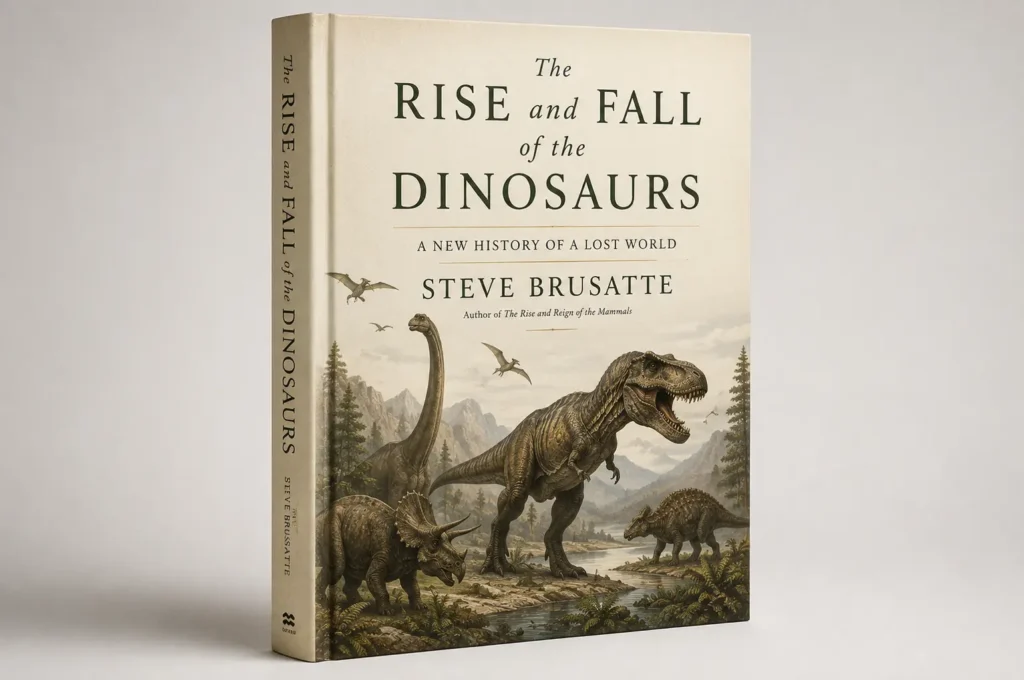
The Rise and Fall of the Dinosaurs
A compelling history of dinosaurs, tracing their origins, diversification, 200-million-year reign, extinction, and enduring legacy.
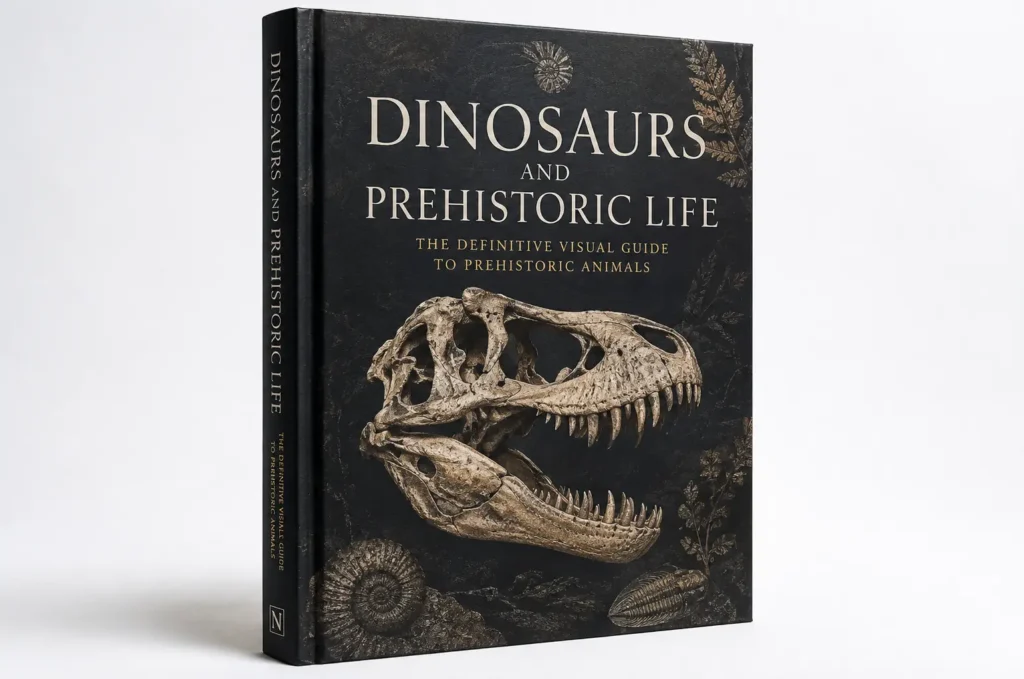
Dinosaurs and Prehistoric Life
A richly illustrated visual reference exploring dinosaurs, fossils, evolution, and prehistoric life across geological time.
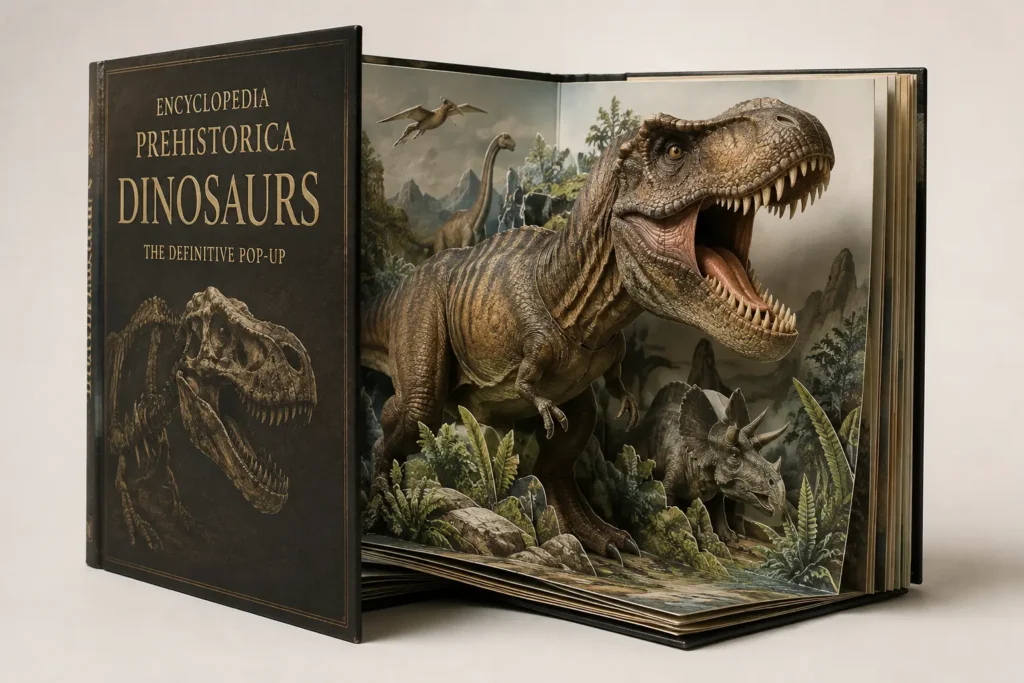
Encyclopedia Prehistorica: Dinosaurs
An interactive dinosaur book featuring spectacular three-dimensional pop-ups, particularly suited to young readers and families.
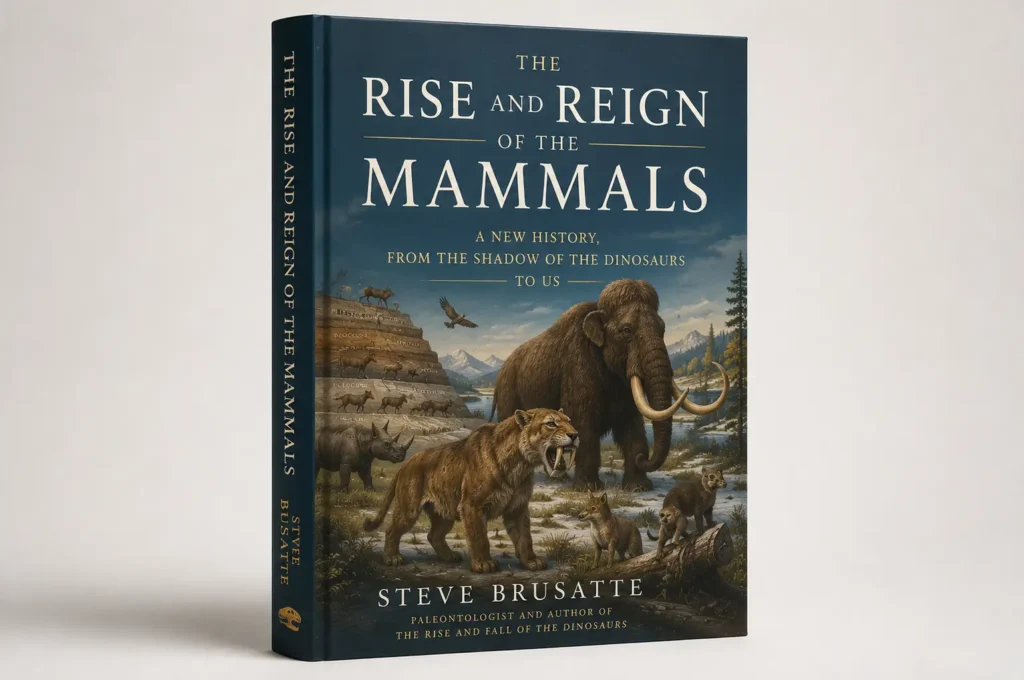
The Rise and Reign of the Mammals
A sweeping history of mammalian evolution, from their origins alongside dinosaurs through the Cenozoic and the emergence of humans.