
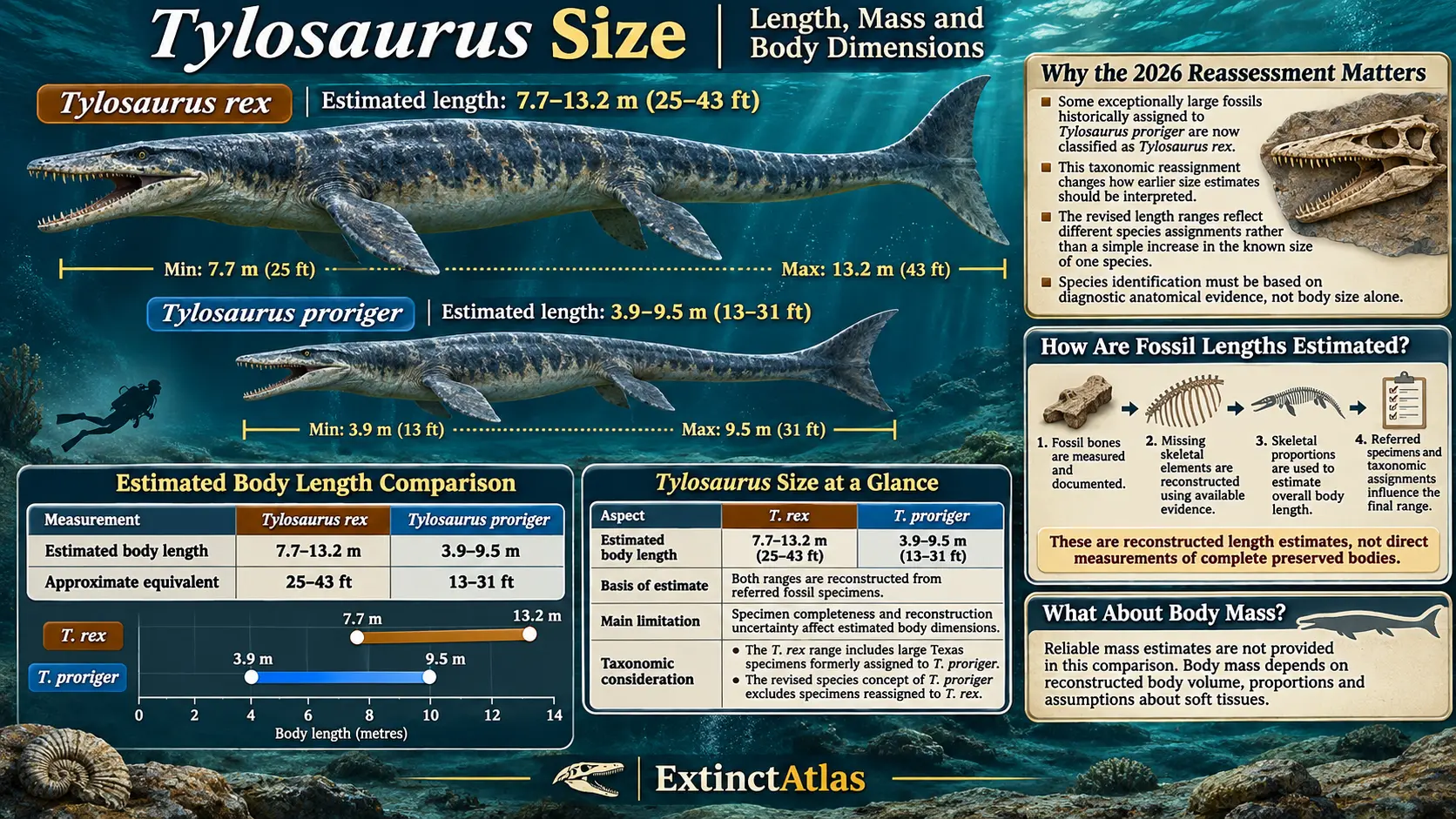
Tylosaurus was a large marine reptile whose estimated body length varied by species. A 2026 taxonomic study reported lengths of 7.7–13.2 metres for Tylosaurus rex and 3.9–9.5 metres for Tylosaurus proriger. These figures are reconstructed estimates based on fossil specimens, not direct measurements of complete bodies. The distinction matters because some exceptionally large fossils once assigned to T. proriger are now classified as T. rex.

Tylosaurus Size at a Glance
| Measurement | Tylosaurus rex | Tylosaurus proriger |
|---|---|---|
| Estimated body length | 7.7–13.2 m | 3.9–9.5 m |
| Approximate equivalent in feet | 25–43 ft | 13–31 ft |
| Basis of estimate | Reconstructed from referred fossil specimens | Reconstructed from referred fossil specimens |
| Main limitation | Specimen completeness and reconstruction uncertainty | Specimen completeness and reconstruction uncertainty |
| Taxonomic consideration | Includes large Texas specimens formerly assigned to T. proriger | Revised species concept excludes specimens reassigned to T. rex |
Source: Zietlow, Polcyn and Tykoski (2026), Bulletin of the American Museum of Natural History.
How Long Was Tylosaurus?
The largest reported estimates for the genus now include specimens assigned to Tylosaurus rex, a species formally described in 2026. Its estimated maximum length of 13.2 metres makes it substantially larger than the upper end of the revised estimate for T. proriger.
These figures represent estimated total body length, including the tail. They should not be interpreted as measurements taken from every fossil specimen in its entirety. Paleontologists reconstruct missing portions using preserved skeletal elements, anatomical relationships and comparisons with better-known material.
The difference between the two species is not explained simply by assuming that the larger specimens were older individuals. The 2026 study identified anatomical differences that remained diagnostic in specimens whose sizes overlapped. The authors nevertheless noted that the difference in estimated size distributions could be affected by preservation and collection biases.
Tylosaurus rex vs Tylosaurus proriger: Size Comparison
The distinction between these species is important when interpreting older size records.
Tylosaurus proriger is well known from the Niobrara Chalk deposits of the central North American interior. Several much larger specimens collected principally in northern Texas were historically identified as the same species. The 2026 study reassigned those specimens to Tylosaurus rex on the basis of anatomical characters.
The comparison therefore reflects a taxonomic revision as well as differences in estimated body size. Older publications and museum displays may still use identifications that predate the revision.
The reported ranges also overlap: the lower end of the T. rex estimates falls within the upper portion of the T. proriger range. Length alone is therefore insufficient to identify an isolated fossil as one species or the other.
How Much Did Tylosaurus Weigh?
A reliable body-mass estimate requires more than a reconstructed length. Researchers need a defensible estimate of body volume or cross-sectional dimensions, together with assumptions about body shape and tissue density.
The body mass of Tylosaurus is difficult to establish because complete skeletons are rare and body weight cannot be measured directly from fossil remains. Estimates would depend on reconstructed body volume, proportions and assumptions about tissue density. Consequently, the available length estimates do not, by themselves, establish how much either Tylosaurus rex or Tylosaurus proriger weighed.
Body mass may be estimated through volumetric reconstruction or other comparative methods, but different assumptions can produce different results. A mass value presented without its method and uncertainty would imply greater precision than the available evidence supports.
Why Do Tylosaurus Size Estimates Vary?
Several factors affect the estimated size of fossil marine reptiles.
Incomplete skeletons: Some specimens preserve only portions of the skull, vertebral column or other skeletal elements. Missing regions must be reconstructed.
Reconstruction methods: Estimates may differ according to how researchers calculate missing vertebral lengths, body proportions and tail dimensions.
Taxonomic reassignment: The 2026 recognition of T. rex changed which specimens belong in the comparison for T. proriger.
Preservation and collection bias: Historical collections do not necessarily represent all individuals or populations equally. Differences in the available specimens can influence apparent size distributions.
Individual variation: Individuals within a species can differ in size, and overlapping size ranges do not necessarily indicate that specimens belong to the same species.
These limitations do not make fossil-size estimates useless. They mean that estimates should be linked to identifiable specimens, a stated taxonomic assignment and a transparent reconstruction method.
What the Fossils Establish
The 2026 taxonomic study provides a revised basis for comparing the body sizes of Tylosaurus rex and Tylosaurus proriger. Its findings demonstrate that some of the largest specimens historically attributed to T. proriger belong to a distinct species under the authors’ classification.
The available evidence supports a clear distinction between the reported length estimates and the less well-established question of body mass. Further quantitative claims should be tied to the underlying measurements and reconstruction methods rather than inferred from length alone.
Evidence Strength and Assessment
| Evidence category | Assessment |
|---|---|
| Species-level length estimates | Strong — published estimates from the 2026 taxonomic study |
| Taxonomic reassignment | Strong — supported by the revised anatomical assessment |
| Complete body-length reconstruction | Moderate — dependent on specimen completeness and reconstruction |
| Body-mass estimates | Limited — no sufficiently established species-level mass range presented here |
| Differences in size distributions | Qualified — potentially influenced by preservation and collection bias |
References
Zietlow, A. R., Polcyn, M. J., & Tykoski, R. S. (2026). A Gigantic New Species of Tylosaurus (Squamata: Mosasauridae) from Texas, and a Revised Character List for Phylogenetic Analyses of Mosasauridae. Bulletin of the American Museum of Natural History, 482, 1–77.
https://doi.org/10.1206/0003-0090.482.1.1
American Museum of Natural History. (2026, May 21). Giant Mosasaur Species from Texas Named T. rex.
https://www.amnh.org/explore/news-blogs/mosasaur-texas-t-rex
Recommended Paleontology & Natural History Books
As an Amazon Associate, Extinct Atlas may earn from qualifying purchases.
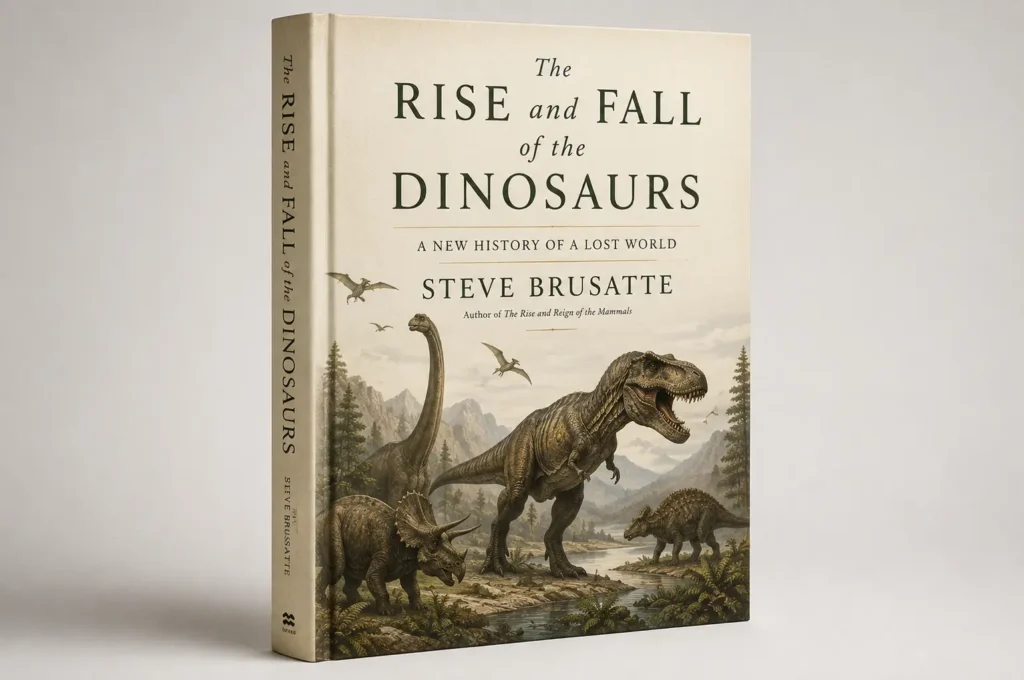
The Rise and Fall of the Dinosaurs
A compelling history of dinosaurs, tracing their origins, diversification, 200-million-year reign, extinction, and enduring legacy.
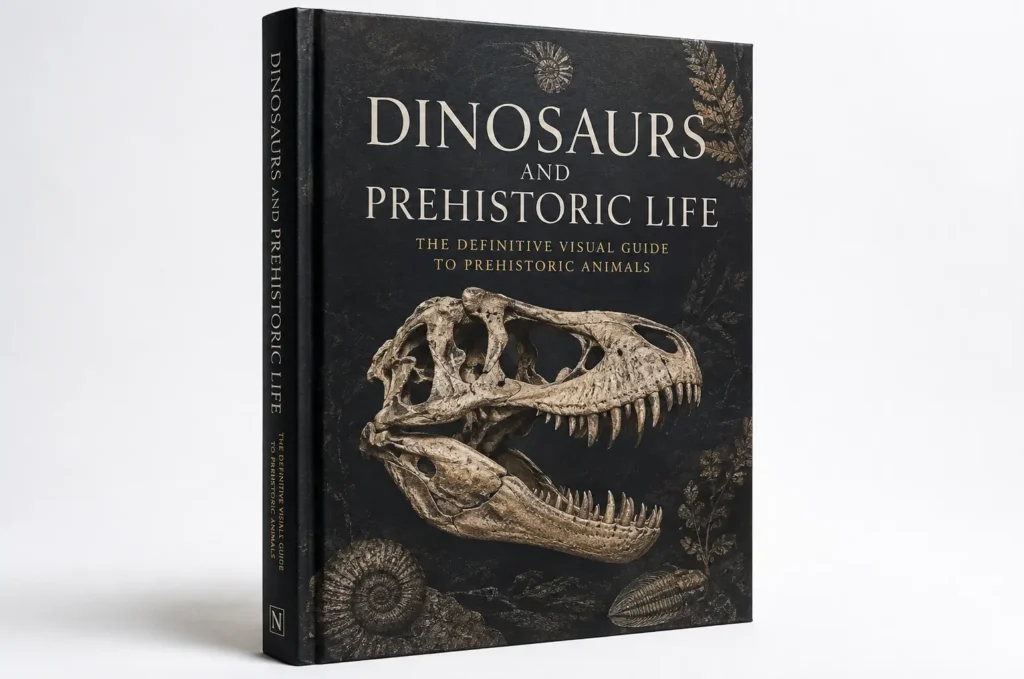
Dinosaurs and Prehistoric Life
A richly illustrated visual reference exploring dinosaurs, fossils, evolution, and prehistoric life across geological time.
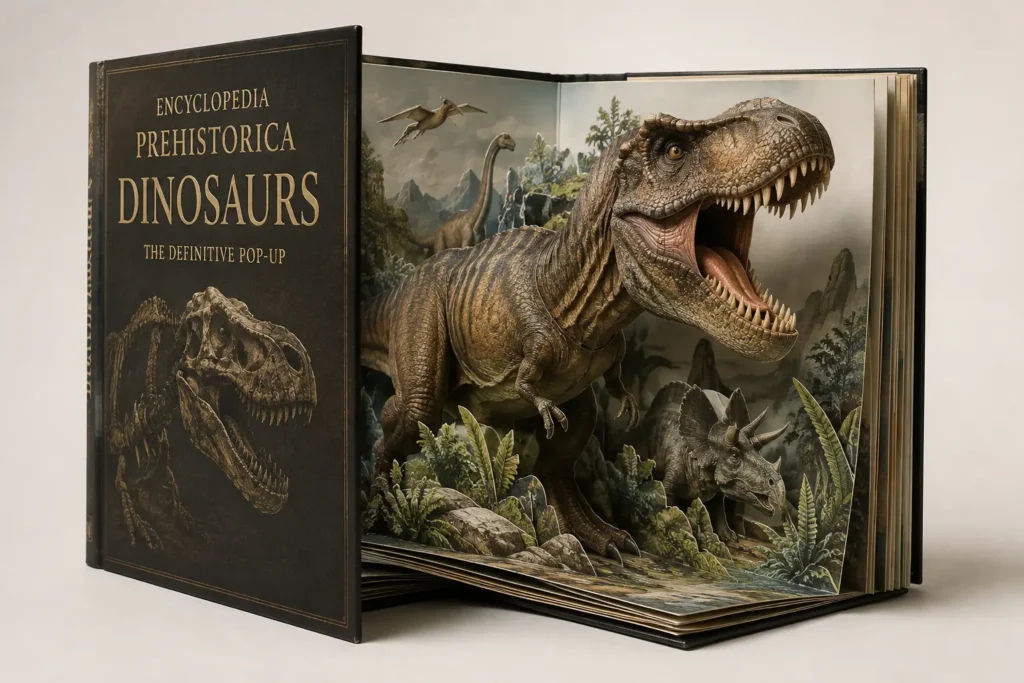
Encyclopedia Prehistorica: Dinosaurs
An interactive dinosaur book featuring spectacular three-dimensional pop-ups, particularly suited to young readers and families.
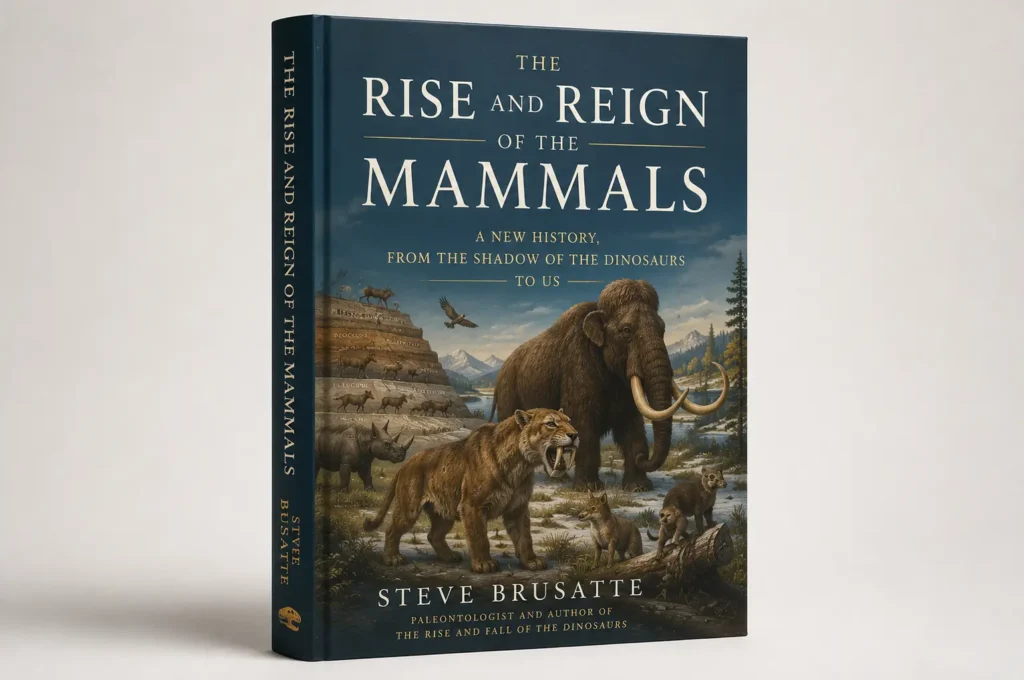
The Rise and Reign of the Mammals
A sweeping history of mammalian evolution, from their origins alongside dinosaurs through the Cenozoic and the emergence of humans.