
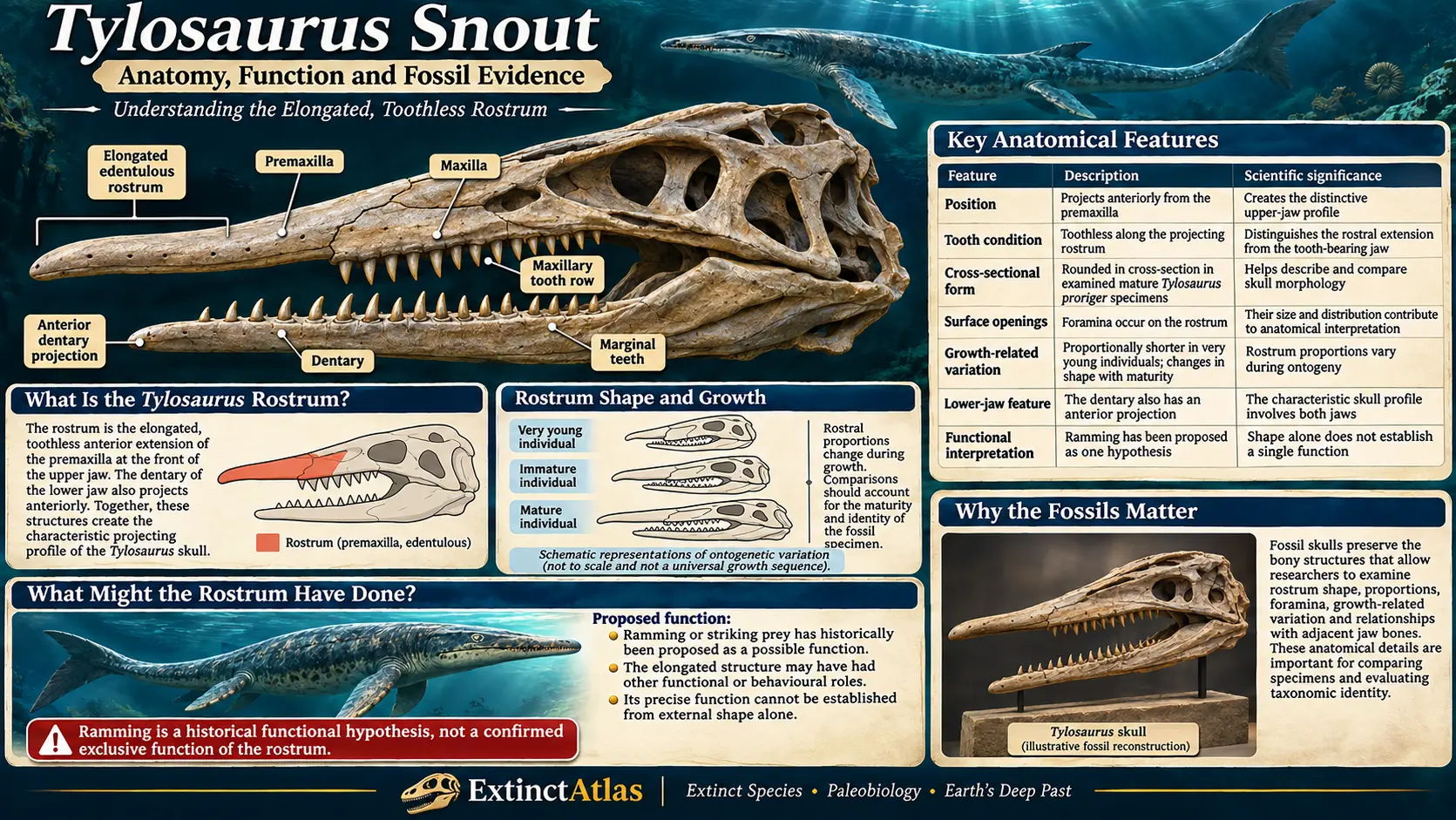
The most distinctive feature of Tylosaurus is its elongated, toothless anterior extension of the premaxilla, commonly called the rostrum. This bony projection extends in front of the tooth-bearing portion of the upper jaw and gives the skull its characteristic profile. A corresponding anterior projection of the dentary contributes to the overall shape of the snout. Although this anatomy is well documented in fossil specimens, its precise functional role remains uncertain.

The rostrum was part of a complex skull, not an isolated weapon whose function can be determined from appearance alone. Its structure, variation during growth, and relationship to surrounding bones help paleontologists identify specimens and investigate how the animal used its head. The suggestion that the rostrum was used for ramming or stunning prey is a historical functional hypothesis, not an established exclusive explanation.
What Is the Tylosaurus Rostrum?
In Tylosaurus, the rostrum is the elongated, toothless anterior extension of the premaxilla, the bone at the front of the upper jaw. The dentary, which forms the tooth-bearing portion of the lower jaw, also extends forward beyond its main tooth row.
These extensions create the characteristic projecting profile of the skull. The upper rostrum is edentulous, meaning that it has no teeth along the projecting portion itself. Teeth are present farther back in the tooth-bearing parts of the jaws.
The term rostrum refers to the projecting structure; it does not mean that the entire snout was toothless. Nor should the rostrum be confused with the complete skull, which includes the tooth-bearing jaws, palate, braincase, and other bones.
Tylosaurus Rostrum: Key Anatomical Features
| Feature | Description | Scientific significance |
|---|---|---|
| Position | Projects anteriorly from the premaxilla | Creates the distinctive upper-jaw profile |
| Tooth condition | Toothless along the projecting rostrum | Distinguishes the rostral extension from the tooth-bearing jaw |
| Cross-sectional form | Rounded in cross-section in the examined mature specimens of Tylosaurus proriger; shape and proportions should be assessed against the individual specimen. | Helps describe and compare skull morphology |
| Surface openings | Foramina occur on the rostrum | Their size and distribution vary and can contribute to anatomical interpretation |
| Growth-related variation | The rostrum is proportionally shorter in very young individuals and changes in shape with maturity | Rostrum proportions should not be treated as identical across all growth stages |
| Associated lower-jaw feature | The dentary also has an anterior projection | The skull’s shape involves more than the upper rostrum alone |
| Functional interpretation | Ramming has been proposed, among other possibilities | Shape alone does not establish a single function |
How Did the Rostrum Change as Tylosaurus Grew?
The rostrum was not identical in all individuals. Research on craniofacial growth in Tylosaurus documented changes in the premaxilla as the animal matured.
In relatively immature specimens, the rostrum is more acute in lateral view and proportionally shorter. In mature individuals, it becomes more rounded and distinctly knobbed. Studies also record variation in the size of the foramina on its surface.
These changes matter for fossil identification. A short or differently shaped rostrum does not automatically indicate a different species: the animal’s growth stage must be considered alongside other diagnostic characters. Conversely, differences between specimens should not automatically be dismissed as growth-related if other anatomical evidence supports a taxonomic distinction.
A study of tylosaurine craniofacial ontogeny found shared growth-related changes in two examined Tylosaurus species and assessed multiple cranial characters. Its results illustrate why identification should use a combination of features rather than one measurement in isolation.
What Was the Tylosaurus Rostrum Used For?
The exact function of the rostrum has not been conclusively established. Its form has encouraged several functional interpretations, but the evidence does not support presenting one proposed use as certain.
The ramming hypothesis
Earlier paleontological work proposed that the robust rostrum might have been used to strike or stun prey, or potentially in defensive interactions. This interpretation draws on its projecting shape and apparent structural robustness.
However, a structure that could withstand some mechanical loading was not necessarily specialised exclusively for ramming. Demonstrating that function would require evidence about the forces it could withstand, the anatomy of its supporting structures, and whether the proposed behaviour is consistent with the wider skull.
Other possible roles
The rostrum may have contributed to interactions with prey or other animals, but the precise mechanics remain uncertain. Its shape alone cannot establish whether it was primarily used for striking, contact during feeding, defence, or another behaviour.
Functional hypotheses should therefore be distinguished from direct observations. The fossil preserves the anatomy; the behaviour must be inferred.
Could the Rostrum Have Helped Tylosaurus Detect Prey?
The rostrum of Tylosaurus contains surface openings called foramina. These openings are associated with neurovascular structures, but their presence alone does not demonstrate that the rostrum functioned as a specialised sensory organ.
A study of Taniwhasaurus antarcticus, a related tylosaurine, used computed tomography to investigate branching neurovascular canals within the rostrum. The authors proposed a possible role in prey detection. This interpretation provides a comparative hypothesis for tylosaurines, but equivalent sensory function has not been directly demonstrated in Tylosaurus.
Is the Tylosaurus Rostrum Unique Among Mosasaurs?
The elongated, toothless anterior rostrum is a characteristic feature of the subfamily Tylosaurinae. It is not a feature that should be described as exclusive to Tylosaurus without qualification, because related tylosaurines such as Taniwhasaurus also possessed an edentulous rostral extension.
Other mosasaur groups had different skull proportions and combinations of anatomical features. Some mosasaurs also evolved projecting structures at the front of the jaws, illustrating that broadly similar shapes can occur in different lineages.
For that reason, the rostrum is useful for recognising tylosaurine anatomy, but species and genus identification should take account of additional cranial characters and the broader fossil context.
Evidence Strength and Assessment
| Claim | Evidence strength | Assessment |
|---|---|---|
| Tylosaurus had an elongated, toothless premaxillary rostrum | Strong | Directly documented in fossil skulls and recognised in tylosaurine diagnoses |
| Rostrum shape changes during growth | Strong | Supported by comparative studies of specimens at different maturity stages |
| The rostrum was used exclusively for ramming | Weak | A proposed functional interpretation, not an established exclusive function |
| The rostrum helped detect prey | Indirect for Tylosaurus | Neurovascular evidence in a related tylosaurine supports a hypothesis, not a direct demonstration for this genus |
| Neurovascular anatomy in Taniwhasaurus demonstrates identical sensory function in Tylosaurus | Unsupported | Comparative anatomy suggests a hypothesis but does not establish identical function across genera |
| Rostrum morphology alone can identify every specimen | Unsupported | Identification requires additional anatomical characters and consideration of growth |
| All tylosaurines had exactly the same rostrum shape | Unsupported | Differences and growth-related variation are documented across specimens and taxa |
Frequently Asked Questions
Did Tylosaurus have teeth on its snout?
The projecting anterior part of the premaxilla was toothless. Teeth were present farther back in the upper jaw and along the tooth-bearing portion of the lower jaw.
Did Tylosaurus use its snout as a battering ram?
Ramming has been proposed as a possible function, but the available evidence does not establish it as the rostrum’s exclusive or definitively proven use.
Was the rostrum the same shape in young and adult Tylosaurus?
No. Research documents growth-related changes. Younger individuals had a proportionally shorter, more acute rostrum, while mature specimens generally show a more rounded, knobbed form.
Did every mosasaur have a Tylosaurus-like snout?
No. The elongated toothless rostrum is characteristic of tylosaurines, including Tylosaurus and Taniwhasaurus. Other mosasaurs show different cranial forms, although some unrelated forms evolved projecting jaw structures.
References
- Zietlow, A. R. (2020). Craniofacial ontogeny in Tylosaurinae. PeerJ, 8, e10145. https://doi.org/10.7717/peerj.10145
- Jiménez-Huidobro, P., & Caldwell, M. W. (2019). A new hypothesis of the phylogenetic relationships of the Tylosaurinae (Squamata: Mosasauroidea). Frontiers in Earth Science, 7, 47. https://doi.org/10.3389/feart.2019.00047
- Álvarez-Herrera, G., Agnolin, F., & Novas, F. (2020). A rostral neurovascular system in the mosasaur Taniwhasaurus antarcticus. The Science of Nature, 107, 19. https://doi.org/10.1007/s00114-020-01677-y
Recommended Paleontology & Natural History Books
As an Amazon Associate, Extinct Atlas may earn from qualifying purchases.
The Rise and Fall of the Dinosaurs
A compelling history of dinosaurs, tracing their origins, diversification, 200-million-year reign, extinction, and enduring legacy.
Dinosaurs and Prehistoric Life
A richly illustrated visual reference exploring dinosaurs, fossils, evolution, and prehistoric life across geological time.
Encyclopedia Prehistorica: Dinosaurs
An interactive dinosaur book featuring spectacular three-dimensional pop-ups, particularly suited to young readers and families.
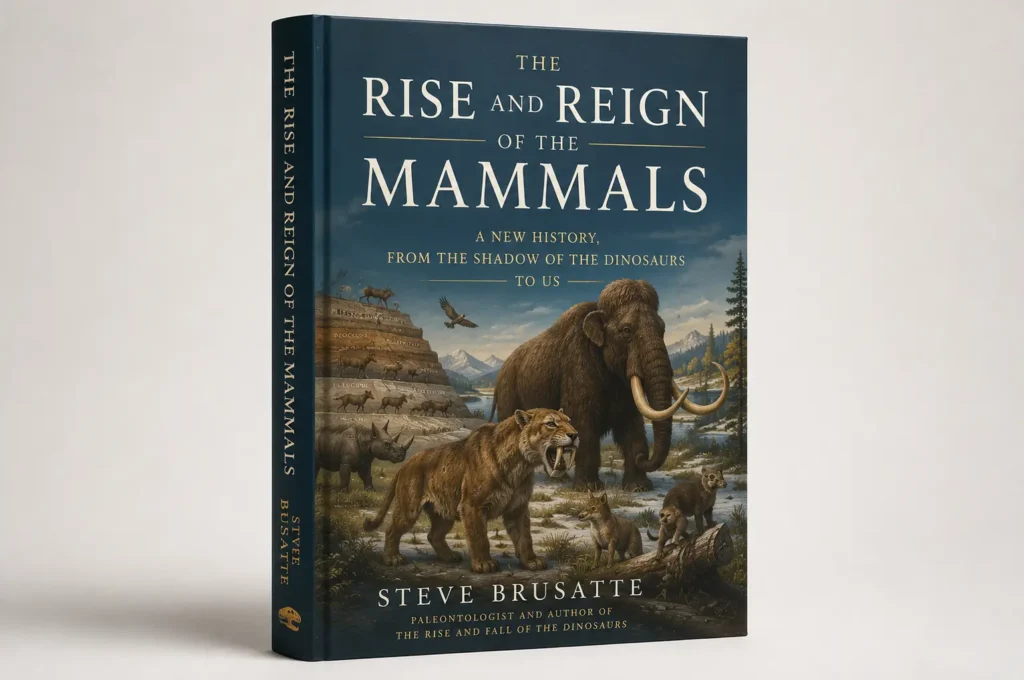
The Rise and Reign of the Mammals
A sweeping history of mammalian evolution, from their origins alongside dinosaurs through the Cenozoic and the emergence of humans.