
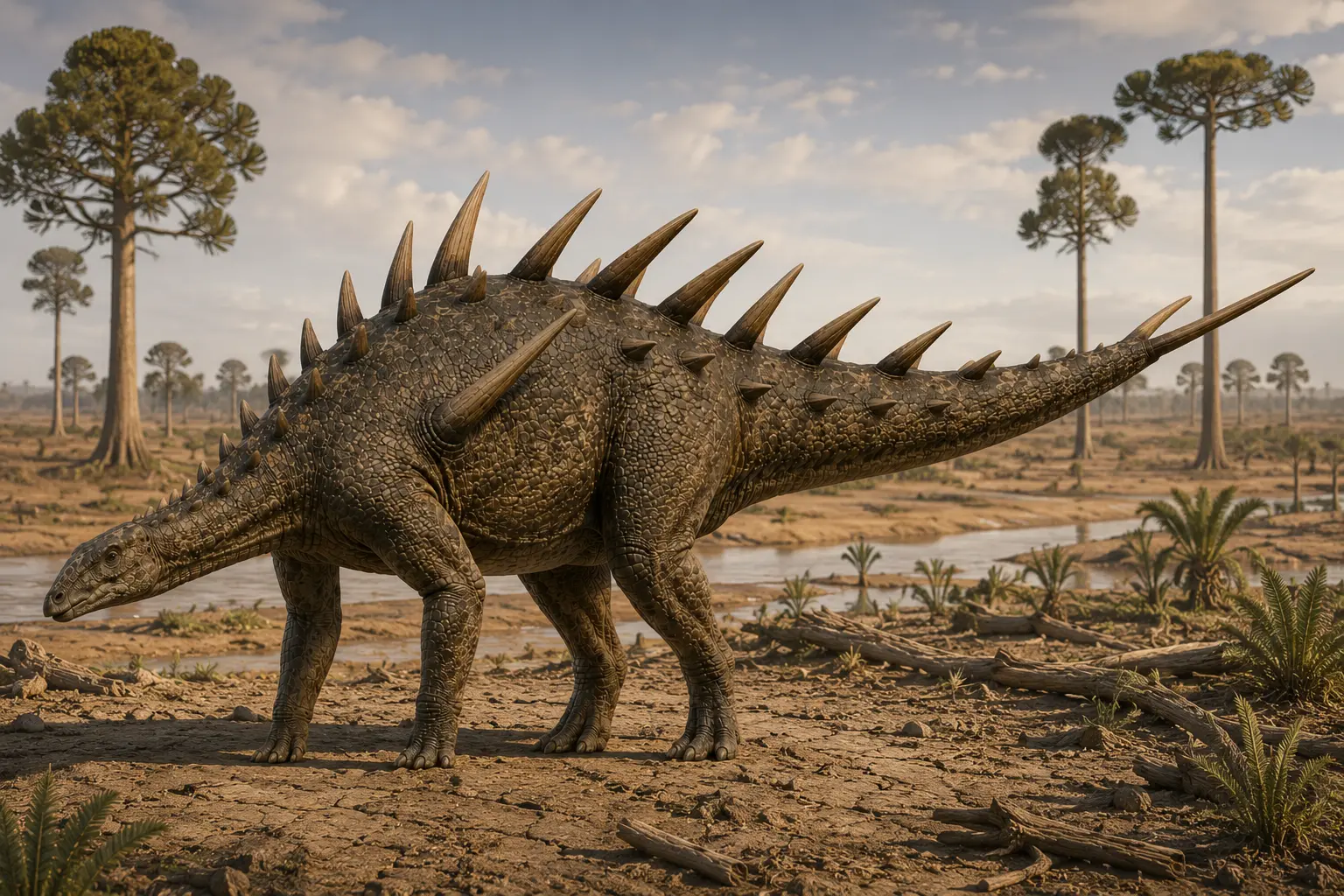
At a Glance
| Attribute | Detail |
|---|---|
| Scientific name | Kentrosaurus aethiopicus |
| Pronunciation | KEN-troh-SORE-us |
| Name meaning | Sharp point lizard |
| Period | Late Jurassic |
| Lived | 152–151 million years ago (Ma) |
| Found in | Tanzania (Tendaguru Formation) |
| Diet | Herbivore |
| Length | 4.5 meters (15 feet) |
| Weight | 700–1,000 kilograms |
| Classification | Dinosauria, Ornithischia, Thyreophora, Stegosauria, Stegosauridae |
Quick Answer
Kentrosaurus was a small, spike-covered stegosaur that lived in Late Jurassic Tanzania approximately 152 to 151 million years ago. Unlike its famous relative Stegosaurus, Kentrosaurus carried proportionally more spikes and fewer plates, with at least seven pairs of tail spikes creating a formidable defensive weapon against predators like Allosaurus.
Introduction
Kentrosaurus stands out among armored dinosaurs for its exceptional weaponization. While most stegosaurs balanced plates and spikes along their backs, this African species committed heavily to spikes, covering the majority of its body with paired defensive points that made it a dangerous target for any predator.
Discovered during one of paleontology’s most ambitious expeditions in early 20th-century Tanzania, Kentrosaurus reveals how the stegosaur body plan adapted to different ecosystems and threats across the Late Jurassic world. This page covers the essentials of Kentrosaurus biology and history, with detailed explorations available in the linked articles below.
Size and Physical Characteristics
| Field | Detail |
|---|---|
| Body length | 4.5 meters (approximately 15 feet) |
| Weight estimate | 700–1,000 kilograms (comparable to a horse) |
| Height at hips | Approximately 1.5 meters |
| Body proportions | Small head, barrel-shaped torso, short front legs, horizontal tail |
| Size comparison | Roughly half the length of Stegosaurus |
Kentrosaurus was compact for a stegosaur, measuring about half the length of its North American relative Stegosaurus. The relatively small body size meant greater agility for defensive maneuvering, particularly the rapid tail-swinging behavior that made its spike array so dangerous.
Diet and Feeding Behaviour
| Field | Detail |
|---|---|
| Diet type | Low-browsing herbivore |
| Primary food sources | Ferns, cycads, low-lying vegetation |
| Feeding height | Ground level to approximately 1 meter |
| Jaw structure | Beak-like front for cropping, small cheek teeth for processing |
| Feeding strategy | Selective browsing of soft vegetation |
Kentrosaurus fed on the low-growing plants available in the Tendaguru Formation’s coastal floodplain environment. Its short front legs kept the head close to the ground, limiting feeding range to vegetation below shoulder height. The small, leaf-shaped teeth suggest it processed relatively soft plant material rather than tough, fibrous vegetation that required extensive grinding.
Spikes: Anatomy and Defensive Function
| Field | Detail |
|---|---|
| Tail spike pairs | At least 7 pairs along tail length |
| Maximum spike length | 50–60 centimeters (bone only, not including keratin) |
| Spike construction | Bony core with keratin sheath |
| Shoulder spike debate | Large spikes present, but placement disputed (shoulders vs hips) |
| Defensive mechanism | Rapid tail swing enabled by rear-heavy center of mass |
The spikes of Kentrosaurus created one of the Late Jurassic’s most effective defensive systems. Fossil specimens show healed fractures on spike tips, confirming these weapons saw actual combat use. The animal’s biomechanical adaptations allowed rapid pivoting on the hind legs to swing the spiked tail through a 180-degree arc in under one second, generating sufficient force to puncture a predator’s hide and potentially inflict fatal wounds.
Full details: Kentrosaurus Spikes: Anatomy, Function, and Defensive Power
Plates: Distribution and Purpose
| Field | Detail |
|---|---|
| Plate distribution | Neck and front shoulders only |
| Plate count | Approximately 5–7 pairs |
| Maximum plate size | 15–20 centimeters in height |
| Plate construction | Porous bone with blood vessel channels, covered in keratin |
| Transition point | Plates gave way to spikes at approximately the front third of body |
Unlike Stegosaurus with its dramatic back plates, Kentrosaurus carried only small plates restricted to the neck and shoulder region. The gradual transition from plates to spikes along the body created an armor gradient from potential display structures at the front to pure weaponry at the rear.
Full details: Kentrosaurus Plates: Size, Distribution, and Evolution
Kentrosaurus vs Stegosaurus
| Field | Detail |
|---|---|
| Size difference | Kentrosaurus 4.5 meters; Stegosaurus 9 meters |
| Geographic separation | Kentrosaurus in Africa; Stegosaurus in North America |
| Armor emphasis | Kentrosaurus spike-heavy; Stegosaurus plate-heavy |
| Tail spikes | Kentrosaurus 7+ pairs; Stegosaurus 4 spikes total |
| Time period overlap | Both lived during Late Jurassic, roughly contemporary |
These two stegosaurs represent divergent evolutionary strategies within the same family. Stegosaurus invested in massive display plates and a larger body size, while Kentrosaurus emphasized extensive spike coverage with a more compact frame. The geographic separation meant they never encountered each other despite living during the same general time period.
Full details: Kentrosaurus vs Stegosaurus: Size, Spikes, and Key Differences
Discovery and Fossil History
| Field | Detail |
|---|---|
| Discovery location | Tendaguru Formation, Tanzania |
| Excavation period | 1909–1913 (main expedition) |
| Expedition leader | Werner Janensch (field director); Edwin Hennig (stegosaur specialist) |
| Formal description | Edwin Hennig, 1915 |
| Primary specimen repository | Museum für Naturkunde, Berlin |
| Notable mount | Berlin skeleton, originally mounted 1925, remounted 2007 |
The German Tendaguru Expedition ranks among the largest dinosaur excavations ever undertaken, employing over 500 workers at its peak and shipping more than 230 tons of fossils to Berlin. The mounted Kentrosaurus skeleton has been a museum centerpiece for nearly a century, though the colonial context of the expedition continues to generate discussions about fossil ownership and repatriation.
Full details: Kentrosaurus Discovery: The German Tendaguru Expedition
Related and Contemporary Species
- Stegosaurus from North America represents Kentrosaurus’s most famous relative, sharing similar body plans but with different armor configurations and a much larger size.
- Allosaurus, or a closely related theropod, served as the primary large predator in the Tendaguru ecosystem, creating the selective pressure that favored Kentrosaurus’s extensive spike weaponry.
- Giraffatitan (originally described as Brachiosaurus brancai) was the dominant large herbivore at Tendaguru, frequently found in the same fossil layers as Kentrosaurus.
- Dacentrurus from Europe showed a mixed plate-spike arrangement intermediate between Kentrosaurus and Stegosaurus, helping illustrate the range of defensive strategies within the stegosaur family.
- Tuojiangosaurus from China possessed moderate plates and spikes, representing another variation on the stegosaur theme from a different Late Jurassic ecosystem.
Common Questions About Kentrosaurus
What did Kentrosaurus eat?
Kentrosaurus was a herbivore that fed on low-growing vegetation, including ferns, cycads, and other soft plants available in its coastal floodplain habitat. Its beak-like front jaw cropped vegetation, while small cheek teeth provided limited processing ability for plant material. The animal’s short front legs kept its head close to ground level, restricting feeding to vegetation below approximately one meter in height.
How dangerous was Kentrosaurus to predators?
Kentrosaurus posed a serious threat to attacking predators. Its tail carried at least seven pairs of long, sharp spikes that could be swung with lethal force through a wide arc. Fossil evidence shows healed fractures on spike tips, confirming the weapons saw actual defensive use. A well-placed strike could puncture vital organs or cripple a predator’s ability to hunt, making Kentrosaurus a high-risk target despite being a medium-sized herbivore.
Where can I see Kentrosaurus fossils?
The primary mounted Kentrosaurus skeleton is on permanent display at the Museum für Naturkunde in Berlin, Germany, where it has been exhibited since 1925 (remounted in 2007 with updated posture). This mount combines bones from multiple individuals excavated during the German Tendaguru Expedition. Casts of Kentrosaurus skeletal elements appear in various museums worldwide, though the original Tendaguru specimens remain in Berlin.
Did Kentrosaurus live in herds?
The fossil evidence for Kentrosaurus’ social behavior is limited. Multiple individuals were found in the same Tendaguru Formation deposits, but this could reflect repeated use of the same area over time rather than simultaneous herd living. Some stegosaur trackways from other locations suggest possible group movement, but no definitive evidence confirms whether Kentrosaurus traveled in herds, lived solitarily, or maintained small family groups.
Why did Kentrosaurus have both plates and spikes?
The combination of plates on the neck and spikes on the rest of the body likely reflects different functions along the body axis. The front plates may have served species recognition or minor display purposes, while the rear spikes were clearly optimized for defense. The gradual transition from one to the other suggests a developmental gradient where the same genetic program produced different structures in response to positional signals along the spine.
🦷 Anatomy


Recommended Paleontology & Natural History Books
As an Amazon Associate, Extinct Atlas may earn from qualifying purchases.
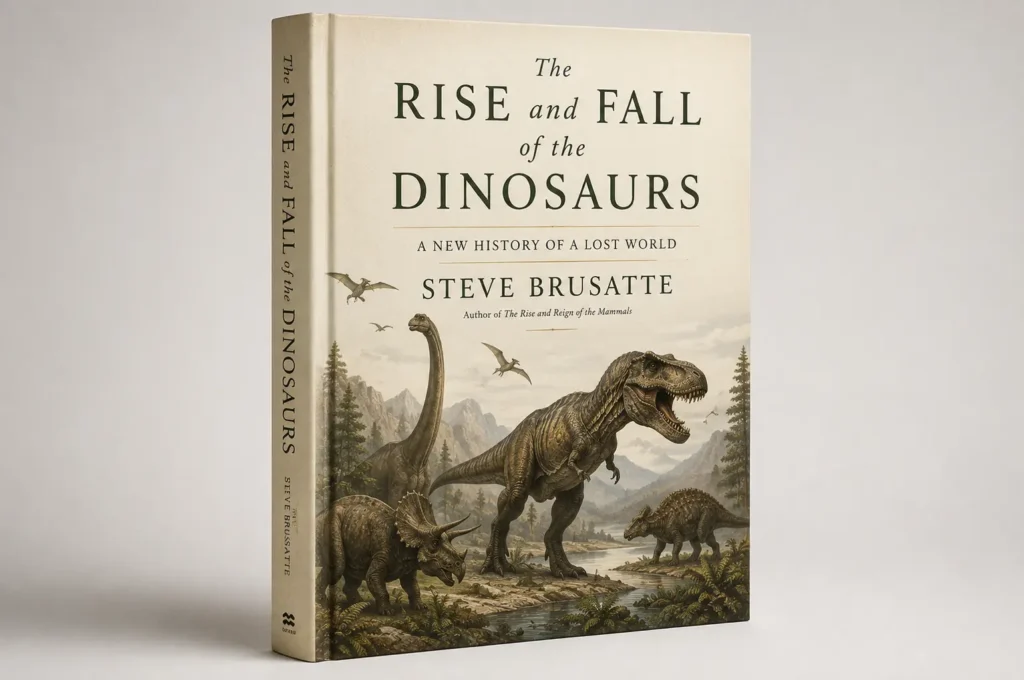
The Rise and Fall of the Dinosaurs
A compelling history of dinosaurs, tracing their origins, diversification, 200-million-year reign, extinction, and enduring legacy.
Dinosaurs and Prehistoric Life
A richly illustrated visual reference exploring dinosaurs, fossils, evolution, and prehistoric life across geological time.
Encyclopedia Prehistorica: Dinosaurs
An interactive dinosaur book featuring spectacular three-dimensional pop-ups, particularly suited to young readers and families.
The Rise and Reign of the Mammals
A sweeping history of mammalian evolution, from their origins alongside dinosaurs through the Cenozoic and the emergence of humans.