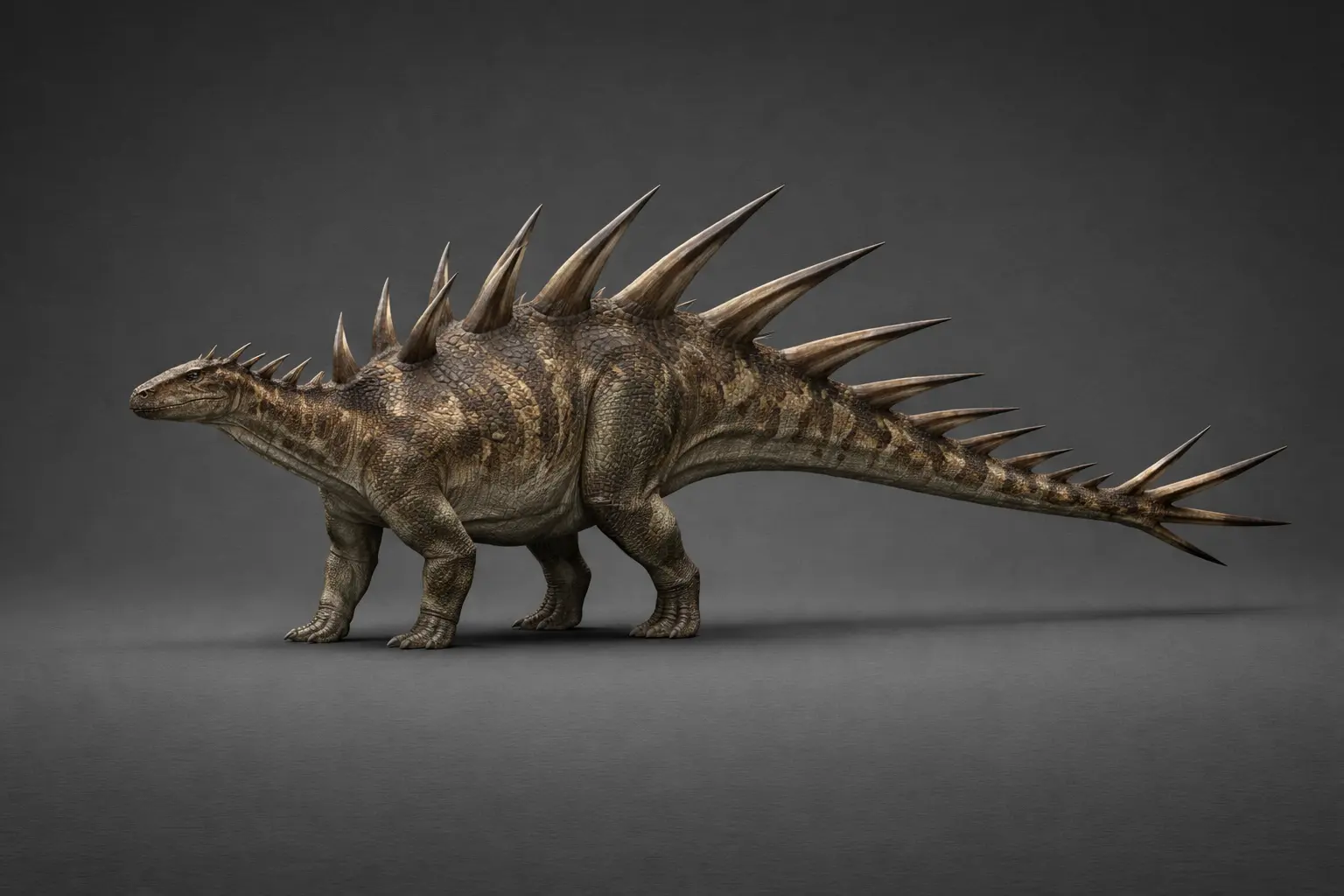
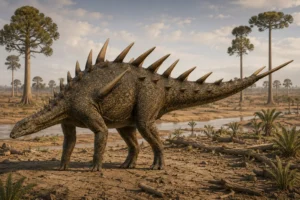
Kentrosaurus possessed pairs of long, sharp spikes running along its tail and potentially on its shoulders, serving as a powerful defensive weapon against predators like Allosaurus. The tail spikes, up to 60 centimeters long, could be swung with lethal force thanks to the animal’s ability to pivot rapidly on its hind legs.
Introduction
The spikes of Kentrosaurus transformed this herbivore into one of the Late Jurassic’s most formidably armed dinosaurs. While its North American relative Stegosaurus is more famous, Kentrosaurus carried proportionally more spikes and fewer plates, creating a bristling defense system that made attacking it a dangerous proposition for any predator. Fossil evidence from Tanzania’s Tendaguru Formation reveals both the structure of these weapons and hints at how they were deployed in life-or-death encounters.
How Many Spikes Did Kentrosaurus Have?
Kentrosaurus carried at least seven pairs of tail spikes arranged along the length of its tail, creating a spiked club that extended from the hips to near the tail tip. These spikes varied in size, with the longest pairs reaching 50 to 60 centimeters in length and positioned roughly mid-tail, where leverage would have been greatest during a swing. Unlike Stegosaurus, which had only four tail spikes, Kentrosaurus devoted much more of its tail length to spike coverage.
The spikes were formed from bone covered in a keratin sheath, similar to modern animal horns. This keratin covering would have extended the spike’s length beyond the fossilized bone and sharpened the tip into a puncturing point. Each spike was paired, extending laterally from either side of the tail vertebrae at roughly 45-degree angles from horizontal, creating a wide striking zone.
Fossil preservation shows that the spikes were firmly anchored to the vertebrae through robust bony attachments. This secure mounting was essential for transferring the force of a tail swing into a predator’s body without the spike breaking loose or the attachment point fracturing.
The Shoulder Spike Debate
One of the most contentious questions in Kentrosaurus paleontology centers on whether the animal carried a pair of defensive spikes on its shoulders or hips. The most complete mounted skeleton in Berlin’s Museum für Naturkunde displays shoulder spikes, but this placement was based on early 20th-century interpretations that modern researchers continue to debate.
The uncertainty stems from how the fossils were preserved. The original Tendaguru specimens were found partially disarticulated, meaning bones had separated from their anatomical positions before fossilization. When Edwin Hennig first described Kentrosaurus in 1915, he positioned a pair of particularly large spikes on the shoulders based on where he believed they would provide optimal defense. However, some paleontologists argue these spikes may have actually belonged further back on the hips, as this position appears more consistent with spike placement in related stegosaurs.
Recent comparative anatomy studies lean toward the hip placement hypothesis, but without finding a perfectly articulated specimen with spikes still attached in their original positions, definitive proof remains elusive. The 2007 remounting of the Berlin specimen maintained the traditional shoulder placement, acknowledging that while hip placement may be more likely, the evidence doesn’t yet warrant changing the iconic display.
Biomechanics of the Tail Swing
The true defensive power of Kentrosaurus lay not just in its spikes, but in its ability to swing them with devastating force. Analysis of the animal’s skeletal structure reveals adaptations specifically suited for rapid tail movement. The tail vertebrae show unusually flexible joints in the forward section, transitioning to stiffer joints near the spiked region, creating a whip-like action that would accelerate the spike tips to high velocity.
Kentrosaurus possessed a center of mass positioned unusually far back on the body, a trait shared with other stegosaurs but particularly pronounced in this species. This rear-heavy weight distribution allowed the animal to pivot rapidly on its hind legs, rotating the entire back half of its body to bring the tail around in a horizontal arc. Computer modeling suggests a full-grown Kentrosaurus could swing its tail through a 180-degree arc in under one second.
The impact force of a tail spike strike would have been formidable. A 50-centimeter spike traveling at the end of a 4-meter tail could generate enough kinetic energy to puncture hide, muscle, and potentially bone. For predators like Allosaurus that hunted in the same Tendaguru ecosystem, approaching a Kentrosaurus from behind or from the side required accepting the risk of a potentially crippling or fatal injury.
Fossil Evidence of Spike Damage
Several Kentrosaurus tail spikes from the Tendaguru Formation show damage patterns consistent with use in defense. Some specimens display fractured tips that healed during the animal’s lifetime, visible as roughened bone texture where new bone tissue grew to repair the break. These healed fractures prove the spikes weren’t merely for show but were actively used in ways that subjected them to significant mechanical stress.
One spike specimen shows a diagonal crack pattern characteristic of impact loading, suggesting the spike struck something hard enough to nearly break it. The fact that the animal survived this encounter and the spike partially healed indicates Kentrosaurus could sustain defensive combat and recover. Other spikes show wear patterns on the keratin-covered surfaces, though interpreting these marks requires caution since fossilization processes can mimic biological wear.
No definitive evidence of Kentrosaurus spike wounds on predator fossils has been identified, but this absence isn’t surprising given the rarity of fossilized soft tissue damage and the difficulty of linking specific injuries to specific encounters across millions of years.
Related and Contemporary Species
- Kentrosaurus shared the Tendaguru Formation with Allosaurus, a large theropod predator whose hunting strategies likely influenced the evolution of stegosaur defensive weapons.
- Stegosaurus from North America’s Morrison Formation carried similar tail weapons, though with fewer, larger spikes in a different arrangement.
- Dacentrurus, a European stegosaur from roughly the same period, possessed both tail spikes and possible shoulder or hip spikes, suggesting this defensive strategy evolved multiple times within the stegosaur family.
- Tuojiangosaurus from China shows an intermediate condition between plate-heavy and spike-heavy stegosaurs, helping illustrate the evolutionary transition toward more aggressive defense systems.
Frequently Asked Questions
How long were Kentrosaurus’ tail spikes?
The longest Kentrosaurus tail spikes reached 50 to 60 centimeters (roughly 20 to 24 inches) in bone length alone, not counting the keratin sheath that would have extended beyond the fossilized portion. Mid-tail spike,s where leverage was greatest for swinging, tended to be the longest, while spikes closer to the tail tip were progressively shorter.
Could Kentrosaurus spikes kill a predator?
Yes, a well-placed tail spike strike had the potential to inflict fatal wounds. The combination of spike length, sharpness, and swing velocity could penetrate vital organs or major blood vessels, and even non-fatal strikes to limbs could cripple a predator’s ability to hunt. The presence of healed spike fractures on fossil specimens confirms that these weapons saw genuine defensive use.
Did the shoulder spikes actually exist?
Large spikes definitely existed as part of Kentrosaurus’ anatomy, but their precise placement remains debated. Traditional reconstructions place them on the shoulders, but modern analysis suggests the hips may be more anatomically consistent. Until a perfectly articulated specimen is found with spikes in their original positions, both placements remain possible interpretations of the same fossil evidence.
Conclusion
The spikes of Kentrosaurus represent one of nature’s most effective defensive weapon systems, combining sharp piercing points with biomechanical adaptations for powerful swinging strikes. Whether positioned on the shoulders or hips, these spikes supplemented the tail weapons to create a formidably armed herbivore that could credibly threaten even the largest predators of its ecosystem.
Featured Museum Collections
Museum-quality paleoart and educational poster
collections based on evidence-informed prehistoric
Life reconstructions.