Quick Info
| Field | Information |
|---|---|
| Species | Mammuthus primigenius — Proboscidea, Elephantidae |
| First appearance | Approximately 400,000 years ago (Middle Pleistocene) |
| Extinction (mainland) | Approximately 10,000 years ago (early Holocene) |
| Extinction (Wrangel Island) | Approximately 4,000 years ago (mid-Holocene) |
| Total temporal range | Approximately 400,000–4,000 years ago |
Quick Answer: Woolly mammoths lived from approximately 400,000 years ago until around 4,000 years ago—a span of roughly 400,000 years. They first appeared during the Middle Pleistocene, reached their greatest geographic extent during the Late Pleistocene, and survived across mainland Eurasia and North America until about 10,000 years ago. A final isolated population persisted on Wrangel Island in the Arctic Ocean until approximately 4,000 years ago.

When the last woolly mammoths were alive on Wrangel Island, the pyramids of ancient Egypt were already standing. This is not a speculative comparison but a conclusion supported by radiocarbon dating. Far from being creatures of deep geological time, woolly mammoths survived into an era approaching recorded human history.
When Did Woolly Mammoths Live?
Woolly mammoths lived from approximately 400,000 years ago until approximately 4,000 years ago, spanning the Middle Pleistocene through the early-to-mid Holocene. This chronology is established primarily through radiometric dating, particularly radiocarbon dating for younger specimens and other geochronological methods for older material.
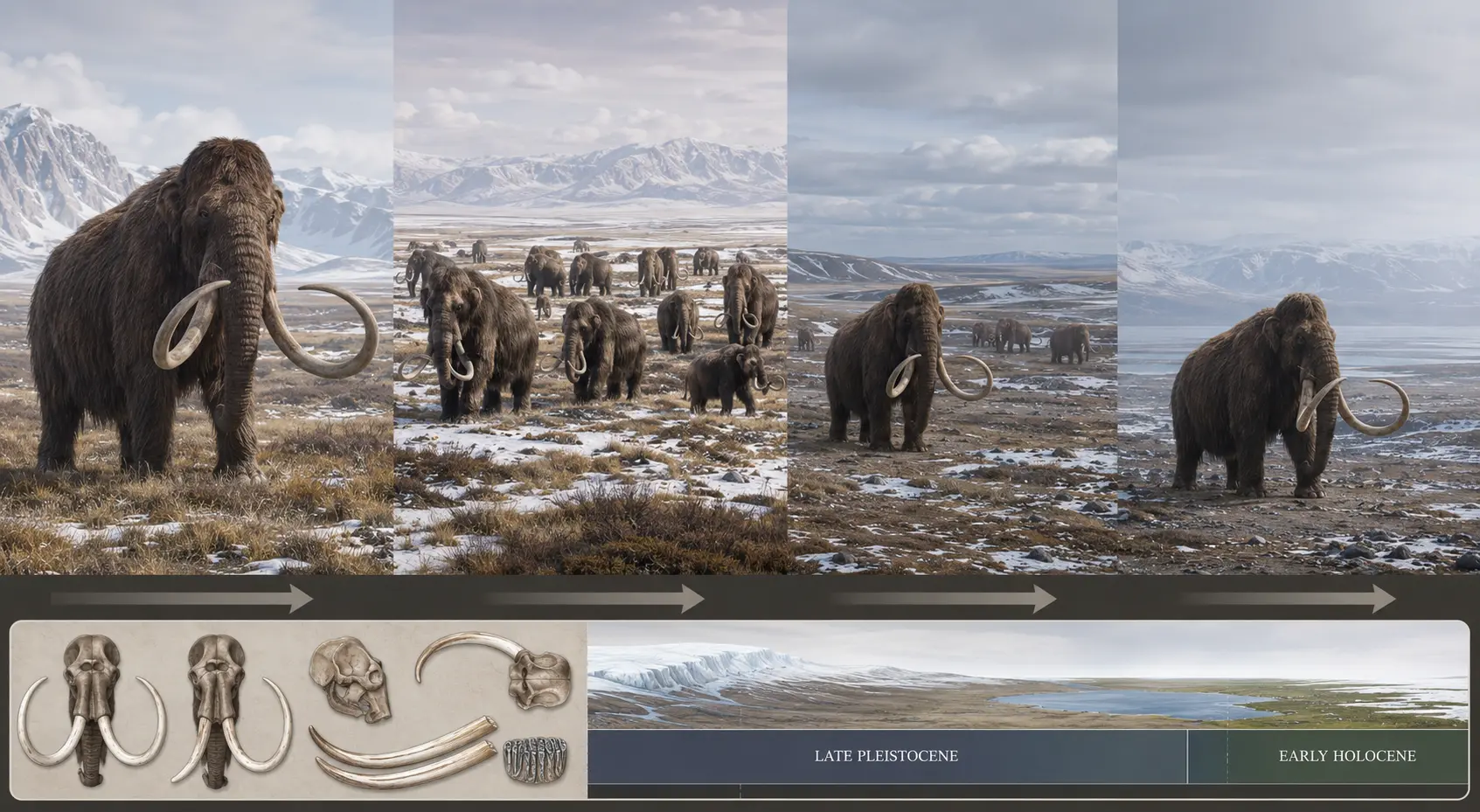
During this period, the species survived multiple glacial–interglacial cycles. Woolly mammoth populations expanded during colder glacial phases, when mammoth-steppe environments spread across northern Eurasia and North America, and contracted during warmer interglacial periods. Only the climatic and ecological changes associated with the Holocene ultimately led to their disappearance from continental ecosystems.
Woolly Mammoth Evolutionary Origins
The Mammoth Lineage
Mammuthus primigenius did not appear suddenly in the fossil record. It evolved within a lineage of proboscideans that originated in Africa and later dispersed into Eurasia. The species most commonly regarded as its immediate ancestor is the steppe mammoth (Mammuthus trogontherii), a larger Eurasian mammoth that lived during the Middle Pleistocene.
The earliest widely accepted woolly mammoth fossils date to approximately 400,000 years ago and are known from Europe and Siberia. The transition from steppe mammoth to woolly mammoth involved the gradual accumulation of cold-adapted traits, including denser body insulation, reduced ears and tail, and increasingly complex molar ridges adapted for grazing abrasive vegetation.
Relationship to Earlier Mammoths
The mammoth genus Mammuthus originated in Africa approximately 5 million years ago. One of the earliest recognised species, Mammuthus subplanifrons, is known from Pliocene deposits and represents an early stage in mammoth evolution.
As mammoths dispersed beyond Africa, they diversified into multiple species across Eurasia and North America. The steppe mammoth became the dominant Eurasian form and is generally regarded as the direct precursor of the woolly mammoth. In North America, the Columbian mammoth (Mammuthus columbi) evolved along a separate trajectory. However, genomic evidence demonstrates that gene flow occasionally occurred between Columbian and woolly mammoth populations where their ranges overlapped.
The Peak of the Woolly Mammoth’s Range
The woolly mammoth reached its greatest geographic extent during the Last Glacial Maximum, approximately 26,000–19,000 years ago. At that time, its range stretched from Western Europe across northern Eurasia, through Beringia, and into North America. The mammoth-steppe ecosystem that supported these populations was at its most extensive during this period, forming one of the largest continuous terrestrial biomes of the Late Pleistocene.
Genetic and palaeontological evidence suggests that woolly mammoth populations were most widespread during major glacial intervals, although direct population estimates are not available from the fossil record. The species had already survived multiple glacial–interglacial cycles before the Holocene. Fossil and genomic evidence indicate repeated population fluctuations associated with climatic change, including range contractions during warmer interglacial periods and re-expansions during colder phases.
The Decline and Terminal Chronology
Mainland Extinction
Radiocarbon evidence indicates that woolly mammoth populations across mainland Eurasia and North America had largely disappeared by approximately 10,000 years ago, around the transition from the Pleistocene to the Holocene. The timing of extinction varied regionally, and some isolated populations may have survived slightly longer than others. However, the resolution of the radiocarbon record makes it difficult to reconstruct precise continent-wide extinction sequences.
Relict and Island Populations
Following the disappearance of mainland populations, woolly mammoths survived in at least two well-documented island refugia. A population on St. Paul Island in the Bering Sea persisted until approximately 5,600 years ago. The best-known late-surviving population inhabited Wrangel Island in the Arctic Ocean and survived until approximately 4,000 years ago, as demonstrated by multiple radiocarbon-dated specimens.
The Wrangel Island mammoths were not simply mainland survivors occupying a geographic refuge. Genomic analyses show that prolonged isolation resulted in reduced genetic diversity and the accumulation of deleterious mutations, evidence of a long-term population bottleneck that likely weakened the population before its eventual extinction. The precise causes of the final extinction remain debated and are discussed in detail in the dedicated extinction article.
How Is the Date Established?
Radiocarbon dating of collagen extracted from mammoth bones, tusks, and teeth provides the primary chronological framework for Late Pleistocene and Holocene specimens younger than approximately 50,000 years. For older fossils, researchers employ additional geochronological techniques, including uranium-series dating and other radiometric methods applied to associated sediments and deposits.
The approximately 4,000-year age of the final Wrangel Island population is supported by multiple independent radiocarbon dates obtained from numerous specimens. Because these dates are highly consistent across different samples and studies, confidence in the chronology of the last known woolly mammoths is exceptionally high.
Woolly Mammoths and Human History: A Timeline Overlap
The coexistence of woolly mammoths and anatomically modern humans is well documented across Eurasia and, later, North America. Humans and mammoths shared landscapes for tens of thousands of years, a relationship evidenced by mammoth depictions in Upper Palaeolithic cave art, mammoth-bone dwelling structures, butchered mammoth remains, and mammoth ivory artefacts recovered from archaeological sites throughout Europe and Siberia.
In North America, woolly mammoths overlapped in time with some of the continent’s earliest widely recognised human cultures. Radiocarbon evidence indicates that mammoths survived into the period associated with the Clovis tradition during the terminal Pleistocene, and mammoth remains have been recovered from several archaeological contexts associated with human activity.
The survival of the Wrangel Island population until approximately 4,000 years ago means that woolly mammoths persisted into a period when complex human societies were already established elsewhere in the world. The last mammoths were alive during the Bronze Age and roughly contemporary with the construction phases of Stonehenge and the flourishing of ancient Egyptian civilisation. This remarkable chronological overlap is one of the most striking aspects of the species’ history.
Related and Contemporary Species
- Mammuthus trogontherii (steppe mammoth) — the Middle Pleistocene mammoth is generally regarded as the direct ancestor or closest ancestral relative of the woolly mammoth.
- Mammuthus columbi (Columbian mammoth) — a North American mammoth that coexisted with woolly mammoths and experienced occasional gene flow with them where their ranges overlapped.
- Coelodonta antiquitatis (woolly rhinoceros) — a major herbivore of the mammoth-steppe ecosystem that shared much of the woolly mammoth’s Eurasian range during the Late Pleistocene.
- Equus ferus (wild horse) — a widespread Pleistocene grazer that occupied many of the same grassland environments as woolly mammoths and frequently appears alongside them in archaeological and palaeoecological records.
- Homo sapiens — anatomically modern humans who coexisted with woolly mammoths across Eurasia and later North America for tens of thousands of years.
Frequently Asked Questions
When did the last woolly mammoth die?
The last known woolly mammoths lived on Wrangel Island in the Arctic Ocean and disappeared approximately 4,000 years ago. This date is supported by multiple radiocarbon-dated specimens from the island. Mainland populations in Eurasia and North America had already disappeared by approximately 10,000 years ago.
Did woolly mammoths live at the same time as dinosaurs?
No. Non-avian dinosaurs became extinct approximately 66 million years ago at the end of the Cretaceous Period. Woolly mammoths first appeared approximately 400,000 years ago, meaning the two groups were separated by more than 65 million years of evolutionary history.
Note: The precise first appearance of Mammuthus primigenius, the timing of regional population declines, and the demographic history reconstructed from genomic evidence remain active areas of research. The broad chronology of woolly mammoth evolution, expansion, and extinction, however, is well established.
Conclusion
The woolly mammoth’s history spans roughly 400,000 years, from the Middle Pleistocene to the edge of recorded human history. It survived repeated climatic fluctuations, expanded across three continents, and persisted long enough for its final populations to overlap chronologically with some of the earliest complex human societies. This unusually recent extinction is one reason the woolly mammoth remains one of the most intensively studied and culturally significant animals of the Ice Age.
References
B. Peer-Reviewed Literature
Palkopoulou, E., Mallick, S., Skoglund, P., Enk, J., Rohland, N., Li, H., Omrak, A., Vartanyan, S., Poinar, H., Götherström, A. and Reich, D., 2015. Complete genomes reveal signatures of demographic and genetic declines in the woolly mammoth. Current Biology, 25(10), pp.1395–1400. https://doi.org/10.1016/j.cub.2015.04.007
Graham, R.W., Belmecheri, S., Choy, K., Culleton, B.J., Davies, L.J., Froese, D., Heintzman, P.D., Hritz, C., Kapp, J.D., Newsom, L.A., and Rawcliffe, R., 2016. Timing and causes of mid-Holocene mammoth extinction on St. Paul Island, Alaska. Proceedings of the National Academy of Sciences, 113(33), pp.9310–9314. https://doi.org/10.1073/pnas.1604903113
Rogers, R.L. and Slatkin, M., 2017. Excess of genomic defects in a woolly mammoth on Wrangel Island. PLOS Genetics, 13(3), e1006601. https://doi.org/10.1371/journal.pgen.1006601
C. Monographs, Books, and Technical Reports
Lister, A.M. and Bahn, P., 2007. Mammoths: Giants of the Ice Age. Revised Edition. University of California Press, Berkeley.
D. Databases and Online Resources
Smithsonian National Museum of Natural History. Educational resources and specimen information relating to Mammuthus primigenius and Pleistocene proboscideans.
Featured Museum Collections
Museum-quality paleoart and educational poster
collections based on evidence-informed prehistoric
Life reconstructions.