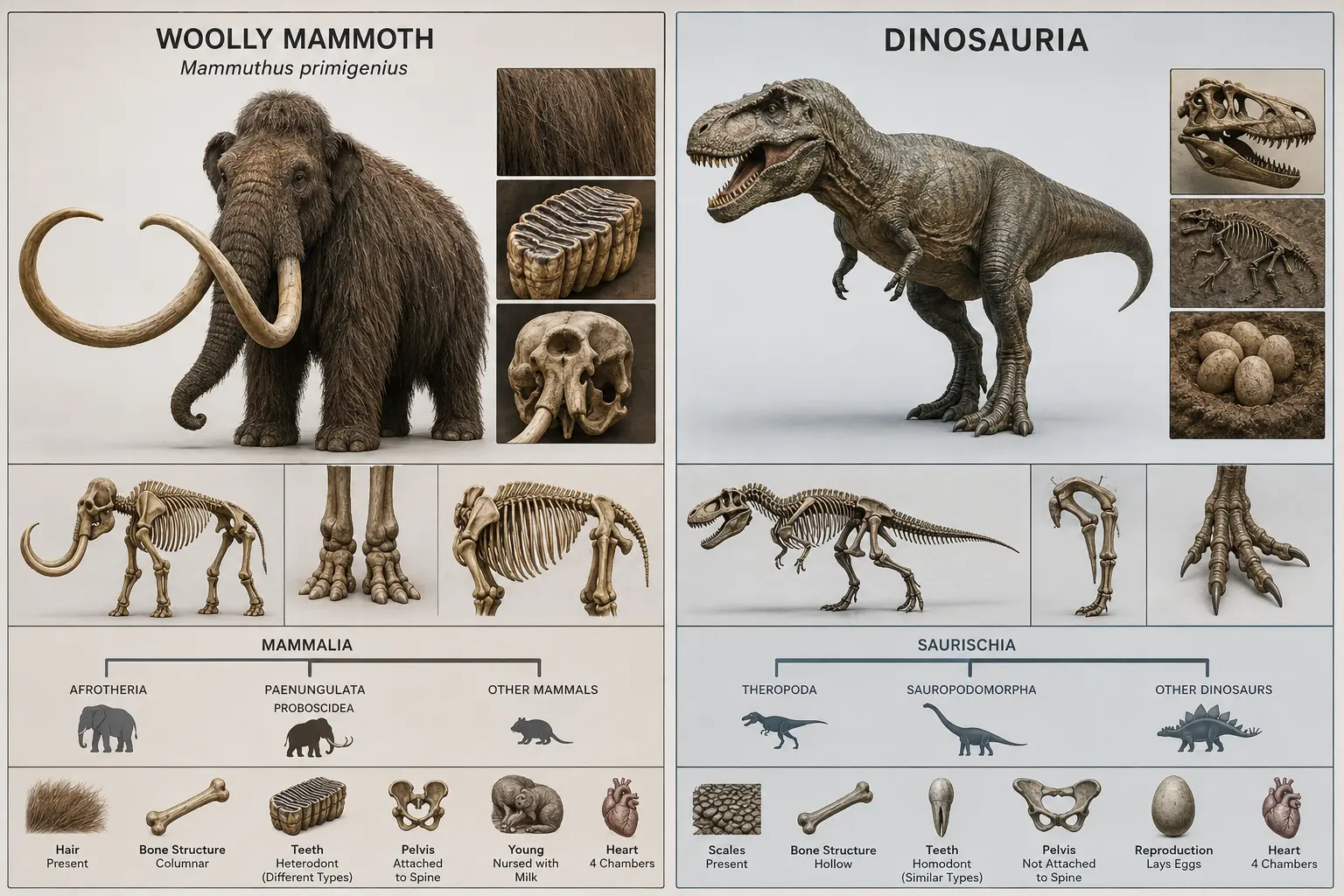
Quick Info
| Field | Information |
|---|---|
| Species | Mammuthus primigenius |
| Class | Mammalia |
| Order | Proboscidea |
| Family | Elephantidae |
| Time Period | Late Pleistocene–Holocene (approximately 400,000–4,000 years ago) |
| Dinosaur? | No |
| Closest Living Relative | Asian elephant (Elephas maximus) |
Quick Answer
No, a woolly mammoth was not a dinosaur.

Woolly mammoths were mammals—warm-blooded, fur-covered animals that gave birth to live young and nursed their calves with milk. They belonged to the order Proboscidea, the same group that includes modern elephants.
Non-avian dinosaurs became extinct approximately 66 million years ago, whereas woolly mammoths evolved hundreds of thousands of years ago and survived until about 4,000 years ago. The two groups were separated by more than 65 million years of evolutionary history.
The confusion is understandable because both mammoths and dinosaurs are large extinct animals commonly associated with prehistoric life. In reality, a woolly mammoth was not a dinosaur but an elephant relative that lived during the Ice Age and coexisted with humans.
Is a Woolly Mammoth a Dinosaur?
A woolly mammoth was not a dinosaur.
Dinosaurs were a distinct group of reptiles that first evolved during the Triassic Period approximately 230 million years ago. Non-avian dinosaurs became extinct at the end of the Cretaceous Period around 66 million years ago during the mass extinction event associated with a large asteroid impact and related environmental changes.
Woolly mammoths belonged to the class Mammalia. Like modern elephants, they were warm-blooded vertebrates covered with hair, gave birth to live young, and produced milk for their offspring.
The evolutionary lineage leading to mammals diverged from the lineage that later produced dinosaurs hundreds of millions of years ago. By the time the first dinosaurs appeared, mammalian ancestors were already evolving along a separate branch of the vertebrate family tree.
What Kind of Animal Was the Woolly Mammoth?
Classification
The woolly mammoth (Mammuthus primigenius) belonged to the order Proboscidea, the group that includes living elephants and their extinct relatives. Within this order, mammoths were members of the family Elephantidae, making them more closely related to modern elephants than to mastodons, which belonged to a different family.
| Rank | Classification |
|---|---|
| Kingdom | Animalia |
| Phylum | Chordata |
| Class | Mammalia |
| Order | Proboscidea |
| Family | Elephantidae |
| Genus | Mammuthus |
| Species | Mammuthus primigenius |
Key Mammalian Features
Multiple lines of evidence demonstrate that woolly mammoths were mammals.
Exceptionally preserved specimens recovered from Arctic permafrost retain dense fur consisting of a soft insulating undercoat and longer guard hairs, a characteristic mammalian feature. Their skulls, teeth, and overall skeletal anatomy closely resemble those of modern elephants and other mammalian proboscideans.
Like all mammals, woolly mammoths gave birth to live young and nourished their calves with milk. Their close evolutionary relationship with living elephants provides strong evidence for these biological traits, even where direct soft-tissue evidence is limited.
Together, their anatomy, physiology, and evolutionary relationships clearly identify woolly mammoths as mammals rather than dinosaurs.
Why Do People Think Woolly Mammoths Were Dinosaurs?
The confusion usually arises because mammoths and dinosaurs are both famous extinct animals associated with prehistoric life.
Most people encounter them in similar contexts—museum exhibits, documentaries, books, and educational media about the distant past. Both groups are known from fossils and preserved remains, and both included species that were much larger than many animals alive today.
The key difference is time.
Non-avian dinosaurs disappeared approximately 66 million years ago, while woolly mammoths evolved only a few hundred thousand years ago and survived until about 4,000 years ago. Although both are considered prehistoric animals, mammoths lived far more recently and even coexisted with humans.
As a result, mammoths and dinosaurs are often grouped in popular culture as “ancient extinct animals,” even though they belonged to entirely different evolutionary lineages and lived during vastly different periods of Earth’s history.
Are Woolly Mammoths Related to Elephants?
Yes. Woolly mammoths were closely related to modern elephants and belonged to the same family, Elephantidae.
Genetic studies show that the Asian elephant (Elephas maximus) is the woolly mammoth’s closest living relative. African elephants (Loxodonta africana and Loxodonta cyclotis) are also close relatives within the same family.
Woolly mammoths were not the direct ancestors of living elephants. Instead, mammoths and modern elephants descended from earlier elephantid ancestors and evolved along separate lineages over millions of years.
Their close relationship is evident not only in DNA evidence but also in their anatomy, including similar skull structure, tusks, molars, trunks, and overall body plan.
Is There Any Woolly Mammoth Left on Earth?
No living woolly mammoths exist today.
The last known population survived on Wrangel Island in the Arctic Ocean until approximately 4,000 years ago. Since then, no credible evidence of surviving mammoths has been discovered anywhere in the world.
Interest in woolly mammoths remains high because scientists are investigating whether some mammoth traits could potentially be reintroduced through genetic engineering. These efforts aim to create cold-adapted elephants that possess selected mammoth characteristics, but no living woolly mammoth currently exists.
Occasionally, news reports about exceptionally well-preserved mammoth remains recovered from Siberian permafrost can create confusion. These discoveries involve frozen carcasses that retain soft tissues such as skin, fur, and internal organs. While remarkably preserved, they are not living animals and do not indicate that mammoths survived into recent times.
Related Species
Asian Elephant (Elephas maximus)
The closest living relative of the woolly mammoth. Both belong to the family Elephantidae and share a recent common ancestor.
African Savanna Elephant (Loxodonta africana)
A close relative within the family Elephantidae, and the largest living land animal.
American Mastodon (Mammut americanum)
An extinct proboscidean related to mammoths but belonging to a different family, Mammutidae. Despite superficial similarities, mastodons and mammoths followed separate evolutionary paths.
Steppe Mammoth (Mammuthus trogontherii)
A large mammoth species widely regarded as the immediate predecessor of the woolly mammoth and one of its closest extinct relatives.
Woolly Rhinoceros (Coelodonta antiquitatis)
A cold-adapted Ice Age mammal that lived alongside woolly mammoths across much of northern Eurasia.
Frequently Asked Questions
Is there any mammoth left on Earth?
No. The last known woolly mammoths survived on Wrangel Island until approximately 4,000 years ago. No living mammoth populations exist today.
Scientists are investigating whether some mammoth traits could be reintroduced through genetic engineering, but no living woolly mammoth has been recreated.
Are woolly mammoths older than dinosaurs?
No. Dinosaurs evolved approximately 230 million years ago, whereas woolly mammoths appeared only a few hundred thousand years ago. Dinosaurs are vastly older than mammoths.
Did humans live with woolly mammoths?
Yes. Modern humans and woolly mammoths coexisted for tens of thousands of years. Archaeological evidence shows that humans hunted mammoths and depicted them in Ice Age art.
Are mammoths and elephants related?
Yes. Woolly mammoths and modern elephants belong to the same family, Elephantidae. Genetic and anatomical evidence show that the Asian elephant is the mammoth’s closest living relative.
Conclusion
The woolly mammoth was not a dinosaur. It was a mammal closely related to modern elephants that lived during the Ice Age and survived until surprisingly recent times.
Although mammoths and dinosaurs are often grouped as prehistoric animals, they belonged to entirely different evolutionary lineages and lived millions of years apart. Understanding this distinction highlights how remarkable the woolly mammoth truly was—not a relic of the Age of Dinosaurs, but a member of the Ice Age world that humans once shared.
References
Peer-Reviewed Literature
Palkopoulou, E., Lipson, M., Mallick, S., Nielsen, S., Rohland, N., Baleka, S., Karpinski, E., Ivancevic, A.M., To, T.H., Kortschak, R.D., Raison, J.M., Qu, Z., Chin, T.J., Alt, K.W., Claesson, S., Dalén, L., MacPhee, R.D.E., Meller, H., Roca, A.L., Ryder, O.A., Heintzman, P.D., Harkins, T.T., Shaw, C.A., Ben-Dor, M., Hall, C.M., Southon, J., Manica, A., Gonzalez Fortes, G., Almécija, S., Rogers, J., Frandsen, P., Boeskorov, G., Burns, J.A., Breen, M., Williams, C., Lenglet, G., Morton, D., Pavliuchenko, V., Stafford, T.W., Llamas, B., Reher, D., Nikolskiy, P., Jass, C.N., Iacumin, P., Crégut-Bonnoure, E., Rolando, A., Froese, D.G., Zazula, G., Pond, B.A., de Manuel, M., Marques-Bonet, T., Salzberg, S.L., Vartanyan, S., Willerslev, E., Orlando, L., Sher, A., Stoneking, M., Schuster, S.C., Miller, W., Slatkin, M. and Reich, D., 2018. A comprehensive genomic history of extinct and living elephants. Proceedings of the National Academy of Sciences, 115(11), pp.E2566–E2574. DOI: 10.1073/pnas. 1720554115.
Lister, A.M., 2014. Evolutionary radiation of elephantids. Quaternary International, 379, pp.11–22.
Books and Monographs
Lister, A.M. and Bahn, P., 2007. Mammoths: Giants of the Ice Age. Revised Edition. Berkeley: University of California Press.
Benton, M.J., 2015. Vertebrate Palaeontology. 4th Edition. Chichester: Wiley-Blackwell.
Museums, Databases, and Reference Resources
Smithsonian National Museum of Natural History. What Is a Mammoth? Available through the Smithsonian National Museum of Natural History educational resources.
Integrated Taxonomic Information System (ITIS). Mammuthus primigenius (Blumenbach, 1799). Taxonomic database record.
Paleobiology Database (PBDB). Mammuthus primigenius occurrence and classification records.
International Commission on Zoological Nomenclature (ICZN). International Code of Zoological Nomenclature.
Featured Museum Collections
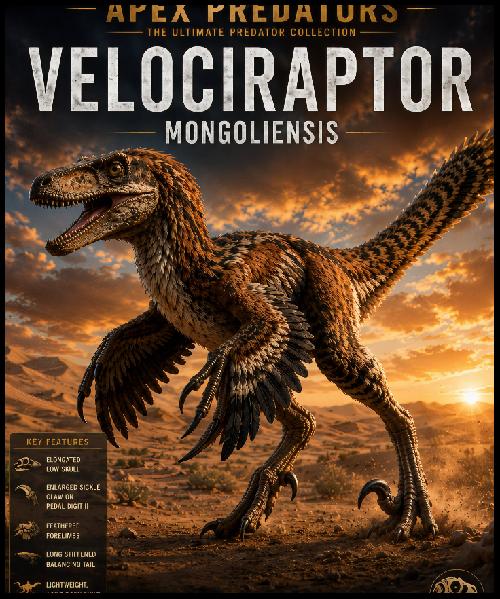
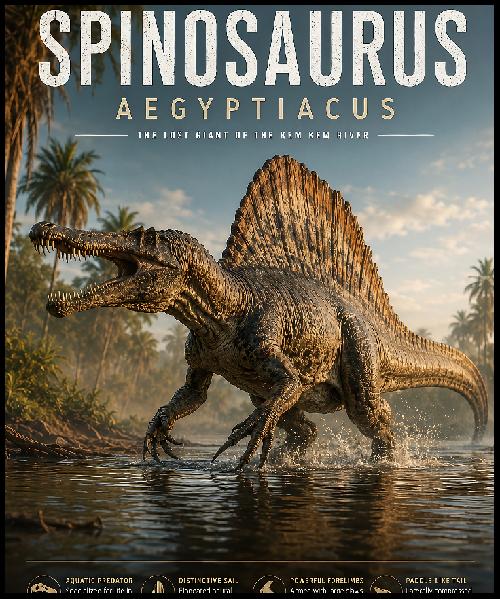
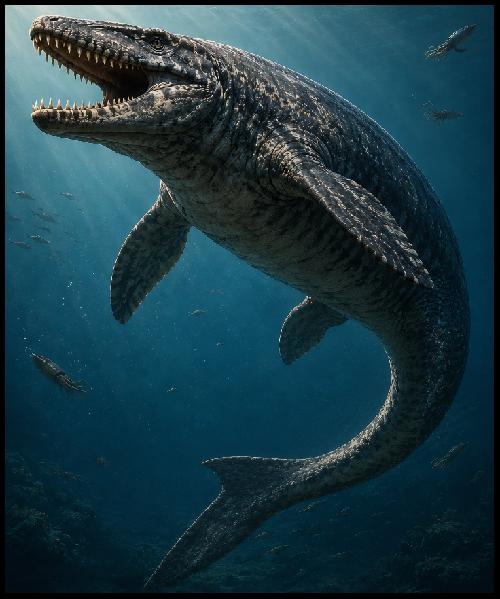
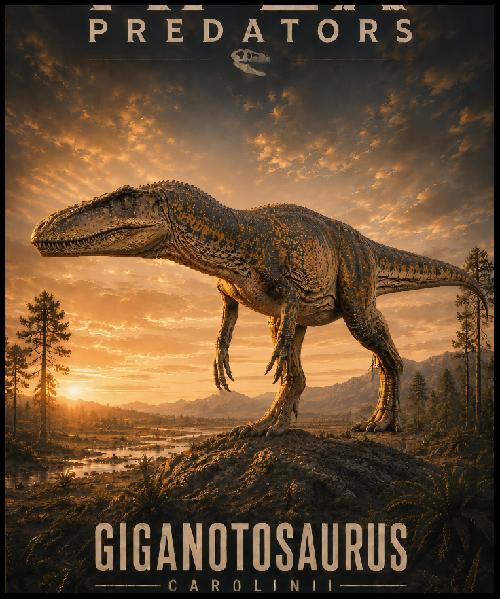
Museum-quality paleoart and educational poster
collections based on evidence-informed prehistoric
Life reconstructions.