Quick Info
| Category | Information |
|---|---|
| Scientific Name | Deinonychus antirrhopus |
| Classification | Dromaeosauridae |
| Geological Age | Early Cretaceous (115–108 Ma) |
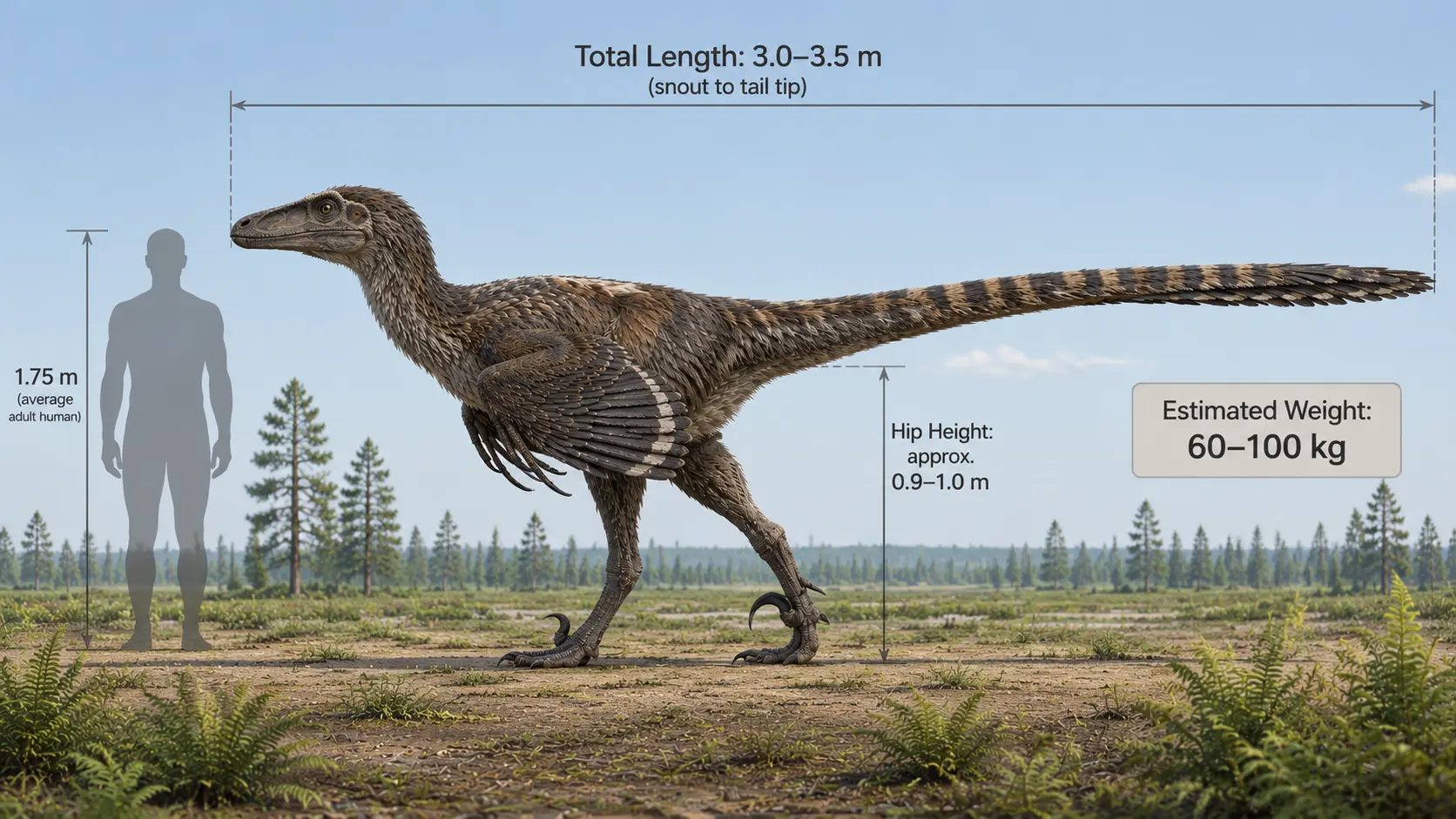
| Estimated Length | 3.0–3.5 m |
| Estimated Weight | 60–100 kg |
| Estimated Hip Height | 0.9–1.2 m |
| Largest Common Estimates | Approximately 3.5 m and 100 kg |
| Evidence Basis | Multiple partial skeletons |
| Confidence Level | High |
Quick Answer
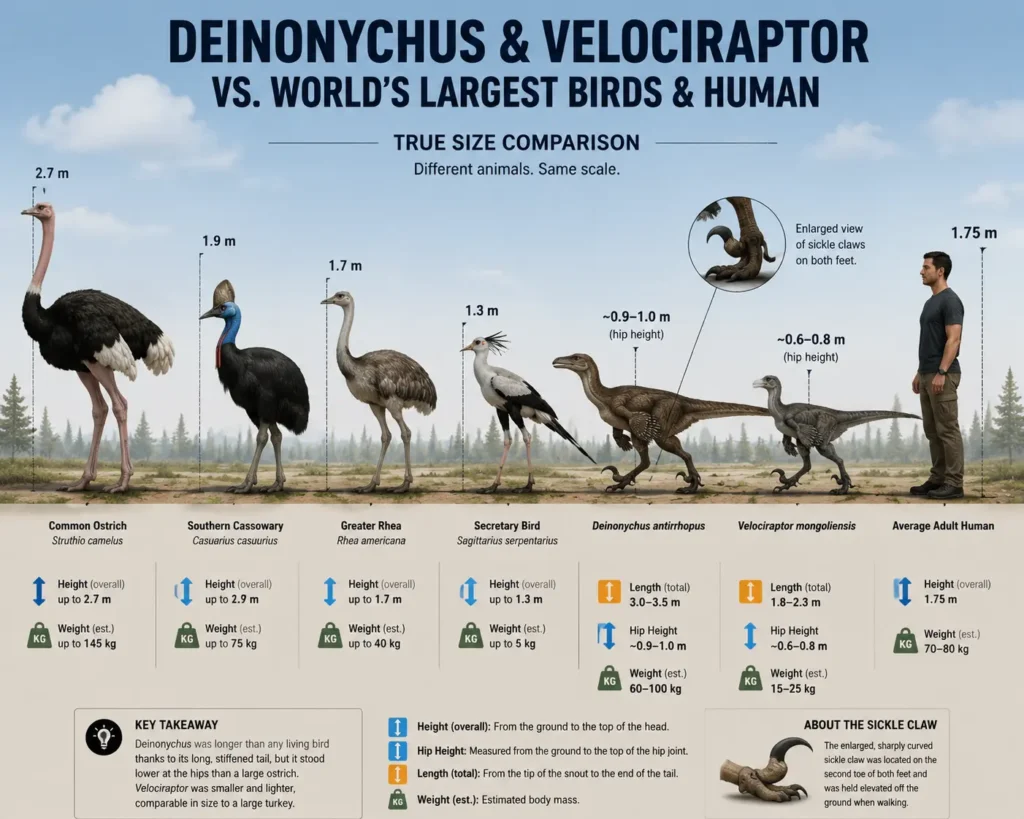
Deinonychus was a medium-sized dromaeosaurid dinosaur that typically measured about 3.0–3.5 meters in length and weighed approximately 60–100 kilograms. Although substantially smaller than giant theropods such as Tyrannosaurus rex, it was considerably larger than Velociraptor and among the most formidable medium-sized predators of Early Cretaceous North America. Because numerous specimens preserve substantial portions of the skeleton, body-size estimates for Deinonychus are supported by relatively strong fossil evidence.

Introduction
Size is one of the best-understood aspects of Deinonychus antirrhopus biology. Since the species is represented by multiple individuals and reasonably complete skeletal material, paleontologists can estimate its body dimensions with greater confidence than is possible for many extinct predators.
The available fossils indicate a lightly built but powerful animal adapted for active terrestrial predation. Its proportions combined relatively long hind limbs, a stiffened balancing tail, and grasping forelimbs, creating a body plan suited for agility rather than sheer mass.
What Is Known From Evidence
Fossil Evidence
Body-size estimates are derived primarily from skeletal remains recovered from the Cloverly Formation and related Early Cretaceous deposits of western North America.
Unlike many fragmentary theropods known from isolated bones, Deinonychus is represented by multiple specimens preserving substantial portions of the skeleton. These fossils provide direct evidence for overall body proportions and reduce the uncertainty associated with size reconstruction.
Specimen Evidence
| Measurement Category | Estimated Range | Evidence Confidence |
|---|---|---|
| Total Length | 3.0–3.5 m | High |
| Body Weight | 60–100 kg | Moderate to High |
| Hip Height | 0.9–1.2 m | Moderate |
| Tail Length | Approximately half total body length | High |
Length estimates are generally more reliable than weight estimates because body mass must be inferred from skeletal dimensions and reconstructed soft tissues.
Anatomical Proportions
| Body Region | Relative Proportion | Functional Significance |
|---|---|---|
| Hind Limbs | Long | Agility and locomotion |
| Tail | Long and stiffened | Balance and maneuverability |
| Forelimbs | Relatively large | Grasping prey |
| Skull | Moderately sized | Predatory feeding adaptations |
The overall body plan suggests a predator optimized for mobility and prey handling rather than brute force.
Scientific Interpretation
How Large Was Deinonychus Compared With Other Dromaeosaurids?
| Taxon | Estimated Length | Estimated Weight |
|---|---|---|
| Velociraptor mongoliensis | ~2.0 m | ~15–20 kg |
| Deinonychus antirrhopus | 3.0–3.5 m | 60–100 kg |
| Utahraptor ostrommaysorum | 5–7 m | 300–700+ kg |
These comparisons place Deinonychus between smaller dromaeosaurids such as Velociraptor and giant forms such as Utahraptor.
Its size may have allowed it to target prey larger than those typically hunted by smaller dromaeosaurids while maintaining greater agility than larger theropod predators.
Growth and Ontogeny
Direct evidence documenting growth stages in Deinonychus remains more limited than in some exceptionally well-sampled dinosaur species.
Nevertheless, available specimens indicate that juveniles were substantially smaller than adults and likely underwent significant size increases throughout development. As with other theropod dinosaurs, body proportions may have changed during growth, although the extent of these changes remains incompletely understood.
Current Scientific Understanding
Published estimates generally place Deinonychus within a range of approximately 3.0–3.5 meters in length and roughly 60–100 kilograms in body mass, although exact values vary among studies because body-mass reconstructions depend on differing anatomical and volumetric methodologies.
While precise body-mass calculations vary among studies due to differences in reconstruction methods, overall size estimates remain relatively consistent across the scientific literature. The available fossil record provides high confidence that Deinonychus was significantly larger than Velociraptor but substantially smaller than giant dromaeosaurids such as Utahraptor.
Its combination of moderate size, relatively long hind limbs, and specialized predatory adaptations contributed to its role as one of the dominant medium-sized predators in Early Cretaceous ecosystems of western North America.
Evidence Assessment
| Evidence Category | Assessment |
|---|---|
| Skeletal Anatomy | Strong Direct Evidence |
| Length Estimates | High Confidence |
| Weight Estimates | Moderate Confidence |
| Growth Patterns | Moderate Confidence |
| Soft Tissue Reconstruction | Limited Evidence |
| Maximum Size Estimates | Moderate Confidence |
The strongest evidence relates to overall body length and skeletal proportions. Weight estimates are necessarily less certain because they depend on reconstructed musculature and body volume. Despite these limitations, the available fossil record provides a robust foundation for estimating the size of Deinonychus.
Why Are Weight Estimates Less Certain?
Unlike body length, which can be measured directly from fossilized bones, body weight cannot be observed in the fossil record. While the skeleton of Deinonychus preserves the framework of the body, soft tissues such as muscles, fat, skin, and internal organs are rarely fossilized. As a result, paleontologists must reconstruct the animal’s overall body volume before estimating its mass. Modern techniques often combine detailed skeletal measurements with three-dimensional digital models, laser scanning, and volumetric reconstruction methods to simulate the amount of soft tissue that likely surrounded the bones. These models are then compared with living animals to estimate body density and total weight. Because different reconstruction methods make different assumptions about soft tissue distribution and body shape, published weight estimates vary more than length estimates. Nevertheless, most studies consistently place Deinonychus within a body-mass range of approximately 60–100 kilograms, providing moderate confidence in its overall size despite unavoidable uncertainty.
Frequently Asked Questions
How big was Deinonychus compared to Velociraptor?
Deinonychus was significantly larger. Most estimates place Deinonychus at 3.0–3.5 meters in length and 60–100 kilograms in weight, whereas Velociraptor was roughly 2 meters long and commonly estimated at 15–20 kilograms.
Was Deinonychus the largest dromaeosaurid?
No. Larger dromaeosaurids are known, including Utahraptor, which may have exceeded 5 meters in length and several hundred kilograms in body mass.
How accurate are Deinonychus weight estimates?
Weight estimates are less certain than length estimates because soft tissues are not preserved. Most published estimates fall within a broad range of approximately 60–100 kilograms.
Did all Deinonychus individuals reach the same size?
Probably not. As in modern animals, body size likely varied between individuals and across different growth stages.
References
Primary Taxonomic Sources
Ostrom, J.H. (1969). Osteology of Deinonychus antirrhopus, an unusual theropod from the Lower Cretaceous of Montana. Bulletin of the Peabody Museum of Natural History, 30, 1–165.
Ostrom, J.H. (1976). Archaeopteryx and the origin of birds. Biological Journal of the Linnean Society, 8, 91–182.
Peer-Reviewed Literature
Turner, A.H., Makovicky, P.J., & Norell, M.A. (2012). A review of dromaeosaurid systematics and paravian phylogeny. Bulletin of the American Museum of Natural History, 371, 1–206.
Bates, K.T., Manning, P.L., Hodgetts, D., & Sellers, W.I. (2009). Estimating mass properties of dinosaurs using laser imaging and 3D computer modelling. PLoS ONE, 4(2), e4532.
Hutchinson, J.R., Ng-Thow-Hing, V., & Anderson, F.C. (2007). A 3D interactive method for estimating body segmental parameters in animals. Journal of Anatomy, 210(6), 693–706.
Turner, A.H., Pol, D., Clarke, J.A., Erickson, G.M., & Norell, M.A. (2007). A basal dromaeosaurid and size evolution preceding avian flight. Science, 317(5843), 1378–1381.
Books and Monographs
Paul, G.S. (2016). The Princeton Field Guide to Dinosaurs (2nd ed.). Princeton University Press.
Holtz, T.R. Jr. (2007). Dinosaurs: The Most Complete, Up-to-Date Encyclopedia for Dinosaur Lovers of All Ages. Random House.
Brusatte, S.L. (2018). The Rise and Fall of the Dinosaurs. William Morrow.
Databases and Online Resources
The Theropod Database — Deinonychus entry.
Paleobiology Database — Occurrence and taxonomic records for Deinonychus antirrhopus.
Featured Museum Collections
Museum-quality paleoart and educational poster
collections based on evidence-informed prehistoric
Life reconstructions.