Quick Info
| Category | Information |
|---|---|
| Scientific Name | Deinonychus antirrhopus |
| Classification | Dromaeosauridae |
| Geological Age | Early Cretaceous (115–108 Ma) |
| Direct Feather Fossils | None Known |
| Feather Inference | Strongly Supported |
| Closest Feathered Relatives | Numerous dromaeosaurids and paravians |
| Evolutionary Significance | Key evidence linking dinosaurs and birds |
| Scientific Confidence | High |
| Major Debate | Extent and appearance of feathering |
Quick Answer
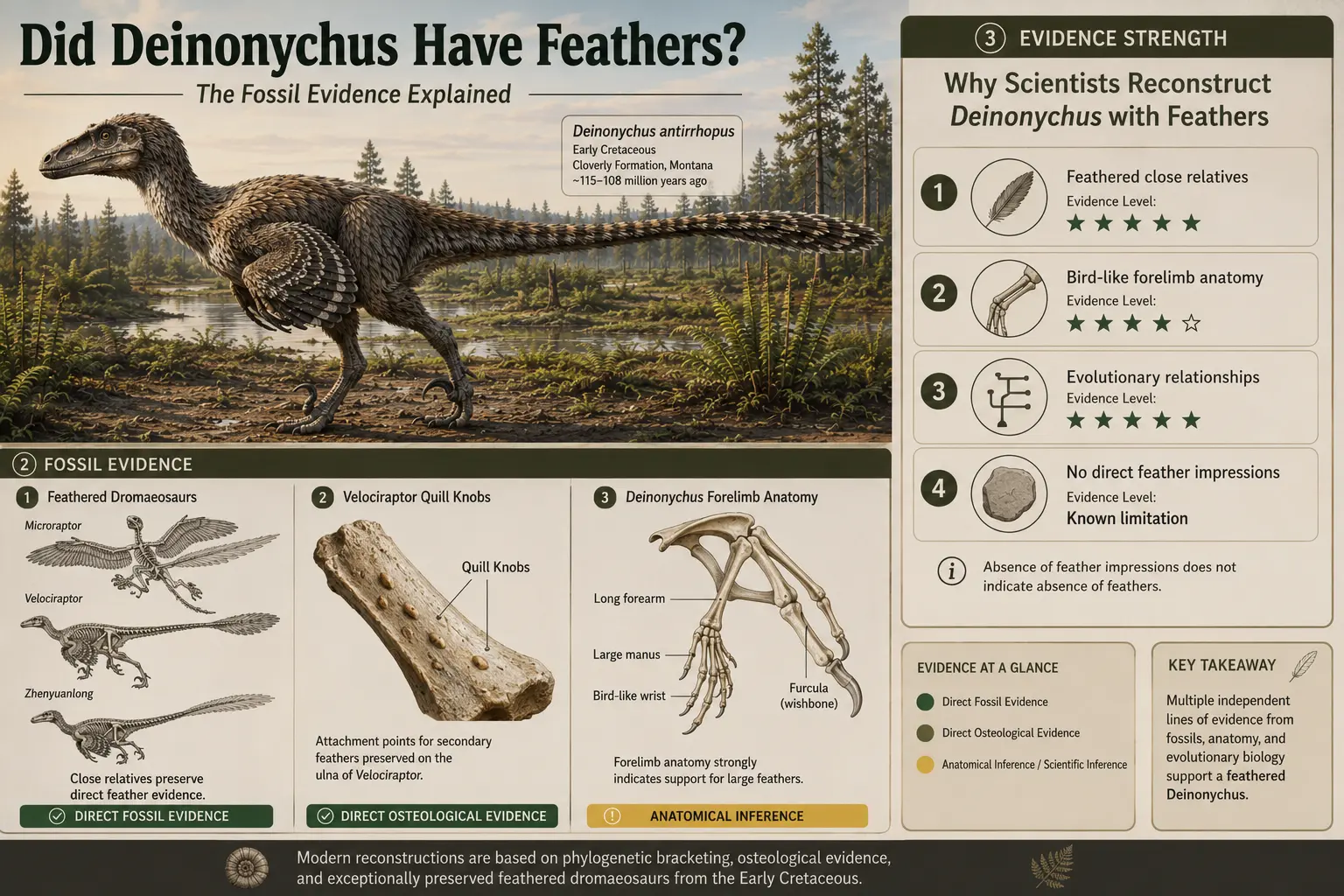
Although no feathers have been directly preserved on known Deinonychus fossils, current scientific evidence strongly supports the conclusion that it was feathered. This inference is based on the discovery of feathers in numerous closely related dromaeosaurids and other paravian dinosaurs. Deinonychus also played a pivotal role in demonstrating the close evolutionary relationship between non-avian theropod dinosaurs and birds, helping establish the modern scientific consensus that birds evolved from small feathered theropods.

Introduction
Few dinosaurs have had a greater impact on our understanding of bird origins than Deinonychus antirrhopus. When John Ostrom described the species in 1969, he noted numerous anatomical similarities between Deinonychus and birds. At the time, the dinosaurian origin of birds remained controversial.
Subsequent discoveries of feathered dinosaurs from China and elsewhere have reinforced many of Ostrom’s observations. Today, Deinonychus is recognized as one of the most important species in the history of evolutionary biology because it helped bridge the gap between traditional dinosaurs and modern birds.
What Is Known From Evidence
Direct Feather Evidence
| Evidence Category | Status |
|---|---|
| Preserved Feathers | Not Known |
| Feather Impressions | Not Known |
| Soft Tissue Preservation | Limited |
| Direct Integument Evidence | Absent |
| Confidence Level | High |
No known Deinonychus specimen preserves feathers or feather impressions.
This absence does not necessarily indicate that feathers were lacking. Fossilization conditions capable of preserving delicate integumentary structures are rare, and most Deinonychus fossils consist primarily of skeletal remains.
Indirect Feather Evidence
| Evidence Type | Significance |
|---|---|
| Feathered Dromaeosaurids | Strong |
| Feathered Paravians | Strong |
| Evolutionary Relationships | Strong |
| Comparative Anatomy | Strong |
| Phylogenetic Bracketing | Strong |
The strongest evidence for feathering comes from closely related species.
Numerous dromaeosaurids discovered after Deinonychus was described preserve feathers directly. These include taxa such as:
- Microraptor
- Sinornithosaurus
- Zhenyuanlong
Because feathers appear widespread within Dromaeosauridae and Paraves, researchers generally infer that Deinonychus also possessed feathers.
Why Do Scientists Think Deinonychus Had Feathers?
Although no direct fossil evidence of feathers has been discovered in Deinonychus, multiple independent lines of scientific evidence strongly support the conclusion that it was feathered. This inference is based on evolutionary relationships rather than speculation.
- No direct feather fossils: No known Deinonychus specimen preserves feathers or feather impressions because the conditions needed to preserve delicate soft tissues are exceptionally rare.
- Feathered relatives: Numerous closely related dromaeosaurids, including Microraptor, Sinornithosaurus, and Zhenyuanlong, preserve feathers directly, indicating that feathering was widespread within the group.
- Phylogenetic bracketing: Scientists use this evolutionary method to infer traits shared by closely related species. Because many members of Dromaeosauridae and Paraves possessed feathers, Deinonychus likely inherited them from a common ancestor.
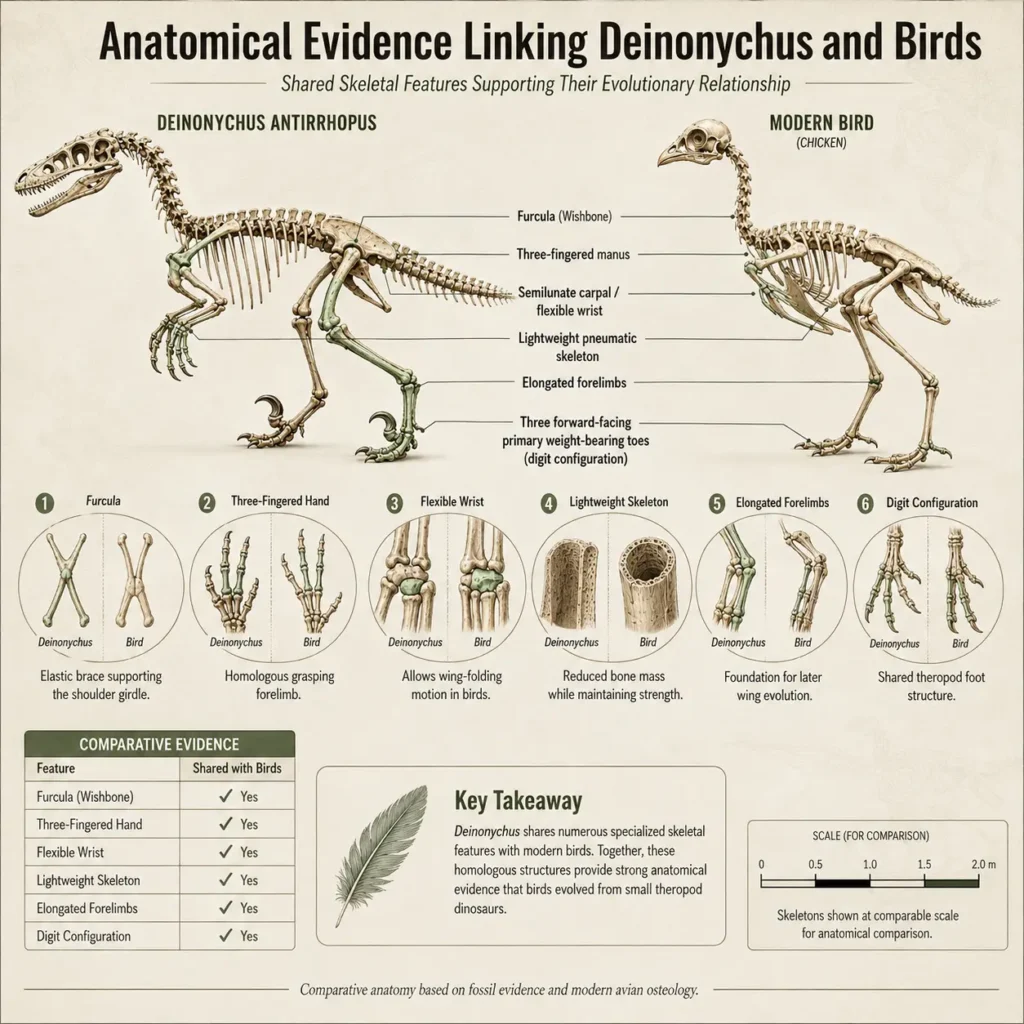
- Shared anatomy: Bird-like features such as the semilunate wrist bone, furcula (wishbone), and three-fingered hands further support its close relationship with feathered theropods.
- Evolutionary relationships: Modern analyses consistently place Deinonychus within Paraves, the dinosaur lineage that also includes birds.
- Why indirect evidence is reliable: In paleontology, well-supported evolutionary relationships can provide strong evidence for traits that are not directly preserved, making feathering in Deinonychus one of the best-supported anatomical inferences despite the absence of fossilized feathers.
Anatomical Evidence Linking Deinonychus and Birds
Skeletal Similarities
| Feature | Shared with Birds? |
|---|---|
| Furcula (Wishbone) | Yes |
| Three-Fingered Hand | Yes |
| Flexible Wrist | Yes |
| Lightweight Skeleton | Yes |
| Elongated Forelimbs | Yes |
| Digit Configuration | Yes |
Many skeletal features once considered uniquely avian are now known to occur in non-avian theropods, including Deinonychus.
These similarities played a major role in reshaping scientific views of dinosaur evolution.
The Semilunate Carpal
| Feature | Importance |
|---|---|
| Semilunate Wrist Bone | High |
| Wrist Flexibility | High |
| Bird-Like Movement | High |
| Evolutionary Significance | Exceptional |
One of the most influential discoveries involved the semilunate carpal, a specialized wrist structure allowing folding movements similar to those used by modern birds.
Ostrom recognized this feature as powerful evidence linking theropod dinosaurs and birds.
Scientific Interpretation
Why Scientists Infer Feathers
| Reason | Evidence Strength |
|---|---|
| Close Feathered Relatives | Strong |
| Shared Anatomy | Strong |
| Phylogenetic Position | Strong |
| Evolutionary Consistency | Strong |
The inference that Deinonychus possessed feathers does not rely on speculation alone.
Instead, it follows the principle of phylogenetic bracketing. When multiple closely related species preserve a trait, researchers can often infer that their common ancestors and close relatives likely possessed the same feature unless evidence suggests otherwise.
Under this framework, feathering in Deinonychus is considered highly probable.
What Might Deinonychus Have Looked Like?
| Characteristic | Current Understanding |
|---|---|
| Presence of Feathers | Highly Likely |
| Feather Distribution | Uncertain |
| Feather Color | Unknown |
| Display Structures | Possible |
| Flight Capability | Unsupported |
Current evidence supports the presence of feathers but does not permit detailed reconstruction of coloration, patterning, or exact feather arrangement.
Many artistic reconstructions depict extensive feather coverings, but the precise appearance remains uncertain.
The Role of Deinonychus in Bird-Origin Research
Historical Importance
| Scientific Topic | Impact of Deinonychus |
|---|---|
| Dinosaur Renaissance | Major |
| Bird Origins Research | Major |
| Theropod Evolution | Major |
| Functional Morphology | Major |
| Public Understanding of Dinosaurs | Major |
The influence of Deinonychus extends far beyond feather discussions.
Its discovery helped revive and strengthen the hypothesis that birds evolved from theropod dinosaurs. This idea, once controversial, is now strongly supported by extensive fossil evidence.
Before and After Deinonychus
| Scientific View | Historical Trend |
|---|---|
| Pre-1969 | Dinosaur-bird link debated |
| Post-1969 | Renewed scientific support |
| Modern View | Birds are living theropod dinosaurs |
The modern consensus recognizes birds as surviving members of the theropod dinosaur lineage.
Deinonychus was one of the most important taxa in establishing that perspective.
Alternative Interpretations
There is little debate regarding the evolutionary relationship between birds and theropod dinosaurs. However, some uncertainty remains concerning:
- The exact extent of feather coverage in Deinonychus
- Whether certain feather structures were used primarily for insulation, display, or other functions
- The appearance of juvenile versus adult individuals
These questions reflect gaps in direct fossil evidence rather than disagreement about the broader dinosaur-bird relationship.
Current Scientific Understanding
Current evidence strongly supports the interpretation that Deinonychus was a feathered dromaeosaurid closely related to the ancestors of modern birds. Although feathers have not been directly preserved in known specimens, discoveries in numerous related species make feathering highly probable.
The anatomical similarities between Deinonychus and birds were instrumental in advancing the modern understanding of bird origins. Research over the past several decades has repeatedly reinforced the conclusion that birds evolved from small theropod dinosaurs.
As a result, Deinonychus remains one of the most scientifically important dinosaurs for understanding the evolutionary transition between traditional non-avian dinosaurs and modern birds.
Evidence Assessment
| Evidence Category | Assessment |
|---|---|
| Dinosaur-Bird Relationship | Strong Direct Evidence |
| Comparative Anatomy | Strong Direct Evidence |
| Phylogenetic Evidence for Feathers | Strong Evidence |
| Direct Feather Preservation | Absent |
| Feather Distribution | Moderate Uncertainty |
| Feather Coloration | Unknown |
| Evolutionary Significance | Exceptional Evidence |
The strongest evidence concerns the evolutionary relationship between Deinonychus and birds. Evidence for feathering is indirect but robust due to the abundance of feathered close relatives. By contrast, specific details of feather appearance remain uncertain because direct integumentary preservation is absent.
Frequently Asked Questions
Did Deinonychus have feathers?
No feathers have been directly preserved, but current evidence strongly suggests that Deinonychus was feathered because many closely related dromaeosaurids preserve feathers.
Could Deinonychus fly?
There is currently no evidence that Deinonychus was capable of powered flight.
Why is Deinonychus important to bird evolution?
Its anatomy provided some of the earliest and strongest evidence that birds evolved from theropod dinosaurs.
Are birds dinosaurs?
Yes. Modern scientific consensus recognizes birds as living theropod dinosaurs.
References
Primary Taxonomic Sources
Ostrom, J.H. (1969). Osteology of Deinonychus antirrhopus, an unusual theropod from the Lower Cretaceous of Montana. Bulletin of the Peabody Museum of Natural History, 30, 1–165.
Peer-Reviewed Scientific Literature
Ostrom, J.H. (1970). The discovery of dinosaurian characteristics in Archaeopteryx and the origin of birds. Quarterly Review of Biology, 45(1), 27–47.
Ostrom, J.H. (1976). Archaeopteryx and the origin of birds. Biological Journal of the Linnean Society, 8, 91–182.
Xu, X., Zhou, Z., Wang, X., Kuang, X., Zhang, F., & Du, X. (2003). Four-winged dinosaurs from China. Nature, 421, 335–340.
Turner, A.H., Makovicky, P.J., & Norell, M.A. (2012). A review of dromaeosaurid systematics and paravian phylogeny. Bulletin of the American Museum of Natural History, 371, 1–206.
Brusatte, S.L., O’Connor, J.K., & Jarvis, E.D. (2015). The origin and diversification of birds. Current Biology, 25(19), R888–R898.
Xu, X., Zheng, X., & You, H. (2015). Exceptional dinosaur fossils show ontogenetic development of early feathers. Nature, 521, 70–73.
Pei, R., Pittman, M., Goloboff, P.A., Dececchi, T.A., Habib, M.B., Kaye, T.G., et al. (2020). Potential for powered flight neared by most close avialan relatives but few crossed its thresholds. Current Biology, 30(20), 4033–4046.
Monographs and Academic Books
Chiappe, L.M., & Witmer, L.M. (2002). Mesozoic Birds: Above the Heads of Dinosaurs. University of California Press.
Weishampel, D.B., Dodson, P., & Osmólska, H. (Eds.). (2004). The Dinosauria (2nd ed.). University of California Press.
Paul, G.S. (2016). The Princeton Field Guide to Dinosaurs (2nd ed.). Princeton University Press.
Brusatte, S.L. (2018). The Rise and Fall of the Dinosaurs. William Morrow.
Museum and Institutional Sources
Yale Peabody Museum. Historical collections, specimen information, and archival resources relating to Deinonychus antirrhopus.
Databases
Paleobiology Database. Taxonomic and occurrence records for Deinonychus antirrhopus.
The Theropod Database. Taxonomic, anatomical, phylogenetic, and bibliographic information for Deinonychus and Dromaeosauridae.
Featured Museum Collections
Museum-quality paleoart and educational poster
collections based on evidence-informed prehistoric
Life reconstructions.