Quick Info
| Category | Information |
|---|---|
| Scientific Name | Deinonychus antirrhopus |
| Structure | Enlarged second-toe claw |
| Location | Second digit of each foot |
| Traditional Interpretation | Slashing weapon |
| Modern Leading Hypothesis | Prey restraint |
| Direct Behavioral Evidence | Limited |
| Biomechanical Evidence | Available |
| Scientific Confidence | Moderate |
| Major Debate | Primary function of the claw |
Quick Answer
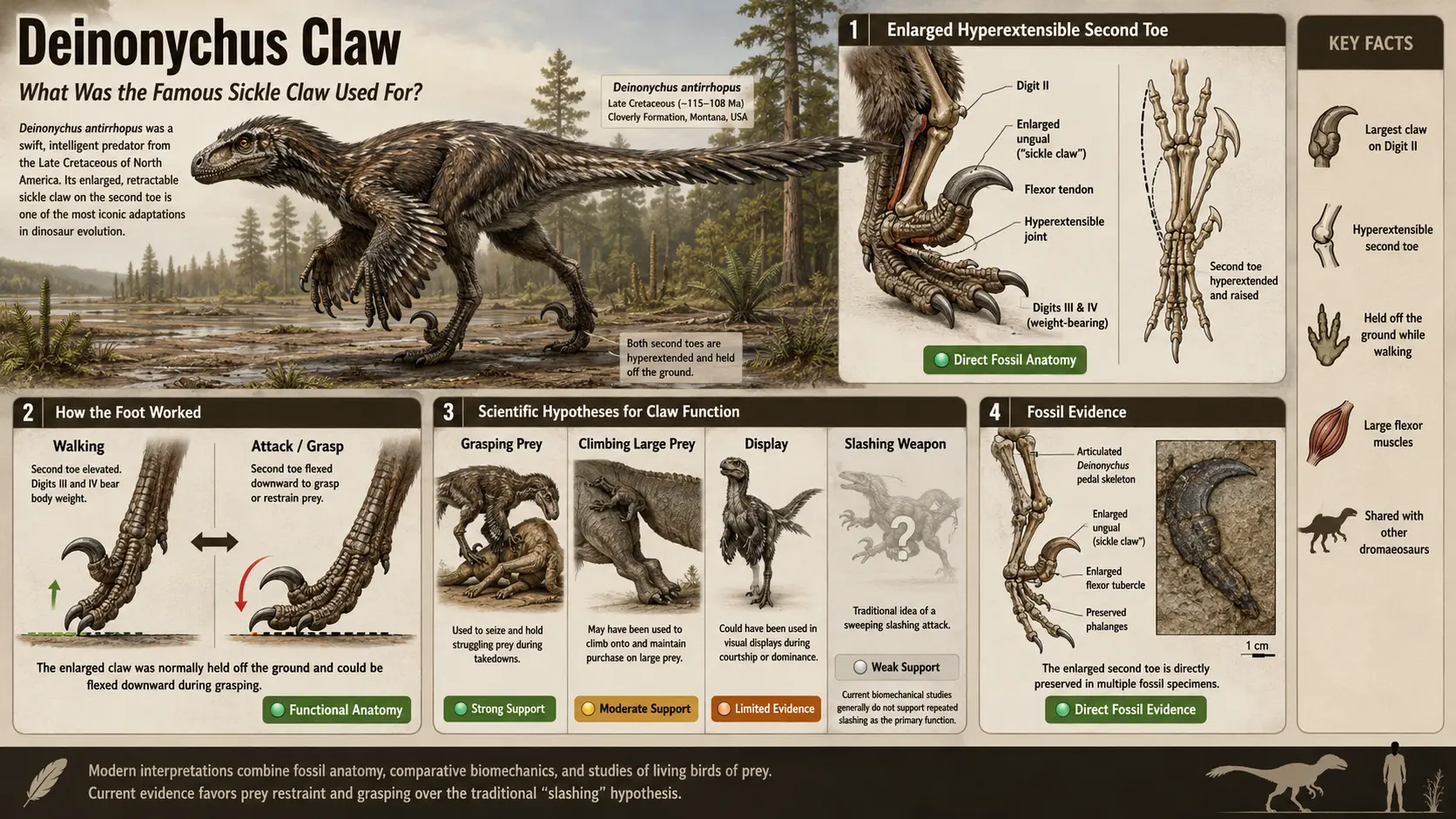
The enlarged sickle-shaped claw of Deinonychus was almost certainly an important predatory adaptation, but its exact function remains debated. Early interpretations proposed that it served as a slashing weapon used to disembowel prey. More recent biomechanical studies have suggested that the claw may have functioned primarily as a prey-restraint device, helping the animal grip struggling prey while delivering bites. Current evidence supports a predatory role, but no single explanation has achieved universal scientific acceptance.

Introduction
The enlarged claw on the second toe is the most famous anatomical feature of Deinonychus. It inspired the genus name, which means “terrible claw,” and has become one of the defining characteristics of dromaeosaurid dinosaurs.
Since the species was described in 1969, paleontologists have proposed numerous explanations for the claw’s function. These hypotheses range from active predation and prey restraint to climbing assistance and display behavior. Because behavior does not fossilize directly, interpretations rely heavily on anatomy, biomechanics, comparative biology, and functional modeling.
What Is Known From Evidence
Claw Anatomy
| Feature | Description |
|---|---|
| Digit | Second toe |
| Shape | Strongly curved |
| Relative Size | Enlarged compared to other toes |
| Position | Held elevated while walking |
| Structure | Deeply recurved ungual |
The claw of Deinonychus was significantly larger and more curved than the claws on the other toes. Anatomical studies indicate that it could be held off the ground during locomotion, reducing wear and potentially preserving a sharp tip.
Anatomical Characteristics
| Characteristic | Interpretation |
|---|---|
| Deep Curvature | Gripping capability |
| Enlarged Flexor Attachment Areas | Strong pulling force |
| Elevated Position During Walking | Specialized function |
| Robust Construction | Resistance to mechanical stress |
These features indicate that the claw was highly specialized and likely served a function beyond ordinary locomotion.
Fossil Evidence
| Evidence Type | Contribution |
|---|---|
| Skeletal Anatomy | Direct evidence |
| Muscle Attachment Sites | Functional inference |
| Joint Structure | Range-of-motion estimates |
| Comparative Anatomy | Behavioral interpretation |
| Biomechanical Modeling | Functional testing |
Although no fossil preserves a Deinonychus actively using its claw, anatomical evidence provides substantial insight into its potential capabilities.
Historical Interpretation: The Slashing Weapon Hypothesis
Traditional View
| Interpretation | Status |
|---|---|
| Slashing Large Prey | Historically Influential |
| Disembowelment Function | Proposed |
| Primary Predatory Weapon | Proposed |
| Scientific Consensus | Not Established |
For decades, the most popular interpretation held that Deinonychus used its enlarged claw to slash or disembowel prey.
This view was influenced by the claw’s size, shape, and apparent sharpness. Popular books, documentaries, and films frequently portrayed dromaeosaurids attacking prey with powerful downward kicks.
Limitations of the Slashing Model
Later studies questioned whether the claw was optimally shaped for repeated cutting motions.
Researchers noted that the claw’s curvature and mechanical properties may not match what would be expected from a structure specialized primarily for slashing large wounds.
The Prey Restraint Hypothesis
The Raptor Prey Restraint Model
| Feature | Proposed Function |
|---|---|
| Enlarged Toe Claw | Anchoring prey |
| Grasping Feet | Holding prey |
| Forelimbs | Additional restraint |
| Jaws | Feeding while prey restrained |
One of the most influential modern interpretations is the Raptor Prey Restraint (RPR) model.
Under this hypothesis, Deinonychus used its feet in a manner somewhat analogous to modern birds of prey. The enlarged claw helped maintain grip on struggling prey while the animal stabilized itself and delivered bites.
Supporting Evidence
| Evidence | Strength |
|---|---|
| Claw Curvature | Strong |
| Biomechanical Modeling | Moderate |
| Comparison With Raptors | Moderate |
| Flexor Muscle Anatomy | Strong |
| Predatory Context | Strong |
Several anatomical features are consistent with a gripping function. The claw’s shape resembles structures used for prey retention in some modern predatory birds more closely than structures specialized for cutting.
Comparison With Modern Birds of Prey
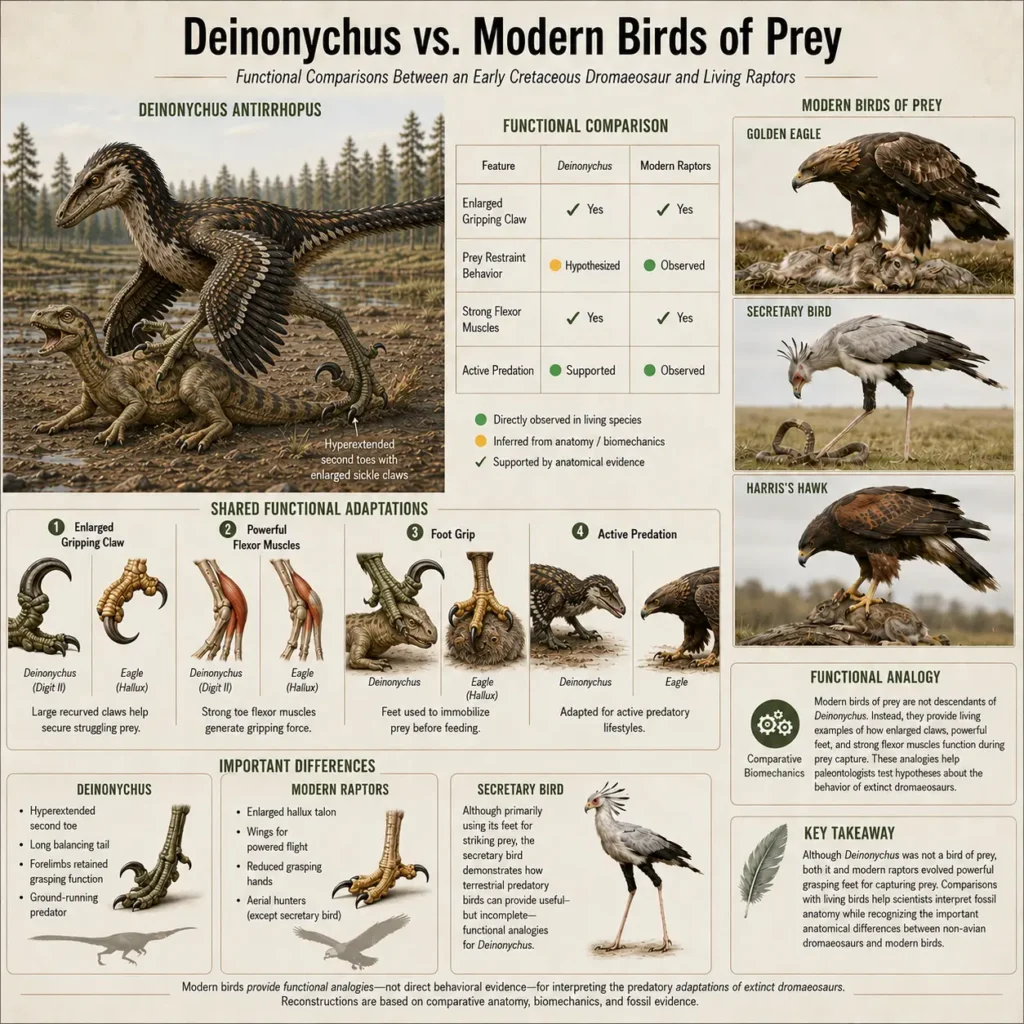
| Feature | Deinonychus | Modern Raptors |
|---|---|---|
| Enlarged Gripping Claw | Yes | Yes |
| Prey Restraint Behavior | Hypothesized | Observed |
| Strong Flexor Muscles | Yes | Yes |
| Active Predation | Supported | Observed |
Although Deinonychus was not a bird of prey, these comparisons provide useful functional analogies.
Alternative Hypotheses
Climbing Assistance
| Interpretation | Assessment |
|---|---|
| Tree Climbing | Possible |
| Climbing Large Prey | Possible |
| Primary Function | Uncertain |
Some researchers have suggested that the claw could have assisted in climbing, either onto environmental structures or onto larger prey animals.
Current evidence does not strongly support climbing as the primary function, but it remains a plausible secondary use.
Multi-Function Hypothesis
| Potential Function | Plausibility |
|---|---|
| Prey Restraint | High |
| Climbing Assistance | Moderate |
| Display Behavior | Low to Moderate |
| Defensive Use | Possible |
| Intraspecific Combat | Possible |
Like many anatomical structures, the claw may have served multiple purposes rather than a single exclusive function.
Scientific Debate
Why the Function Remains Uncertain
| Limitation | Impact |
|---|---|
| No Direct Behavioral Fossils | High |
| Soft Tissue Not Preserved | High |
| Multiple Plausible Functions | High |
| Modern Analogues Imperfect | Moderate |
The primary challenge is that behavior rarely fossilizes directly. Researchers must infer function from anatomy and biomechanics.
As a result, several competing explanations remain scientifically viable.
Areas of Agreement
Despite ongoing debate, most researchers agree that:
- The claw was a specialized adaptation.
- It played an important role in predation.
- It was unlikely to be merely ornamental.
- It functioned alongside the forelimbs and jaws rather than independently.
Why Did Deinonychus Hold Its Sickle Claw Off the Ground?
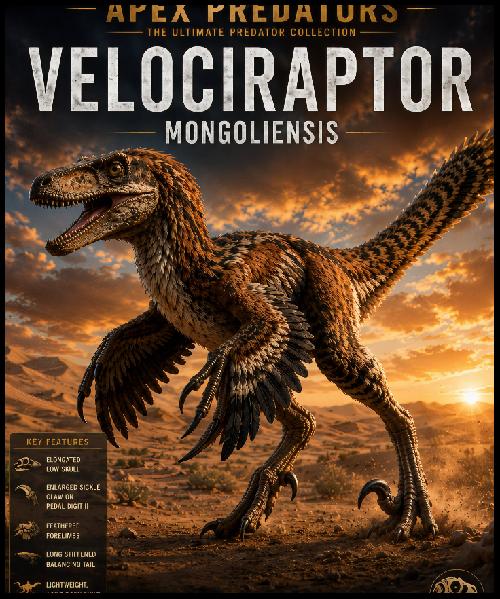
The enlarged second-toe claw of Deinonychus was not normally placed flat on the ground during walking. Fossil anatomy indicates that the second toe was held in a raised position, suggesting the claw had a specialized function beyond ordinary locomotion.
- Elevated second toe: The second digit was capable of being held above the ground while the animal walked, preventing the enlarged claw from bearing body weight.
- Reduced wear: Keeping the claw elevated would have minimized abrasion against the ground, helping preserve its structural integrity over time.
- Preservation of a sharp claw: By avoiding constant contact with the substrate, the deeply recurved claw likely remained sharper and more effective for gripping prey or performing other specialized behaviors.
- Specialized locomotion: The remaining toes supported most of the animal’s weight, allowing Deinonychus to move efficiently while keeping its enlarged claw protected.
- Comparison with modern birds: Some living birds, particularly birds of prey, also keep enlarged talons from excessive ground contact, providing a useful functional analogy, although not a direct behavioral equivalent.
- Anatomical evidence for hyperextension: The shape of the toe joints indicates that the second digit could be hyperextended, allowing the claw to remain elevated during locomotion and rapidly brought into use when needed for predatory or other specialized functions.
Current Scientific Understanding
Current evidence strongly supports the interpretation that the enlarged second-toe claw of Deinonychus was a specialized predatory structure. Although the traditional slashing hypothesis remains historically important, many modern studies favor some form of prey restraint function.
The Raptor Prey Restraint model currently represents one of the most influential explanations because it is supported by claw morphology, muscle attachment anatomy, and biomechanical analyses. Nevertheless, uncertainty remains, and alternative interpretations—including climbing assistance and multifunctional use—have not been entirely excluded.
The available evidence suggests that the claw worked as part of an integrated predatory system involving the feet, forelimbs, tail, and jaws rather than as a solitary weapon.
Evidence Assessment
| Evidence Category | Assessment |
|---|---|
| Specialized Claw Anatomy | Strong Direct Evidence |
| Predatory Function | Strong Evidence |
| Prey Restraint Hypothesis | Moderate Support |
| Slashing Hypothesis | Moderate Support |
| Climbing Hypothesis | Limited Support |
| Direct Behavioral Evidence | Absent |
| Multifunctional Use | Plausible |
The strongest evidence concerns the existence of a highly specialized predatory claw. The precise behavior associated with that claw remains uncertain because direct behavioral evidence is unavailable. Consequently, discussions of function should emphasize evidence-supported interpretations rather than definitive conclusions.
Frequently Asked Questions
What was the sickle claw of Deinonychus used for?
Current evidence suggests it was used primarily in predation, possibly to help restrain prey while the animal delivered bites.
Did Deinonychus slash prey with its claw?
This was the traditional interpretation, but many modern studies favor prey restraint rather than large-scale slashing.
Was the claw used for climbing?
Some researchers have proposed climbing as a possible secondary function, but evidence for this interpretation remains limited.
Was the claw unique to Deinonychus?
No. Enlarged second-toe claws are characteristic of dromaeosaurids, although their size and proportions varied among species.
References
Primary Taxonomic Sources
Ostrom, J.H. (1969). Osteology of Deinonychus antirrhopus, an unusual theropod from the Lower Cretaceous of Montana. Bulletin of the Peabody Museum of Natural History, 30, 1–165.
Peer-Reviewed Scientific Literature
Manning, P.L., Payne, D., Pennicott, J., Barrett, P.M., & Ennos, A.R. (2006). Dinosaur killer claws or climbing crampons? Biology Letters, 2(1), 110–112.
Senter, P. (2009). Pedal function in deinonychosaurian theropods and implications for locomotion and prey capture. Acta Palaeontologica Polonica, 54(3), 501–508.
Fowler, D.W., Freedman, E.A., Scannella, J.B., & Kambic, R.E. (2011). The predatory ecology of Deinonychus and the origin of flapping in birds. PLoS ONE, 6(12), e28964.
Turner, A.H., Makovicky, P.J., & Norell, M.A. (2012). A review of dromaeosaurid systematics and paravian phylogeny. Bulletin of the American Museum of Natural History, 371, 1–206.
Gianechini, F.A., Makovicky, P.J., & Apesteguía, S. (2020). The evolution of the raptorial pes in dromaeosaurids and functional implications. Journal of Anatomy, 236(1), 140–165.
Monographs and Academic Books
Weishampel, D.B., Dodson, P., & Osmólska, H. (Eds.). (2004). The Dinosauria (2nd ed.). University of California Press.
Paul, G.S. (2016). The Princeton Field Guide to Dinosaurs (2nd ed.). Princeton University Press.
Holtz, T.R. Jr. (2007). Dinosaurs: The Most Complete, Up-to-Date Encyclopedia for Dinosaur Lovers of All Ages. Random House.
Brusatte, S.L. (2018). The Rise and Fall of the Dinosaurs. William Morrow.
Museum and Institutional Sources
Yale Peabody Museum. Historical collections and specimen information relating to Deinonychus antirrhopus and associated research.
Databases
Paleobiology Database. Taxonomic and occurrence records for Deinonychus antirrhopus.
The Theropod Database. Anatomical, taxonomic, and bibliographic information for Deinonychus and related dromaeosaurids.
Featured Museum Collections
Museum-quality paleoart and educational poster
collections based on evidence-informed prehistoric
Life reconstructions.