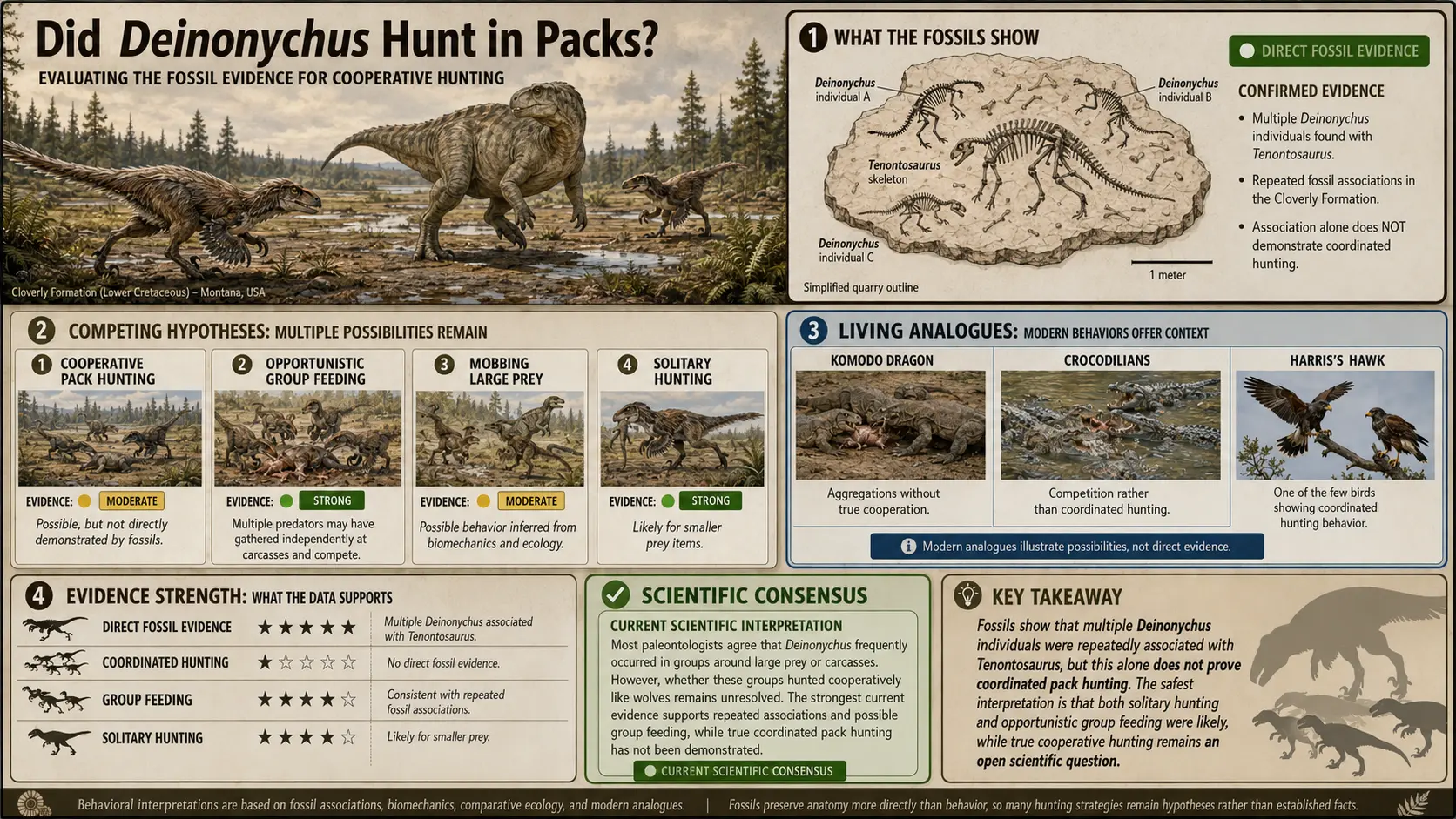
Quick Info
| Category | Information |
|---|---|
| Scientific Name | Deinonychus antirrhopus |
| Topic Type | Behavioral Interpretation |
| Evidence Category | Indirect |
| Direct Evidence of Pack Hunting | None |
| Primary Evidence Source | Fossil associations with Tenontosaurus |
| Scientific Confidence | Low |
| Research Status | Actively Debated |
| Consensus Position | Unresolved |
| Content Classification | Restricted |
Quick Answer
No fossil evidence currently demonstrates coordinated pack hunting in Deinonychus. Fossil associations with Tenontosaurus indicate repeated ecological interactions but can be explained by multiple competing hypotheses, including cooperative hunting, predator aggregation, scavenging, or time-averaged accumulation. Consequently, pack hunting remains a plausible but unconfirmed interpretation.

Introduction
Few questions about Deinonychus have attracted more public interest than whether it hunted in packs. Popular media frequently portrays dromaeosaurids as highly coordinated social predators capable of working together to bring down prey much larger than themselves.
The scientific evidence, however, is far less straightforward. Unlike skeletal anatomy, behavior rarely fossilizes directly. As a result, interpretations of Deinonychus social behavior rely on indirect evidence, particularly fossil associations and comparisons with living animals.
Because the available evidence is incomplete and open to multiple interpretations, this topic is classified as Restricted under the ExtinctAtlas framework.
What Is Known From Evidence
Evidence Overview
| Evidence Category | Status |
|---|---|
| Direct Observation | Impossible |
| Behavioral Trace Fossils | None Known |
| Multiple Individuals at Sites | Present |
| Associated Prey Remains | Present |
| Coordinated Hunting Evidence | Not Directly Demonstrated |
| Scientific Confidence | Low |
No fossil currently preserves Deinonychus actively hunting, communicating, or cooperating with other individuals.
The debate therefore centers on how fossil associations should be interpreted.
The Tenontosaurus Associations
Why Tenontosaurus Matters
| Taxon | Ecological Role |
|---|---|
| Deinonychus | Medium-sized predator |
| Tenontosaurus | Large herbivore |
The most important evidence comes from several fossil localities where remains of Deinonychus occur alongside remains of Tenontosaurus.
These associations attracted attention because Tenontosaurus was substantially larger than an individual Deinonychus. Some researchers proposed that successful attacks on such prey may have required cooperation among multiple predators.
Evidence from Fossil Sites
| Observation | Interpretation Potential |
|---|---|
| Multiple Deinonychus Individuals | Possible aggregation |
| Presence of Large Prey | Possible feeding event |
| Repeated Associations | Ecological relationship |
| Mixed-Age Individuals | Behavioral uncertainty |
The repeated occurrence of these associations suggests that interactions between the two species were ecologically significant.
However, the fossil record does not reveal exactly how those interactions occurred.
The Pack Hunting Hypothesis
Traditional Interpretation
| Claim | Status |
|---|---|
| Cooperative Hunting | Proposed |
| Coordinated Attacks | Proposed |
| Social Predator Behavior | Proposed |
| Established Fact | No |
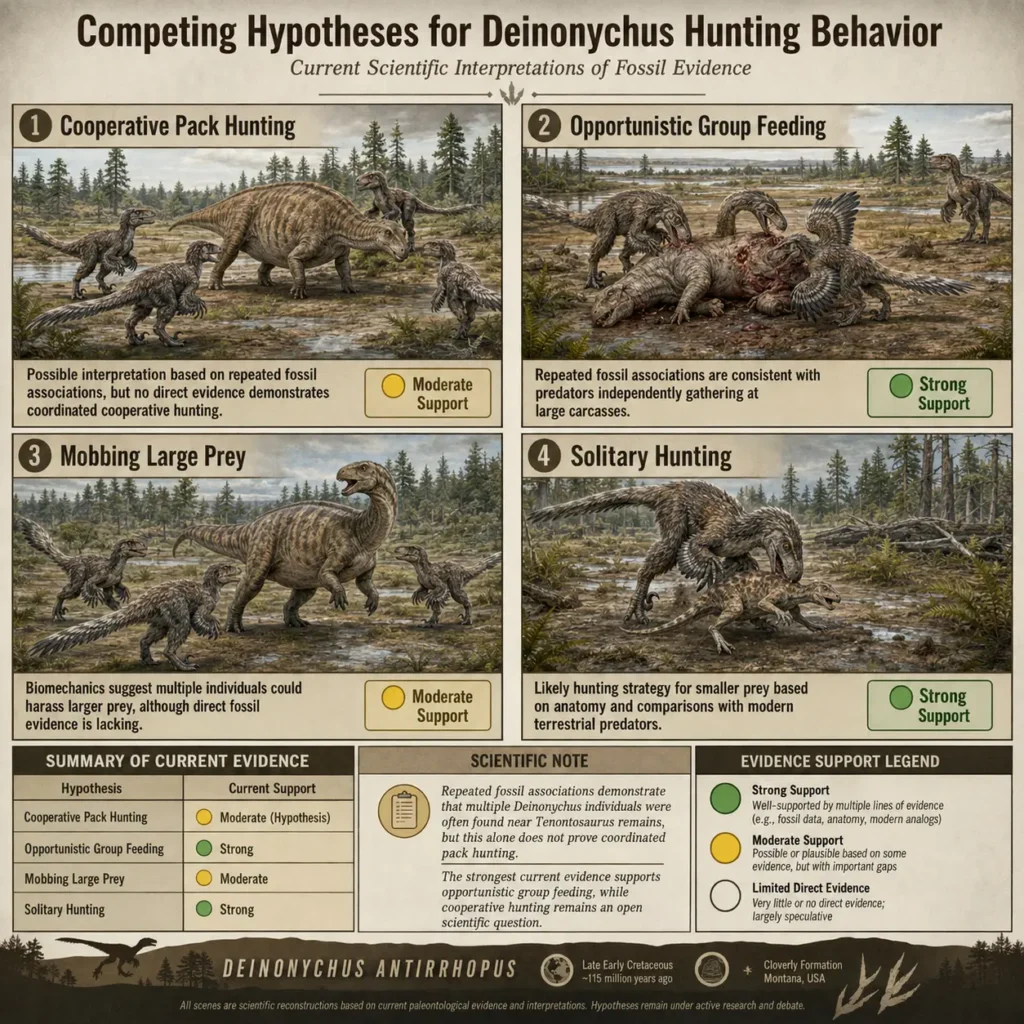
One influential interpretation argues that multiple Deinonychus individuals cooperated to attack and subdue prey larger than themselves.
Supporters of this hypothesis point to:
Repeated Deinonychus–Tenontosaurus associations
The apparent difficulty of attacking large prey alone
Comparisons with some modern social predators
Under this model, Deinonychus may have functioned similarly to wolves or lions, coordinating attacks to increase hunting success.
Strengths of the Hypothesis
| Supporting Argument | Strength |
|---|---|
| Multiple Individuals Present | Moderate |
| Large Potential Prey | Moderate |
| Repeated Fossil Associations | Moderate |
| Ecological Plausibility | Moderate |
The pack-hunting hypothesis provides a straightforward explanation for why multiple predators might be associated with large herbivore remains.
However, none of these observations directly demonstrates cooperative behavior.
Alternative Explanations
Predator Aggregation Hypothesis
| Interpretation | Assessment |
|---|---|
| Multiple Predators at Food Source | Plausible |
| Coordinated Hunting Required | Not Necessarily |
| Supported by Modern Analogues | Yes |
Many modern predators gather around carcasses without cooperating during the hunt.
Examples include:
- Komodo dragons
- Crocodilians
- Some birds of prey
- Numerous mammalian carnivores
Under this interpretation, multiple Deinonychus individuals may simply have been attracted independently to the same food source.
Scavenging and Opportunistic Feeding
| Interpretation | Plausibility |
|---|---|
| Opportunistic Feeding | High |
| Scavenging | Possible |
| Cooperative Hunting Required | No |
The fossil record cannot always distinguish between hunting and feeding after death.
A carcass could attract multiple predators regardless of whether they participated in killing the animal.
Sequential Accumulation
| Interpretation | Assessment |
|---|---|
| Multiple Events Over Time | Plausible |
| Single Coordinated Event | Uncertain |
| Taphonomic Complexity | High |
Some fossil deposits form over extended periods rather than during a single event.
As a result, remains found together may not necessarily represent animals interacting simultaneously.
Modern Reassessment
The Roach and Brinkman Study
| Contribution | Significance |
|---|---|
| Reevaluation of Evidence | Major |
| Critique of Pack Hunting Claims | Major |
| Alternative Behavioral Models | Major |
One of the most influential reassessments was published by Roach and Brinkman (2007).
The authors argued that the available evidence does not require cooperative hunting and may be more consistent with predator aggregations resembling those seen in Komodo dragons.
Juvenile and Adult Behavior
| Observation | Implication |
|---|---|
| Mixed Age Individuals | Complex social interpretation |
| Competition Possible | Yes |
| Cooperation Demonstrated | No |
Some researchers have noted that age distributions at fossil sites do not necessarily resemble those expected in highly coordinated social predators.
This observation has further complicated interpretations of Deinonychus behavior.
What Scientists Agree On
Areas of Broad Agreement
| Statement | Scientific Support |
|---|---|
| Deinonychus Was Carnivorous | Strong |
| It Interacted With Tenontosaurus | Strong |
| Multiple Individuals Occur Together | Strong |
| Pack Hunting Proven | No |
| Social Behavior Possible | Yes |
Most researchers agree on several fundamental points.
There is strong evidence that Deinonychus interacted ecologically with Tenontosaurus and other prey species. There is also strong evidence that multiple individuals occasionally occurred at the same locations.
The disagreement concerns whether these observations demonstrate coordinated social hunting.
Why This Question Is Difficult to Answer
Limitations of the Fossil Record
| Limitation | Impact |
|---|---|
| Behavior Rarely Fossilizes | High |
| Multiple Interpretations Possible | High |
| Time Averaging of Deposits | High |
| Lack of Direct Observation | Absolute |
Behavior is among the most difficult aspects of extinct-animal biology to reconstruct.
Even exceptionally preserved fossils rarely provide direct evidence of cooperation, communication, or hunting strategies.
As a result, certainty is much lower than for anatomy, size, or taxonomy.
Current Scientific Understanding
Current scientific evidence does not demonstrate that Deinonychus hunted in coordinated packs. The hypothesis remains plausible and continues to be discussed in the scientific literature, but it is not supported strongly enough to be regarded as fact.
The strongest evidence consists of repeated associations between Deinonychus and Tenontosaurus remains. While these associations indicate ecological interactions and possible predator-prey relationships, they do not reveal whether hunting was cooperative.
Many researchers now favor more cautious interpretations involving predator aggregations, opportunistic feeding, or a combination of behaviors. Consequently, the most defensible scientific position is that pack hunting remains possible but unproven.
Evidence Assessment
| Evidence Category | Assessment |
|---|---|
| Multiple Individuals Found Together | Strong Direct Fossil Evidence |
| Deinonychus–Tenontosaurus Associations | Strong Direct Evidence |
| Predator-Prey Relationship | Moderate to Strong Evidence |
| Cooperative Hunting | Low Confidence Hypothesis |
| Social Behavior | Low Confidence |
| Predator Aggregation | Plausible Interpretation |
| Direct Behavioral Evidence | Absent |
The strongest evidence concerns ecological associations between Deinonychus and potential prey species. The weakest evidence concerns coordinated social hunting, because no fossil currently demonstrates cooperation directly.
Frequently Asked Questions
Did Deinonychus hunt in packs?
Current evidence does not prove pack hunting. The hypothesis remains plausible but unconfirmed.
Why do scientists think Deinonychus may have hunted cooperatively?
Repeated associations between Deinonychus fossils and large prey such as Tenontosaurus have been interpreted by some researchers as evidence of cooperative behavior.
What is the main alternative to pack hunting?
Many researchers favor predator aggregation models, where multiple individuals gather around food resources without coordinating hunts.
Is pack hunting the scientific consensus?
No. The current scientific consensus is that the evidence is insufficient to determine whether Deinonychus hunted cooperatively.
References
Primary Taxonomic Sources
Ostrom, J.H. (1969). Osteology of Deinonychus antirrhopus, an unusual theropod from the Lower Cretaceous of Montana. Bulletin of the Peabody Museum of Natural History, 30, 1–165.
Peer-Reviewed Scientific Literature
Maxwell, W.D., & Ostrom, J.H. (1995). Taphonomy and paleoecology of Deinonychus bonebeds from the Cloverly Formation (Lower Cretaceous) of Montana and Wyoming. Palaios, 10(3), 285–298.
Roach, B.T., & Brinkman, D.L. (2007). A reevaluation of cooperative pack hunting and gregariousness in Deinonychus antirrhopus and other nonavian theropod dinosaurs. Bulletin of the Peabody Museum of Natural History, 48(1), 103–138.
Fowler, D.W., Freedman, E.A., Scannella, J.B., & Kambic, R.E. (2011). The predatory ecology of Deinonychus and the origin of flapping in birds. PLoS ONE, 6(12), e28964.
Turner, A.H., Makovicky, P.J., & Norell, M.A. (2012). A review of dromaeosaurid systematics and paravian phylogeny. Bulletin of the American Museum of Natural History, 371, 1–206.
Frederickson, J.A., Engel, M.H., & Cifelli, R.L. (2020). Ontogenetic dietary resource partitioning in Deinonychus and implications for social behavior. Palaeogeography, Palaeoclimatology, Palaeoecology, 552, 109780.
Monographs and Academic Books
Weishampel, D.B., Dodson, P., & Osmólska, H. (Eds.). (2004). The Dinosauria (2nd ed.). University of California Press.
Paul, G.S. (2016). The Princeton Field Guide to Dinosaurs (2nd ed.). Princeton University Press.
Holtz, T.R. Jr. (2007). Dinosaurs: The Most Complete, Up-to-Date Encyclopedia for Dinosaur Lovers of All Ages. Random House.
Brusatte, S.L. (2018). The Rise and Fall of the Dinosaurs. William Morrow.
Museum and Institutional Sources
Yale Peabody Museum. Historical collections, specimen records, and archival resources relating to Deinonychus antirrhopus.
Databases
Paleobiology Database. Taxonomic and occurrence records for Deinonychus antirrhopus.
The Theropod Database. Taxonomic, anatomical, and bibliographic information for Deinonychus and related dromaeosaurids.
Featured Museum Collections
Museum-quality paleoart and educational poster
collections based on evidence-informed prehistoric
Life reconstructions.