
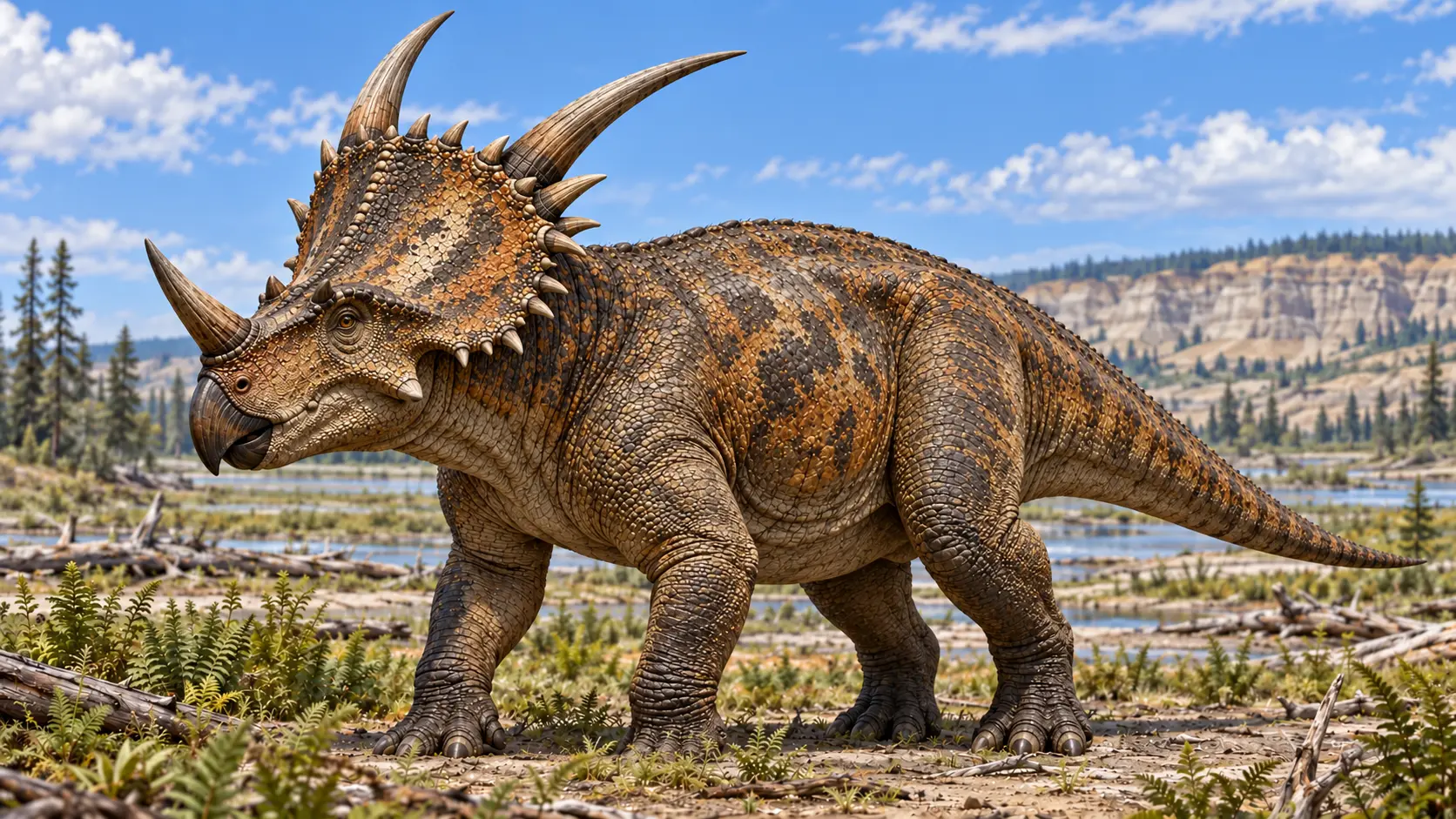
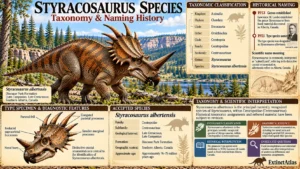
Styracosaurus was a Late Cretaceous centrosaurine ceratopsid known primarily from the upper Dinosaur Park Formation of Alberta, Canada. Its most distinctive features were a large nasal horn and a broad neck frill bearing prominent parietal spikes. The type species is Styracosaurus albertensis, named by Lawrence M. Lambe in 1913.
At a Glance
| Feature | Information |
|---|---|
| Scientific name | Styracosaurus albertensis |
| Genus authority | Lambe, 1913 |
| Family | Ceratopsidae |
| Subfamily | Centrosaurinae |
| Geological period | Late Cretaceous |
| Geological stage | Campanian |
| Principal formation | Dinosaur Park Formation |
| Principal confirmed region | Alberta, Canada |
| Diet | Herbivorous |
| Locomotion | Quadrupedal |
| Type specimen | CMN 344 |
| Characteristic features | Large nasal horn and prominent parietal frill spikes |
The Natural History Museum places Styracosaurus in Ceratopsidae and Centrosaurinae and gives a broad Late Cretaceous age of about 76–75 million years. More detailed stratigraphic research places S. albertensis specifically in the upper Dinosaur Park Formation.
What Was Styracosaurus?
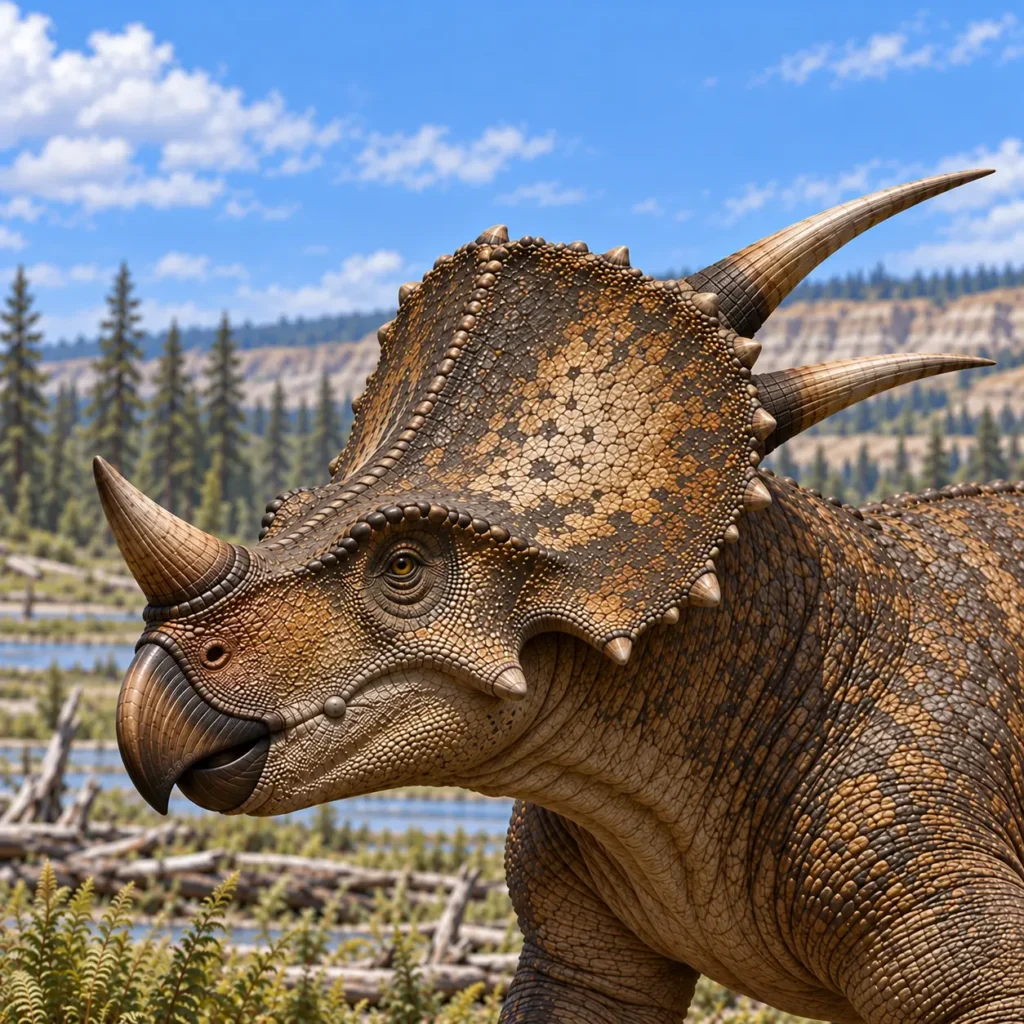
Styracosaurus was a horned dinosaur belonging to Ceratopsidae, the group that includes centrosaurines and chasmosaurines. Within Centrosaurinae, S. albertensis is characterized particularly by its strongly developed parietal ornamentation and elongate nasal horn.
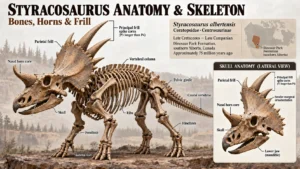
The genus was established by Lawrence M. Lambe in 1913 from Alberta material. Its type species is Styracosaurus albertensis. The holotype, CMN 344, preserves a largely complete skull and most of the postcranial skeleton, although portions of the skull were damaged or incomplete and subsequently reconstructed.
The name Styracosaurus is commonly translated as “spiked lizard,” referring to the conspicuous spikes surrounding its frill.
Classification and Type Species
The principal classification is:
| Rank | Classification |
|---|---|
| Dinosauria | Dinosaur |
| Ornithischia | Bird-hipped dinosaur |
| Ceratopsia | Horned-dinosaur clade |
| Ceratopsidae | Ceratopsid |
| Centrosaurinae | Centrosaurine |
| Genus | Styracosaurus |
| Type species | Styracosaurus albertensis |
The higher-level placement within Ceratopsidae and Centrosaurinae is well established, although relationships among centrosaurine genera can vary between phylogenetic analyses.
The species Styracosaurus albertensis remains the primary taxon for the genus. Historical names and assignments require more careful treatment because centrosaurine taxonomy has been repeatedly revised.
In particular, Styracosaurus parksi has generally been treated as a synonym of S. albertensis, with the characters originally used to distinguish it falling within the recognized variation of S. albertensis.
The history of Styracosaurus ovatus is more complicated and should not be reduced to a simple synonymy. It was historically separated from S. albertensis, subsequently placed in the genus Rubeosaurus, and later returned to Styracosaurus by Wilson, Ryan and Evans (2020), who retained it as a separate species. Other research has proposed that S. ovatus falls within the variation of S. albertensis. The taxonomic history therefore remains an area where competing published interpretations need to be distinguished.
When and Where Did Styracosaurus Live?
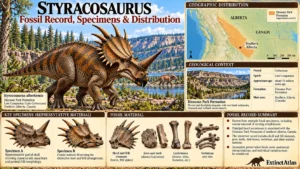
The strongest species-level fossil evidence for Styracosaurus albertensis comes from Alberta, Canada, particularly the upper Dinosaur Park Formation. Multiple specimens and bonebeds document the taxon within this formation.
Its geological occurrence falls within the Campanian Stage of the Late Cretaceous. A radiometric date of approximately 76.1 million years from the Lethbridge Coal Zone, near the top of the Dinosaur Park Formation, indicates that the highest known occurrences of S. albertensis are slightly older than that date.
The Dinosaur Park Formation represents a terrestrial alluvial environment associated with rivers, floodplains, channels, paleosols, and coal-forming environments on the western side of the contemporaneous Western Interior Seaway.
The broad public-facing description of Styracosaurus sometimes gives both Canada and the USA as its distribution. However, the species-level evidence needs more careful handling: S. albertensis is securely documented from Alberta, whereas Montana material historically assigned to Styracosaurus involves the separate and taxonomically complicated S. ovatus problem. There is no established evidence that S. albertensis itself occurred in the Two Medicine Formation.
Key Physical Features
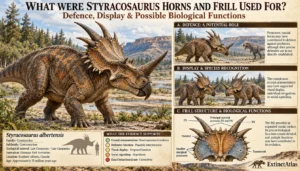
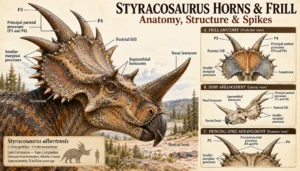
The most recognizable feature of Styracosaurus was its large cranial ornamentation.
Its skull included:
- a prominent nasal horn;
- relatively small supraorbital horncores;
- a broad parietal frill;
- elongated parietal processes, particularly P3 and P4;
- additional posterior frill processes whose development varied among individuals.
The frill was not identical in every known individual. Research has documented substantial variation in the size and configuration of the parietal processes, as well as left-right asymmetry. This variation is important when distinguishing individual variation from taxonomically meaningful differences.
The holotype skull, CMN 344, remains central to understanding the genus. Some portions of the skull were incomplete and have been reconstructed, so illustrations and mounted skeletons should not be interpreted as representing an entirely preserved skull.
Detailed treatment of the skull, skeleton, horns, and frill is provided in the dedicated Styracosaurus Anatomy & Skeleton and Styracosaurus Horns and Frill pages.
Size
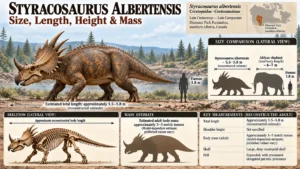
Published summaries commonly give Styracosaurus a body length of approximately 5.5 m, while estimates of body mass and height vary according to the reconstruction and methodology used. The Natural History Museum, for example, lists approximately 5.5 m in length and 2,700 kg in weight.
These values should be regarded as estimates rather than direct measurements of a living animal. Fossil specimens preserve bones, not complete soft-tissue body dimensions or body mass.
Size is therefore better expressed using specimen-based measurements and source-specific reconstructions rather than treating one numerical value as an exact species-wide measurement.
The dedicated Styracosaurus Size, Length, Height & Body Mass page provides the detailed quantitative treatment.
Diet and Feeding
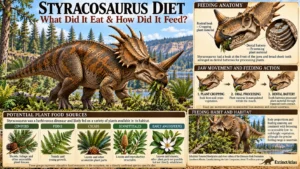
Styracosaurus was herbivorous. Its skull possessed a keratinous beak and rows of teeth adapted for processing plant material. The teeth were continuously replaced, as in other ceratopsids.
The structure of the jaws and teeth supports a plant-processing function, while the orientation of the head has been interpreted as compatible with feeding on relatively low vegetation. That interpretation is functional inference rather than direct observation of feeding behavior.
The available evidence supports broad herbivory much more securely than it supports a precise list of plant species or an exclusive feeding strategy.
Detailed discussion of the beak, teeth, jaws, and feeding mechanics belongs to the dedicated Styracosaurus Diet and Feeding page.
Locomotion
The skeletal anatomy indicates a quadrupedal animal. Styracosaurus carried its body on four limbs, with the forelimbs contributing to support and locomotion.
Detailed biomechanical research has examined the forelimbs and their range of motion. Such studies provide evidence for habitual quadrupedal locomotion while also showing that the forelimbs had a broader range of possible positions than would be implied by a single static skeletal reconstruction.
A precise running speed, however, should not be presented as a fact without appropriate biomechanical evidence.
The dedicated Styracosaurus Locomotion, Gait & Movement page examines these issues in greater detail.
Fossil Record
The fossil record of S. albertensis is substantially broader than the original holotype alone.
Important evidence
| Evidence | Significance |
|---|---|
| CMN 344 | Holotype of S. albertensis; skull and substantial postcranial skeleton |
| AMNH 5372 | Historically named S. parksi; subsequently treated as S. albertensis |
| TMP specimens | Provide additional skull and frill evidence |
| UALVP 55900 | Large, exceptionally informative skull and associated skeleton |
| Bonebed 42 | Important occurrence of S. albertensis material |
| Additional Dinosaur Park Formation specimens | Expand knowledge of anatomy, ontogeny and variation |
The growing specimen sample has substantially changed understanding of the taxon. The 2020 study noted that knowledge of S. albertensis had historically depended heavily on only a small number of skeletons, whereas additional material now demonstrates considerably greater anatomical variation.
The species is known from multiple occurrences in the upper Dinosaur Park Formation, including Bonebed 42 and other localities. Some specimens also provide information about ontogenetic change, allowing researchers to distinguish features associated with growth from features potentially useful for taxonomy.
What the Fossil Evidence Can Tell Us
The fossil record securely establishes several aspects of Styracosaurus biology:
- its identity as a centrosaurine ceratopsid;
- its distinctive cranial anatomy;
- its quadrupedal skeletal organization;
- its herbivorous feeding adaptations;
- its occurrence in the upper Dinosaur Park Formation;
- substantial variation in cranial ornamentation;
- changes in cranial morphology during growth;
- the existence of bonebed concentrations containing Styracosaurus material.
Other aspects are less certain.
For example, bonebeds provide evidence relevant to aggregation and possible gregarious behavior, but they do not by themselves establish a permanent year-round herd structure. Similarly, the presence of large theropods in the same ecosystem demonstrates ecological coexistence but does not provide direct evidence of a particular predator attacking Styracosaurus.
Evidence Assessment
| Topic | Evidence strength | Assessment |
|---|---|---|
| Taxonomic identity | High | Well documented |
| Type species | High | S. albertensis |
| Alberta occurrence | High | Multiple specimens |
| Upper Dinosaur Park Formation | High | Strong stratigraphic evidence |
| Cranial anatomy | High | Multiple skulls |
| Postcranial anatomy | High | Holotype and additional material |
| Herbivory | High | Strong anatomical evidence |
| Quadrupedal locomotion | High | Skeletal evidence |
| Exact body mass | Moderate | Reconstruction-dependent |
| Detailed feeding behavior | Moderate | Functional inference |
| Horn/frill function | Moderate to low | Multiple hypotheses |
| Gregariousness | Moderate | Bonebed evidence |
| Permanent herd structure | Low / unresolved | Not demonstrated |
| Specific predator attack | Not established | No direct evidence identified |
| S. parksi as separate species | Low | Generally treated as synonymized |
| S. ovatus relationship to S. albertensis | Contested | Competing published interpretations |
Current Scientific Understanding
Styracosaurus albertensis is a well-documented centrosaurine ceratopsid of the Late Cretaceous Dinosaur Park Formation of Alberta. Its large nasal horn and elaborate frill are among the most distinctive features of its skull, while its fossil record includes multiple individuals that reveal substantial variation in cranial ornamentation and changes during growth.
The evidence is strongest for its taxonomy, anatomy, herbivorous ecology, quadrupedal body plan, and occurrence in the upper Dinosaur Park Formation. Interpretations concerning the exact functions of its horns and frill, the organization of its social behavior, and some aspects of its taxonomic history remain more dependent on inference or competing analyses.
For that reason, Styracosaurus should not be reconstructed as a completely resolved animal. Its fossil record provides a strong anatomical and ecological foundation while also demonstrating where scientific uncertainty remains.
🧠 Behavior

🦴 Fossil History
🦷 Anatomy
Recommended Paleontology & Natural History Books
As an Amazon Associate, Extinct Atlas may earn from qualifying purchases.
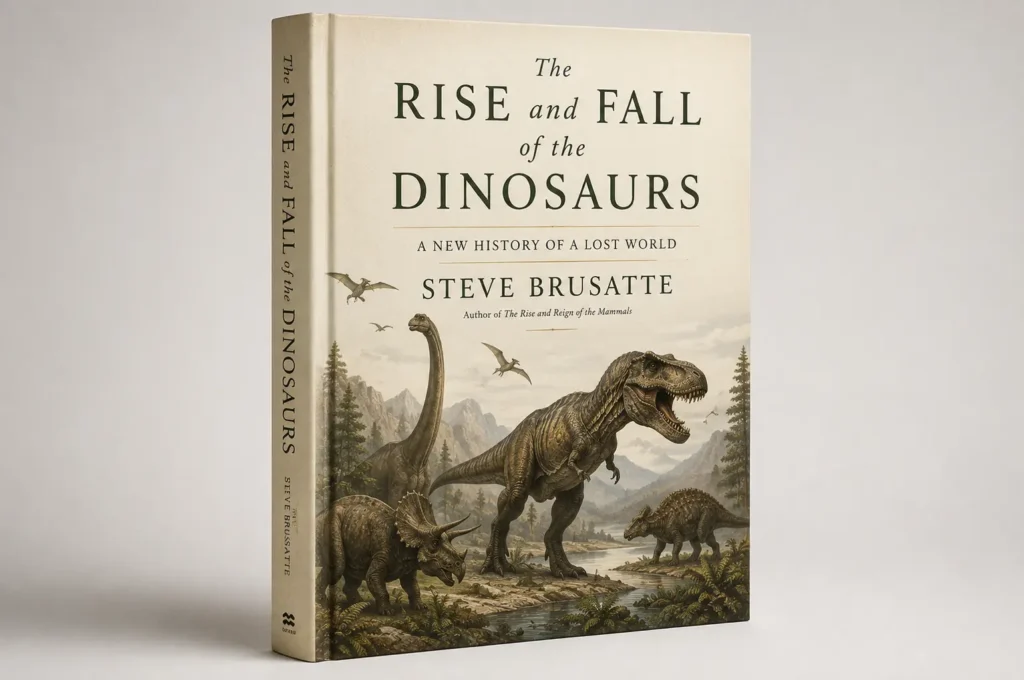
The Rise and Fall of the Dinosaurs
A compelling history of dinosaurs, tracing their origins, diversification, 200-million-year reign, extinction, and enduring legacy.
Dinosaurs and Prehistoric Life
A richly illustrated visual reference exploring dinosaurs, fossils, evolution, and prehistoric life across geological time.
Encyclopedia Prehistorica: Dinosaurs
An interactive dinosaur book featuring spectacular three-dimensional pop-ups, particularly suited to young readers and families.
The Rise and Reign of the Mammals
A sweeping history of mammalian evolution, from their origins alongside dinosaurs through the Cenozoic and the emergence of humans.