At a Glance
| Field | Information |
|---|---|
| Species | Spinosaurus aegyptiacus |
| Period | Cretaceous (Cenomanian stage, approximately ~100–94 Ma) |
| Aquatic evidence | Paddle-like tail (2020); dense bone tissue; isotopic signature; short hind limbs |
| Key study | Ibrahim et al. (2020), Nature — paddle tail propulsion model |
| Habitat | Kem Kem river systems and estuaries, North Africa |
| Debate status | Active — wading/heron-like model vs active aquatic pursuit model unresolved |
Quick Answer: Spinosaurus almost certainly spent significant time in water, supported by its paddle-shaped tail, unusually dense bones, short hind limbs, and isotopic chemistry. Whether it was an active underwater pursuit predator or a wading animal that entered water for feeding remains genuinely debated — both models have published scientific support.
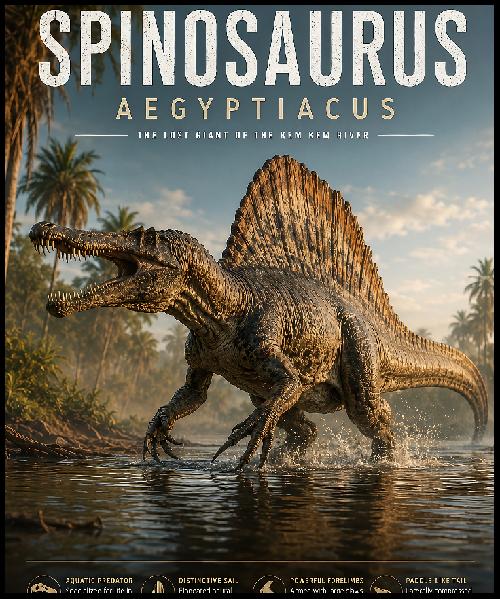
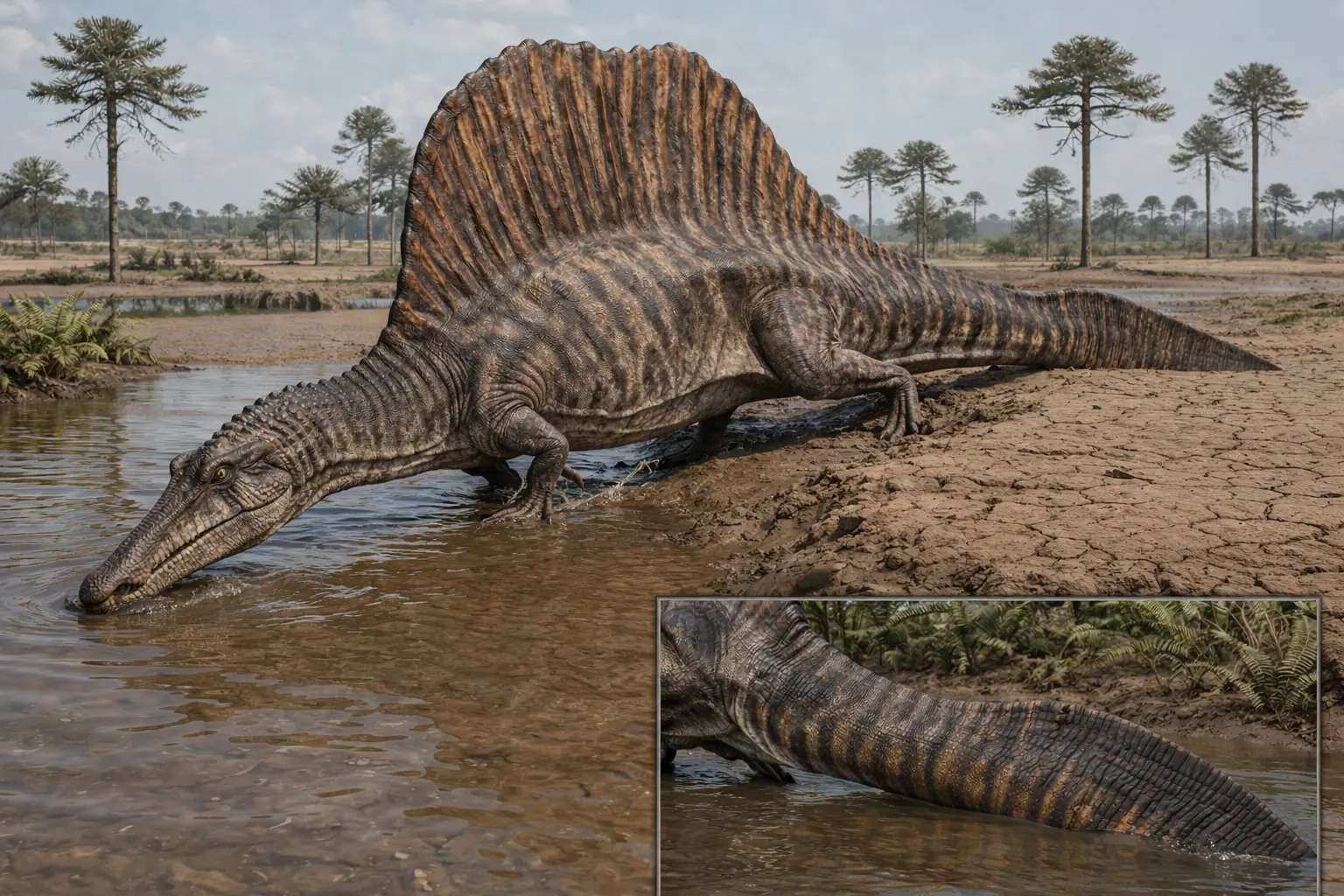
In 2020, a remarkable tail skeleton from the Kem Kem deposits of Morocco changed the way scientists think about Spinosaurus. The bones told a story nobody had clearly read before: this was not simply a large theropod that stood at the water’s edge. The tail, with its tall, flexible neural spines, was built to move through water.
Did Spinosaurus Live in Water? The Evidence
Spinosaurus was at minimum semi-aquatic, spending substantial time in and around water. The evidence for this comes from four independent sources.
The Paddle Tail — 2020 Discovery
A partial tail skeleton recovered from Morocco and described by Nizar Ibrahim and colleagues in Nature (2020) showed something unexpected: the neural spines of the tail were tall and closely spaced, forming a flexible, paddle-like structure capable of generating propulsive force through lateral undulation. Biomechanical modelling in the same study estimated the tail could generate significantly more thrust in water than the stiff tails of other theropods — closer in function to the tails of crocodilians than to those of terrestrial dinosaurs.
This was the first direct skeletal evidence that a non-avian theropod had a tail adapted for aquatic propulsion. It strengthened the case for active aquatic locomotion, though the degree of aquatic capability remains debated.
Bone Density
Spinosaurus has unusually dense, pachyostotic (thickened) bone tissue — a feature found in many modern semi-aquatic or aquatic vertebrates, including manatees, hippos, and penguins. Dense bones reduce buoyancy, making it easier to remain submerged at shallow depths without fighting to stay down. This is a passive adaptation that takes millions of years to evolve and is strongly associated with aquatic or wading lifestyles in the fossil record.
Short Hind Limbs
The hind limbs of Spinosaurus are proportionally short relative to its body length — shorter than those of comparable large theropods. This reduces its efficiency as a terrestrial strider but would not have impaired aquatic locomotion. Current evidence indicates this is consistent with a secondary reduction in cursorial ability as the lineage shifted toward aquatic habits, though the sequence of these changes is not yet fully resolved.
Isotopic Chemistry
As noted in our guide to Spinosaurus’s diet, oxygen isotope ratios in Spinosaurus teeth align more closely with those of aquatic vertebrates than with contemporaneous terrestrial theropods from the same formation. This indicates sustained time in or around water rather than occasional visits for drinking.
Wader or Swimmer? The Active Debate
The question of how Spinosaurus used water is not settled. Two main models have been published with scientific support, and neither has been definitively eliminated.
Model 1 — Active Aquatic Pursuit Predator
The Ibrahim et al. (2020) study argued that Spinosaurus was capable of active underwater locomotion, using its paddle tail for propulsion while submerged. Under this model, Spinosaurus pursued fish in river channels and was genuinely aquatic in the way crocodilians are aquatic — entering the water to hunt, capable of sustained swimming.
Model 2 — Wading Predator (Heron-Like)
A 2022 study published in eLife challenged the active swimmer interpretation. The study argued that Spinosaurus’s centre of mass and overall body plan were poorly suited to stable underwater locomotion, and that the tail, while paddle-shaped, may not have been biomechanically sufficient for effective pursuit swimming at the scale of a 14-metre animal. Under this model, Spinosaurus waded in shallow water — as herons and storks do — striking at fish from the surface rather than pursuing them below it.
Both models agree that Spinosaurus was semi-aquatic. The disagreement is about degree and method, not whether water was central to its lifestyle.
The Kem Kem Habitat
Spinosaurus lived in the Kem Kem region of what is now Morocco and Algeria, approximately 95 million years ago. At that time, the area was dominated by a vast river system — sometimes described as one of the most dangerous ecosystems in the fossil record — containing enormous fish, multiple large crocodilians, turtles, and other predatory dinosaurs.
This environment would have made aquatic specialisation highly advantageous. The rivers offered a food supply — large fish, including Onchopristis and Mawsonia — that a terrestrial predator could not efficiently exploit. Aquatic adaptations would have given Spinosaurus access to resources unavailable to its terrestrial competitors, most notably Carcharodontosaurus.
The density and diversity of large predators in the Kem Kem formation — multiple apex-level carnivores in the same ecosystem — is unusual and suggests strong niche partitioning, with Spinosaurus occupying the aquatic feeding niche as its primary ecological role.
How Does Spinosaurus Compare to Modern Semi-Aquatic Animals?
No living animal is a perfect analogue for Spinosaurus, but several offer partial comparisons.
- Nile crocodile — shares the combination of aquatic ambush predation and terrestrial capability; Spinosaurus was likely more committed to the aquatic niche based on its skeletal adaptations.
- Gharial — the closest skull analogue among living reptiles; shares the narrow, fish-adapted jaws but is a dedicated aquatic predator with very limited terrestrial mobility.
- Heron/marabou stork — the closest behavioural analogue under the wading model; large wading birds that strike at aquatic prey from the surface margin.
- Hippopotamus — shares dense bone tissue as a buoyancy-management adaptation; not a predator, but it illustrates how pachyostosis functions in semi-aquatic large-bodied animals.
None of these comparisons should be taken as direct equivalents. Spinosaurus was a unique evolutionary experiment with no precise modern parallel.
Related and Contemporary Species
- Baryonyx walkeri — a close spinosaurid relative from Early Cretaceous England; shares the elongated skull, conical teeth, and likely fish-focused diet, but lacks the extreme aquatic skeletal adaptations seen in Spinosaurus, suggesting the aquatic specialisation intensified within the lineage over time.
- Suchomimus tenerensis — a large spinosaurid from Niger, slightly earlier in time than Spinosaurus; shares the general body plan but shows less pronounced aquatic adaptation, consistent with a transitional position in spinosaurid evolutionary history.
- Sarcosuchus imperator — a giant crocodilian from the same Kem Kem-era deposits; likely occupied a broadly similar semi-aquatic niche and may have been a competitor or occasional prey item for large Spinosaurus individuals.
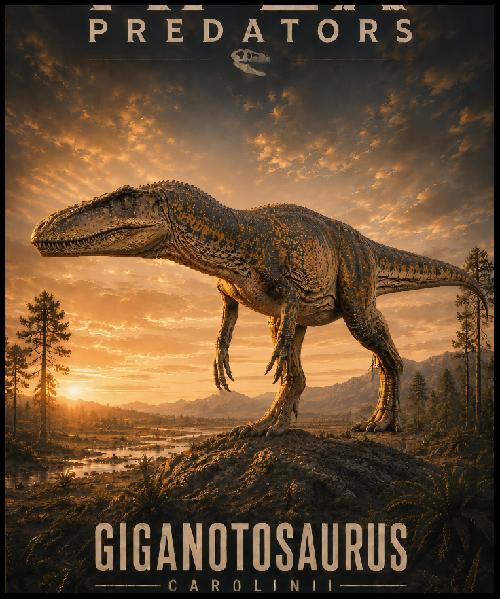
- Carcharodontosaurus saharicus — the dominant terrestrial predator of the same ecosystem; its presumed terrestrial hunting niche contrasts sharply with Spinosaurus’s aquatic specialisation and supports the niche-partitioning model for the Kem Kem predator guild.
Frequently Asked Questions
Could Spinosaurus swim?
Current evidence strongly indicates Spinosaurus could swim, supported by its paddle-shaped tail, dense bones that reduced buoyancy, and isotopic data showing sustained aquatic activity. Whether it was an active underwater pursuit swimmer or a surface wader remains debated, but some form of capable aquatic locomotion is well supported by the fossil evidence. [Flag: FAQ schema implementation required]
Did Spinosaurus live in water all the time?
Almost certainly not. Even under the most aquatic committed models, Spinosaurus likely spent time on land — moving between water bodies, resting, and possibly nesting. Its skeletal adaptations point to semi-aquatic specialisation comparable to a crocodilian rather than a fully aquatic animal like a plesiosaur.
When was the Spinosaurus tail discovered?
The paddle-like tail skeleton was described in a landmark 2020 study in Nature by Nizar Ibrahim and colleagues, based on material from the Kem Kem deposits of Morocco. This was one of the most significant Spinosaurus discoveries since the partial skeleton recovered in 2014, and it substantially strengthened the case for active aquatic locomotion.
Spinosaurus stands alone among non-avian dinosaurs as the taxon with the strongest skeletal case for aquatic adaptation. Whether it was an active underwater hunter or a giant wader, the fossil evidence is clear that water was not incidental to its life — it was central to it.
Featured Museum Collections
Museum-quality paleoart and educational poster
collections based on evidence-informed prehistoric
Life reconstructions.