At a Glance
| Field | Information |
|---|---|
| Species | Spinosaurus aegyptiacus |
| First described | 1915, by Ernst Stromer von Reichenbach |
| Original find location | Bahariya Oasis, Egypt |
| Holotype status | Destroyed, Munich, 1944 |
| Key modern find | 2014 partial skeleton, Morocco (Ibrahim et al.) |
| Recent development | 2026 Spinosaurus mirabilis discovery, central Sahara |
Quick Answer: Spinosaurus was first discovered in Egypt in 1912 by German palaeontologist Ernst Stromer, who described it in 1915. The original fossils were destroyed in a WWII Allied bombing raid on Munich in 1944. The species was largely rebuilt from fragmentary material until a partial skeleton described in 2014 by Nizar Ibrahim fundamentally changed how scientists understand Spinosaurus — and a 2026 discovery added a second species to the genus.
For three decades after World War II, Spinosaurus existed almost entirely on paper. The bones that proved it real were ash. What palaeontologists knew of the largest predatory dinosaur ever found had to be reconstructed from drawings, notes, and scattered fragments — a situation unlike almost any other major dinosaur in the scientific record.
Ernst Stromer and the Original Discovery
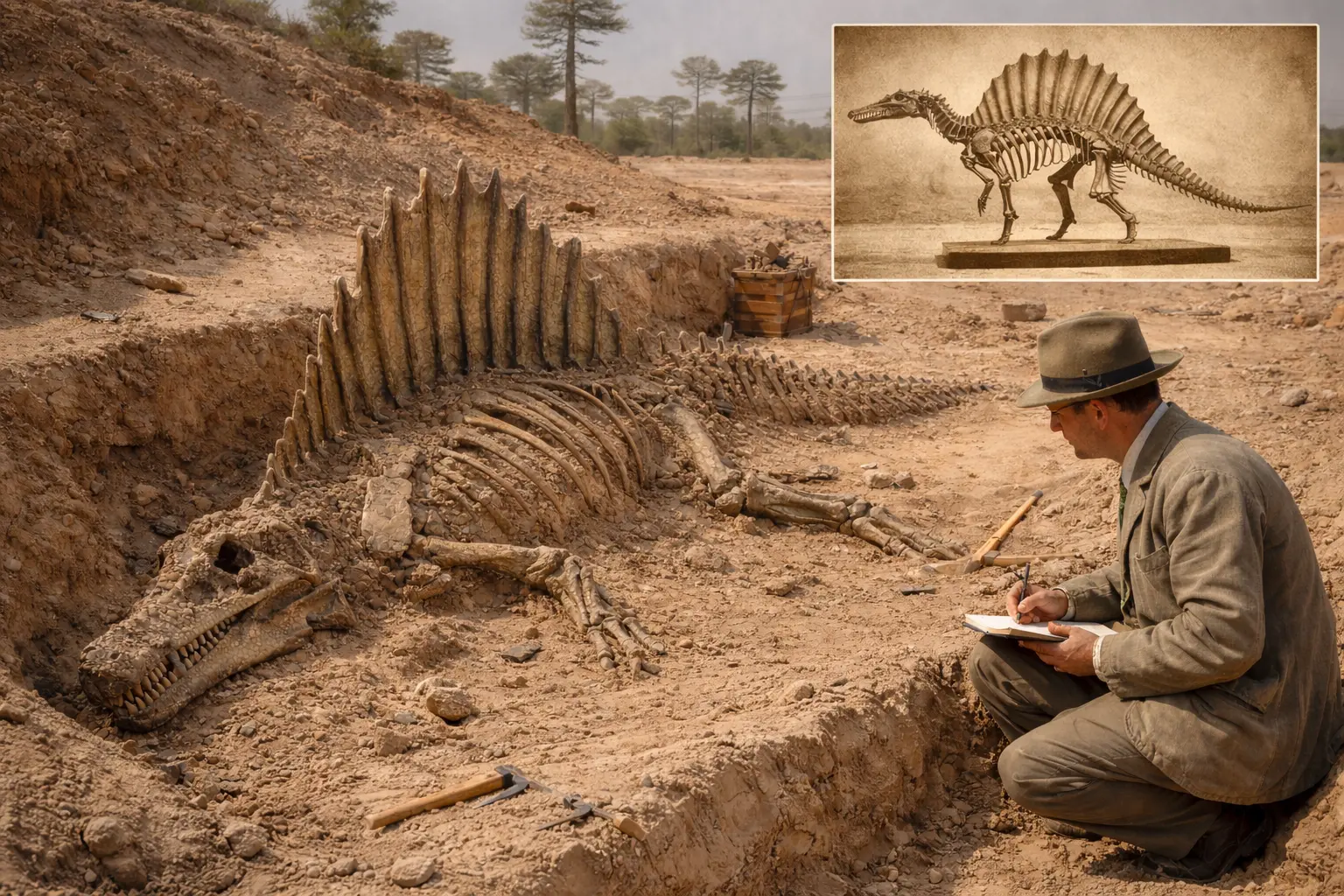
Ernst Stromer von Reichenbach was a Bavarian palaeontologist who led expeditions to the Bahariya Oasis in Egypt’s Western Desert beginning in 1911. The region, now arid, was during the Cretaceous a lush river delta system teeming with large vertebrates. In 1912, Stromer’s team recovered the material that would eventually be described as Spinosaurus aegyptiacus — “spine lizard from Egypt.”
Stromer’s 1915 description established the genus and species. The fossils included vertebrae with dramatically elongated neural spines — the structures that formed the animal’s distinctive dorsal sail — along with jaw fragments and other skeletal elements. Stromer recognised immediately that the elongated spines were unlike anything previously described.
He was working, however, in a period before the full toolkit of modern palaeontology. With limited comparative material and no framework for semi-aquatic theropods, Stromer interpreted Spinosaurus as a large terrestrial predator — a reasonable conclusion given what was available to him.
The Munich Holotype
The original Spinosaurus fossils were transported to the Bavarian State Collection of Palaeontology and Geology in Munich, where they were housed and studied. Stromer recognised the collection’s vulnerability as World War II escalated and repeatedly petitioned museum authorities to move the fossils to safer storage. His requests were refused.
On the night of 24–25 April 1944, Allied bombing raids struck Munich. The museum took a direct hit. The Spinosaurus holotype — along with other irreplaceable Stromer specimens including Aegyptosaurus, Bahariasaurus, and Carcharodontosaurus material — was destroyed. Stromer, who had opposed the Nazi regime and whose sons had been imprisoned for resistance activity, survived the war. He died in 1952 having seen his life’s work reduced to records and drawings.
The destruction of the holotype left Spinosaurus in a uniquely precarious scientific position. Without the original material, researchers could not apply modern analytical techniques to the founding specimens. For decades, knowledge of the animal was based almost entirely on Stromer’s published descriptions and plates.
The 2014 Partial Skeleton and the Semi-Aquatic Shift
The field shifted significantly in 2014 when palaeontologist Nizar Ibrahim and colleagues described a partial Spinosaurus skeleton recovered from the Kem Kem Beds of southeastern Morocco.
The specimen included anatomical elements not previously known for Spinosaurus, and their interpretation challenged earlier views of the animal as a fully terrestrial predator. The fossils showed short, robust hind limbs, dense bone tissue associated with reduced buoyancy in semi-aquatic vertebrates, and body proportions inconsistent with a fast-moving terrestrial hunter. The study argued that Spinosaurus was adapted for life in and around water to a greater extent than previously recognised.
The interpretation remains debated. Some researchers have questioned whether all the material described belongs to a single individual, and the extent of Spinosaurus’s aquatic adaptations continues to be actively discussed in the literature.
How Interpretations Have Shifted
The arc from Stromer to Ibrahim illustrates how heavily fossil interpretation depends on the material available. Stromer, working from vertebrae and jaw fragments, saw a terrestrial apex predator. Researchers in the late twentieth century, working from equally limited material, envisaged a large bipedal fish-eater analogous to a heron scaled to dinosaur proportions. The 2014 skeleton introduced genuine locomotor and physiological data that pushed the interpretation toward active semi-aquatic behaviour.
Each shift was driven by new fossils, not new theory. Spinosaurus’s interpretive history is in this sense a case study in how science works — and how much a single well-preserved specimen can change.
The 2026 Spinosaurus mirabilis Discovery
In 2026, researchers reported new spinosaurid fossil material from the central Sahara that may represent previously unrecognised diversity within the group. These findings have prompted renewed discussion about variation in dorsal spine shape and the possibility of multiple closely related forms within what is currently classified as Spinosaurus aegyptiacus.
The material remains under study, and its implications for spinosaurid taxonomy and ecology are not yet fully resolved. Scientists continue to evaluate whether these differences reflect distinct species, regional variation, or individual variation within a single species.
H2: Related and Contemporary Species
Baryonyx walkeri — a spinosaurid from Early Cretaceous England, described in 1986; its well-preserved skull provided the clearest early evidence that spinosaurids were fish-eaters, and its discovery informed reinterpretation of Spinosaurus’s feeding ecology.
Irritator challengeri — a Brazilian spinosaurid known from a partial skull; its discovery confirmed that spinosaurids had a wide geographic distribution across Gondwana during the Cretaceous.
Suchomimus tenerensis — a large spinosaurid from Niger, closely related to Spinosaurus; its description helped establish the ecological picture of African spinosaurids as riverine fish-hunters.
Carcharodontosaurus saharicus — not a spinosaurid but a contemporary apex predator from the same Kem Kem formation, almost certainly sharing habitat with Spinosaurus; its rediscovery in the 1990s, also from material partially destroyed in WWII, parallels the Spinosaurus fossil history in notable ways.
Frequently Asked Questions
Who discovered Spinosaurus?
Spinosaurus was first described by German palaeontologist Ernst Stromer von Reichenbach in 1915, based on fossils recovered from the Bahariya Oasis in Egypt in 1912. Stromer named the species Spinosaurus aegyptiacus, meaning “spine lizard from Egypt.”
Why were the original Spinosaurus fossils destroyed?
The original holotype fossils were housed in Munich’s Bavarian State Collection of Palaeontology. They were destroyed when Allied bombing raids struck the museum on the night of 24–25 April 1944. Stromer had repeatedly warned that the collection was at risk and requested that the specimens be moved to safety, but his requests were not acted upon.
What did the 2014 Spinosaurus discovery change?
The 2014 partial skeleton described by Nizar Ibrahim introduced skeletal data — including short hind limbs and dense bone tissue associated with reduced buoyancy — that shifted scientific interpretation of Spinosaurus from a large terrestrial predator to a semi-aquatic or actively aquatic animal. It remains the most complete Spinosaurus specimen described to date.
Conclusion
Spinosaurus has one of the most fragmented and dramatically interrupted fossil records of any major dinosaur. From Stromer’s destroyed holotype to Ibrahim’s paradigm-shifting 2014 skeleton to the 2026 S. mirabilis announcement, each chapter of its discovery history has changed what scientists thought they knew — and underlined how much still depends on the next find.
Featured Museum Collections
Museum-quality paleoart and educational poster
collections based on evidence-informed prehistoric
Life reconstructions.