| Field | Information |
|---|---|
| Species | Allosaurus fragilis — Saurischia, Allosauridae |
| Period | Late Jurassic, 155–145 Ma |
| Formation | Morrison Formation, western North America |
| Climate | Semi-arid with seasonal wet periods |
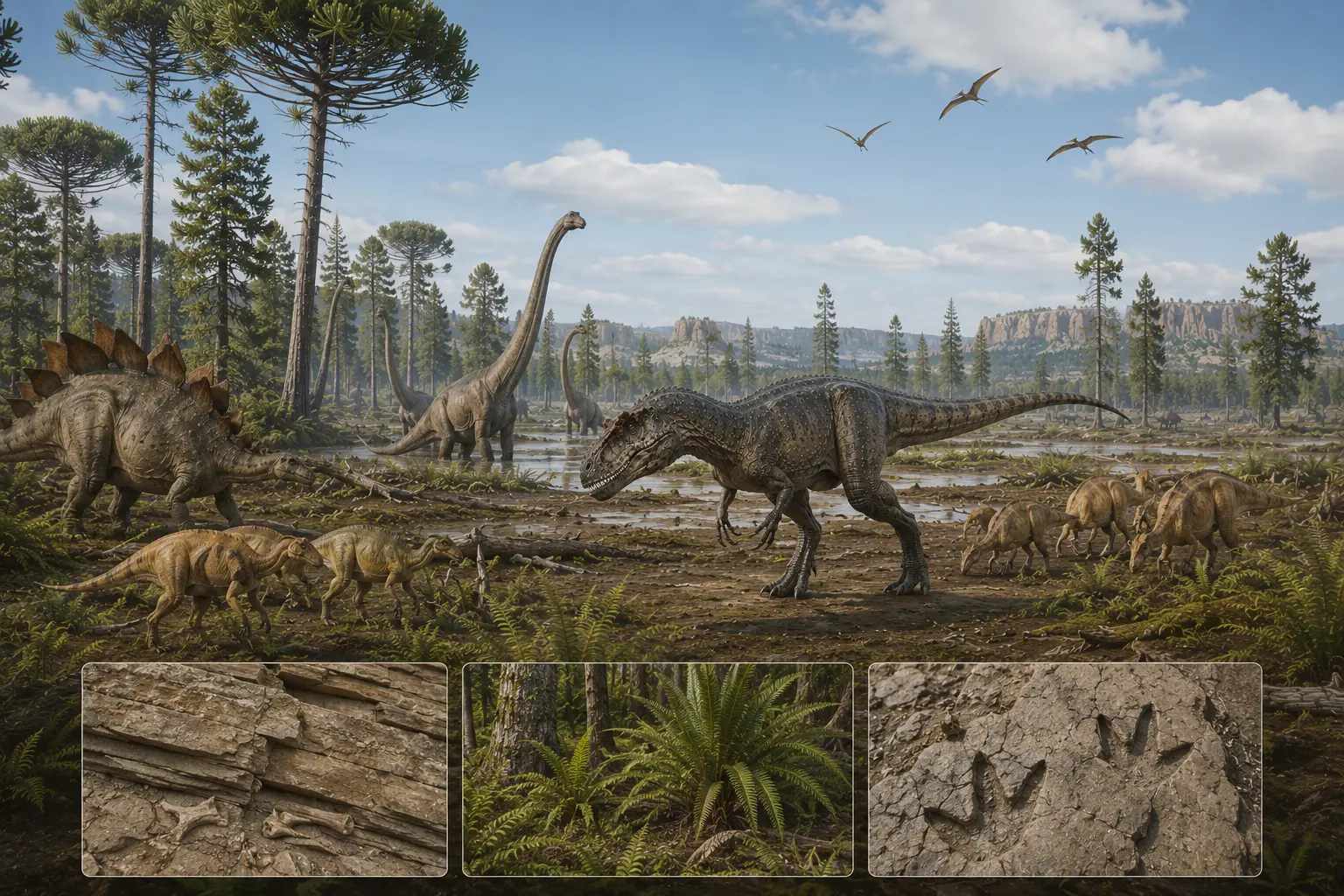
Quick Answer:Allosaurus inhabited the Morrison Formation of western North America — a vast Late Jurassic ecosystem spanning much of what is now the western United States. Paleoenvironmental evidence indicates a predominantly semi-arid landscape shaped by seasonal river systems, broad floodplains, and patchy woodland, supporting a diverse dinosaur fauna that included some of the largest terrestrial animals of the Jurassic.

The world Allosaurus fragilis occupied looked nothing like the forests of popular imagination. Fossil evidence from across the Morrison Formation paints a picture of a broad, seasonally dry landscape interrupted by river systems — and populated by some of the largest animals that have ever lived on land.
Where Did Allosaurus Live?
Allosaurus habitat, based on fossil evidence and formation analysis, was centred on the Morrison Formation — a geological unit deposited during the Late Jurassic across a vast area of western North America. Fossil sites yielding Allosaurus material are distributed across what are now the states of Utah, Colorado, Wyoming, Montana, South Dakota, Oklahoma, and New Mexico. The formation represents a floodplain and river-channel depositional environment that existed approximately 155–145 million years ago.
The Morrison Formation Environment
Fossil evidence from plant material, sedimentary structures, and isotopic analysis of Morrison Formation deposits indicates a semi-arid climate with pronounced seasonal variation. Wet seasons brought flooding to broad river systems; dry seasons produced drought conditions across open floodplains. Inferred from formation analysis, vegetation included ferns, cycads, conifers, and tree ferns concentrated along waterways, with more open ground between drainage systems.
Geographic Range
Fossil evidence shows Allosaurus had one of the broadest geographic distributions of any Morrison Formation theropod. Specimens have been recovered from sites spanning more than 1,500 km (930 miles) north to south. This broad range implies ecological flexibility and an ability to exploit varied local conditions within the overall formation environment.
Climate and Seasonal Dynamics
Paleoenvironmental evidence from Morrison Formation sediments, paleosols, and plant fossils indicates a predominantly semi-arid climate with pronounced seasonal variation in water availability. River systems and wetter intervals would have created locally productive habitats, while drier periods likely placed ecological pressure on large herbivore populations and their predators. Some researchers have proposed that these seasonal environmental stresses may have contributed to unusual fossil accumulations at sites such as Cleveland-Lloyd Dinosaur Quarry, although the exact processes behind those deposits remain actively debated.
The Morrison Fauna: Who Shared Allosaurus’s World?
The Morrison Formation preserves one of the most diverse large-vertebrate faunas in the entire fossil record. Allosaurus fragilis coexisted with an assemblage of herbivores that included some of the largest land animals known, as well as a range of smaller predators, early mammals, and other vertebrates.
Large Herbivores
Fossil evidence documents the following large herbivores as contemporaries of Allosaurus within the Morrison Formation:
- Diplodocus — a long-necked sauropod reaching up to 26 metres (85 ft) in length
- Brachiosaurus — a tall-browsing sauropod with an estimated mass of 30,000–60,000 kg (66,000–132,000 lb)
- Camarasaurus — the most commonly recovered Morrison sauropod
- Stegosaurus — a plated ornithischian and documented prey item of Allosaurus
- Camptosaurus and Dryosaurus — smaller ornithopods forming a lower tier of the herbivore community
Other Predators
Allosaurus was not the only large predator in the Morrison ecosystem. Fossil evidence documents Ceratosaurus, Torvosaurus, and Marshosaurus as contemporary theropods, reflecting a predator community with multiple large carnivorous taxa. Allosaurus is among the most frequently recovered large theropods in Morrison fossil assemblages, though the ecological relationships between these predators remain incompletely understood. Differences in body size, skull morphology, and probable prey preferences suggest some degree of niche differentiation.
Allosaurus Within Its Ecosystem
Fossil evidence places Allosaurus fragilis among the principal large predators of the Morrison Formation ecosystem. Its broad geographic distribution, frequent representation in fossil assemblages, and documented feeding interactions with large herbivorous dinosaurs support its interpretation as a major apex carnivore within Late Jurassic western North America. Details of specific prey associations and feeding behaviour are explored in the dedicated post on what Allosaurus ate, while temporal range and extinction context are covered separately.
Related and Contemporary Species
- Diplodocus longus — a major Morrison Formation sauropod, contemporary and plausible feeding target for large theropods
- Stegosaurus stenops — a plated ornithischian contemporary associated with feeding trace evidence linked to large theropod activity
- Ceratosaurus nasicornis — a contemporary theropod likely occupying a somewhat different ecological niche within the same ecosystem
- Torvosaurus tanneri — a large contemporary theropod sharing the Morrison predator guild with Allosaurus
- Camarasaurus supremus — one of the most abundant Morrison sauropods and an important component of the herbivore community
Frequently Asked Questions
What is the Morrison Formation?
The Morrison Formation is the geological unit in which Allosaurus and most of its contemporaries are preserved. It is a sequence of sedimentary rock deposited across western North America during the Late Jurassic, approximately 155–148 million years ago, representing ancient floodplain, river, and lake environments. It is one of the most productive dinosaur-bearing formations in the world, with fossil sites distributed across at least seven present-day US states.
Did Allosaurus live in forests or open landscapes?
Allosaurus lived primarily in open, semi-arid floodplain environments rather than dense forests, based on formation analysis of Morrison sediments and plant fossil assemblages. Inferred from paleoenvironmental reconstruction, tree cover was concentrated along river channels, with open ground dominating between drainage systems. This landscape is broadly analogous to modern semi-arid savannahs rather than temperate woodland environments.
Did any other large predators compete with Allosaurus?
Yes. Several other predatory theropods coexisted with Allosaurus in the Morrison Formation, including Ceratosaurus, Torvosaurus, and Marshosaurus. Fossil evidence indicates that these predators shared the same broad ecosystem, although their exact ecological relationships remain uncertain. Differences in size, anatomy, and likely prey preferences suggest some degree of niche differentiation, reducing direct competition even within overlapping habitats. Allosaurus is among the most frequently recovered large theropods from Morrison deposits and is generally regarded as one of the principal apex predators of that ecosystem.
Note: Morrison Formation paleoclimate reconstruction and the predator-trap hypothesis for Cleveland-Lloyd Quarry are active areas of research. Details reflect current scientific consensus but may be revised as new evidence emerges.
Conclusion
Allosaurus lived in a semi-arid, seasonally dynamic landscape that was simultaneously harsh and extraordinarily productive. The Morrison Formation ecosystem supported a diversity of giant herbivores that provided the resource base for the apex predator role that Allosaurus occupied. Understanding its habitat is inseparable from understanding how this animal functions as an ecological dominant.
References
Peer-Reviewed Literature
Chure, D.J. and Loewen, M.A., 2020. Cranial anatomy of Allosaurus jimmadseni, a new species from the lower part of the Morrison Formation (Upper Jurassic) of western North America. PeerJ, 8:e7803. https://doi.org/10.7717/peerj.7803
Turner, C.E. and Peterson, F., 2004. Reconstruction of the Upper Jurassic Morrison Formation extinct ecosystem—a synthesis. Sedimentary Geology, 167(3–4), pp.309–355. https://doi.org/10.1016/j.sedgeo.2004.01.009
Monographs and Reference Works
Fastovsky, D.E. and Weishampel, D.B., 2016. Dinosaurs: A Concise Natural History. 3rd ed. Cambridge University Press.
Foster, J.R., 2003. Paleoecological Analysis of the Vertebrate Fauna of the Morrison Formation (Upper Jurassic), Rocky Mountain Region, U.S.A. New Mexico Museum of Natural History and Science Bulletin 23.
Foster, J.R., 2007. Jurassic West: The Dinosaurs of the Morrison Formation and Their World. Indiana University Press.
Madsen, J.H., 1976. Allosaurus fragilis: A Revised Osteology. Utah Geological and Mineral Survey Bulletin 109. Salt Lake City, Utah.
Paul, G.S., 2016. The Princeton Field Guide to Dinosaurs. 2nd ed. Princeton University Press.
Databases and Online Resources
Dinosaur National Monument, U.S. National Park Service, 2026. Geological and paleontological resources. Available at: https://www.nps.gov/dino [Accessed 19 May 2026].
Paleobiology Database, 2026. Morrison Formation and Allosaurus fragilis occurrence data. Available at: https://paleobiodb.org [Accessed 19 May 2026].
Featured Museum Collections
Museum-quality paleoart and educational poster
collections based on evidence-informed prehistoric
Life reconstructions.