| Field | Information |
|---|---|
| Species | Allosaurus fragilis — Saurischia, Allosauridae |
| Period | Late Jurassic, 155–145 Ma |
| Integument evidence | No direct skin impression evidence for Allosaurus |
| Cranial ornamentation | Low lacrimal crests; rugose nasal ridge — fossil evidence confirmed |
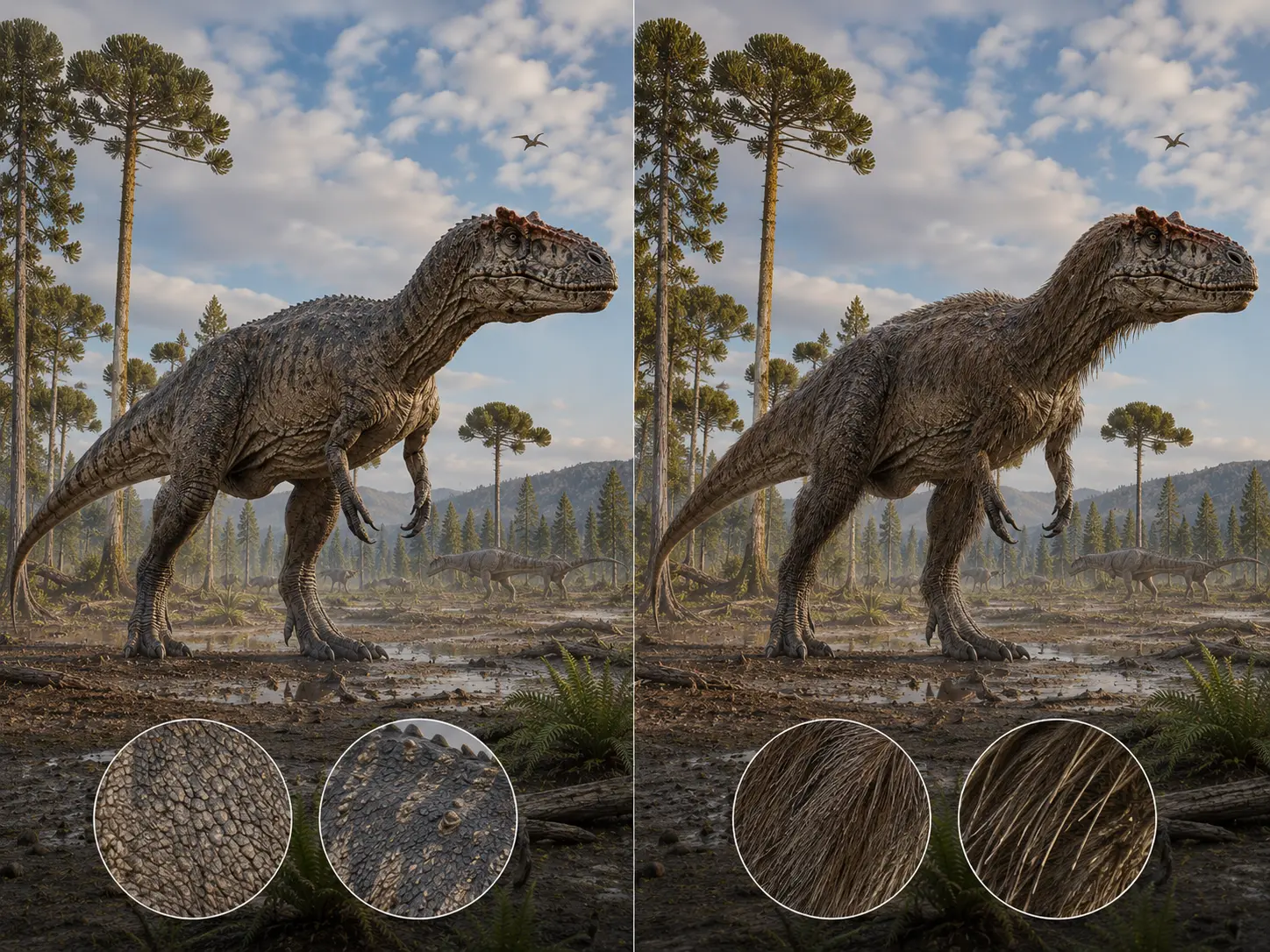
Quick Answer: Did Allosaurus have feathers? No direct fossil evidence confirms feathers on Allosaurus. Its phylogenetic position within Carnosauria, combined with its large body size, makes extensive feather covering unlikely. Current scientific consensus favours scaled or bare skin, though soft tissue evidence for this specific genus is absent and the question cannot be fully resolved from existing fossil material.

The question of what Allosaurus fragilis actually looked like — beyond the bones — is one where science must be candid about the limits of the evidence. Skin, colour, and soft tissue coverings are rarely preserved in the fossil record, and Allosaurus has not yet yielded the impressions that would settle the matter definitively.
Did Allosaurus Have Feathers?
Whether Allosaurus had feathers is a question the current fossil record cannot answer with direct evidence. No skin impressions, feather traces, or integument evidence have been recovered from any Allosaurus specimen. The scientific consensus, inferred from phylogenetic position and body size modelling, leans against extensive feather coverage — but this inference rests on indirect reasoning rather than preserved tissue.
Phylogenetic Position and Feather Probability
Comparison with related taxa indicates that filamentous or feather-like structures are most consistently documented in coelurosaurs, the theropod group that includes T. rex relatives and eventually birds. Allosaurus belongs to Carnosauria — a separate theropod lineage — and no carnosaur has yet yielded confirmed feather or filament evidence. Inferred from this phylogenetic pattern, the ancestral integument of allosauroids was more likely scaled than filamentous, though the absence of evidence is not equivalent to evidence of absence.
Body Size as a Thermal Constraint
Biomechanical modelling of thermoregulation in large-bodied dinosaurs suggests that animals above a certain mass threshold would face overheating risks if extensively covered in insulating filaments. Inferred from comparison with modern large-bodied endotherms, Allosaurus at 1,500–2,500 kg (3,300–5,500 lb) would likely have had little thermoregulatory benefit from dense insulating cover. This line of reasoning supports a scaled or sparsely covered integument as the more parsimonious inference for the trunk and limbs.
What Direct Evidence Exists?
Fossil evidence from the Allosaurus skeleton reveals extensive bone surface texture information, including attachment sites for soft tissue structures, but no preserved skin. Comparisons with other large Jurassic theropods whose skin impressions have been recovered — such as some specimens from Asian formations — consistently show scales rather than feather traces in large-bodied carnivores of this period. This comparative inference supports but does not confirm a scaled integument for Allosaurus.
Speculatively, some researchers have proposed that juvenile Allosaurus individuals might have carried filamentous insulating structures that were lost or reduced in adults, following a pattern inferred from some tyrannosaur material. This is extrapolation, not direct evidence, and no Allosaurus specimen of any age has preserved integument.
Cranial Ornamentation: Crests and Ridges
The Lacrimal Crests
Fossil evidence shows Allosaurus bore a pair of low, blade-like crests above the eyes, formed by the lacrimal bones. These crests are variable in prominence across specimens and were composed of bone rather than keratin or other soft tissue. Their function is debated — proposals include display, species recognition, and thermoregulation — but no functional interpretation is confirmed from direct evidence.
The Nasal Ridge
Fossil evidence documents a rugose, textured ridge running along the nasal bones of the skull, more prominent in some specimens than others. Inferred from surface texture and bone morphology, this ridge likely supported a keratinous or other soft tissue covering in life, potentially increasing its visual prominence beyond what the bone alone suggests. The precise appearance of this structure in life cannot be reconstructed with confidence from current material.
Variation Between Species
Fossil evidence from Allosaurus jimmadseni — described in 2020 — shows subtle differences in lacrimal crest form and skull proportions relative to Allosaurus fragilis. These differences suggest the cranial ornamentation of the genus was subject to variation across both species and individual specimens. Taxonomy and morphological boundaries within Allosaurus are an active area of research.
Body Proportions and General Appearance
Fossil evidence from well-preserved specimens, including MOR 693 (“Big Al”), allows confident reconstruction of Allosaurus skeletal proportions. The body was deep-chested and horizontally oriented, with a large skull, robust neck, moderately long tail used for balance, and hindlimbs built for sustained locomotion. The forelimbs were proportionally substantial compared to later large theropods, bearing three functional fingers with large recurved claws — anatomy covered in the post on Allosaurus bite force and hunting mechanics.
Colour, skin patterning, and the precise texture of external surfaces cannot be determined from fossil evidence. Any reconstruction showing specific colours or patterning represents an artistic interpretation informed by comparison with living reptiles and birds, not a claim grounded in preserved evidence.
Related and Contemporary Species
- Allosaurus jimmadseni — second named species; cranial ornamentation differences from A. fragilis documented in the 2020 formal description
- Ceratosaurus nasicornis — Morrison Formation, contemporary with a prominent nasal horn; integument unknown, but no evidence of feathers
- Yutyrannus huali — a large Early Cretaceous tyrannosauroid from China with confirmed filamentous integument; cited for comparative body-size and feather context, not phylogenetic proximity
- Carnotaurus sastrei — a large theropod with confirmed skin impressions showing scales; demonstrates scaly integument in large-bodied non-coelurosaur theropods.
- Giganotosaurus carolinii — a large allosauroid whose integument is unknown; useful phylogenetic comparison for carnosaur appearance inferences.
Frequently Asked Questions
What did Allosaurus look like?
Allosaurus looked like a large, bipedal predator with a deep chest, horizontal body posture, and a proportionally large skull bearing low crests above the eyes. Fossil evidence confirms skeletal proportions, cranial ornamentation, and limb anatomy in detail. Skin colour and texture cannot be confirmed from current fossil material; reconstructions showing specific colours are artistic interpretations informed by comparison with living relatives.
Did Allosaurus have scales?
Whether Allosaurus had scales cannot be confirmed from direct fossil evidence, as no skin impressions from any Allosaurus specimen have been recovered. Inferred from phylogenetic position within Carnosauria and comparison with skin impressions recovered from other large non-coelurosaurian theropods, scaled integument is the most parsimonious current inference. The absence of direct integument evidence means this remains an open question.
What were the crests on Allosaurus’s head for?
The function of the crests on Allosaurus’s head is not established from direct fossil evidence. Fossil evidence confirms that the lacrimal crests and nasal ridge were present in bone and varied across specimens. Proposed functions include intraspecific display, species recognition, and thermoregulation, but none of these interpretations has been confirmed. The variation in crest prominence between individuals and between named species suggests a role in visual signalling is plausible but unproven.
Note: Integument inferences for large-bodied Jurassic theropods, the function of Allosaurus cranial ornamentation, and species-level morphological boundaries within Allosaurus are active areas of research. Details reflect current scientific consensus but may be revised as new evidence emerges.
Conclusion
The appearance of Allosaurus is known in detail where bones survive, and is almost entirely unknown where soft tissue is required. Its skeletal anatomy is among the best documented of any large Jurassic predator. Its integument remains unconfirmed, its colours unknown, and its cranial ornament function unresolved. These are honest gaps in the evidence — and the science of Allosaurus’ appearance is more interesting for acknowledging them.
References
Peer-Reviewed Literature
Bell, P.R., Campione, N.E., Persons, W.S., Currie, P.J., Larson, P.L., Tanke, D.H., and Bakker, R.T., 2017. Tyrannosaurid integument reveals conflicting patterns of gigantism and feather evolution. Biology Letters, 13(6), 20170092. https://doi.org/10.1098/rsbl.2017.0092
Chure, D.J. and Loewen, M.A., 2020. Cranial anatomy of Allosaurus jimmadseni, a new species from the lower part of the Morrison Formation (Upper Jurassic) of western North America. PeerJ, 8:e7803. https://doi.org/10.7717/peerj.7803
Xu, X., Norell, M.A., Kuang, X., Wang, X., Zhao, Q., and Jia, C., 2004. Basal tyrannosauroids from China and evidence for protofeathers in tyrannosauroids. Nature, 431, pp.680–684. https://doi.org/10.1038/nature02855
Monographs and Technical Works
Madsen, J.H., 1976. Allosaurus fragilis: A Revised Osteology. Utah Geological and Mineral Survey Bulletin 109. Salt Lake City, Utah.
Paul, G.S., 2016. The Princeton Field Guide to Dinosaurs. 2nd ed. Princeton University Press, Princeton.
Fastovsky, D.E. and Weishampel, D.B., 2016. Dinosaurs: A Concise Natural History. 3rd ed. Cambridge University Press.
Databases and Online Resources
Paleobiology Database, 2026. Allosaurus fragilis occurrence and specimen data. Available at: https://paleobiodb.org [Accessed 19 May 2026].
Featured Museum Collections
Museum-quality paleoart and educational poster
collections based on evidence-informed prehistoric
Life reconstructions.