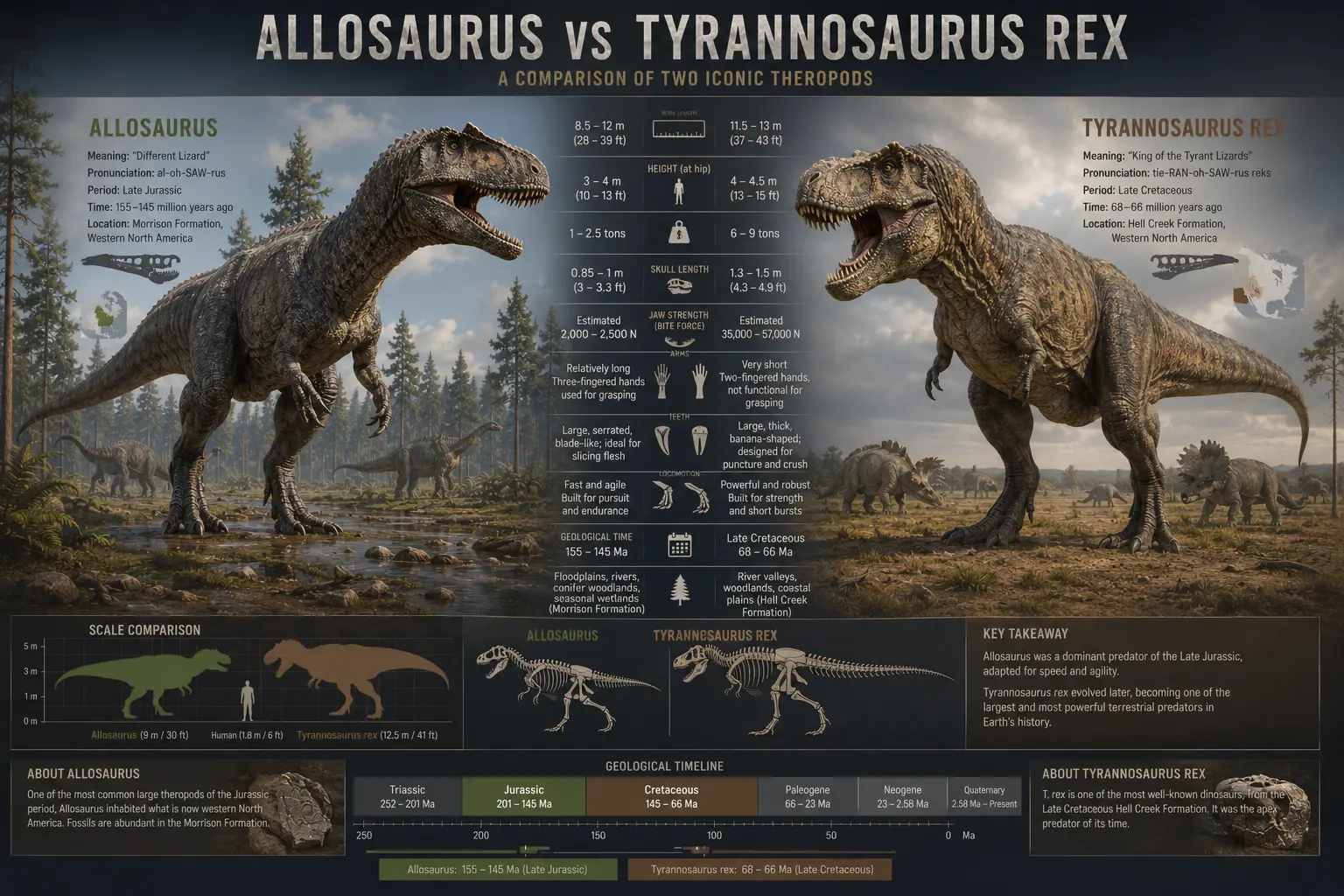
| Feature | Allosaurus fragilis | Tyrannosaurus rex |
|---|---|---|
| Period | Late Jurassic, approximately 155–145 Ma | Late Cretaceous, approximately 68–66 Ma |
| Length | Approximately 8.5–10 m (28–33 ft) | Approximately 12–13 m (39–43 ft) |
| Mass | Approximately 1,500–3,500+ kg (3,300–7,700+ lb), depending on specimen and reconstruction | Approximately 8,000–14,000 kg (17,600–30,900 lb), depending on specimen and reconstruction |
| Bite force (estimated) | Significantly lower than T. rex; exact estimates remain uncertain | Approximately 35,000–57,000 N (7,900–12,800 lbf) |
| Forelimbs | Robust, three-fingered forelimbs with large claws; likely functionally important in prey handling | Reduced, two-fingered forelimbs; exact function remains debated |
| Skull build | Relatively lighter skull construction adapted for a different feeding strategy than T. rex | Deep, massively reinforced skull adapted for extremely powerful biting |
| Did they meet? | No | No |
Quick Answer: Allosaurus and Tyrannosaurus rex never coexisted. They were separated by roughly 80 million years of geological time. T. rex was substantially larger and possessed a far more powerful bite, while Allosaurus represented an earlier large theropod predator with different anatomical adaptations shaped by the Late Jurassic ecosystems it inhabited.

Comparisons between Allosaurus and T. rex are popular because both were iconic large predatory dinosaurs, but scientifically, they belong to very different evolutionary and ecological contexts. Although both occupied top predatory roles in their respective ecosystems, they were separated by a span of time longer than the interval between the extinction of T. rex and the present day.
Allosaurus vs T. Rex: Did They Ever Meet?
This comparison is entirely hypothetical. Fossil evidence places Allosaurus in the Late Jurassic, approximately 155–145 million years ago, while Tyrannosaurus rex lived much later in the Late Cretaceous, approximately 68–66 million years ago.
That means the two genera were separated by roughly 80 million years and never overlapped in time. Because temporal coexistence is impossible, any encounter scenario between them is purely speculative rather than something supported by the fossil record.
Size Comparison: How Big Were They?
T. rex was substantially larger than Allosaurus by all primary size metrics. Fossil evidence places T. rex at 12–13 metres (39–43 ft) in length, and biomechanical estimates suggest a mass of 8,000–14,000 kg (17,600–30,900 lb). By comparison, Allosaurus reached 8.5–9 metres (28–30 ft) in typical adults with a mass of 1,500–2,500 kg (3,300–5,500 lb). Body dimension data for Allosaurus is covered in full in the dedicated post on Allosaurus size.
Skull and Jaw Anatomy
Allosaurus: A Lighter-Built Predatory Skull
The skull of Allosaurus was relatively lightly constructed compared with the deep, heavily reinforced skull of Tyrannosaurus rex. Large cranial openings (fenestrae) reduced skull mass while maintaining structural strength, a common theropod adaptation. Biomechanical studies suggest Allosaurus employed a feeding strategy different from the extreme bite-force-driven approach seen in tyrannosaurids, though the exact mechanics remain debated. Some researchers have proposed strike-and-tear feeding behaviours based on cranial stress modelling, but these interpretations should not be treated as definitive.
T. rex: A Bone-Crushing Predator
Tyrannosaurus rex possessed one of the most powerfully built skulls known among terrestrial vertebrates. Its deep, reinforced cranial architecture, exceptionally strong jaws, and forward-facing vision indicate a highly specialised predatory anatomy. Bite-force estimates commonly range from approximately 35,000 to 57,000 newtons (7,900–12,800 lbf), sufficient to crush bone—a feeding behaviour supported by fossil bite marks and damaged prey remains attributed to T. rex.
These skull designs reflect different evolutionary solutions among large theropod predators rather than a simple “stronger versus weaker” comparison.
Forelimbs: A Major Anatomical Contrast
One of the clearest anatomical differences between Allosaurus and T. rex lies in the forelimbs.
Allosaurus possessed relatively robust three-fingered forelimbs with large recurved claws, indicating that the arms were functionally important. Many palaeontologists interpret them as useful in prey handling or close-range interactions, although precise behavioural roles cannot be directly confirmed from fossils alone.
By contrast, T. rex had proportionally much smaller two-fingered forelimbs relative to its overall body size. Despite their reduced length, the arms were strongly muscled, and their exact function remains debated, with hypotheses ranging from prey stabilisation to mating or locomotor assistance.
Speed Comparison
Estimating dinosaur speed is inherently uncertain because results depend heavily on biomechanical modelling assumptions.
Current estimates generally suggest that Allosaurus may have been somewhat more agile than T. rex, reflecting its lighter body build, though exact maximum speeds remain uncertain. Estimates for T. rex are typically lower due to its extreme mass and biomechanical constraints.
Neither dinosaur is thought to have been an exceptionally fast runner by modern animal standards. The more meaningful distinction is likely one of locomotor style and agility rather than precise top-speed figures, which remain actively debated in palaeontological research.
Predatory Strategy: Different Tools for Different Worlds
Based on skeletal anatomy, feeding biomechanics, and fossil evidence from their respective ecosystems, Allosaurus and Tyrannosaurus rex likely employed different predatory strategies shaped by distinct ecological contexts.
Allosaurus lived in the Late Jurassic Morrison ecosystem, where it shared its environment with large herbivores, including sauropods and ornithopods. Its lighter skull construction, functional forelimbs, and more gracile overall build suggest a hunting style different from that of later giant tyrannosaurids, though the exact behavioural details remain uncertain.
T. rex, by contrast, inhabited Late Cretaceous ecosystems dominated by large herbivores such as ceratopsians and hadrosaurs. Its immense bite force, heavily reinforced skull, and massive body indicate a predatory strategy centred on overwhelming force, whether in active predation, scavenging, or a combination of both.
These differences reflect evolutionary adaptation to different prey communities and environmental pressures rather than a direct performance hierarchy.
Hypothetical Encounter
Any confrontation between Allosaurus and T. rex is entirely fictional, as the two animals were separated by approximately 80 million years and never coexisted.
From a purely anatomical comparison, T. rex possessed clear advantages in body mass and bite force, while Allosaurus was lighter-built and likely more agile. However, behavioural outcomes in hypothetical interspecific encounters cannot be scientifically tested, so any definitive “winner” claim would be speculative entertainment rather than evidence-based palaeontology.
Phylogenetic Relationship
Allosaurus and Tyrannosaurus rex were both large theropod dinosaurs, but they were not closely related within Theropoda.
Allosaurus belongs to Allosauridae, a clade within Carnosauria, while T. rex belongs to Tyrannosauridae within Coelurosauria. These are distinct major theropod lineages that diverged long before either genus appeared in the fossil record.
Although both evolved into large apex predators within their respective ecosystems, their similarities reflect convergent evolution—independent adaptation to similar ecological roles—rather than close common ancestry. Their last common ancestor lived considerably earlier than either animal, likely during the early diversification of theropod dinosaurs.
Related and Comparative Species
- Allosaurus jimmadseni — a second named species of Allosaurus, currently recognised from older Morrison Formation strata and differing anatomically from A. fragilis, particularly in cranial morphology.
- Ceratosaurus nasicornis — a contemporary large theropod from the Morrison Formation that shared parts of the Late Jurassic ecosystem with Allosaurus.
- Torvosaurus tanneri — a large megalosaurid theropod contemporary with Allosaurus, useful for comparison among Jurassic apex predators.
- Tarbosaurus bataar — a close Asian tyrannosaurid relative of T. rex, valuable for comparative tyrannosaur anatomy and evolution.
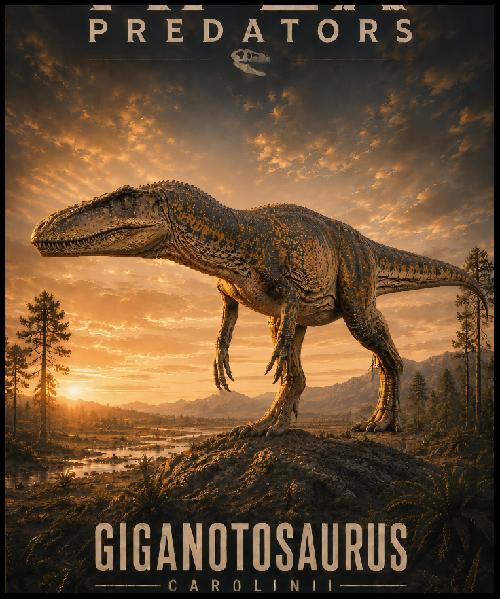
- Giganotosaurus carolinii — a giant carcharodontosaurid theropod from the Late Cretaceous of South America, more closely related to Allosaurus than T. rex at the broad theropod level, though still separated by substantial evolutionary distance.
Frequently Asked Questions
Is an Allosaurus bigger than a T. rex?
No. Tyrannosaurus rex was substantially larger than Allosaurus across most major size measurements. Typical adult Allosaurus specimens are estimated at approximately 8.5–10 metres (28–33 ft) in length, whereas T. rex commonly reached around 12–13 metres (39–43 ft). Mass differences were even more pronounced, with T. rex outweighing Allosaurus several times depending on the specimens and reconstruction methods compared. Even unusually large Allosaurus individuals do not approach the size of the largest known T. rex specimens.
Were Allosaurus and T. rex related?
Yes, but only distantly. Both were theropod dinosaurs, meaning they shared a much earlier common theropod ancestor. However, they were not closely related. Allosaurus belonged to Allosauridae within Carnosauria, while T. rex belonged to Tyrannosauridae within Coelurosauria—separate major theropod lineages that diverged long before either genus evolved. Their broad anatomical similarities reflect convergent evolution rather than close kinship.
Which was more dangerous, Allosaurus or T. rex?
This question is inherently hypothetical because Allosaurus and T. rex never coexisted and occupied very different ecosystems.
Within their respective environments, both were among the dominant large predators of their time. T. rex possessed far greater body mass and one of the most powerful bites known among terrestrial animals, while Allosaurus had a lighter build and different anatomical adaptations associated with Jurassic predatory ecology.
Any claim about which was definitively “more dangerous” depends entirely on the comparison being made—ecological role, prey-handling ability, anatomical weaponry, or speculative combat—and cannot be answered conclusively from fossil evidence alone.
Note: Large theropod body-mass estimates, locomotor performance, and some aspects of feeding biomechanics remain active areas of palaeontological research and may be refined as new evidence emerges.
Conclusion
Allosaurus and Tyrannosaurus rex were two iconic large theropod predators separated by approximately 80 million years of evolutionary history. Although both occupied dominant predatory roles in their respective ecosystems, they belonged to distinct theropod lineages and evolved different anatomical adaptations in response to different ecological pressures. The comparison is scientifically useful for understanding theropod evolution, but any direct matchup remains purely hypothetical.
References
A. Primary Taxonomic and Phylogenetic Sources
Chure DJ, Loewen MA. 2020. Cranial anatomy of Allosaurus jimmadseni, a new species from the lower part of the Morrison Formation (Upper Jurassic) of western North America. PeerJ. 8:e7803. https://doi.org/10.7717/peerj.7803
Brusatte SL, Carr TD. 2016. The phylogeny and evolutionary history of tyrannosauroid dinosaurs. Scientific Reports. 6:20252. https://doi.org/10.1038/srep20252
B. Peer-Reviewed Literature
Rayfield EJ, Norman DB, Horner CC, Horner JR, Smith PM, Thomason JJ, Upchurch P. 2001. Cranial design and function in a large theropod dinosaur. Nature. 409:1033–1037. https://doi.org/10.1038/35059070
Bates KT, Falkingham PL. 2012. Estimating maximum bite performance in Tyrannosaurus rex using multi-body dynamics. Biology Letters. 8(4):660–664. https://doi.org/10.1098/rsbl.2012.0056
Hutchinson JR, Garcia M. 2002. Tyrannosaurus was not a fast runner. Nature. 415:1018–1021. https://doi.org/10.1038/4151018a
Sellers WI, Manning PL. 2007. Estimating dinosaur maximum running speeds using evolutionary robotics. Proceedings of the Royal Society B. 274:2711–2716. https://doi.org/10.1098/rspb.2007.0846
Turner CE, Peterson F. 2004. Reconstruction of the Upper Jurassic Morrison Formation extinct ecosystem—a synthesis. Sedimentary Geology. 167(3–4):309–355. https://doi.org/10.1016/j.sedgeo.2004.01.009
C. Monographs and Technical Works
Paul GS. 2016. The Princeton Field Guide to Dinosaurs. 2nd ed. Princeton: Princeton University Press.
Fastovsky DE, Weishampel DB. 2016. Dinosaurs: A Concise Natural History. 3rd ed. Cambridge: Cambridge University Press.
D. Databases and Online Resources
Paleobiology Database. 2026. Allosaurus fragilis and Tyrannosaurus rex occurrence records. Available at: https://paleobiodb.org (accessed 20 May 2026).
Featured Museum Collections
Museum-quality paleoart and educational poster
collections based on evidence-informed prehistoric
Life reconstructions.