
Species Quick Info
| Field | Information |
|---|---|
| Scientific Name | Carnotaurus sastrei |
| Topic | Diet |
| Taxonomic Group | Abelisauridae |
| Geological Age | Late Cretaceous (72–69.9 Ma) |
| Formation | La Colonia Formation (commonly cited; stratigraphic interpretation remains discussed) |
| Geographic Range | Patagonia, Argentina |
| Dietary Category | Carnivore |
| Evidence Strength | Strong Inference |
Quick Answer
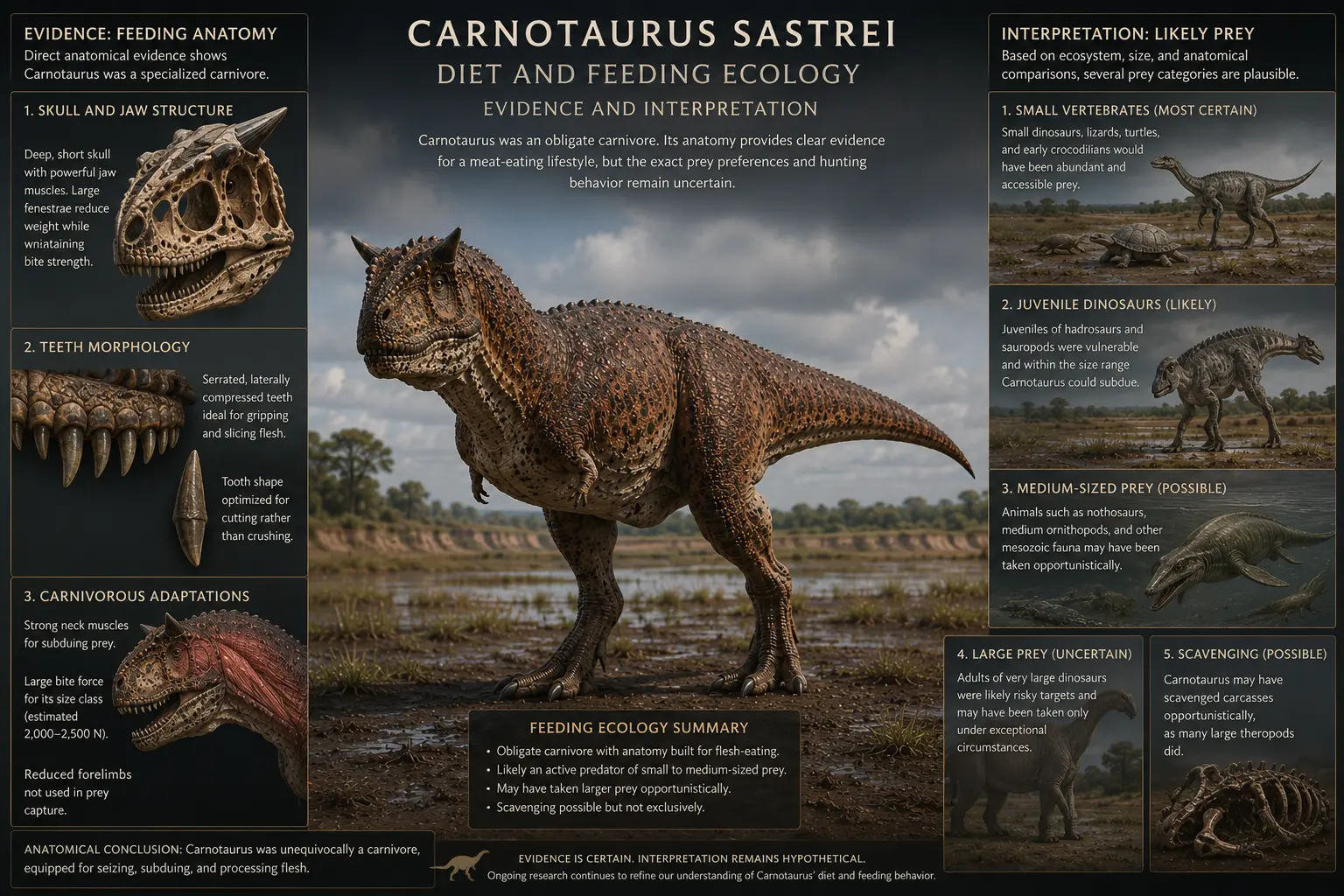
Carnotaurus sastrei was a carnivorous theropod dinosaur that likely preyed upon medium-sized vertebrates living in Late Cretaceous Patagonia. Although no stomach contents, coprolites, or direct feeding traces are known, its skull anatomy, teeth, and overall body design strongly indicate a predatory lifestyle. Current evidence suggests Carnotaurus was an active predator and possibly an opportunistic scavenger, but the specific animals it consumed remain unknown.

Summary
| Topic | Current Understanding |
|---|---|
| Diet Type | Carnivorous |
| Direct Prey Evidence | None known |
| Feeding Evidence | Skull and dentition morphology |
| Likely Food Sources | Medium-sized vertebrates |
| Scavenging Possible | Yes |
| Evidence Strength | Strong Inference |
Introduction
Understanding the diet of Carnotaurus presents a challenge common to many extinct predators. While its anatomy clearly indicates a carnivorous lifestyle, direct evidence of specific prey remains absent.
Unlike some theropods known from preserved stomach contents or feeding traces, Carnotaurus is understood primarily through anatomical evidence. Researchers therefore reconstruct its feeding ecology by examining skull structure, tooth morphology, neck musculature, body proportions, and the animals that shared its environment.
The resulting picture is that of a specialized predatory dinosaur adapted to hunting terrestrial prey, although important uncertainties remain regarding prey preferences and feeding behavior.
Diet Evidence Strength
| Topic | Confidence |
|---|---|
| Carnivorous Lifestyle | High |
| Tooth Function | High |
| Feeding Mechanics | Moderate |
| Scavenging Behavior | Moderate |
| Hunting Strategy | Low |
| Preferred Prey | Low |
Evidence for Carnivory
Several anatomical features provide strong evidence that Carnotaurus was a meat-eating dinosaur.
Carnivorous Adaptations
| Feature | Interpretation |
|---|---|
| Serrated teeth | Flesh processing |
| Deep skull | Powerful biting mechanics |
| Forward-facing sensory systems | Predatory lifestyle |
| Large body size | Apex predator role |
| Theropod anatomy | Consistent with carnivory |
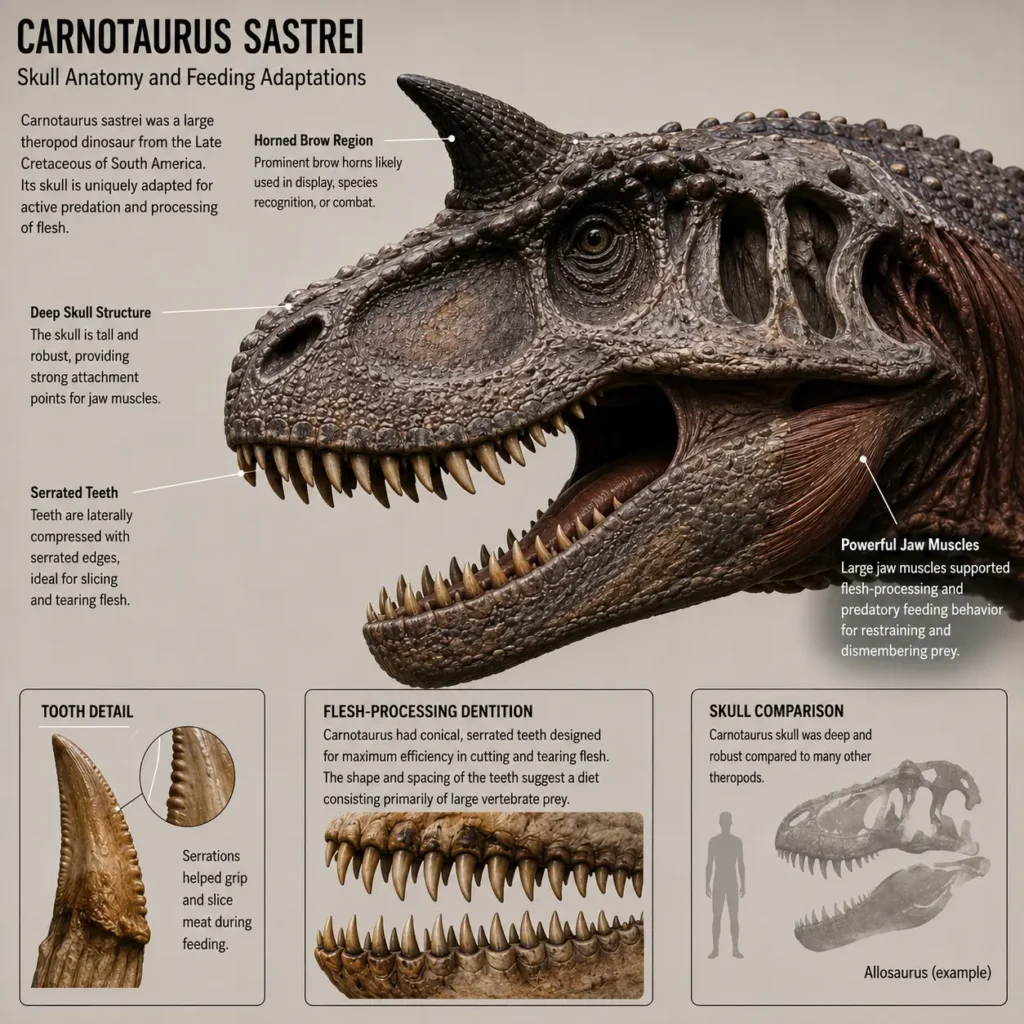
The teeth of Carnotaurus were laterally compressed and serrated, characteristics commonly associated with cutting flesh. Similar tooth designs occur throughout predatory theropod dinosaurs.
The overall skull architecture also supports carnivory. Its robust construction indicates the ability to withstand forces associated with prey capture and feeding.
Evidence Strength
Direct Evidence
Carnivorous adaptations are preserved directly in the fossil skeleton.
Skull and Feeding Adaptations
The skull of Carnotaurus differs from those of many other large theropods.
Skull Characteristics
| Feature | Potential Feeding Significance |
|---|---|
| Short, deep skull | Increased structural strength |
| Reinforced facial bones | Resistance to feeding stress |
| Strong neck musculature | Powerful head movements |
| Relatively weak bite force estimates | Possible emphasis on rapid strikes |
Biomechanical studies suggest that Carnotaurus may not have possessed the extremely powerful bite force associated with tyrannosaurids. Instead, it may have relied more heavily on rapid head and neck movements during feeding.
Some researchers have proposed that the animal delivered repeated slashing bites rather than sustained crushing bites.
Evidence Strength
Strong Inference
Functional interpretations are based on biomechanical analysis of directly preserved anatomy.
What Did Carnotaurus Eat?
No direct fossil evidence identifies the prey of Carnotaurus.
Current Evidence
| Topic | Status |
|---|---|
| Preserved Stomach Contents | Unknown |
| Associated Kill Sites | None known |
| Feeding Traces | None conclusively attributed |
| Direct Prey Identification | Unknown |
Because direct evidence is absent, researchers infer potential prey from the ecosystem in which Carnotaurus lived.
Potential Prey Categories
| Potential Prey | Confidence |
|---|---|
| Small dinosaurs | Moderate |
| Medium-sized dinosaurs | Moderate |
| Juvenile large dinosaurs | Possible |
| Crocodyliforms | Possible |
| Other vertebrates | Possible |
These categories reflect ecological plausibility rather than demonstrated dietary preferences.
Evidence Strength
Limited Evidence
Specific prey remains unknown.
Carnotaurus Within Its Ecosystem
Carnotaurus occupied the role of a large terrestrial predator within the ecosystems of Late Cretaceous Patagonia.
Ecological Role
| Topic | Assessment |
|---|---|
| Trophic Level | High |
| Predator Status | Large carnivore |
| Ecosystem Role | Predatory consumer |
| Direct Evidence | Limited |
The La Colonia ecosystem supported a variety of vertebrates, including dinosaurs, turtles, fishes, and crocodyliforms. Carnotaurus likely interacted with numerous potential prey species, although the nature of these interactions remains poorly documented.
Because of its body size, Carnotaurus was probably among the dominant terrestrial predators in its environment.
Known Contemporary Fauna
| Group | Examples |
|---|---|
| Titanosaurs | Present |
| Crocodyliforms | Present |
| Turtles | Present |
| Fish | Present |
| Small Vertebrates | Present |
Evidence Strength
Strong Inference
Ecological role is reconstructed from anatomy and ecosystem context.
Hunting Behavior
The exact hunting strategy of Carnotaurus remains uncertain.
Proposed Hunting Models
| Hypothesis | Current Support |
|---|---|
| Active pursuit predator | Moderate |
| Ambush predator | Possible |
| Generalist predator | Possible |
| Specialized prey hunter | Uncertain |
Its long hind limbs and relatively lightweight body have led some researchers to suggest that Carnotaurus was capable of pursuing prey over short distances.
However, behavior does not fossilize directly, and no evidence conclusively demonstrates how Carnotaurus hunted.
Scientific Restriction
Behavioral interpretations are inferred rather than directly observed and should not be treated as fact.
Evidence Strength
Limited Evidence
Could Carnotaurus Scavenge?
Like most large carnivores, Carnotaurus probably scavenged when opportunities arose.
Evidence Assessment
| Topic | Assessment |
|---|---|
| Direct Scavenging Evidence | None |
| Ecological Plausibility | High |
| Modern Analogs | Support opportunistic scavenging |
| Scientific Confidence | Moderate |
Most large predatory animals exploit carcasses when available. Consequently, occasional scavenging is considered likely, although direct evidence is lacking.
Evidence Strength
Strong Inference
Comparison With Other Abelisaurids
Carnotaurus shared many feeding characteristics with other abelisaurid theropods.
Abelisaurid Feeding Comparison
| Taxon | Dietary Interpretation |
|---|---|
| Carnotaurus | Large terrestrial carnivore |
| Majungasaurus | Large carnivore |
| Rajasaurus | Large carnivore |
| Skorpiovenator | Carnivore |
| Aucasaurus | Carnivore |
This consistency suggests that Carnotaurus occupied a broadly similar ecological role to many of its relatives, although species-specific differences undoubtedly existed.
Evidence Assessment
Diet Evidence Overview
| Topic | Evidence Strength |
|---|---|
| Carnivorous Lifestyle | Direct Evidence |
| Tooth Function | Direct Evidence |
| Feeding Mechanics | Strong Inference |
| Ecological Role | Strong Inference |
| Scavenging Behavior | Strong Inference |
| Specific Prey | Limited Evidence |
| Hunting Strategy | Limited Evidence |
The strongest evidence supports the conclusion that Carnotaurus was a carnivorous predator. Uncertainty increases substantially when attempting to identify prey species or reconstruct detailed feeding behaviors.
Remaining Scientific Uncertainties
| Topic | Current Status |
|---|---|
| Preferred Prey Species | Unknown |
| Hunting Strategy | Debated |
| Frequency of Scavenging | Unknown |
| Degree of Dietary Specialization | Uncertain |
| Seasonal Dietary Changes | Unknown |
| Competitive Interactions | Poorly Known |
Most unresolved questions stem from the absence of direct feeding evidence rather than uncertainty regarding Carnotaurus itself.
Future discoveries of feeding traces, bite marks, coprolites, or additional fossil associations could significantly improve understanding of its dietary ecology.
FAQ
What did Carnotaurus eat?
Carnotaurus almost certainly ate other animals, but the specific prey species remain unknown.
Was Carnotaurus a carnivore?
Yes. Its teeth, skull structure, and overall anatomy clearly indicate a carnivorous lifestyle.
Did Carnotaurus hunt large dinosaurs?
It is possible, but current evidence does not identify any specific prey species.
Was Carnotaurus an apex predator?
It was likely among the largest terrestrial predators in its ecosystem, although ecological relationships remain incompletely understood.
Did Carnotaurus scavenge?
Probably at least occasionally, as most large carnivores do, but direct evidence is lacking.
Current Scientific Understanding
Current evidence strongly supports the interpretation of Carnotaurus sastrei as a carnivorous theropod dinosaur occupying the role of a large terrestrial predator in Late Cretaceous Patagonia. This conclusion is based primarily on direct anatomical evidence, including its teeth, skull structure, and overall theropod body plan.
However, important uncertainties remain. Researchers cannot currently identify specific prey species, determine the frequency of scavenging, or reconstruct hunting behavior with confidence. Most ecological interpretations rely on inference from anatomy and environmental context rather than direct fossil evidence.
The most scientifically defensible conclusion is that Carnotaurus was a large carnivorous predator whose general dietary role is well supported, while many details of its feeding ecology remain unresolved.
References
A. Primary Taxonomic Sources
Bonaparte, J.F. 1985. A horned Cretaceous carnosaur from Patagonia. National Geographic Research 1(2):149–151.
Bonaparte, J.F., Novas, F.E., and Coria, R.A. 1990. Carnotaurus sastrei Bonaparte, the horned, lightly built carnosaur from the Middle Cretaceous of Patagonia. Contributions in Science 416:1–42.
B. Scientific Literature
Mazzetta, G.V., Fariña, R.A., and Vizcaíno, S.F. 1998. On the palaeobiology of Carnotaurus sastrei Bonaparte. Gaia 15:185–192.
Persons, W.S. IV and Currie, P.J. 2011. Dinosaur speed demon: The caudal musculature of Carnotaurus sastrei and implications for the evolution of South American abelisaurids. PLOS ONE 6(10):e25763.
Delcourt, R. 2018. Ceratosaur palaeobiology: New insights on evolution and ecology of the southern rulers. Scientific Reports 8:9730.
C. Books and Reference Works
Holtz, T.R. Jr. 2011. Dinosaurs: The Most Complete, Up-to-Date Encyclopedia for Dinosaur Lovers of All Ages.
Paul, G.S. 2016. The Princeton Field Guide to Dinosaurs. 2nd Edition. Princeton University Press.
D. Databases and Online Resources
Paleobiology Database. Taxonomic and occurrence data for Carnotaurus sastrei.
Recommended Paleontology & Natural History Books
As an Amazon Associate, Extinct Atlas may earn from qualifying purchases.
The Rise and Fall of the Dinosaurs
A compelling history of dinosaurs, tracing their origins, diversification, 200-million-year reign, extinction, and enduring legacy.
Dinosaurs and Prehistoric Life
A richly illustrated visual reference exploring dinosaurs, fossils, evolution, and prehistoric life across geological time.
Encyclopedia Prehistorica: Dinosaurs
An interactive dinosaur book featuring spectacular three-dimensional pop-ups, particularly suited to young readers and families.
The Rise and Reign of the Mammals
A sweeping history of mammalian evolution, from their origins alongside dinosaurs through the Cenozoic and the emergence of humans.