
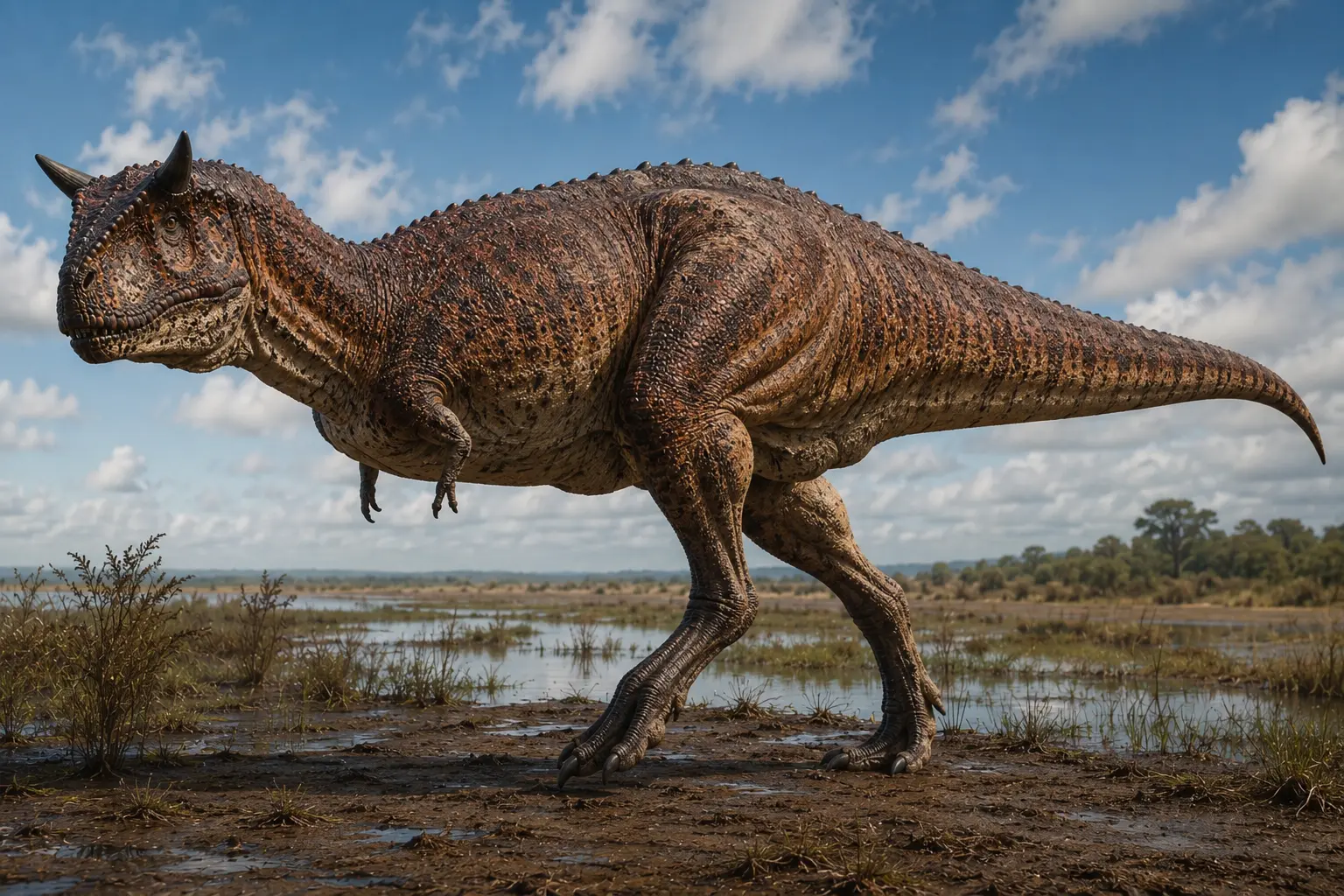
Carnotaurus Quick Info
| Field | Information |
|---|---|
| Scientific Name | Carnotaurus sastrei |
| Common Name | Carnotaurus |
| Taxonomic Status | Valid species |
| Classification | Theropoda → Abelisauridae |
| Geological Age | Late Cretaceous (Maastrichtian) |
| Age Range | Approximately 72–69.9 million years ago |
| Formation | La Colonia Formation (commonly cited; stratigraphic interpretation remains discussed) |
| Location | Chubut Province, Patagonia, Argentina |
| Diet | Carnivorous |
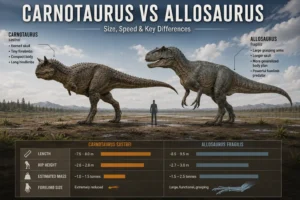
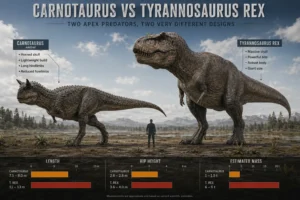
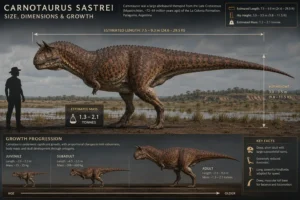
| Estimated Length | 7.5–9 m |
| Estimated Weight | 1.3–2.1 tonnes |
| Locomotion | Bipedal |
| Holotype | MACN-CH 894 |
| Fossil Completeness | Exceptional |
| Evidence Strength | Direct Evidence |
Quick Answer
Carnotaurus sastrei was a large predatory dinosaur that lived in Patagonia during the Late Cretaceous. It is best known for the distinctive horns above its eyes, extremely reduced forelimbs, and one of the most complete skeletons known among abelisaurid theropods. Fossil evidence indicates that it was a fast-moving bipedal carnivore, although the exact extent of its running abilities remains debated. Extensive skin impressions preserved alongside the skeleton provide rare direct evidence of the animal’s external appearance, making Carnotaurus one of the most scientifically important theropods from South America.

Summary
| Topic | Current Scientific Understanding |
|---|---|
| Size | Large theropod measuring approximately 7.5–9 m in length |
| Diet | Carnivorous predator |
| Habitat | Coastal plains, river systems, and floodplain environments of Late Cretaceous Patagonia |
| Horns | Likely used for display, species recognition, and possibly low-impact combat |
| Skin | Extensive scales preserved; no evidence of feathers |
| Locomotion | Adapted for efficient running, though speed estimates remain uncertain |
| Fossil Evidence | Known from an exceptionally complete skeleton and skin impressions |
| Scientific Confidence | High for anatomy; moderate for ecology and behavior |
Introduction
Carnotaurus is one of the most recognizable predatory dinosaurs ever discovered. Described in 1985 by Argentine paleontologist José Bonaparte, it belongs to Abelisauridae, a group of theropod dinosaurs that dominated many southern continents during the Late Cretaceous.
The species is represented by a remarkably complete skeleton discovered in Patagonia, Argentina. This specimen preserves much of the skull, vertebral column, limbs, and extensive skin impressions. Such preservation is uncommon among large theropod dinosaurs and provides researchers with unusually detailed information about Carnotaurus anatomy.
Although often overshadowed by larger predators such as Tyrannosaurus and Giganotosaurus, Carnotaurus occupies an important place in dinosaur research because it demonstrates how abelisaurids evolved highly specialized body plans, including shortened skulls, distinctive horns, and dramatically reduced forelimbs.
Classification
Carnotaurus belongs to the theropod dinosaur lineage, the same broad group that includes birds and many famous predatory dinosaurs.
Classification Summary
| Rank | Taxon |
|---|---|
| Kingdom | Animalia |
| Phylum | Chordata |
| Clade | Dinosauria |
| Clade | Theropoda |
| Family | Abelisauridae |
| Genus | Carnotaurus |
| Species | Carnotaurus sastrei |
Abelisaurids were particularly successful across the southern continents during the Late Cretaceous. Carnotaurus represents one of the most specialized members of this family and is often considered among the best-known abelisaurids because of its exceptional preservation.
Evidence Strength Overview
| Topic | Evidence Strength |
|---|---|
| Classification | Direct Evidence |
| Size | Direct Evidence |
| Fossil Preservation | Direct Evidence |
| Skin Texture | Direct Evidence |
| Diet | Strong Inference |
| Habitat | Direct Geological Evidence |
| Horn Function | Strong Inference |
| Locomotion | Limited Evidence |
| Hunting Behaviour | Limited Evidence |
| Social Behaviour | Unknown |
Current Evidence Status
| Topic | Confidence |
|---|---|
| Horn Presence | High |
| Display Function | Moderate |
| Combat Function | Low |
| Sexual Signaling | Low |
Size Summary
| Measurement | Current Estimate |
|---|---|
| Length | 7.5–9 m |
| Weight | 1.3–2.1 tonnes |
| Height at Hips | Approximately 2.5–3 m |
| Fossil Basis | Holotype skeleton |
| Evidence Strength | Direct Evidence |
Carnotaurus was a large predator, though not among the largest theropods known. Most modern estimates place its length between approximately 7.5 and 9 meters, with body mass estimates commonly ranging from about 1.3 to 2.1 tonnes.
The animal possessed a deep skull, powerful hind limbs, and a relatively lightweight body compared with some giant theropods. These proportions have led some researchers to suggest that Carnotaurus was adapted for rapid movement.
For detailed measurement analysis, specimen comparisons, and discussion of competing estimates, see the dedicated Carnotaurus Size guide.
Diet Summary
| Topic | Current Understanding |
|---|---|
| Diet Type | Carnivorous |
| Direct Prey Evidence | None known |
| Feeding Evidence | Skull and tooth morphology |
| Ecological Role | Large terrestrial predator |
| Evidence Strength | Strong Inference |
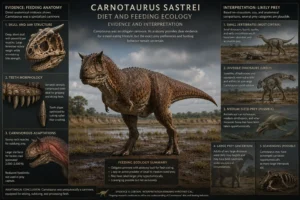
Carnotaurus was a carnivore whose anatomy clearly indicates a predatory lifestyle. Its skull was deep and heavily built, while its teeth were blade-like and suited for processing flesh.
Potential Prey Assessment
| Candidate Prey | Evidence Level |
|---|---|
| Small dinosaurs | Moderate |
| Juvenile titanosaurs | Low |
| Crocodyliforms | Low |
| Scavenged carcasses | Moderate |
Direct evidence of specific prey remains unknown, but researchers generally infer that Carnotaurus hunted or scavenged medium-sized vertebrates that shared its ecosystem. The exact composition of its diet remains uncertain because no preserved stomach contents or feeding traces have been conclusively linked to the species.
For a full evidence review, see Carnotaurus Diet.
Habitat Summary
| Topic | Current Understanding |
|---|---|
| Geological Age | Maastrichtian, Late Cretaceous |
| Region | Patagonia, Argentina |
| Formation | La Colonia Formation (commonly cited; stratigraphic interpretation remains discussed) |
| Environment | Floodplains, coastal plains, river systems |
| Evidence Strength | Direct Geological Evidence |
Carnotaurus lived in what is now Patagonia during the Late Cretaceous. Fossil and geological evidence suggests environments that included floodplains, river systems, coastal regions, and vegetated lowlands.
The region supported a diverse fauna of dinosaurs, crocodyliforms, turtles, fishes, and other vertebrates. Carnotaurus occupied the role of a large terrestrial predator within these ecosystems.
For detailed paleoenvironmental reconstruction, see Carnotaurus Habitat.
Horns and Skull Features
| Topic | Current Understanding |
|---|---|
| Horn Presence | Confirmed |
| Horn Location | Above the eyes |
| Display Function | Supported hypothesis |
| Combat Function | Possible but debated |
| Evidence Strength | Strong Inference |
The defining feature of Carnotaurus is the pair of thick horns positioned above the eyes. These horns are unique among large theropod dinosaurs and have been the subject of considerable scientific study.
Horn Function Hypothesis Comparison
| Hypothesis | Support Level | Evidence Type |
|---|---|---|
| Display | Strong | Comparative anatomy |
| Species Recognition | Moderate | Evolutionary inference |
| Sexual Signaling | Moderate | Comparative analogy |
| Combat | Limited | Biomechanical studies |
Researchers have proposed several functions, including visual display, species recognition, sexual signaling, and limited head-to-head combat. Current evidence supports display-related functions, although the possibility of physical interactions between individuals remains under investigation.
The skull itself was unusually short and deep compared with many other large theropods, creating one of the most distinctive head profiles in dinosaur evolution.
For a detailed discussion of competing hypotheses, see Carnotaurus Horn Function.
Fossil Evidence Summary
| Topic | Evidence |
|---|---|
| Holotype | MACN-CH 894 |
| Skeleton Preservation | Near complete |
| Skull Preservation | Complete |
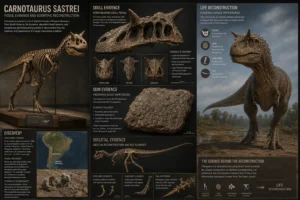
| Skin Impressions | Extensive |
| Evidence Strength | Direct Evidence |
Carnotaurus is known primarily from a single exceptionally preserved specimen discovered in Chubut Province, Argentina.
The holotype preserves:
- Most of the skeleton
- The complete skull
- Vertebral column
- Limb elements
- Pelvic elements
- Extensive skin impressions
The preserved skin impressions reveal large scales interspersed with larger conical feature scales. No feather impressions have been found.
Because of this preservation quality, Carnotaurus provides some of the best direct evidence for abelisaurid anatomy and external appearance.
For a full specimen history and fossil review, see Carnotaurus Fossils and Discovery.
Locomotion Summary
| Topic | Current Understanding |
|---|---|
| Locomotion | Bipedal |
| Hind Limb Adaptations | Present |
| Running Ability | Likely strong |
| Maximum Speed | Uncertain |
| Evidence Strength | Limited Evidence |
Carnotaurus possessed unusually long hind limbs relative to body size and an anatomy that suggests efficient forward movement. Several biomechanical studies have proposed that it may have been among the faster large theropods.
However, speed estimates vary depending on reconstruction methods and modeling assumptions. Current evidence supports strong running ability but does not allow a precise maximum speed to be determined with confidence.
Locomotion Evidence Table
| Feature | Locomotor Significance |
|---|---|
| Long hind limbs | Increased stride |
| Enlarged tail musculature | Greater propulsion |
| Reduced forelimbs | Reduced anterior mass |
| Deep caudal musculature | Acceleration potential |
Behavioral interpretations based on locomotion remain limited, and speed estimates should be treated cautiously.
For detailed biomechanical analysis, see Carnotaurus Speed and Locomotion.
Remaining Scientific Uncertainties
Although Carnotaurus is one of the best-preserved abelisaurid theropods, several aspects of its biology remain unresolved.
| Topic | Current Status |
|---|---|
| Horn Function | Debated |
| Maximum Running Speed | Uncertain |
| Hunting Strategy | Limited Evidence |
| Preferred Prey | Unknown |
| Social Behaviour | Unknown |
| Reproductive Biology | Unknown |
| Growth Rate | Under Investigation |
The most significant debates concern the function of the skull horns and the extent of Carnotaurus’s locomotor specialization. Researchers continue to evaluate whether the horns were primarily used for display, species recognition, or physical interactions between individuals. Likewise, biomechanical studies support efficient running ability but do not provide a definitive maximum speed estimate.
Other uncertainties stem from the absence of direct fossil evidence. No nests, eggs, embryos, stomach contents, or trackways have been conclusively attributed to Carnotaurus. As a result, reproductive behavior, prey preferences, and social interactions remain poorly understood.
Future discoveries of additional specimens could significantly improve understanding of these aspects of Carnotaurus biology.
Related Abelisaurids
| Species | Relationship |
|---|---|
| Majungasaurus | Close abelisaurid relative from Madagascar |
| Aucasaurus | South American abelisaurid |
| Skorpiovenator | Derived Patagonian abelisaurid |
| Rajasaurus | Indian abelisaurid |
| Ekrixinatosaurus | Large South American abelisaurid |
FAQ
What does the name Carnotaurus mean?
The name Carnotaurus means “meat-eating bull,” referring to its carnivorous lifestyle and the horn-like structures above its eyes.
How big was Carnotaurus?
Most estimates place Carnotaurus at approximately 7.5–9 meters in length and between 1.3 and 2.1 tonnes in mass.
Did Carnotaurus have feathers?
No direct evidence of feathers has been discovered. The known skin impressions preserve scales and larger feature scales.
Why did Carnotaurus have horns?
Researchers have proposed functions including display, species recognition, and possibly limited combat. No single explanation has been conclusively demonstrated.
Was Carnotaurus faster than Tyrannosaurus rex?
Some biomechanical analyses suggest Carnotaurus may have been capable of faster sustained running than Tyrannosaurus rex, but precise comparisons remain uncertain and depend on modeling assumptions.
Current Scientific Understanding
Carnotaurus is one of the best-understood abelisaurid theropods because its holotype preserves an exceptionally complete skeleton and extensive skin impressions. Scientific confidence is highest regarding its anatomy, body size, classification, and external skin texture.
Evidence strongly supports its interpretation as a large terrestrial predator with specialized cranial ornamentation and extremely reduced forelimbs. However, questions remain regarding the precise function of its horns, the limits of its running ability, and aspects of its predatory behavior.
Current research increasingly emphasizes Carnotaurus as a highly specialized abelisaurid adapted to the ecosystems of Late Cretaceous South America. While future discoveries may refine ecological interpretations, the overall anatomical understanding of the species is considered robust and scientifically stable.
Stratigraphic Notes
Current literature generally places Carnotaurus sastrei within Maastrichtian deposits of Patagonia. Some discussions concerning formation-level assignment and regional stratigraphy persist, but these do not affect the validity of the species.
References
A. Primary Taxonomic Sources
Bonaparte, J.F. 1985. A horned Cretaceous carnosaur from Patagonia. National Geographic Research 1(2):149–151.
Bonaparte, J.F., Novas, F.E., and Coria, R.A. 1990. Carnotaurus sastrei Bonaparte, the horned, lightly built carnosaur from the Middle Cretaceous of Patagonia. Contributions in Science 416:1–42.
B. Scientific Literature
Mazzetta, G.V., Fariña, R.A., and Vizcaíno, S.F. 1998. On the palaeobiology of Carnotaurus sastrei Bonaparte. Gaia 15:185–192.
Persons, W.S. IV and Currie, P.J. 2011. Dinosaur speed demon: The caudal musculature of Carnotaurus sastrei and implications for the evolution of South American abelisaurids. PLOS ONE 6(10):e25763.
Delcourt, R. 2018. Ceratosaur palaeobiology: New insights on evolution and ecology of the southern rulers. Scientific Reports 8:9730.
C. Books and Reference Works
Holtz, T.R. Jr. 2011. Dinosaurs: The Most Complete, Up-to-Date Encyclopedia for Dinosaur Lovers of All Ages.
Paul, G.S. 2016. The Princeton Field Guide to Dinosaurs, 2nd Edition.
D. Databases and Online Resources
Paleobiology Database. Carnotaurus occurrence and taxonomic data.
⚖️ Comparison

🦷 Anatomy


🦴 Fossil History
Recommended Paleontology & Natural History Books
As an Amazon Associate, Extinct Atlas may earn from qualifying purchases.
The Rise and Fall of the Dinosaurs
A compelling history of dinosaurs, tracing their origins, diversification, 200-million-year reign, extinction, and enduring legacy.
Dinosaurs and Prehistoric Life
A richly illustrated visual reference exploring dinosaurs, fossils, evolution, and prehistoric life across geological time.
Encyclopedia Prehistorica: Dinosaurs
An interactive dinosaur book featuring spectacular three-dimensional pop-ups, particularly suited to young readers and families.
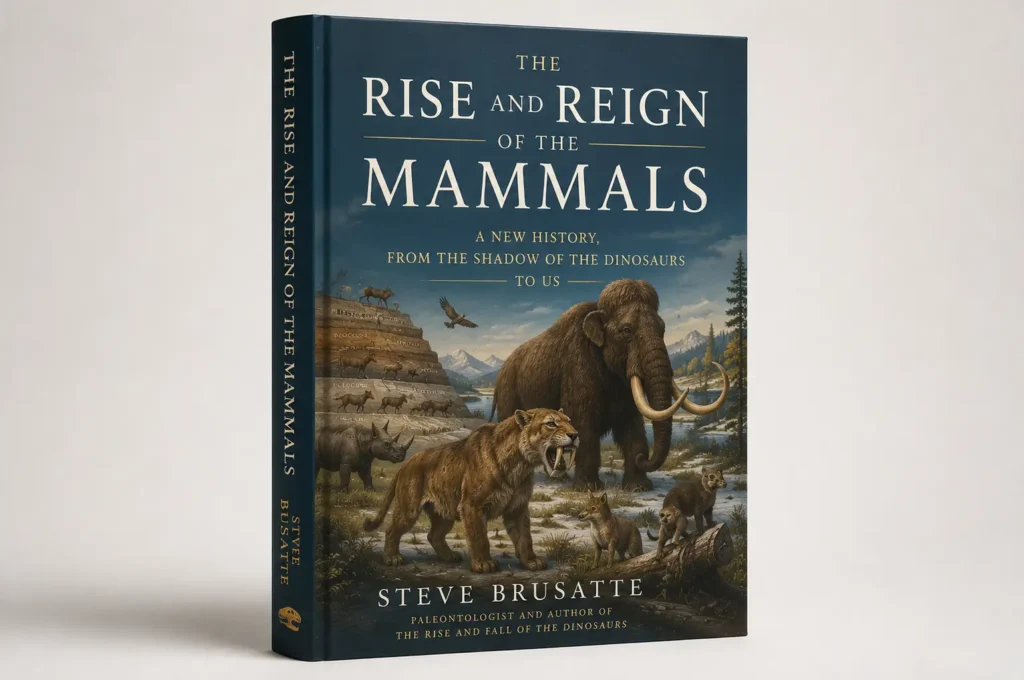
The Rise and Reign of the Mammals
A sweeping history of mammalian evolution, from their origins alongside dinosaurs through the Cenozoic and the emergence of humans.