
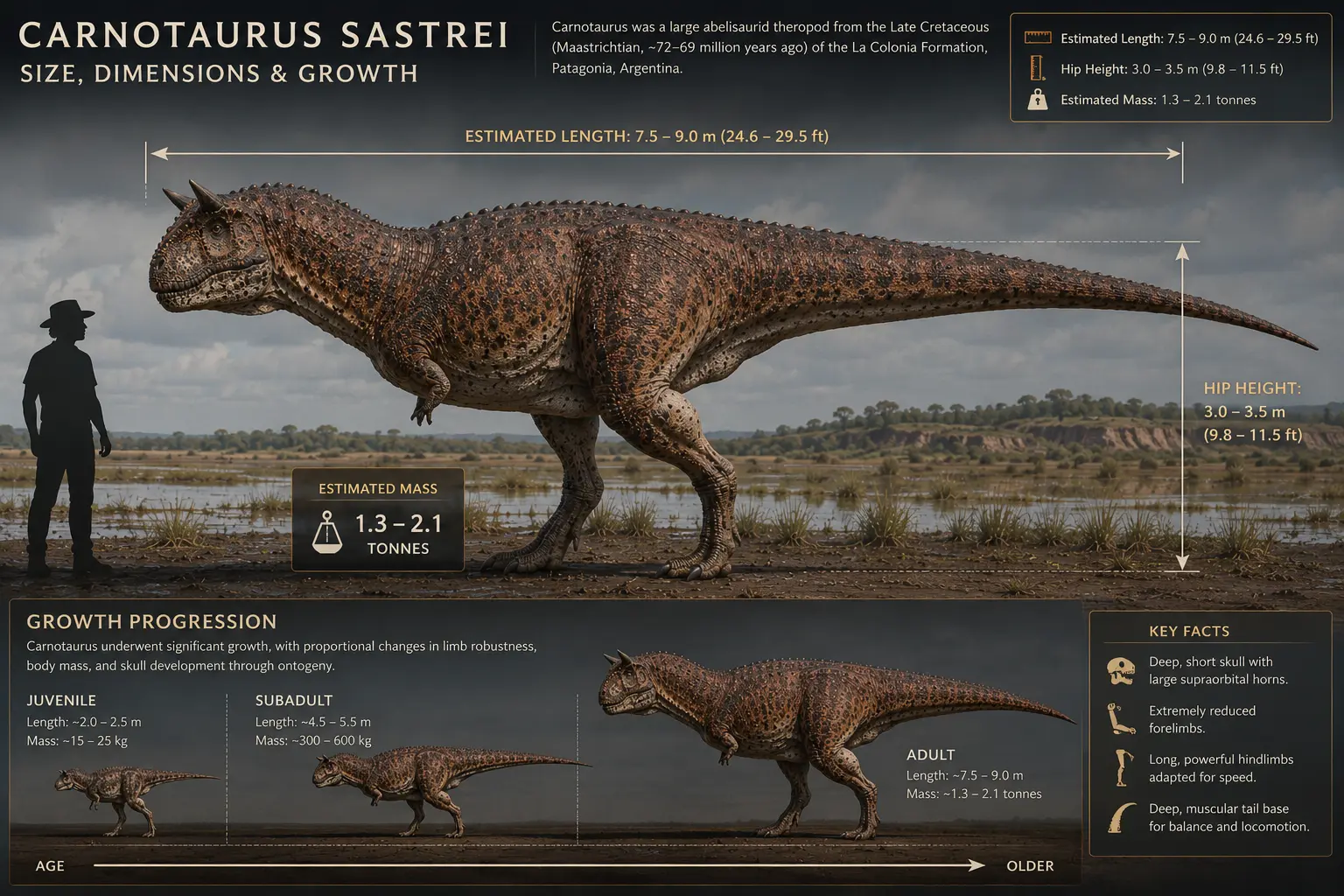
Species Quick Info
| Field | Information |
|---|---|
| Scientific Name | Carnotaurus sastrei |
| Topic | Body Size |
| Taxonomic Group | Abelisauridae |
| Geological Age | Late Cretaceous (72–69.9 Ma) |
| Known Specimen Basis | Holotype MACN-CH 894 |
| Estimated Length | 7.5–9 m |
| Estimated Weight | 1.3–2.1 tonnes |
| Evidence Strength | Direct Evidence |
Quick Answer
Carnotaurus sastrei was a large theropod dinosaur measuring approximately 7.5–9 meters (25–30 feet) in length and weighing roughly 1.3–2.1 tonnes. Most size estimates are based on its exceptionally complete holotype skeleton, making Carnotaurus one of the best-documented abelisaurids. Although different studies have produced somewhat different measurements, researchers generally agree that Carnotaurus was a large predator, though smaller than giant theropods such as Tyrannosaurus rex, Giganotosaurus, and Spinosaurus.

Summary Table
| Measurement | Current Estimate |
|---|---|
| Length | 7.5–9 m |
| Weight | 1.3–2.1 tonnes |
| Hip Height | Approximately 2.5–3 m |
| Skull Length | Approximately 60 cm |
| Largest Known Individual | Holotype MACN-CH 894 |
| Evidence Strength | Direct Evidence |
Introduction
Carnotaurus was among the largest predatory dinosaurs inhabiting South America during the Late Cretaceous. Unlike many large theropods known from fragmentary remains, Carnotaurus is represented by a remarkably complete skeleton, allowing researchers to estimate its body dimensions with a relatively high degree of confidence.
Most size discussions focus on body length and mass. While the preserved skeleton provides direct anatomical evidence, body mass estimates require reconstruction and therefore vary somewhat among studies. As a result, published measurements should be viewed as scientifically informed ranges rather than precise values.
Size Evidence Strength
| Measurement | Confidence |
|---|---|
| Length | High |
| Hip Height | High |
| Skull Length | High |
| Weight | Moderate |
| Growth Rate | Low |
| Maximum Species Size | Low |
How Large Was Carnotaurus?
Size Overview
| Dimension | Estimate |
|---|---|
| Length | 7.5–9 m |
| Weight | 1.3–2.1 tonnes |
| Hip Height | 2.5–3 m |
| Skull Length | Approximately 60 cm |
Carnotaurus possessed a relatively streamlined body compared with some larger theropods. It combined a deep skull and powerful hind limbs with a comparatively lightweight build.
The animal’s proportions differ noticeably from those of giant tyrannosaurids and carcharodontosaurids. Rather than achieving enormous mass, Carnotaurus appears to have emphasized locomotor efficiency and agility.
Evidence Strength
Direct Evidence
Length estimates are based directly on the preserved skeleton.
Length Estimates
Body length estimates for Carnotaurus are among the least controversial measurements because the holotype preserves most of the skeleton.
Published Length Estimates
| Study Type | Length Estimate |
|---|---|
| Conservative Reconstructions | ~7.5 m |
| Common Modern Estimates | 8–8.5 m |
| Upper Estimates | ~9 m |
Differences arise from alternative methods of reconstructing missing portions of the tail and minor uncertainties in vertebral articulation.
Despite these variations, most reconstructions place Carnotaurus comfortably within the 8-meter range.
Evidence Assessment
| Topic | Assessment |
|---|---|
| Skeletal Preservation | Exceptional |
| Missing Material | Minimal |
| Confidence Level | High |
| Evidence Strength | Direct Evidence |
Weight Estimates
Estimating body mass is more difficult than estimating length because soft tissues are not preserved.
Researchers typically use volumetric reconstructions, limb measurements, and biomechanical models to estimate body weight.
Published Mass Estimates
| Estimate Range | Approximate Weight |
|---|---|
| Lower Estimates | ~1.3 tonnes |
| Common Estimates | 1.5–1.8 tonnes |
| Upper Estimates | ~2.1 tonnes |
Why Estimates Differ
| Factor | Effect |
|---|---|
| Soft Tissue Reconstruction | Changes body volume |
| Muscle Mass Assumptions | Alters final weight |
| Modeling Techniques | Produces different outcomes |
| Skeletal Posture | Influences body shape estimates |
Because mass estimates rely partly on reconstruction, they should be treated as ranges rather than exact values.
Evidence Strength
Strong Inference
The skeleton is directly preserved, but body mass must be reconstructed.
Comparison With Other Abelisaurids
Carnotaurus ranks among the largest known members of Abelisauridae.
Selected Abelisaurid Size Comparison
| Taxon | Length | Weight |
|---|---|---|
| Carnotaurus | 7.5–9 m | 1.3–2.1 t |
| Majungasaurus | 6–7 m | 0.75–1.2 t |
| Rajasaurus | 6.5–8 m | ~1–2 t |
| Skorpiovenator | ~6 m | ~1 t |
| Aucasaurus | 5–6 m | ~0.5–0.8 t |
Carnotaurus appears to have been among the most derived and largest abelisaurids currently known, although some estimates for related taxa remain uncertain.
Comparison With Larger Theropods
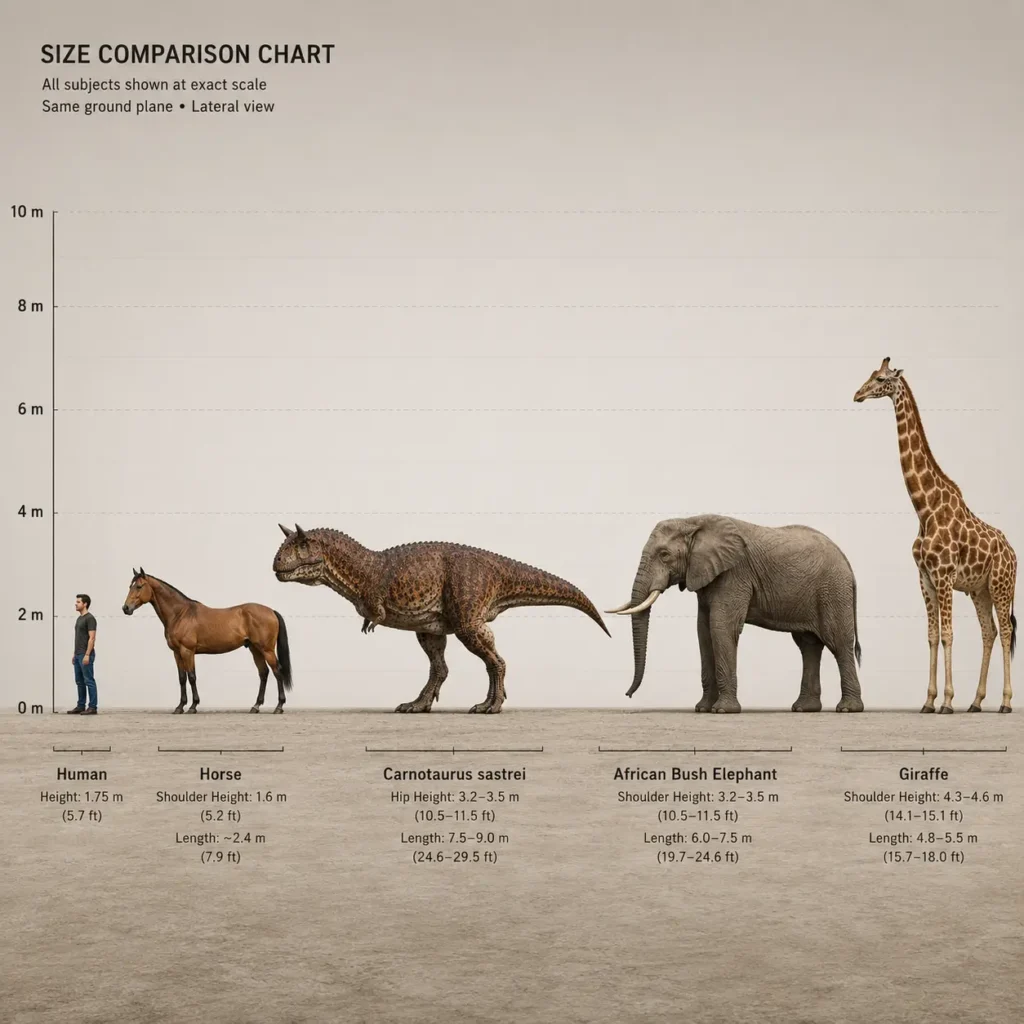
Although Carnotaurus was a large predator, it was considerably smaller than several famous theropods.
Large Theropod Comparison
| Taxon | Length |
|---|---|
| Carnotaurus | 7.5–9 m |
| Tyrannosaurus rex | 12–13 m |
| Giganotosaurus carolinii | 12–13 m |
| Spinosaurus aegyptiacus | 14–15 m+ |
These comparisons illustrate that Carnotaurus occupied the medium-to-large theropod size category rather than the giant category.
Growth and Size Variation
Because only a single exceptionally complete specimen is known, growth patterns remain incompletely understood.
Current Evidence
| Topic | Status |
|---|---|
| Adult Size | Well Supported |
| Juvenile Material | Limited |
| Growth Rate | Under Investigation |
| Maximum Species Size | Uncertain |
The holotype is generally interpreted as representing a mature or near-mature individual. However, the absence of numerous specimens limits understanding of variation within the species.
Evidence Strength
Limited Evidence
Additional specimens are needed to fully understand growth and population-level size variation.
Evidence Assessment
Measurement Reliability
| Measurement | Evidence Strength |
|---|---|
| Skeleton Length | Direct Evidence |
| Skull Size | Direct Evidence |
| Limb Proportions | Direct Evidence |
| Body Mass | Strong Inference |
| Growth Rate | Limited Evidence |
| Maximum Species Size | Limited Evidence |
The exceptional preservation of the holotype provides unusually reliable anatomical measurements. Uncertainty increases when estimating body mass or broader population characteristics.
Remaining Scientific Uncertainties
| Topic | Current Status |
|---|---|
| Maximum Adult Size | Uncertain |
| Species-Wide Variation | Poorly Known |
| Growth Rate | Under Investigation |
| Sexual Size Differences | Unknown |
| Juvenile Proportions | Poorly Known |
Most uncertainties arise from the limited number of known specimens rather than poor fossil preservation. Future discoveries could significantly improve understanding of growth and variation within the species.
FAQ
How big was Carnotaurus?
Most studies estimate a length of approximately 7.5–9 meters and a weight of roughly 1.3–2.1 tonnes.
Was Carnotaurus larger than Tyrannosaurus rex?
No. Tyrannosaurus rex was substantially larger and heavier.
How tall was Carnotaurus?
Hip height is generally estimated at approximately 2.5–3 meters.
Why do weight estimates vary?
Mass estimates require reconstruction of muscles and soft tissues, which are not preserved in fossils.
Is Carnotaurus the largest abelisaurid?
It is among the largest known abelisaurids, although some estimates for related taxa remain subject to revision.
Current Scientific Understanding
Carnotaurus was a large abelisaurid theropod measuring approximately 7.5–9 meters in length and weighing between 1.3 and 2.1 tonnes. Its exceptional skeletal preservation allows unusually reliable estimates of body proportions and overall size compared with many other theropods.
Length estimates are supported directly by fossil evidence and carry relatively high confidence. Mass estimates are less certain because they depend on reconstructed soft tissues and modeling assumptions. The principal limitations in understanding Carnotaurus size stem not from fossil quality but from the fact that only one exceptionally complete specimen is currently known.
Overall, current evidence indicates that Carnotaurus was among the largest abelisaurids while remaining substantially smaller than the giant theropods that dominated some Late Cretaceous ecosystems.
References
A. Primary Taxonomic Sources
Bonaparte, J.F. 1985. A horned Cretaceous carnosaur from Patagonia. National Geographic Research 1(2):149–151.
Bonaparte, J.F., Novas, F.E., and Coria, R.A. 1990. Carnotaurus sastrei Bonaparte, the horned, lightly built carnosaur from the Middle Cretaceous of Patagonia. Contributions in Science 416:1–42.
B. Scientific Literature
Mazzetta, G.V., Fariña, R.A., and Vizcaíno, S.F. 1998. On the palaeobiology of Carnotaurus sastrei Bonaparte. Gaia 15:185–192.
Persons, W.S. IV and Currie, P.J. 2011. Dinosaur speed demon: The caudal musculature of Carnotaurus sastrei and implications for the evolution of South American abelisaurids. PLOS ONE 6(10):e25763.
Delcourt, R. 2018. Ceratosaur palaeobiology: New insights on evolution and ecology of the southern rulers. Scientific Reports 8:9730.
C. Books and Reference Works
Paul, G.S. 2016. The Princeton Field Guide to Dinosaurs. 2nd Edition. Princeton University Press.
Holtz, T.R. Jr. 2011. Dinosaurs: The Most Complete, Up-to-Date Encyclopedia for Dinosaur Lovers of All Ages.
D. Databases and Online Resources
Paleobiology Database. Taxonomic and occurrence data for Carnotaurus sastrei.
Recommended Paleontology & Natural History Books
As an Amazon Associate, Extinct Atlas may earn from qualifying purchases.
The Rise and Fall of the Dinosaurs
A compelling history of dinosaurs, tracing their origins, diversification, 200-million-year reign, extinction, and enduring legacy.
Dinosaurs and Prehistoric Life
A richly illustrated visual reference exploring dinosaurs, fossils, evolution, and prehistoric life across geological time.
Encyclopedia Prehistorica: Dinosaurs
An interactive dinosaur book featuring spectacular three-dimensional pop-ups, particularly suited to young readers and families.
The Rise and Reign of the Mammals
A sweeping history of mammalian evolution, from their origins alongside dinosaurs through the Cenozoic and the emergence of humans.