Species Quick Info
| Field | Information |
|---|---|
| Scientific Name | Carnotaurus sastrei |
| Topic | Horn Function |
| Taxonomic Group | Abelisauridae |
| Geological Age | Late Cretaceous (72–69.9 Ma) |
| Fossil Basis | Holotype MACN-CH 894 |
| Horn Preservation | Complete cranial horns preserved |
| Scientific Status | Active Research Topic |
| Evidence Strength | Strong Inference |
Quick Answer
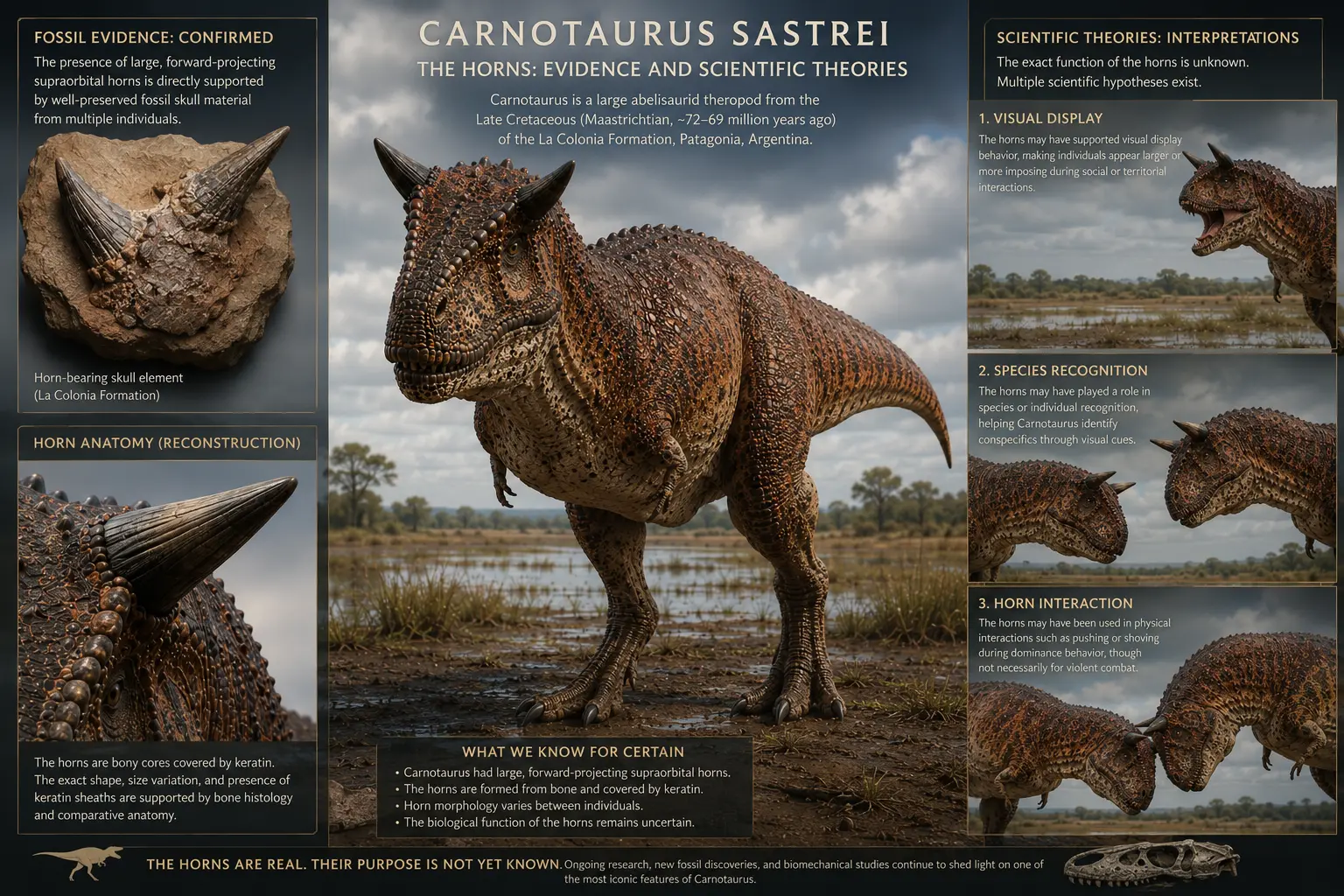
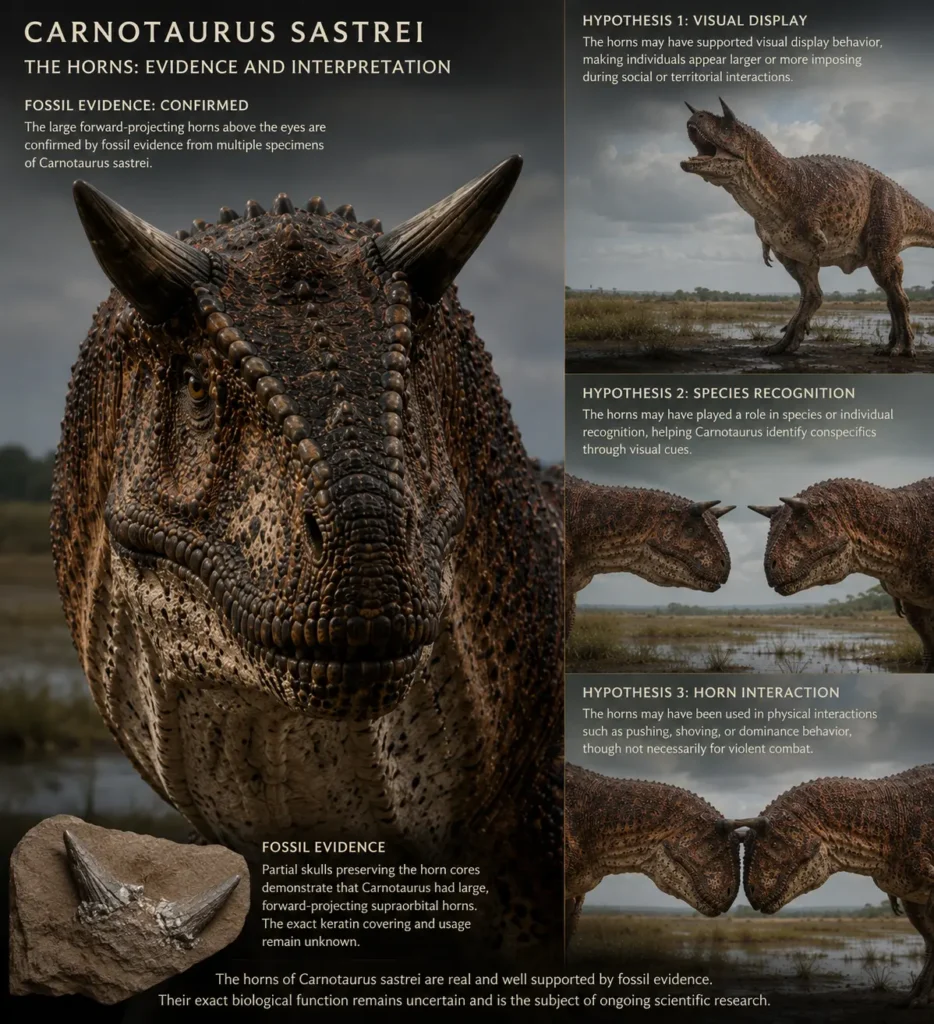
The horns of Carnotaurus were almost certainly important biological structures, but their exact function remains uncertain. Researchers have proposed several explanations, including visual display, species recognition, sexual signaling, and limited head-to-head combat. Current evidence most strongly supports display-related functions, while physical interactions between individuals remain plausible but less certain. No direct fossil evidence conclusively demonstrates how the horns were used in life.

Summary
| Topic | Current Understanding |
|---|---|
| Horn Presence | Confirmed |
| Horn Location | Above the eyes |
| Display Function | Supported |
| Species Recognition | Supported |
| Sexual Signaling | Possible |
| Combat Function | Possible but debated |
| Evidence Strength | Strong Inference |
Introduction
Among all large theropod dinosaurs, Carnotaurus possessed one of the most distinctive skull ornamentations ever discovered. The paired horns above its eyes immediately distinguish it from other abelisaurids and from most predatory dinosaurs more generally.
Unlike many cranial structures preserved in extinct animals, the horns of Carnotaurus are known directly from exceptionally preserved fossil material. Their existence is not debated. What remains uncertain is why such structures evolved and how they were used.
Because behavior does not fossilize directly, interpretations of horn function rely on anatomical evidence, biomechanical studies, comparisons with living animals, and broader evolutionary patterns among horned vertebrates. Several competing hypotheses have emerged, and researchers continue to evaluate their relative strengths.
Current Evidence Status
| Topic | Confidence |
|---|---|
| Horn Presence | High |
| Horn Anatomy | High |
| Display Function | Moderate |
| Species Recognition | Moderate |
| Combat Function | Low |
| Sexual Signaling | Low |
Horn Anatomy
The horns of Carnotaurus formed from thickened frontal bones positioned above the eyes. Each horn projected upward and slightly outward from the skull, creating a distinctive profile unlike that of any other known large theropod.
Horn Anatomy Summary
| Feature | Description |
|---|---|
| Position | Above the eyes |
| Composition | Frontal bone extensions |
| Shape | Thick, conical projections |
| Orientation | Upward and slightly lateral |
| Preservation | Direct fossil evidence |
| Evidence Strength | Direct Evidence |
The horns were not separate structures attached to the skull. Instead, they were integral components of the cranial skeleton. Their robust construction indicates they were biologically significant rather than incidental anatomical features.
The skull surrounding the horns was also unusually deep and reinforced compared with many other theropods, contributing to discussions about potential mechanical functions.
Display Hypothesis
The most widely supported explanation is that the horns functioned primarily as visual display structures.
Evidence Assessment
| Observation | Relevance |
|---|---|
| Highly visible position | Supports display function |
| Distinctive appearance | Supports recognition |
| Limited direct combat evidence | Weakens combat-only interpretation |
| Common evolutionary pattern | Consistent with display structures in living animals |
Researchers frequently note that display structures evolve repeatedly across vertebrates. Horns, crests, antlers, and ornamental feathers often function in communication rather than combat alone.
In this interpretation, the horns may have helped individuals identify members of their own species, assess rivals, attract mates, or communicate social status. Because visual signaling is widespread among modern animals, many paleontologists regard this hypothesis as the most parsimonious explanation.
Evidence Strength
Strong Inference
The horns are directly preserved, but their behavioral function must be inferred.
Species Recognition Hypothesis
A closely related interpretation suggests that the horns helped Carnotaurus recognize members of its own species.
Large theropod ecosystems often contained multiple predatory dinosaurs. Distinctive cranial ornamentation could have provided a rapid visual cue that allowed individuals to identify conspecifics.
Evidence Assessment
| Factor | Assessment |
|---|---|
| Unique horn morphology | Supports recognition |
| Distinct skull profile | Supports recognition |
| Direct behavioral evidence | Absent |
| Comparative support | Moderate |
This hypothesis is difficult to test directly because recognition behaviors do not fossilize. Nevertheless, it remains consistent with broader patterns observed among modern vertebrates.
Evidence Strength
Strong Inference
Combat Hypothesis
Some researchers have proposed that the horns may have been used in physical interactions between individuals.
The idea gained attention because the horns are relatively thick and because portions of the skull appear capable of resisting mechanical stress.
Potential Supporting Evidence
| Observation | Interpretation |
|---|---|
| Robust horn bases | Could withstand force |
| Reinforced skull regions | May reduce impact stress |
| Thick cranial construction | Consistent with limited combat |
Biomechanical analyses have suggested that low-impact pushing or shoving behaviors may have been possible.
However, the horns lack some characteristics commonly associated with specialized combat structures in living animals. Furthermore, no known fossils preserve injuries that clearly demonstrate repeated horn-to-horn fighting.
Evidence Strength
Limited Evidence
Combat remains plausible, but current evidence does not establish it as the primary function.
Sexual Signaling Hypothesis
Another possibility is that the horns played a role in mate attraction or reproductive signaling.
Many living vertebrates use conspicuous cranial structures as sexual signals. If the horns served a similar purpose, they may have communicated health, maturity, or reproductive fitness.
Evidence Assessment
| Factor | Assessment |
|---|---|
| Large visual structures | Consistent with signaling |
| Modern analogs exist | Supports possibility |
| Sexual dimorphism known | No |
| Direct evidence | None |
The principal limitation is the absence of multiple specimens that could reveal differences between sexes. Because only one exceptionally complete specimen is known, sexual signaling remains difficult to evaluate.
Evidence Strength
Limited Evidence
Comparative Context
Cranial ornamentation was common among abelisaurid theropods.
Selected Abelisaurid Comparisons
| Taxon | Ornamentation | Suggested Function |
|---|---|---|
| Carnotaurus | Paired horns | Display debated |
| Majungasaurus | Cranial dome | Display debated |
| Rajasaurus | Crest-horn | Display debated |
| Skorpiovenator | Rugose skull | Unknown |
The repeated evolution of cranial display structures within Abelisauridae suggests that visual signaling may have been an important component of their biology.
This broader evolutionary pattern provides indirect support for display-related interpretations of the horns in Carnotaurus.
Evidence Assessment
Evidence Strength Overview
| Hypothesis | Evidence Strength |
|---|---|
| Display | Strong Inference |
| Species Recognition | Strong Inference |
| Sexual Signaling | Limited Evidence |
| Combat | Limited Evidence |
The strongest evidence supports functions related to visual communication. Combat and reproductive signaling remain possible but are currently less well supported.
Importantly, these hypotheses are not mutually exclusive. A structure can serve multiple biological functions simultaneously.
Remaining Scientific Uncertainties
| Topic | Current Status |
|---|---|
| Primary Horn Function | Debated |
| Frequency of Physical Combat | Unknown |
| Role in Mate Selection | Unknown |
| Degree of Sexual Dimorphism | Unknown |
| Growth Changes Through Life | Poorly Known |
| Soft-Tissue Covering | Unknown |
Although the horns themselves are preserved directly, the behaviors associated with them are not. Additional specimens and future biomechanical analyses may help clarify how these structures functioned in life.
FAQ
Did Carnotaurus really have horns?
Yes. The horns are preserved directly on the skull of the holotype specimen and are among the defining features of the species.
What were the horns used for?
The most widely supported explanation is visual display, although species recognition, sexual signaling, and limited combat remain possible.
Did Carnotaurus fight with its horns?
It may have engaged in low-impact physical interactions, but current evidence does not demonstrate regular horn-to-horn combat.
Were the horns used to hunt prey?
There is currently no strong evidence supporting the use of the horns in prey capture or hunting.
Are there other dinosaurs with similar horns?
Several abelisaurids evolved cranial ornamentation, but the large paired horns of Carnotaurus are among the most distinctive known among theropods.
Current Scientific Understanding
The horns of Carnotaurus are among the most distinctive cranial structures known in predatory dinosaurs. Their presence and anatomy are established by direct fossil evidence, but their behavioral function remains unresolved.
Current research most strongly supports a role in visual communication, including display and species recognition. Combat and sexual signaling remain plausible hypotheses, but direct supporting evidence is limited. The available data suggest that the horns were biologically important structures that likely served one or more social functions rather than purely mechanical roles.
Future discoveries, particularly additional specimens and refined biomechanical analyses, may help clarify how these remarkable structures were used. At present, display-related interpretations represent the closest approximation to scientific consensus.
References
A. Primary Taxonomic Sources
Bonaparte, J.F. 1985. A horned Cretaceous carnosaur from Patagonia. National Geographic Research 1(2):149–151.
Bonaparte, J.F., Novas, F.E., and Coria, R.A. 1990. Carnotaurus sastrei Bonaparte, the horned, lightly built carnosaur from the Middle Cretaceous of Patagonia. Contributions in Science 416:1–42.
B. Scientific Literature
Mazzetta, G.V., Fariña, R.A., and Vizcaíno, S.F. 1998. On the palaeobiology of Carnotaurus sastrei Bonaparte. Gaia 15:185–192.
Delcourt, R. 2018. Ceratosaur palaeobiology: New insights on evolution and ecology of the southern rulers. Scientific Reports 8:9730.
Canale, J.I., Scanferla, C.A., Agnolín, F.L., and Novas, F.E. 2009. New carnivorous dinosaur from the Late Cretaceous of Patagonia and the evolution of Abelisauridae. Naturwissenschaften 96:409–414.
C. Books and Reference Works
Holtz, T.R. Jr. 2011. Dinosaurs: The Most Complete, Up-to-Date Encyclopedia for Dinosaur Lovers of All Ages.
Paul, G.S. 2016. The Princeton Field Guide to Dinosaurs. 2nd Edition. Princeton University Press.
D. Databases and Online Resources
Paleobiology Database. Taxonomic and occurrence data for Carnotaurus sastrei.
Featured Museum Collections
Museum-quality paleoart and educational poster
collections based on evidence-informed prehistoric
Life reconstructions.