| Specimen / Feature | Detail |
|---|---|
| Species | Diplodocus longus — Sauropoda, Diplodocidae |
| Named by | Othniel Charles Marsh, 1878 |
| Type material | Housed at the Yale Peabody Museum |
| Key specimen | Diplodocus carnegii specimen at the Carnegie Museum of Natural History |
| Discovery sites | Morrison Formation deposits of Colorado, Utah, Wyoming, and other regions of western North America |
| Named species | Species-level taxonomy remains under active revision; D. longus and D. carnegii are among the most widely recognised historical species |
Quick Answer
The first Diplodocus fossil was formally described by Othniel Charles Marsh in 1878 from material recovered in Colorado. Subsequent discoveries—particularly the exceptionally complete Diplodocus carnegii skeleton acquired by the Carnegie Museum in the early twentieth century—transformed Diplodocus into one of the best-known sauropods and one of the most widely exhibited dinosaurs in museum collections worldwide.

Few dinosaurs have a discovery history as closely tied to the personalities and rivalries of nineteenth-century palaeontology as Diplodocus. Its naming occurred during the Bone Wars—the intense scientific competition between Othniel Charles Marsh and Edward Drinker Cope—and its later history includes major museum expeditions, international scientific collaboration, and more than a century of taxonomic revision.
Diplodocus Fossil Discovery
The first material assigned to Diplodocus was recovered during the late 1870s from Morrison Formation deposits in Colorado and formally described by Marsh in 1878. Marsh established the genus Diplodocus and designated D. longus as the type species based on fragmentary postcranial remains. The name Diplodocus derives from the distinctive paired chevron bones beneath the tail vertebrae, which Marsh regarded as a defining anatomical feature.
Marsh’s original material was limited, and early reconstructions of the animal were necessarily incomplete. More substantial discoveries followed throughout the 1880s and 1890s as fossil collecting intensified across the Morrison Formation, yielding additional material from Colorado, Wyoming, and Utah.
The Carnegie Museum Specimen
One of the most important discoveries in the history of Diplodocus resulted from expeditions funded by industrialist Andrew Carnegie in the late nineteenth and early twentieth centuries. Fossils recovered from Morrison Formation deposits in Wyoming formed the basis of Diplodocus carnegii, which was named by John Bell Hatcher in 1901.
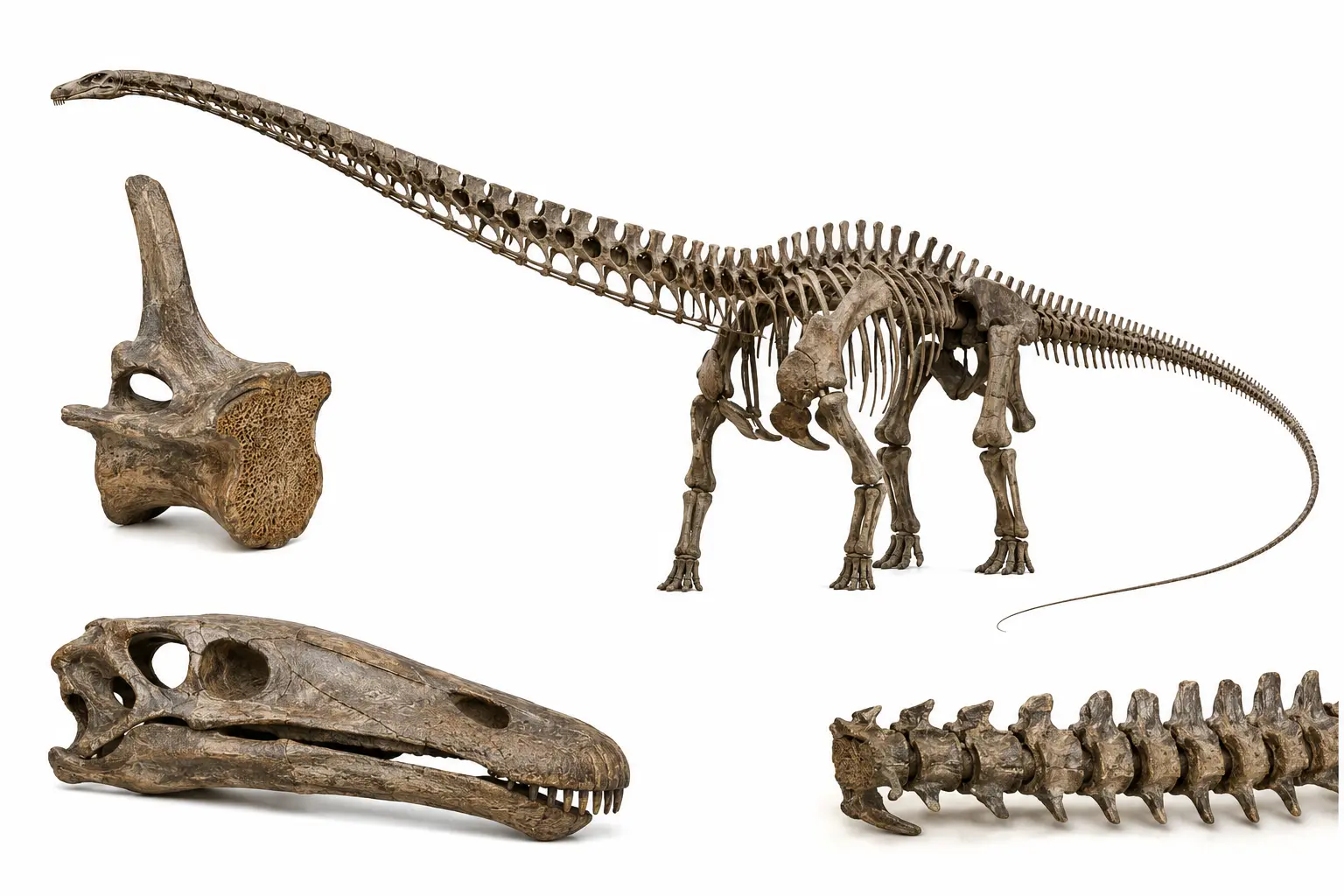
The Carnegie Museum specimen is among the most complete Diplodocus skeletons ever recovered and provided the foundation for many early anatomical studies of the genus. Its exceptional preservation helped establish Diplodocus as one of the best-understood sauropods of its time.
Carnegie later funded the production of full-scale casts of the skeleton, which were presented to major museums across Europe and elsewhere. Replicas displayed in institutions such as those in London, Paris, Berlin, Vienna, and Bologna introduced Diplodocus to an international audience and played a major role in making it one of the most recognisable dinosaurs in the world long before the emergence of modern mass media.
Diplodocus Species and Classification
| Species | Named by | Year | Key material |
|---|---|---|---|
| D. longus | Marsh | 1878 | Fragmentary postcranial remains; type species |
| D. carnegii | Hatcher | 1901 | Near-complete skeleton; Carnegie Museum specimen |
| D. hallorum | Gillette | 1991 | Large fragmentary material originally described as Seismosaurus |
| D. lacustris | Marsh | 1884 | Taxonomic status uncertain; often regarded as a dubious species |
Species diversity within Diplodocus remains an active area of research and may be revised as additional specimens are discovered and phylogenetic analyses are updated. The reassignment of Seismosaurus hallorum to Diplodocus hallorum illustrates how interpretations of sauropod diversity can change as new evidence becomes available. Taxonomic revisions of this kind are common in dinosaur palaeontology and reflect ongoing efforts to clarify relationships within Diplodocidae.
What Does “Diplodocus” Mean?
The name Diplodocus is derived from the Greek words diplos (“double”) and dokos (“beam”), referring to the paired chevron bones on the underside of the tail vertebrae. Marsh regarded these distinctive double-beamed structures as an important diagnostic feature when he established the genus in 1878.
Historical Classification and Taxonomic Revisions
The classification of Diplodocus has changed considerably since its original description. Diplodocidae has been revised repeatedly, and the position of Diplodocus within sauropod evolutionary history has become increasingly refined as new specimens and analytical techniques have become available.
Early classifications grouped many large sauropods using anatomical similarities that would not meet modern phylogenetic standards. The adoption of cladistic methods during the late twentieth century greatly improved understanding of relationships among diplodocids, other diplodocoids, and the broader sauropod lineage. The specimen-level analysis published by Tschopp, Mateus, and Benson in 2015 represented one of the most comprehensive modern revisions of diplodocid taxonomy and remains a widely cited reference for species-level questions within the family.
Several historical interpretations of Diplodocus have since been rejected. Early twentieth-century reconstructions often portrayed the animal as a swamp-dweller that required deep water to support its body weight. Modern evidence from trackways, skeletal biomechanics, and Morrison Formation geology demonstrates that Diplodocus was a fully terrestrial dinosaur capable of supporting its weight on land.
Where Are Diplodocus Fossils Held Today?
Important Diplodocus specimens are housed in several major institutions, including the Carnegie Museum of Natural History in Pittsburgh and the Yale Peabody Museum of Natural History. Casts of the famous Carnegie specimen are displayed in museums around the world, including the Natural History Museum in London.
Dinosaur National Monument on the Colorado–Utah border preserves Morrison Formation fossils within its celebrated quarry wall exhibit, providing one of the few opportunities for visitors to observe dinosaur remains preserved directly within their original rock matrix.
Related and Contemporary Species
- Apatosaurus — a closely related diplodocid recovered from many of the same Morrison Formation deposits as Diplodocus. Its taxonomic history is similarly complex, including the long-running debate surrounding the name Brontosaurus.
- Barosaurus — a close diplodocid relative distinguished by proportionally longer cervical vertebrae and an even more elongated neck.
- Camarasaurus — one of the most abundant sauropods in the Morrison Formation and frequently recovered from the same fossil-bearing deposits as Diplodocus.
- Supersaurus — a giant diplodocid known from fragmentary remains, with some reconstructions suggesting total lengths that may have exceeded those of Diplodocus.
- Brontosaurus — historically synonymised with Apatosaurus but recognised as a distinct genus in some modern phylogenetic analyses. Its classification history illustrates the continuing refinement of diplodocid taxonomy.
Frequently Asked Questions
Who discovered Diplodocus?
Diplodocus was first formally described by Othniel Charles Marsh in 1878 based on fossil material recovered from the Morrison Formation of Colorado. Marsh established both the genus Diplodocus and the type species Diplodocus longus. The fossils themselves were collected by field crews working for Marsh during the Bone Wars, the intense period of dinosaur discovery and scientific rivalry that characterised late nineteenth-century American palaeontology.
How many Diplodocus skeletons have been found?
Multiple Diplodocus individuals have been recovered from Morrison Formation deposits, making it one of the better-represented sauropods in the fossil record. Numerous specimens ranging from isolated bones to relatively complete skeletons have contributed to the scientific understanding of the genus. Exact specimen counts vary depending on taxonomic interpretation, specimen completeness, and whether fragmentary material is included.
Note
Diplodocus species diversity, the status of historically named species, and the phylogenetic relationships within Diplodocidae remain active areas of research. Interpretations presented here reflect current scientific understanding but may be refined as discoveries and analytical methods become available.
Conclusion
Diplodocus has one of the richest discovery histories of any dinosaur, spanning more than a century of scientific investigation. From Marsh’s original description in 1878 to modern specimen-level phylogenetic analyses, its fossils have played a central role in shaping scientific and public understanding of sauropod dinosaurs. Continued discoveries and taxonomic research ensure that Diplodocus remains one of the most important and extensively studied dinosaurs in the fossil record.
References
A. Primary Taxonomic Sources
Marsh, O.C., 1878. Principal characters of American Jurassic dinosaurs. Part I. American Journal of Science and Arts, Series 3, 16(95), pp.411–416.
Hatcher, J.B., 1901. Diplodocus (Marsh): Its Osteology, Taxonomy, and Probable Habits, with a Restoration of the Skeleton. Memoirs of the Carnegie Museum, 1(1), pp.1–63.
Gillette, D.D., 1991. Seismosaurus halli, gen. et sp. nov., a new sauropod dinosaur from the Morrison Formation (Upper Jurassic/Lower Cretaceous) of New Mexico, USA. Journal of Vertebrate Paleontology, 11(4), pp.417–433.
B. Peer-Reviewed Literature
Tschopp, E., Mateus, O. and Benson, R.B.J., 2015. A specimen-level phylogenetic analysis and taxonomic revision of Diplodocidae (Dinosauria, Sauropoda). PeerJ, 3:e857. https://doi.org/10.7717/peerj.857
Upchurch, P., Barrett, P.M. and Dodson, P., 2004. Sauropoda. In: Weishampel, D.B., Dodson, P. and Osmólska, H. (eds.) The Dinosauria. 2nd ed. Berkeley: University of California Press, pp.259–322.
D. Databases and Online Resources
Paleobiology Database, 2026. Diplodocus taxonomic and occurrence data. Available at: https://paleobiodb.org [Accessed 19 May 2026].
Featured Museum Collections
Museum-quality paleoart and educational poster
collections based on evidence-informed prehistoric
Life reconstructions.