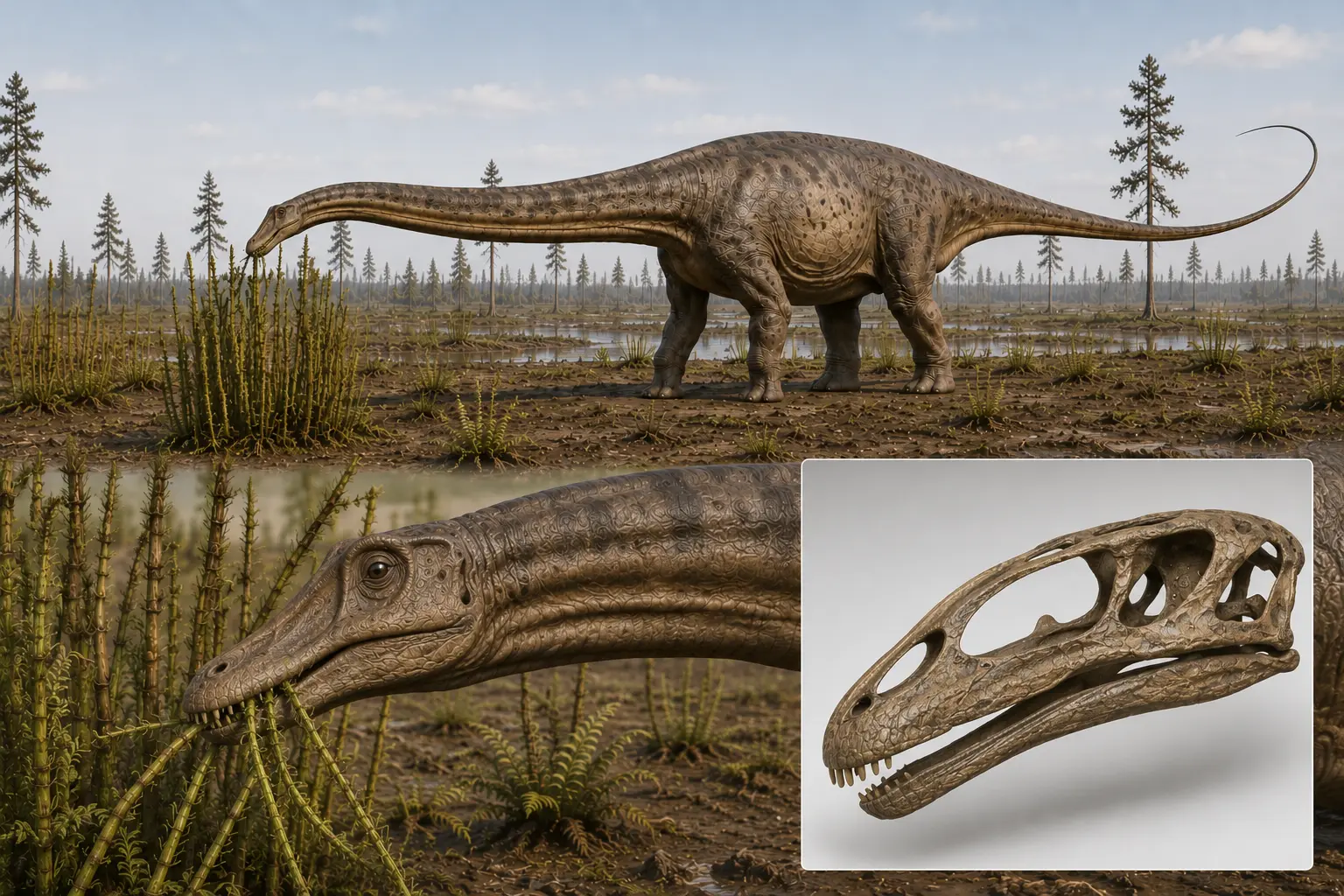
| Field | Information |
|---|---|
| Species | Diplodocus longus — Sauropoda, Diplodocidae |
| Period | Late Jurassic (Kimmeridgian–early Tithonian), approximately 154–149 million years ago |
| Diet | Herbivorous — plants only |
| Tooth type | Pencil-like peg teeth; no grinding surface |
| Feeding method | Stripping or raking vegetation; no oral food processing |
Quick Answer
Diplodocus ate plants exclusively. Its narrow, pencil-shaped teeth were adapted for stripping leaves and other vegetation rather than grinding food, and most processing likely occurred within the digestive system after swallowing. Feeding height remains debated, but many biomechanical studies support predominantly low- to mid-level browsing rather than routine feeding in the upper canopy.

The teeth of Diplodocus provide important clues to its feeding strategy. Unlike the broad, spatulate teeth of some other sauropods, they were slender, peg-like, and restricted to the front of the jaws—a design poorly suited to chewing but highly effective for removing vegetation from branches. The skull and dentition together suggest a feeding strategy focused on efficiently gathering large quantities of plant material rather than selectively processing individual food items.
What Did Diplodocus Eat?
Diplodocus was a herbivore. Fossil evidence from its skull and dentition supports a diet consisting entirely of plant material. Its teeth were narrow, peg-shaped structures confined to the front portions of the upper and lower jaws, with no grinding surfaces or specialised chewing apparatus. This arrangement is consistent with stripping or raking vegetation rather than cropping or processing food within the mouth.
No coprolites have been conclusively attributed to Diplodocus, limiting direct evidence for the specific plants it consumed. Inferred from the Morrison Formation flora, potential food sources included ferns, horsetails, cycads, ginkgophytes, and conifers. These plant groups dominated Late Jurassic terrestrial ecosystems and would have formed the bulk of the vegetation available to large herbivores.
Comparison with modern large herbivores suggests that animals possessing this type of dental morphology function as bulk feeders, consuming large quantities of vegetation and relying primarily on digestive processes rather than chewing to extract nutrients.
How Did Diplodocus Feed?
Diplodocus fed by stripping vegetation with its peg-like teeth rather than grinding it. Biomechanical studies of the skull suggest the jaws were adapted for pulling or raking vegetation from branches rather than generating a powerful crushing bite. This feeding method would have enabled rapid intake of large volumes of plant material with relatively little jaw movement.
Food processing occurred after swallowing. Gastroliths have not been conclusively demonstrated in direct association with Diplodocus skeletal material, although they are known from some other sauropods and have been proposed as digestive aids in large herbivorous dinosaurs. Whether Diplodocus relied on gastroliths, prolonged gut fermentation, or a combination of digestive strategies remains uncertain.
Skull and Tooth Structure
Fossil evidence shows the skull of Diplodocus was long, narrow, and lightly built, making it one of the most slender sauropod skulls known. The external naris (nostril opening) was positioned high on the skull, although its soft-tissue anatomy and functional significance remain debated. Teeth were restricted to the front portions of the upper and lower jaws and displayed wear patterns consistent with repeated contact with vegetation, providing direct evidence of active feeding.
Tooth replacement in diplodocids was exceptionally rapid by vertebrate standards. Studies of diplodocoid sauropods indicate replacement rates approaching one new tooth every few weeks, helping maintain a functional dentition despite continuous wear from feeding. This rapid replacement system compensated for the relatively simple tooth structure and the abrasive demands of processing large quantities of vegetation.
How High Did Diplodocus Browse?
Feeding height in Diplodocus remains an active area of research. Biomechanical analyses of neck posture generally support a neck held in a relatively horizontal or moderately elevated position during routine activity, placing the head at or somewhat above shoulder height—approximately 3–4 m (10–13 ft) above the ground. This contrasts with older reconstructions that depicted the neck being held vertically for extended periods while feeding at treetop level.
These interpretations have important implications for resource partitioning within the Morrison Formation ecosystem. Some ecological reconstructions propose that Brachiosaurus primarily exploited higher vegetation while Diplodocus fed at lower levels, reducing direct competition for food resources. This hypothesis is supported by anatomical differences between the two genera but remains an ecological inference rather than direct fossil evidence.
Computer-based biomechanical modelling has also suggested that Diplodocus may have been capable of rearing onto its hindlimbs to access higher vegetation. However, evidence for the routine use of this behaviour is lacking, and any such feeding strategy remains speculative.
What Plants Did Diplodocus Eat?
The Morrison Formation flora available to Diplodocus included conifers, cycads, ginkgophytes, tree ferns, ground ferns, horsetails, and other non-flowering plants typical of Late Jurassic ecosystems. Flowering plants were either absent or ecologically insignificant during most of the Morrison Formation’s deposition and would not have constituted a major component of the available vegetation.
Although the specific plants consumed by Diplodocus cannot be identified directly, conifer foliage, fern fronds, and other abundant low- to mid-level vegetation likely formed much of its diet. Based on dental morphology, skull structure, and inferred feeding posture, Diplodocus is generally interpreted as a broad-spectrum herbivore capable of processing large quantities of whatever vegetation was most readily available within its feeding range.
Related and Contemporary Species
- Apatosaurus — a diplodocid contemporary with similar peg teeth but a more robust skull, possibly indicating subtle differences in feeding mechanics.
- Camarasaurus — the most common Morrison Formation sauropod, with spatulate teeth and a more robust skull suggesting a different, possibly tougher plant diet.
- Brachiosaurus — a Morrison Formation contemporary whose steep neck angle is consistent with high canopy feeding, likely targeting vegetation well above the range accessible to Diplodocus.
- Barosaurus — a close relative with similar skull and dental morphology, suggesting a broadly comparable feeding strategy.
- Nigersaurus — a relative within Diplodocoidea with an unusually wide-fronted skull and exceptionally dense tooth batteries, representing a more extreme version of the leaf-stripping feeding approach.
Frequently Asked Questions
Did Diplodocus swallow stones to help digestion?
Whether Diplodocus swallowed stones to aid digestion has not been confirmed by direct fossil evidence. Gastroliths have been proposed as a digestive aid in some sauropods, and polished stones have occasionally been reported in association with sauropod remains. However, no gastroliths have been conclusively demonstrated in direct anatomical association with Diplodocus. The extent to which gastroliths contributed to diplodocid digestion, therefore, remains uncertain.
How much did Diplodocus eat per day?
The daily food intake of Diplodocus cannot be determined directly from fossil evidence. Biomechanical and metabolic models suggest that large sauropods may have consumed hundreds of kilograms of vegetation per day to maintain their body mass, although estimates vary considerably depending on assumptions about metabolism, growth rate, and digestive efficiency. No single daily intake figure is universally accepted.
Note
Neck posture, feeding height, digestive physiology, and the role of gastroliths in sauropod biology remain active areas of scientific research. Interpretations presented here reflect widely accepted current evidence but may be refined as discoveries and analytical methods become available.
Conclusion
Diplodocus was a high-volume herbivore whose peg-like teeth, lightly built skull, and probable low- to mid-level browsing habits distinguished it from many other large sauropods. Current evidence indicates that it gathered vegetation efficiently and relied primarily on digestive processing rather than chewing to extract nutrients. This feeding strategy helped support one of the largest terrestrial animals known from the Jurassic fossil record.
References
Upchurch, P. and Barrett, P.M., 2000. The evolution of sauropod feeding mechanisms. In: Sues, H.-D. (ed.) Evolution of Herbivory in Terrestrial Vertebrates. Cambridge University Press, pp.79–122.
Whitlock, J.A., 2011. Inferences of diplodocoid (Sauropoda: Dinosauria) feeding behaviour from snout shape and microwear analyses. PLoS ONE, 6(4):e18304. https://doi.org/10.1371/journal.pone.0018304
D’Emic, M.D., Whitlock, J.A., Smith, K.M., Fisher, D.C., and Wilson, J.A., 2013. Evolution of high tooth replacement rates in sauropod dinosaurs. PLoS ONE, 8(7):e69235. https://doi.org/10.1371/journal.pone.0069235
Taylor, M.P., Wedel, M.J. and Naish, D., 2009. Head and neck posture in sauropod dinosaurs inferred from extant animals. Acta Palaeontologica Polonica, 54(2), pp.213–220.
Paleobiology Database, 2026. Diplodocus occurrence data. Available at: https://paleobiodb.org [Accessed 19 May 2026].
Featured Museum Collections
Museum-quality paleoart and educational poster
collections based on evidence-informed prehistoric
Life reconstructions.