Quick Info
| Field | Information |
|---|---|
| Species | Giganotosaurus carolinii — Saurischia, Carcharodontosauridae |
| Period | Late Cretaceous (Cenomanian), approximately 99–97 Ma |
| Estimated Top Speed | Approximately 40–50 km/h (25–31 mph) |
| Estimation Method | Biomechanical modelling, limb proportions, and body-mass scaling |
| Locomotion Type | Obligate biped |
Quick Answer
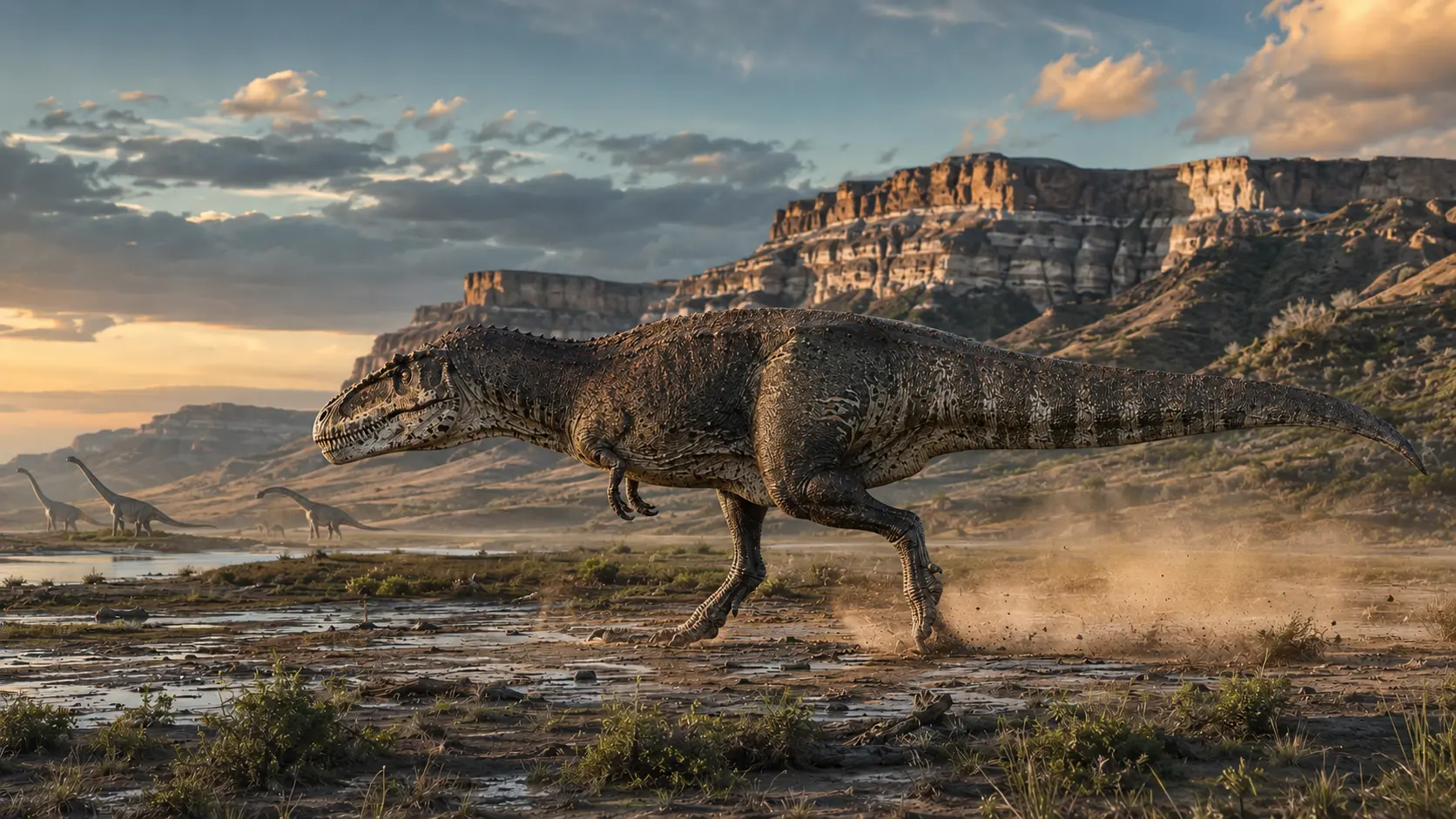
Giganotosaurus carolinii is generally estimated to have reached speeds of approximately 40–50 km/h (25–31 mph) under favourable conditions. These estimates are derived from biomechanical models that analyse limb proportions, muscle mechanics, stride length, and body mass. Because no confirmed Giganotosaurus trackways exist, all speed estimates remain theoretical and should be viewed as plausible ranges rather than precise measurements.

As one of the largest terrestrial predators ever known, Giganotosaurus was probably not built for sustained high-speed pursuit. Instead, it likely relied on a combination of moderate speed, efficient locomotion, and ambush or short-distance pursuit when hunting large herbivorous dinosaurs.
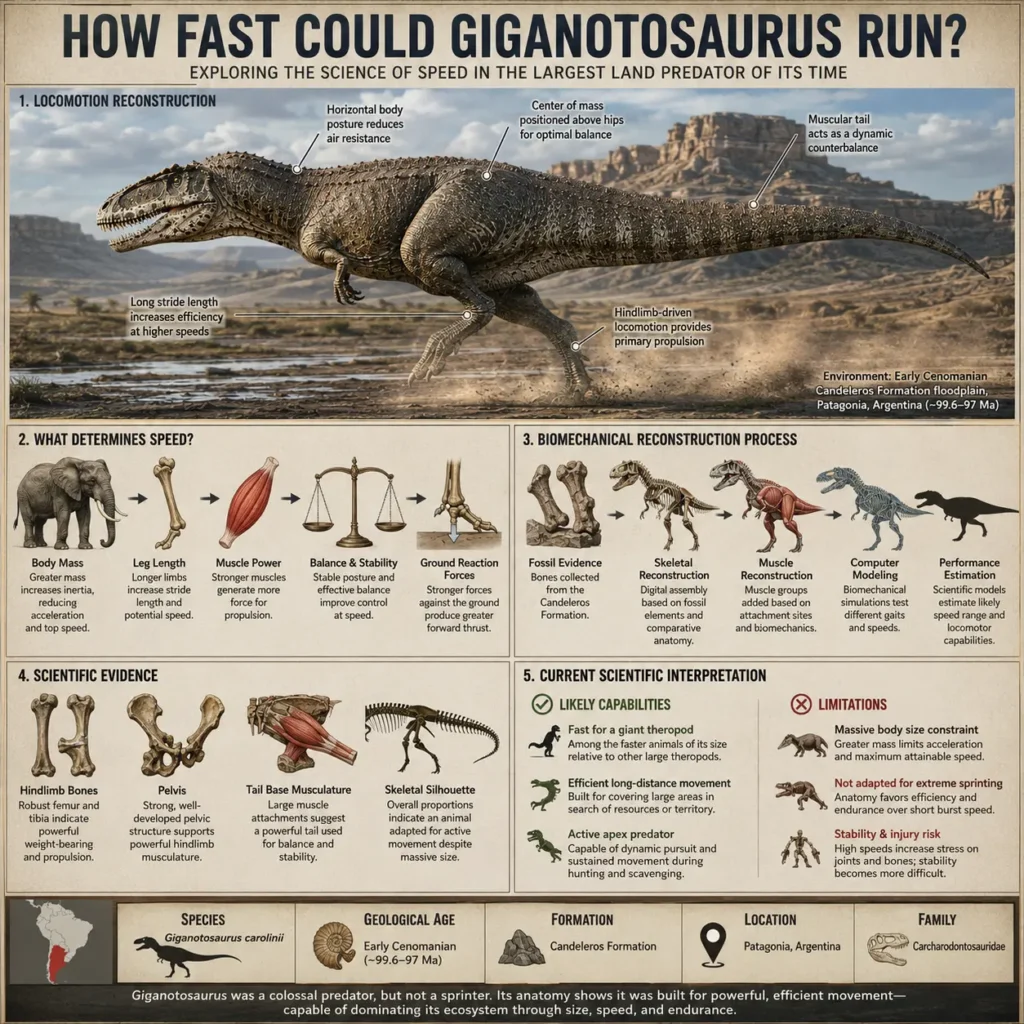
How Fast Could Giganotosaurus Run?
Speed estimates for Giganotosaurus carolinii are derived entirely from biomechanical modelling. No trackways attributable to the species have been discovered, and locomotor performance cannot be measured directly from fossilized bones. Most published estimates for giant theropods of comparable size suggest a top speed in the range of approximately 40–50 km/h (25–31 mph), although considerable uncertainty surrounds these figures.
Different biomechanical approaches can produce different results. Two commonly used methods are inverse dynamic modelling, which estimates the forces required for locomotion and calculates potential speed limits, and limb-proportion scaling, which uses relationships between limb dimensions and locomotor performance observed in living animals. Because no living animal closely matches the size, anatomy, and ecology of giant theropod dinosaurs, all such estimates should be regarded as informed approximations rather than precise measurements.
Limb Proportions and Locomotor Anatomy
Hindlimb Structure
The hindlimb of Giganotosaurus followed the typical large-theropod configuration, consisting of a powerful femur, a tibia and fibula, and three primary weight-bearing toes. Preserved hindlimb elements from the known specimens provide the anatomical data used in biomechanical speed analyses.
In modern bipedal animals, relatively longer distal limb segments—particularly the tibia and metatarsals—are generally associated with increased stride length and improved locomotor efficiency. Studies of carcharodontosaurids indicate that Giganotosaurus possessed limb proportions consistent with an active, mobile predator. However, its anatomy does not suggest the highly specialized cursorial adaptations seen in smaller theropods that were likely capable of substantially greater speeds.
Body Mass as a Constraint
Body mass is one of the most important factors affecting locomotor performance in giant theropods. Most mass estimates for Giganotosaurus fall within a range of approximately 6–8 tonnes, although exact values vary between studies. At such sizes, the forces exerted on bones, muscles, and joints during rapid locomotion become extremely large.
Biomechanical research consistently indicates that increasing body size imposes limits on maximum speed. As a result, giant theropods were unlikely to match the running performance of smaller predatory dinosaurs despite possessing powerful hindlimbs and long strides.
This constraint is evident among modern large terrestrial animals as well. Elephants, rhinoceroses, and other massive mammals achieve impressive movement speeds, but their locomotion differs from that of smaller, more specialized runners. Whether the largest theropods were capable of a fully developed running gait with an aerial phase remains a subject of scientific debate. Consequently, estimates of maximum speed for Giganotosaurus should be interpreted cautiously and viewed as plausible biomechanical predictions rather than facts.
What Speed Did Giganotosaurus Need?
From an ecological perspective, the most important question is not the absolute maximum speed of Giganotosaurus but whether it was capable of moving fast enough to capture its prey.
The ecosystems of the Candeleros Formation were dominated by large herbivorous dinosaurs, including titanosaurs and other sauropods. While juvenile and subadult individuals would have been more vulnerable, even adult sauropods were unlikely to achieve the speeds of much smaller animals. Biomechanical studies of giant sauropods generally suggest relatively modest locomotor performance compared with large theropod predators.
If Giganotosaurus was capable of speeds within the commonly estimated range of approximately 40–50 km/h (25–31 mph), it would have exceeded the likely top speeds of most large herbivorous dinosaurs in its environment. However, successful predation depends on more than speed alone. Factors such as acceleration, maneuverability, environmental conditions, prey behaviour, and hunting strategy may have been equally important.
The energetic cost of accelerating a multi-tonne body would have been substantial. Consequently, many paleontologists consider ambush predation, short-distance pursuit, or opportunistic attacks to be more plausible hunting strategies than prolonged high-speed chases. These interpretations remain hypotheses because direct evidence of hunting behaviour is extremely limited.
Speed Compared to Other Large Theropods
Estimated speeds for Giganotosaurus fall broadly within the range proposed for other giant theropods. However, locomotor performance remains one of the most debated topics in dinosaur biomechanics, and published estimates vary considerably depending on the assumptions used.
Tyrannosaurus rex has been studied more extensively than any other large theropod, producing speed estimates that range from relatively modest jogging speeds to considerably higher values under some models. Most recent biomechanical studies favour lower maximum speeds than those often portrayed in popular media, reflecting the constraints imposed by large body mass.
The limb proportions of Giganotosaurus differ somewhat from those of T. rex, leading some researchers to suggest that the South American predator may have possessed slightly greater locomotor efficiency or somewhat higher potential speeds. However, current evidence does not allow a definitive conclusion that one species was consistently faster than the other. Both were giant apex predators whose movement capabilities were strongly constrained by their enormous size.
Detailed comparisons between Giganotosaurus, Tyrannosaurus, Mapusaurus, and other giant theropods are discussed in dedicated comparative articles.
What About Trackways?
No trackways have been conclusively attributed to Giganotosaurus carolinii. Although large theropod footprints are known from Cretaceous deposits in South America, assigning a trackway to a specific dinosaur species is extremely difficult. Such identifications generally require either a direct association with skeletal remains or a fossil assemblage containing only a single plausible trackmaker of the appropriate size and anatomy—conditions that are rarely met.
As a result, no speed estimates for Giganotosaurus can be derived directly from trackway evidence. Current estimates of its locomotor performance rely entirely on biomechanical modelling of the skeleton and comparisons with other large theropods.
Related and Contemporary Species
- Tyrannosaurus rex — The most extensively studied large theropod in locomotor biomechanics. Its large body mass and robust build provide an important comparison for understanding the movement capabilities of giant predatory dinosaurs.
- Mapusaurus roseae — A closely related Patagonian carcharodontosaurid whose anatomy offers valuable comparative evidence for locomotion within Carcharodontosauridae.
- Carcharodontosaurus saharicus — A giant North African carcharodontosaurid with broadly similar body size and skeletal proportions, making it one of the closest ecological analogues to Giganotosaurus.
- Allosaurus fragilis — A smaller Jurassic allosauroid frequently used in biomechanical studies to examine locomotor scaling across large theropod dinosaurs.
Frequently Asked Questions
How fast could Giganotosaurus run?
Most biomechanical studies suggest that Giganotosaurus may have been capable of speeds of approximately 40–50 km/h (25–31 mph) under favourable conditions. These estimates are derived from analyses of limb proportions, body mass, and locomotor mechanics rather than direct evidence such as trackways. Because different modelling approaches produce different results, the true maximum speed remains uncertain and should be regarded as an informed estimate rather than a fact.
Scientific Note
Biomechanical speed estimates for giant theropods remain an active area of research. Questions surrounding body-mass estimation, locomotor efficiency, muscle mechanics, and the running capabilities of very large dinosaurs continue to be debated. Future discoveries and improved modelling techniques may refine current estimates for Giganotosaurus and other giant predators.
Conclusion
Giganotosaurus carolinii was likely a relatively fast-moving giant predator, with most biomechanical studies suggesting a top speed in the range of 40–50 km/h (25–31 mph). Although the absence of confirmed trackways prevents direct measurement, its limb proportions and overall anatomy indicate an animal capable of efficient locomotion despite its enormous size.
The exact speed of Giganotosaurus will probably never be known with certainty. What the evidence does show is that this giant carcharodontosaurid was not a slow-moving scavenger or lumbering giant, but an active apex predator whose locomotor abilities were sufficient to make it one of the dominant hunters of Cenomanian Patagonia.
References
A. Primary Taxonomic Sources
Coria, R.A. & Salgado, L., 1995. A new giant carnivorous dinosaur from the Cretaceous of Patagonia. Nature, 377, pp.224–226. https://doi.org/10.1038/377224a0
B. Peer-Reviewed Literature
Gatesy, S.M. & Middleton, K.M., 1997. Bipedalism, flight, and the evolution of theropod locomotor diversity. Journal of Vertebrate Paleontology, 17(2), pp.308–329.
Hutchinson, J.R. & Garcia, M., 2002. Tyrannosaurus was not a fast runner. Nature, 415, pp.1018–1021. https://doi.org/10.1038/4151018a
Pontzer, H., Allen, V. & Hutchinson, J.R., 2009. Biomechanics of running indicates endothermy in bipedal dinosaurs. PLOS ONE, 4(11), e7783. https://doi.org/10.1371/journal.pone.0007783
Sellers, W.I., Hepworth-Bell, J., Falkingham, P.L. & Bates, K.T., 2013. Minimum convex hull mass estimations of complete mounted skeletons. Biology Letters, 9(1), 20120948. https://doi.org/10.1098/rsbl.2012.0948
Bates, K.T., Manning, P.L., Hodgetts, D. & Sellers, W.I., 2009. Estimating mass properties of dinosaurs using laser imaging and 3D computer modelling. PLOS ONE, 4(2), e4532. https://doi.org/10.1371/journal.pone.0004532
C. Books and Monographs
Paul, G.S., 2016. The Princeton Field Guide to Dinosaurs, 2nd edition. Princeton University Press, Princeton, New Jersey.
D. Databases and Online Resources
Paleobiology Database, 2025. Giganotosaurus carolinii Occurrence Data. Available at: https://paleobiodb.org
International Commission on Stratigraphy (ICS), 2025. International Chronostratigraphic Chart. Available at: https://stratigraphy.org
Featured Museum Collections
Museum-quality paleoart and educational poster
collections based on evidence-informed prehistoric
Life reconstructions.