
Quick Info
| Field | Information |
|---|---|
| Species | Giganotosaurus carolinii — Saurischia, Carcharodontosauridae |
| Period | Late Cretaceous (Cenomanian), approximately 99–97 million years ago |
| Skull Length | Reconstructed length exceeding 1.5 m (5 ft) |
| Tooth Type | Blade-like, laterally compressed, serrated (ziphodont) teeth |
| Bite Force | Exact value uncertain; generally considered lower than that of Tyrannosaurus rex |
| Feather Evidence | No direct fossil evidence currently known |
Quick Answer
The skull of Giganotosaurus carolinii was among the largest known for any theropod dinosaur, with a reconstructed length exceeding 1.5 metres (5 ft). It was equipped with large, blade-like teeth bearing serrated cutting edges that were well suited for slicing flesh. Unlike the deep, heavily reinforced skull of Tyrannosaurus rex, the skull of Giganotosaurus was elongated and comparatively lightweight, reflecting a different feeding strategy.

Biomechanical studies generally suggest that Giganotosaurus relied more on cutting and tearing motions than on the extreme bone-crushing bite associated with tyrannosaurids. Although the exact bite force remains uncertain and depends on the modelling methods used, most researchers interpret Giganotosaurus as a predator adapted for inflicting large tissue wounds rather than delivering a single crushing bite.
At roughly the length of an adult human, the skull of Giganotosaurus ranks among the most impressive structures in the dinosaur fossil record. Its combination of size, serrated teeth, and lightweight construction illustrates a predatory strategy built around slicing and tearing flesh from very large prey animals.
Giganotosaurus Skull: Size and Structure
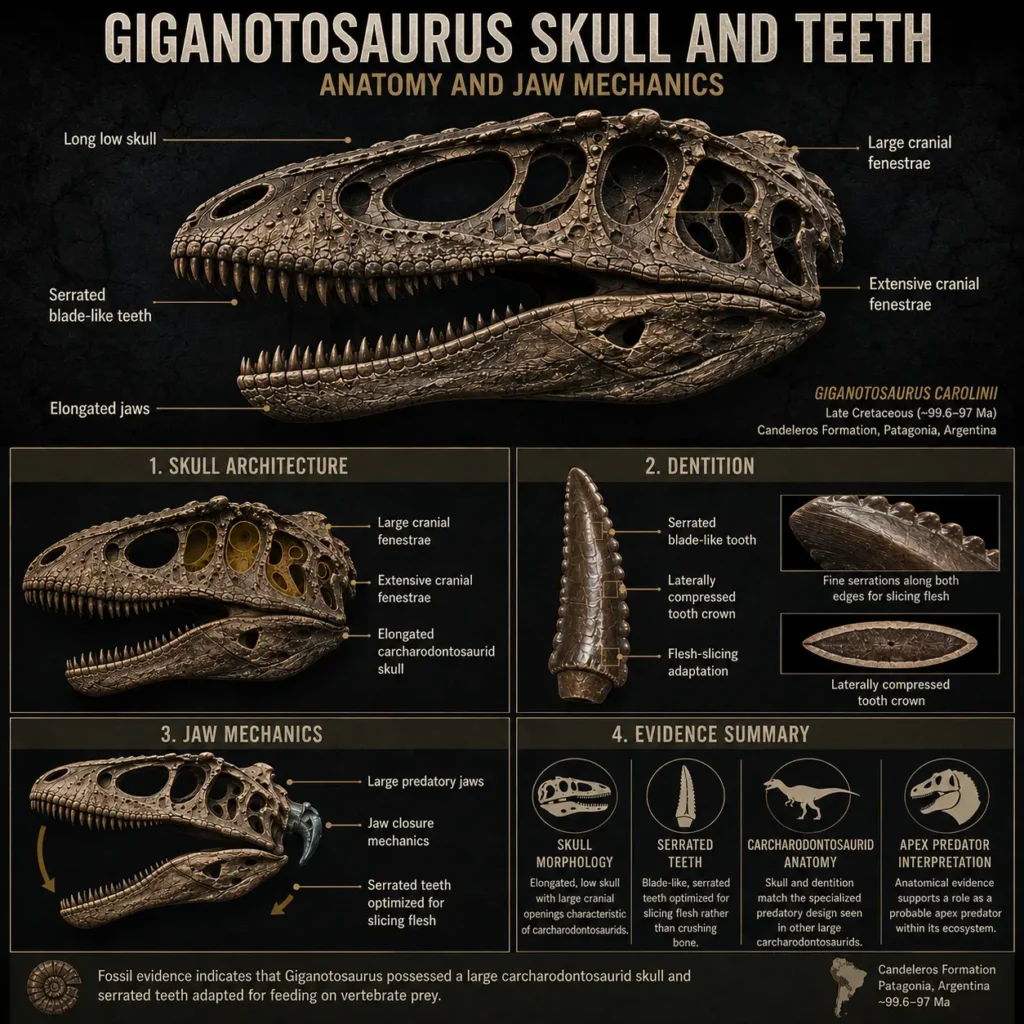
The skull of Giganotosaurus carolinii is preserved in the holotype specimen and provides some of the most important anatomical information known for the species. Reconstructed skull length exceeds 1.5 metres (5 ft), placing it among the largest theropod skulls ever discovered. The skull is elongated and relatively low in profile, with a narrow snout and numerous large openings, known as fenestrae, that reduce overall weight while maintaining structural strength.
The overall skull architecture is characteristic of carcharodontosaurids, a group of large predatory dinosaurs that evolved elongated skulls equipped with blade-like teeth. The shape of the skull and its associated dentition suggest a feeding strategy focused on slicing and tearing flesh rather than generating the extreme bone-crushing forces seen in tyrannosaurids. As a result, Giganotosaurus is generally interpreted as a predator that relied on repeated cutting bites and tissue damage when attacking large prey.
Skull Fenestrae and Weight Reduction
One of the most distinctive features of the Giganotosaurus skull is its extensive fenestration. Fenestrae are large openings within the skull bones that reduce overall weight without eliminating the structural framework needed to support the jaws and teeth. This arrangement is common among large theropods and represents an effective evolutionary solution to the challenge of supporting a massive head.
In Giganotosaurus, these openings contribute to a skull that is both exceptionally large and relatively lightweight for its size. The preserved fossil material clearly shows this pattern of fenestration, which helped reduce bone mass while retaining the rigidity required for feeding. The result was a skull capable of housing large jaw muscles and long serrated teeth without becoming excessively heavy, an important adaptation for one of the largest terrestrial predators known from the fossil record.
Giganotosaurus Teeth: Shape, Function, and Feeding Strategy
Tooth Morphology
Fossil evidence shows that Giganotosaurus carolinii possessed ziphodont teeth—laterally compressed, blade-like teeth bearing serrations along both the front and rear cutting edges. This tooth form is characteristic of carcharodontosaurids and differs markedly from the thick, robust teeth of tyrannosaurids. Rather than being adapted for crushing bone, ziphodont teeth were highly effective cutting tools designed for slicing through soft tissue.
The serrations along the tooth edges functioned much like the serrated edge of a knife, helping concentrate force along the cutting surface and improving the efficiency of tissue penetration and slicing. Preserved tooth material from the holotype specimen clearly demonstrates this serrated morphology, providing direct evidence of the feeding adaptations characteristic of Giganotosaurus.
Implications for Feeding
The tooth anatomy of Giganotosaurus suggests a feeding strategy focused on cutting and tearing flesh from large prey animals. Combined with its elongated skull, the dentition is consistent with repeated slashing bites capable of producing substantial tissue damage.
Researchers commonly interpret carcharodontosaurids as predators adapted to inflict large wounds rather than relying primarily on bone-crushing bite forces. This interpretation is based on the combined evidence of skull shape, tooth morphology, and comparisons with related theropods. Although the precise hunting behaviour of Giganotosaurus cannot be observed directly, its anatomy indicates a predator specialised for processing large prey with slicing bites rather than delivering a single crushing attack.
Comparisons with modern animals that possess similarly serrated cutting teeth can help illustrate the functional advantages of this tooth design, but such comparisons should be viewed as analogies rather than direct evidence of identical feeding behaviour.
Bite Force: How Powerful Was the Giganotosaurus Jaw?
The exact bite force of Giganotosaurus remains uncertain because estimates depend on biomechanical modelling and assumptions about jaw-muscle size, attachment geometry, and skull function. Published studies generally suggest that Giganotosaurus generated substantially lower bite forces than Tyrannosaurus rex, although precise values vary among different models.
This difference reflects contrasting skull architectures rather than differences in predatory effectiveness. Tyrannosaurus rex evolved a short, deep skull and exceptionally robust teeth capable of withstanding enormous compressive forces, adaptations associated with powerful biting and frequent bone contact. In contrast, Giganotosaurus possessed an elongated, relatively lightweight skull equipped with blade-like teeth adapted for slicing and tearing flesh.
As a result, many researchers interpret these two predators as representing different solutions to the challenge of hunting large prey. Tyrannosaurus rex appears to have relied more heavily on extreme bite force, whereas Giganotosaurus relied on cutting dentition and repeated tissue-damaging bites. Neither strategy was inherently superior; each reflects a distinct evolutionary pathway shaped by different anatomical constraints and ecological conditions.
Because soft tissues are not preserved in the fossil record, all bite-force estimates for extinct theropods involve some degree of reconstruction. Consequently, specific numerical values should be treated as estimates rather than direct measurements, and broader functional interpretations are generally more reliable than any single calculated figure.
Did Giganotosaurus Have Feathers?
No direct fossil evidence currently indicates whether Giganotosaurus carolinii possessed feathers or feather-like structures. The known fossil material does not preserve skin impressions or other integumentary remains, meaning the appearance of its body covering cannot be determined directly from the fossil record.
Any discussion of feathers in Giganotosaurus therefore relies on phylogenetic bracketing—the practice of inferring characteristics from related animals. Feathers and feather-like structures are well documented in numerous theropod dinosaurs, particularly within Coelurosauria. However, Giganotosaurus belonged to Carcharodontosauridae, a more distantly related branch of theropods for which direct evidence of feathers is currently lacking.
Because no integumentary material is known for Giganotosaurus itself, scientists cannot confidently determine whether the animal was fully scaled, partially feathered, or possessed some combination of skin coverings. As a result, the presence or absence of feathers remains an open question rather than a resolved aspect of its biology.
Sensory Anatomy
Although the skull of Giganotosaurus provides valuable information about its anatomy, direct evidence for its sensory capabilities remains limited. Features of the skull and braincase can be compared with those of related theropods and living archosaurs to generate hypotheses about vision, smell, and other sensory functions, but these interpretations are necessarily indirect.
The preserved cranial anatomy is broadly consistent with sensory systems comparable to those of other large theropod predators, although direct evidence remains limited. Like many carnivorous dinosaurs, it likely relied on a combination of vision, olfaction, and hearing when locating prey and navigating its environment. However, the precise capabilities of these senses cannot be determined with confidence from the currently available fossil material.
Because soft tissues such as the brain, sensory organs, and associated neural structures are not preserved, most reconstructions of sensory performance remain inferential and should be interpreted cautiously.
Related and Contemporary Species
- Carcharodontosaurus saharicus — a closely related carcharodontosaurid from North Africa that provides important comparative evidence for skull anatomy, dentition, and overall body structure.
- Mapusaurus roseae — a closely related South American carcharodontosaurid whose fossil material helps researchers understand variation within the broader carcharodontosaurid lineage.
- Tyrannosaurus rex — the most frequently used comparison for large theropod skull anatomy and feeding adaptations, representing a different evolutionary approach to predation.
- Allosaurus fragilis — an earlier large predatory dinosaur that provides useful evolutionary context for understanding the origins of allosauroid skull architecture and feeding adaptations.
Frequently Asked Questions
What was the bite force of Giganotosaurus?
The exact bite force of Giganotosaurus carolinii remains uncertain because estimates depend on biomechanical modelling and assumptions about jaw-muscle size, attachment geometry, and skull function. Published studies generally suggest that Giganotosaurus generated substantially lower bite forces than Tyrannosaurus rex, although precise values vary among different models.
Rather than relying on extreme bite force, Giganotosaurus is generally interpreted as a predator adapted for slicing and tearing flesh using its elongated skull and serrated, blade-like teeth. As with all bite-force estimates for extinct animals, specific numerical values should be regarded as estimates rather than direct measurements.
Did Giganotosaurus Have Feathers?
No direct fossil evidence currently indicates whether Giganotosaurus possessed feathers or feather-like structures. The known fossil material does not preserve skin impressions or other integumentary remains, making it impossible to determine the animal’s external covering directly from the fossil record.
Although feathers are well documented in many theropod dinosaurs, particularly within Coelurosauria, Giganotosaurus belonged to Carcharodontosauridae, a different theropod lineage for which direct evidence of feathers is currently lacking. As a result, the presence or absence of feathers in Giganotosaurus remains unresolved.
Conclusion
The skull of Giganotosaurus carolinii ranks among the largest known for any theropod dinosaur. Its elongated shape, extensive skull fenestration, and serrated ziphodont teeth reveal a predator adapted for slicing and tearing flesh rather than crushing bone. These anatomical features distinguish it from large tyrannosaurids and illustrate a different evolutionary approach to predation among giant theropods.
Although the exact bite force of Giganotosaurus remains uncertain, the available fossil evidence indicates a feeding strategy centred on cutting dentition and repeated tissue-damaging bites. Likewise, the presence or absence of feathers cannot currently be determined because no integumentary evidence has been discovered. As additional fossils and analytical techniques become available, scientific understanding of this remarkable predator will continue to improve.
References
A. Primary Taxonomic Sources
Coria, R.A. & Salgado, L. (1995). A new giant carnivorous dinosaur from the Cretaceous of Patagonia. Nature, 377, 224–226. https://doi.org/10.1038/377224a0
B. Peer-Reviewed Literature
Eddy, D.R. & Clarke, J.A. (2011). New information on the cranial anatomy of Acrocanthosaurus atokensis and its implications for the phylogeny of Allosauroidea (Dinosauria: Theropoda). PLOS ONE, 6(3), e17932.
Therrien, F. & Henderson, D.M. (2007). My theropod is bigger than yours … or not: estimating body size from skull length in theropods. Journal of Vertebrate Paleontology, 27(1), 108–115.
C. Books and Reference Works
The Princeton Field Guide to Dinosaurs. Princeton University Press.
Featured Museum Collections
Museum-quality paleoart and educational poster
collections based on evidence-informed prehistoric
Life reconstructions.