Quick Info
| Field | Information |
|---|---|
| Species | Giganotosaurus carolinii — Saurischia, Carcharodontosauridae |
| Period | Late Cretaceous (Cenomanian), approximately 99–97 Ma |
| Pronunciation | jih-GAN-oh-toh-SORE-us |
| Name meaning | “Giant southern lizard” |
| Language roots | Ancient Greek: gigas (giant), notos (south), sauros (lizard) |
| Species name | carolinii — honouring discoverer Rubén Dario Carolini |
Quick Answer
Quick Answer:

Giganotosaurusis commonly pronounced
jih-GAN-oh-toh-SORE-usor
JIG-an-oh-toe-SOR-usin English. The name derives from Ancient Greek roots meaning
“giant southern lizard”, referring to its enormous size and discovery in the Southern Hemisphere. The species name
caroliniihonours amateur fossil collector
Rubén Darío Carolini, who discovered the first known specimen in 1993.
How to Pronounce Giganotosaurus
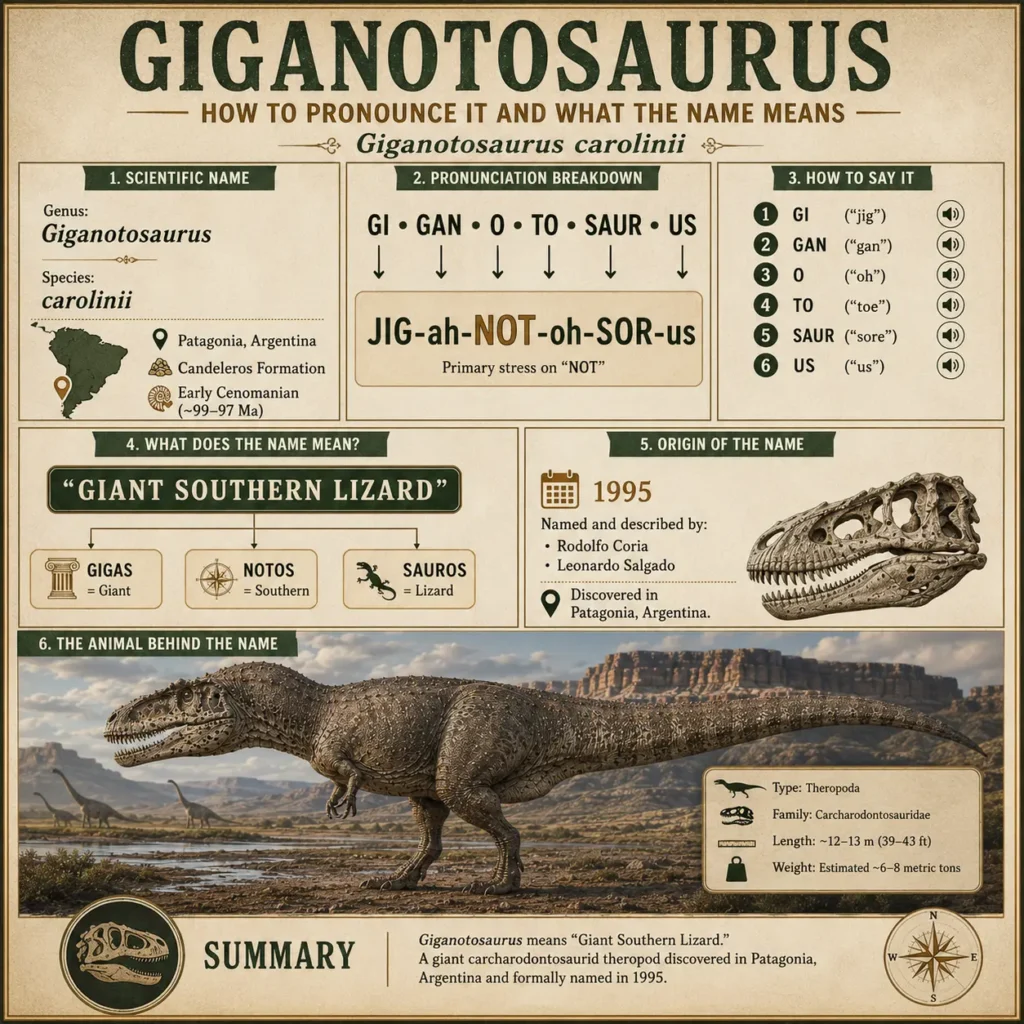
There is no single universally accepted pronunciation of Giganotosaurus. In English-language scientific communication, the most common pronunciation is:
jih-GAN-oh-toh-SORE-us
The name can be divided into six syllables:
jih – GAN – oh – toh – SORE – us
Some speakers instead use:
JIG-an-oh-toe-SOR-us
Both forms are widely understood and encountered in museums, documentaries, educational resources, and paleontological discussions.
Like many scientific names derived from Greek and Latin roots, pronunciation varies between regions, institutions, and individual speakers. What matters most is consistency and recognizability rather than strict adherence to a single spoken form.
Syllable-by-Syllable Guide
| Syllable | Pronunciation | Notes |
|---|---|---|
| Gi | jih / jig | Soft-g variants are most common in English |
| gan | GAN | Usually the stressed syllable |
| o | oh | Connecting vowel |
| to | toh | Unstressed |
| saur | SORE | Standard pronunciation used in many dinosaur names |
| us | us | Final unstressed syllable |
What Does Giganotosaurus Mean?
The name Giganotosaurus means “giant southern lizard.” It is formed from three Ancient Greek elements combined into a single compound name, following a long-standing convention in dinosaur nomenclature.
The first element, gigas (γίγας), means giant and refers to the enormous size of the animal. This is the same root that appears in words such as gigantic and, through scientific Latin, the metric prefix giga-.
The second element, notos (νότος), means south or southern. This component reflects the dinosaur’s discovery in Patagonia, Argentina, and emphasizes its origin in the Southern Hemisphere.
The third element, sauros (σαῦρος), means lizard. This suffix appears in many dinosaur names and is a traditional element in the scientific naming of extinct reptiles.
Together, these roots produce the meaning:
Giganotosaurus = “giant southern lizard.”
Why “Southern” Rather Than a Specific Place Name?
The use of notos (south) emphasizes the dinosaur’s discovery in the Southern Hemisphere rather than linking the name to a specific locality such as Patagonia or Argentina. This approach is consistent with naming practices used for several other Gondwanan dinosaurs that incorporate geographic or directional references into their scientific names.
The name therefore highlights both the animal’s immense size and its southern geographic origin, distinguishing it from many of the giant theropods historically known from Northern Hemisphere fossil deposits.
What Does carolinii Mean?
The species name carolinii is a Latinized form of the surname Carolini, honoring Rubén Darío Carolini, the amateur fossil collector who discovered the holotype specimen in 1993.
Naming species after their discoverers, researchers, or other individuals is a long-established tradition in zoological nomenclature. In this case, the ending -ii represents the Latin genitive form, indicating possession or dedication. The name can therefore be interpreted as meaning “of Carolini” or “Carolini’s.”
As a result, the full scientific name can be understood as:
Giganotosaurus carolinii — “Carolini’s giant southern lizard.”
How Does Giganotosaurus Compare to Other Dinosaur Names?
At six syllables, Giganotosaurus is longer than familiar dinosaur names such as Tyrannosaurus and Triceratops, but it follows pronunciation patterns commonly found throughout dinosaur nomenclature.
Like names such as Pachycephalosaurus, Carcharodontosaurus, and Deinocheirus, Giganotosaurus combines multiple Greek-derived roots into a single compound scientific name. Although the name may appear intimidating at first, most of its pronunciation follows conventions shared by many other dinosaur genera.
The greatest source of confusion is usually the opening syllables, as some readers instinctively associate the name with the modern metric prefix giga-. Once the name is broken into its parts, however, its pronunciation becomes much easier to understand and remember.
The full scientific name is commonly pronounced:
jih-GAN-oh-toh-SORE-us car-oh-LIN-ee-eye
However, the pronunciation of scientific names can vary between regions, institutions, and individual speakers. Variations are common in paleontology, and no single spoken form is universally mandated.
Related and Contemporary Species With Notable Names
- Carcharodontosaurus (kar-KAR-oh-DON-toh-SORE-us) — meaning “shark-toothed lizard.” The name derives from the Greek karcharodon (“jagged” or “sharp-toothed”), referencing the animal’s large, serrated teeth, and sauros (“lizard”).
- Argentinosaurus (ar-jen-TEEN-oh-SORE-us) — meaning “Argentine lizard.” The name honors Argentina, the country in which the dinosaur was discovered. This giant titanosaur lived in the same general region as Giganotosaurus and is often discussed in reconstructions of Patagonian ecosystems.
- Mapusaurus (MAH-poo-SORE-us) — meaning “earth lizard” or “land lizard.” The name combines the Mapuche word mapu (“earth” or “land”) with the Greek sauros (“lizard”), recognizing the indigenous Mapuche people of Patagonia.
- Andesaurus (AN-deh-SORE-us) — meaning “Andes lizard.” Named after the Andes region of South America, this titanosaur was discovered in Cenomanian-aged rocks of the Neuquén Basin and was a contemporary of Giganotosaurus.
Frequently Asked Questions
How do you pronounce Giganotosaurus?
Giganotosaurus is commonly pronounced:
jih-GAN-oh-toh-SORE-us
The stress typically falls on the second syllable (GAN). However, scientific names do not have a single universally accepted spoken pronunciation, and minor regional variations occur among paleontologists, educators, and museums. The pronunciation above is one of the most commonly used in English-language dinosaur literature and educational resources.
What does the name Giganotosaurus mean?
The name Giganotosaurus means “giant southern lizard.” It is derived from three Ancient Greek roots:
- gigas — giant
- notos — south
- sauros — lizard
The name reflects both the enormous size of the animal and its discovery in the Southern Hemisphere. The species name carolinii honors Rubén Darío Carolini, the fossil collector who discovered the holotype specimen in Patagonia in 1993.
Conclusion
Giganotosaurus means “giant southern lizard,” a name that reflects both the immense size of the animal and its discovery in the Southern Hemisphere. The species name carolinii preserves the legacy of Rubén Darío Carolini, who discovered the first known specimen in Patagonia in 1993.
Like many scientific names, Giganotosaurus combines Greek and Latinized elements to create a descriptive name that conveys information about the animal’s characteristics and history. Understanding its pronunciation and meaning provides insight not only into one of the largest predatory dinosaurs ever discovered but also into the traditions of scientific naming that continue to shape paleontology today.
References
A. Primary Taxonomic Sources
Coria, R.A. & Salgado, L., 1995. A new giant carnivorous dinosaur from the Cretaceous of Patagonia. Nature, 377, pp.224–226. https://doi.org/10.1038/377224a0
B. Reference Works and Scholarly Sources
Liddell, H.G., Scott, R. & Jones, H.S., 1996. A Greek–English Lexicon, 9th edition with revised supplement. Oxford University Press, Oxford.
Paul, G.S., 2016. The Princeton Field Guide to Dinosaurs, 2nd edition. Princeton University Press, Princeton, New Jersey.
International Commission on Zoological Nomenclature (ICZN), 1999. International Code of Zoological Nomenclature, 4th edition. International Trust for Zoological Nomenclature, London.
C. Databases and Online Resources
Paleobiology Database, 2025. Giganotosaurus carolinii Occurrence Data. Available at: https://paleobiodb.org
Online Etymology Dictionary. Entries relating to gigantic, gigas, and related Greek-derived terminology. Available at: https://www.etymonline.com
Featured Museum Collections
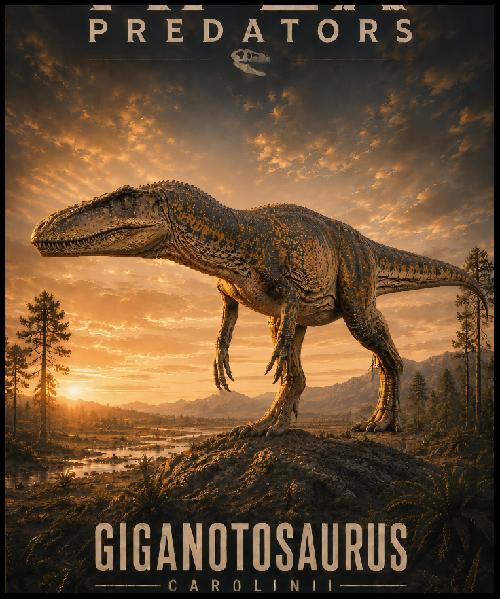
Museum-quality paleoart and educational poster
collections based on evidence-informed prehistoric
Life reconstructions.