
Quick Info
| Field | Information |
|---|---|
| Species | Giganotosaurus carolinii — Theropoda, Carcharodontosauridae |
| Period | Late Cretaceous (Cenomanian), approximately 99–97 million years ago |
| Formation | Candeleros Formation, Neuquén Group, Patagonia, Argentina |
| Climate | Warm and seasonally variable |
| Ecosystem Type | River-dominated floodplain with riparian vegetation |
Quick Answer: Giganotosaurus lived in what is now Patagonia, Argentina, during the Cenomanian Stage of the Late Cretaceous, approximately 99–97 million years ago. Fossils of the species are known exclusively from the Candeleros Formation, a river-dominated floodplain environment that supported large herbivorous dinosaurs, crocodyliforms, turtles, and other vertebrates.

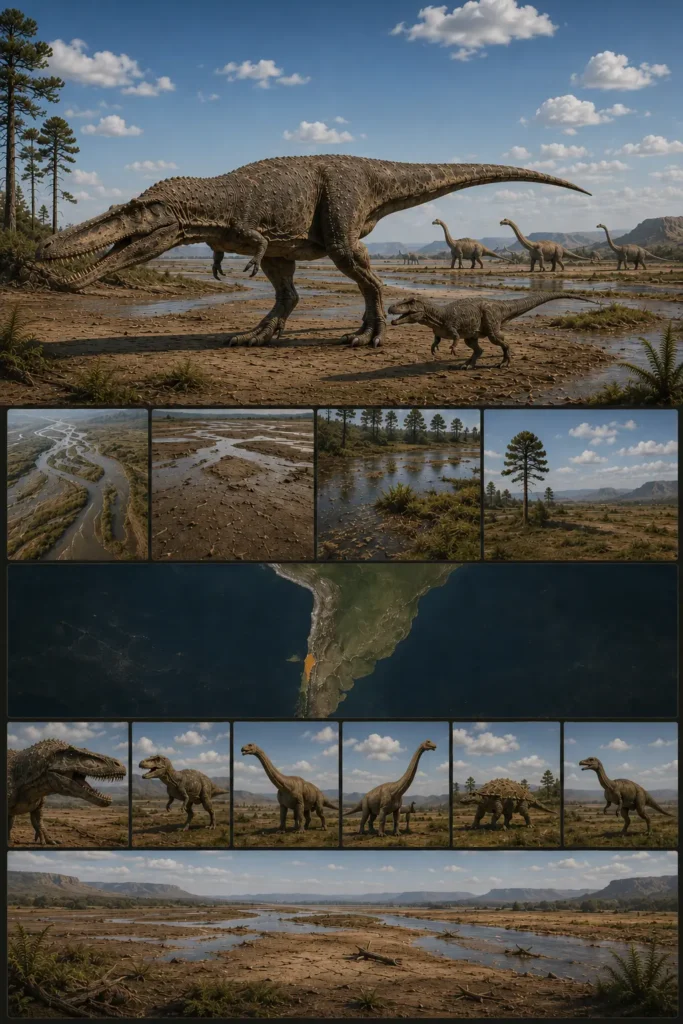
The ground beneath a Giganotosaurus would have been shaped by active river systems, seasonal flooding, and extensive floodplains. Channels migrated across broad lowlands, creating a dynamic landscape capable of supporting some of the largest terrestrial animals known from the fossil record. Rather than a barren environment, the region was a productive ecosystem with abundant water and vegetation.
Where Did Giganotosaurus Live?
Giganotosaurus lived in what is now Neuquén Province in Patagonia, north-western Argentina. All confirmed fossils of the species have been recovered from the Candeleros Formation, the lowest stratigraphic unit of the Neuquén Group. These sediments were deposited during the Cenomanian Stage of the Late Cretaceous, approximately 99–97 million years ago.
The Candeleros Formation preserves evidence of a river-dominated floodplain environment consisting of braided channels, overbank deposits, and seasonally flooded lowlands. Sedimentological studies indicate recurring wet and dry periods that influenced the structure of the ecosystem. Although global temperatures during the Cenomanian were generally higher than today, local climatic conditions in Patagonia are best interpreted as warm and seasonal rather than being reconstructed with high precision.
The Candeleros Formation
The Candeleros Formation forms part of the larger Neuquén Basin, one of South America’s most important Late Cretaceous fossil-bearing regions. The basin accumulated thick sedimentary deposits that preserve a diverse assemblage of terrestrial vertebrates and provide valuable insight into Gondwanan ecosystems.
Fossils recovered from the formation include giant sauropods such as Andesaurus, smaller theropod dinosaurs, crocodyliforms, turtles, and other vertebrates. Together, these discoveries indicate a biologically productive environment capable of supporting large predator-prey relationships.
Available palaeobotanical evidence suggests the presence of vegetation adapted to river-margin and floodplain habitats. Conifers, ferns, cycad-like plants, and other seed plants likely formed parts of the regional flora, although direct plant evidence from the Candeleros Formation remains less abundant than the vertebrate fossil record. Vegetation was probably concentrated around watercourses, creating greener corridors along rivers separated by more open floodplain environments.
Evidence-based ExtinctAtlas standard.
Climate and Vegetation
The Cenomanian world was generally warmer than the modern Earth, with elevated atmospheric carbon dioxide levels and higher global temperatures. During this time, Patagonia occupied a different palaeogeographic position than it does today and experienced climatic conditions that were likely warmer than those of the region at present.
Evidence from the Candeleros Formation indicates a seasonal environment influenced by recurring flooding and periods of reduced water availability. Sedimentary features preserved within the formation suggest fluctuating hydrological conditions that shaped river channels, floodplains, and associated habitats. While seasonal changes likely influenced the distribution of water and vegetation, the movement patterns of local dinosaur populations remain difficult to reconstruct directly from the available fossil evidence.
The regional flora was probably dominated by gymnosperms, including conifers and cycad-like plants, together with ferns and other spore-producing vegetation. Flowering plants had already appeared by the Cenomanian and were diversifying globally, but gymnosperms are generally considered to have remained important components of many terrestrial ecosystems. Grasses were not yet major ecological components of terrestrial landscapes.
Coexisting Species and Food Web
The Candeleros Formation preserves a diverse vertebrate fauna that helps reconstruct the ecosystem inhabited by Giganotosaurus. Among the largest herbivores was Andesaurus, a giant titanosaurian sauropod that likely formed part of the regional megaherbivore community.
Argentinosaurus is frequently associated with Giganotosaurus in popular media. However, Argentinosaurus is known from the overlying Huincul Formation, and direct coexistence with Giganotosaurus carolinii has not been demonstrated by current fossil evidence.
The formation also contains remains of smaller theropod dinosaurs and other vertebrates, indicating a complex predator community. Although the closely related carcharodontosaurid Mapusaurus roseae is often discussed alongside Giganotosaurus, it is known from younger geological deposits and should not be considered a confirmed member of the Candeleros Formation fauna.
Crocodyliforms, turtles, and other aquatic or semi-aquatic animals occupied riverine habitats throughout the ecosystem. Their presence supports interpretations of a landscape shaped by persistent waterways, floodplains, and seasonally active channels.
Giganotosaurus as an Apex Predator
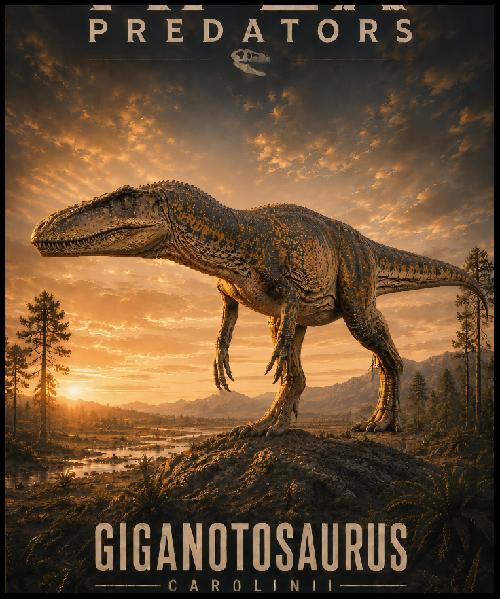
Based on its immense size, cranial anatomy, and cutting dentition, Giganotosaurus is interpreted as the apex predator of the Candeleros Formation ecosystem. No larger carnivorous dinosaur is currently known from the formation.
Direct evidence of predation remains limited. No sauropod bones bearing bite marks that can be confidently attributed to Giganotosaurus have been reported from the Candeleros Formation. Consequently, its ecological role is inferred from anatomical evidence, trophic position, and comparisons with other giant theropods rather than from direct fossilised predator-prey interactions.
The elongated skull and serrated ziphodont teeth of Giganotosaurus suggest an adaptation for delivering slicing bites to large-bodied prey. This feeding strategy differs from the bone-crushing bite associated with later tyrannosaurids and is consistent with interpretations of carcharodontosaurids as specialised hunters of large vertebrates.
Related and Contemporary Species
- Mapusaurus roseae — A large carcharodontosaurid theropod from the younger Huincul Formation of the Neuquén Basin. As a close relative of Giganotosaurus, it provides one of the best ecological and anatomical comparisons for understanding giant South American carcharodontosaurids.
- Andesaurus delgadoi — A large titanosaurian sauropod known from the Candeleros Formation and among the largest herbivores confirmed from the same ecosystem as Giganotosaurus.
- Carcharodontosaurus saharicus — A closely related giant predator from North Africa. Although geographically isolated from Giganotosaurus, both belonged to the family Carcharodontosauridae and occupied similar ecological roles on different continents.
- Brachytrachelopan mesai — A distinctive short-necked sauropod from the Neuquén Basin region. Although not known from the Candeleros Formation itself, it illustrates the remarkable diversity of sauropod body plans present in Patagonia during the Late Cretaceous.
- Araripesuchus — A terrestrial crocodyliform genus known from several South American Cretaceous deposits. It represents part of the broader crocodyliform diversity that occupied riverine and floodplain ecosystems across Gondwana.
Frequently Asked Questions
Did Giganotosaurus live at the same time and place as T. rex?
No. Giganotosaurus and Tyrannosaurus rex lived in different regions and were separated by more than 30 million years. Giganotosaurus inhabited Patagonia during the Cenomanian Stage of the Late Cretaceous, approximately 99–97 million years ago. T. rex lived much later in western North America during the Maastrichtian, approximately 68–66 million years ago. The two species never coexisted.
Scientific Note
The precise ecological relationships between Giganotosaurus and individual sauropod taxa remain subjects of ongoing research. Likewise, detailed reconstructions of Candeleros Formation vegetation continue to evolve as new palaeobotanical evidence becomes available. Current interpretations reflect the best available evidence but may be refined by future discoveries.
Conclusion
Giganotosaurus inhabited a warm, seasonally influenced floodplain environment in what is now Patagonia, Argentina, during the Cenomanian Stage of the Late Cretaceous. River channels, floodplain habitats, and abundant herbivorous dinosaurs supported one of the largest terrestrial predators known from South America. Although many details of its ecosystem remain under investigation, the Candeleros Formation provides one of the clearest windows into the world of giant Gondwanan dinosaurs and continues to yield important discoveries about the environments in which Giganotosaurus lived.
References
Primary Taxonomic Sources
Coria, R.A. & Salgado, L. (1995). A new giant carnivorous dinosaur from the Cretaceous of Patagonia. Nature, 377, 224–226. https://doi.org/10.1038/377224a0
Peer-Reviewed Literature
Calvo, J.O. & Salgado, L. (1995). Rebbachisaurus tessonei sp. nov., a new sauropod from the Albian–Cenomanian of Argentina: new evidence on the origin of the Diplodocidae. GAIA, 11, 13–33.
Garrido, A.C. (2010). Stratigraphy of the Neuquén Group in the southern Neuquén Basin, Argentina. Revista del Museo Argentino de Ciencias Naturales, Nueva Serie, 12(2), 121–177.
Candeiro, C.R.A., Brusatte, S.L., Hendrickx, C., & Wilson, J.A. (2012). The Late Cretaceous faunas of southern continents: a review of dinosaur diversity, biogeography, and evolution. Historical Biology, 24(1), 95–112.
Books and Monographs
The Age of Dinosaurs in South America. Fernando E. Novas (2009). Indiana University Press.
Scientific Databases
Paleobiology Database. Candeleros Formation taxonomic records.
Featured Museum Collections
Museum-quality paleoart and educational poster
collections based on evidence-informed prehistoric
Life reconstructions.