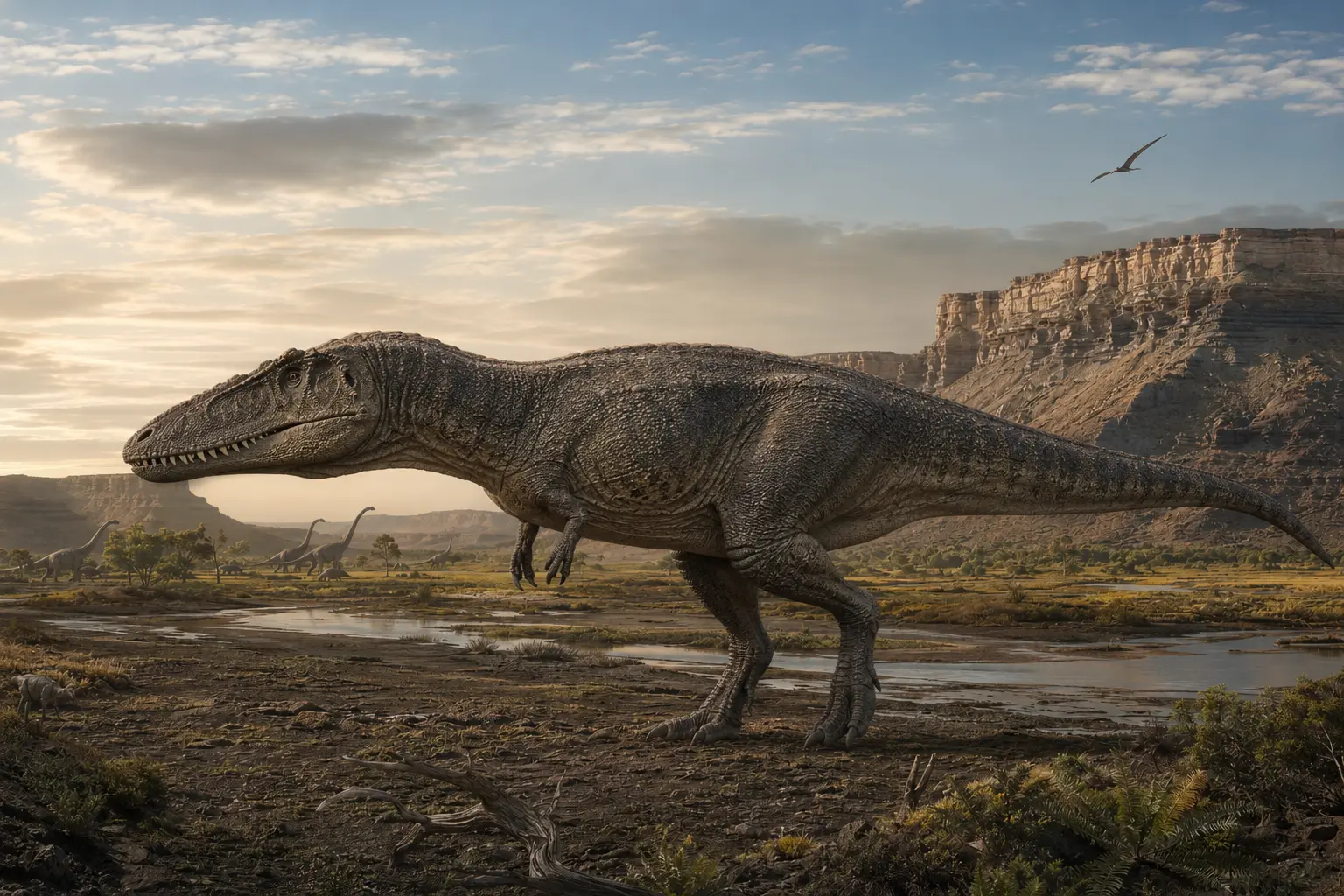
Quick Info
| Field | Information |
|---|---|
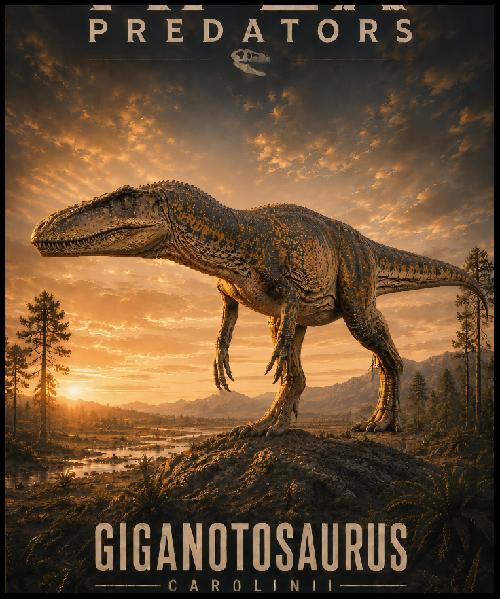
| Species | Giganotosaurus carolinii — Saurischia, Carcharodontosauridae |
| Geological Period | Late Cretaceous, Cenomanian Stage |
| Temporal Range | Approximately 99–97 million years ago (Ma) |
| Formation | Candeleros Formation, Neuquén Group, Argentina |
| Time Before Present | Approximately 97–99 million years |
| Separation from T. rex | Approximately 30 million years earlier |
Quick Answer
Giganotosaurus carolinii lived approximately 99–97 million years ago during the Cenomanian Stage of the Late Cretaceous. It inhabited what is now Patagonia, Argentina, roughly 30 million years before Tyrannosaurus rex evolved. The world of Giganotosaurus was warmer than today, sea levels were significantly higher, and South America was an increasingly isolated continent supporting distinctive dinosaur ecosystems.

Ninety-seven million years is a span of time almost impossible to comprehend. The gap between Giganotosaurus and T. rex is greater than the gap between T. rex and the present day. These giant predators were not contemporaries but members of entirely different dinosaur communities separated by tens of millions of years of evolution and ecological change.
When Did Giganotosaurus Live?
Giganotosaurus carolinii lived during the Cenomanian Stage of the Late Cretaceous, approximately 99–97 million years ago. Fossils of the species come from the Candeleros Formation of the Neuquén Basin in Argentina, a rock unit generally dated to the early part of the Cenomanian. Age estimates are based on stratigraphic studies, radiometric dating of associated volcanic deposits, and correlation with other well-dated Cenomanian formations.
The Cenomanian lasted from approximately 100.5 to 93.9 million years ago and marks the beginning of the Late Cretaceous Epoch. During this interval, Earth experienced one of the warmest climates of the Mesozoic Era. Polar ice was absent or greatly reduced, global sea levels were elevated, and extensive shallow seas covered portions of many continents.
Giganotosaurus therefore lived during a period of major geological and ecological change, when giant titanosaurs dominated many terrestrial ecosystems, and carcharodontosaurid theropods occupied the role of apex predators across parts of South America, Africa, and other Gondwanan landmasses.
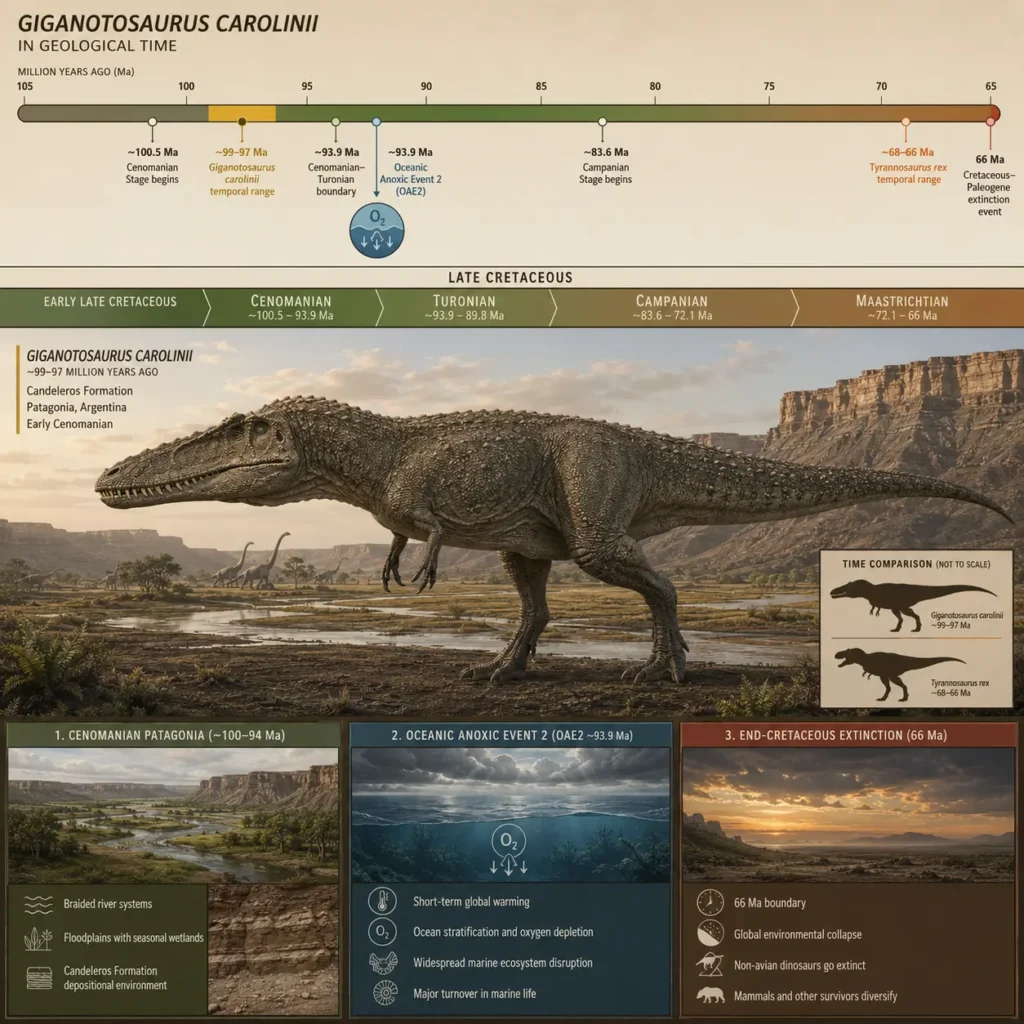
Geological Timeline: Giganotosaurus in Context
| Event | Approximate Date |
|---|---|
| Cenomanian Stage begins | ~100.5 Ma |
| Giganotosaurus temporal range | ~99–97 Ma |
| Cenomanian–Turonian boundary | ~93.9 Ma |
| Oceanic Anoxic Event 2 (OAE2) | ~93.9 Ma |
| Campanian Stage begins | ~83.6 Ma |
| Tyrannosaurus rex temporal range | ~68–66 Ma |
| Cretaceous–Palaeogene extinction event | 66 Ma |
The timeline above illustrates the position of Giganotosaurus within the Late Cretaceous. The species lived during the Cenomanian, one of the earliest stages of the Late Cretaceous, approximately 30 million years before Tyrannosaurus rex appeared in North America. Several million years after the known temporal range of Giganotosaurus, the Cenomanian–Turonian boundary was marked by Oceanic Anoxic Event 2 (OAE2), a major global environmental disturbance associated with significant ecological and faunal turnover. Although no direct connection can be established between OAE2 and the extinction of Giganotosaurus itself, this interval is often considered relevant to the broader decline of carcharodontosaurid theropods.
What Was the World Like When Giganotosaurus Lived?
The Cenomanian was one of the warmest intervals of the Cretaceous Period. Global temperatures were substantially higher than those of the present day, polar ice was absent or extremely limited, and sea levels were among the highest of the entire Mesozoic Era. Extensive shallow seas flooded portions of many continents, creating environments very different from those seen today.
South America had already separated from Africa by this time and was becoming increasingly isolated from other landmasses. This geographic separation contributed to the development of distinctive dinosaur faunas, including giant titanosaurian sauropods and large carcharodontosaurid predators such as Giganotosaurus.
Atmospheric carbon dioxide concentrations were significantly higher than modern levels, supporting extensive vegetation across warm low-latitude regions. Flowering plants (angiosperms) were diversifying rapidly but had not yet achieved the ecological dominance they possess today. Conifers, ferns, cycads, and other gymnosperms remained important components of many terrestrial ecosystems.
The Candeleros Formation preserves evidence of a warm, seasonally dry floodplain crossed by river systems and supporting abundant large herbivorous dinosaurs. Titanosaurs such as Andesaurus, along with other giant sauropods, likely played an important role in the ecosystem inhabited by Giganotosaurus.
Continental Configuration
The increasing isolation of South America during the Cenomanian played a major role in shaping its dinosaur communities. As continental connections diminished, South American ecosystems followed evolutionary pathways distinct from those of North America and Eurasia. This isolation helped foster unique assemblages dominated by titanosaurs, rebbachisaurids, carcharodontosaurids, and other Gondwanan lineages.
Rather than representing evolutionary relics, many of these groups were highly successful and diverse within Gondwanan ecosystems. The prominence of carcharodontosaurids such as Giganotosaurus reflects the unique ecological structure of southern continents during the mid-Cretaceous, where these giant predators occupied apex niches long before tyrannosaurids rose to dominance in the Northern Hemisphere.
When Did Giganotosaurus Go Extinct?
The precise extinction date of Giganotosaurus carolinii is unknown. Fossils of the species are currently restricted to Cenomanian-aged rocks of the Candeleros Formation in Argentina, indicating that it lived approximately 99–97 million years ago. No confirmed remains have been discovered from younger formations, suggesting that the species disappeared sometime after its known temporal range.
Because the fossil record of Giganotosaurus is limited, paleontologists cannot determine exactly when or why the species became extinct. The absence of later fossils may reflect genuine extinction, gaps in the fossil record, or both. As a result, any extinction date beyond the Cenomanian remains speculative.
The broader carcharodontosaurid lineage—the family to which Giganotosaurus belonged—persisted beyond the Cenomanian in some regions. However, carcharodontosaurids became less common during the later stages of the Late Cretaceous, while other predatory groups, including abelisaurids in Gondwana and tyrannosaurids in the Northern Hemisphere, became increasingly prominent.
What Killed Giganotosaurus?
No direct cause of extinction can be identified for Giganotosaurus carolinii. The species is known from a very limited fossil sample, which provides little evidence regarding the circumstances surrounding its disappearance.
Several factors may have contributed to the decline of carcharodontosaurids more broadly during the mid- to Late Cretaceous. These include environmental changes, shifting ecosystems, changes in prey communities, and regional faunal turnover. One major environmental event during this period was Oceanic Anoxic Event 2 (OAE2), which occurred near the Cenomanian–Turonian boundary approximately 93.9 million years ago and had significant global ecological consequences. However, a direct causal link between OAE2 and the extinction of Giganotosaurus has not been demonstrated.
It is important to distinguish between the extinction of Giganotosaurus as a species and the long-term history of Carcharodontosauridae as a family. Other carcharodontosaurids survived after the time of Giganotosaurus, indicating that the family did not disappear immediately following its extinction. Nevertheless, carcharodontosaurids gradually declined during the Late Cretaceous and ultimately vanished before the end of the Mesozoic Era.
The extinction of Giganotosaurus occurred tens of millions of years before the Cretaceous–Palaeogene extinction event 66 million years ago. Consequently, the asteroid impact that ended the age of non-avian dinosaurs played no role in the disappearance of this giant Patagonian predator.
How Does Giganotosaurus Fit Into the Broader Cretaceous Timeline?
The Late Cretaceous lasted from approximately 100.5 to 66 million years ago, spanning more than 34 million years of Earth’s history. Giganotosaurus lived during the Cenomanian, near the beginning of this interval, approximately 99–97 million years ago.
By the time Tyrannosaurus rex appeared during the Maastrichtian, around 68–66 million years ago, the ecosystems of the world had changed dramatically. Many of the giant carcharodontosaurid predators that dominated parts of Gondwana during the mid-Cretaceous were no longer present, while tyrannosaurids had become the dominant apex predators across much of North America and Asia. In Gondwana, abelisaurids emerged as some of the most important large predatory dinosaurs during the later stages of the Late Cretaceous.
The transition from the Cenomanian to the Maastrichtian witnessed substantial changes in dinosaur communities, continental geography, climate, and ecosystem structure. Understanding Giganotosaurus as a Cenomanian predator rather than simply a “Late Cretaceous dinosaur” provides a more accurate picture of its evolutionary and ecological context.
Related and Contemporary Species
- Carcharodontosaurus saharicus — A giant carcharodontosaurid from Cenomanian North Africa and one of the closest known temporal and ecological counterparts to Giganotosaurus.
- Mapusaurus roseae — A large South American carcharodontosaurid from younger deposits of the Neuquén Basin, demonstrating that carcharodontosaurids persisted in Patagonia after the time of Giganotosaurus.
- Andesaurus delgadoi — A titanosaurian sauropod from the Candeleros Formation and a direct contemporary of Giganotosaurus.
- Skorpiovenator bustingorryi — A South American abelisaurid from younger Cretaceous deposits that illustrates the growing importance of abelisaurids in Gondwanan predator communities during the later Late Cretaceous.
Frequently Asked Questions
What killed Giganotosaurus?
No direct cause of extinction has been identified for Giganotosaurus carolinii. The species is known from a limited fossil record, making it impossible to determine precisely when or why it disappeared. Environmental change, ecosystem turnover, and broader evolutionary trends may have contributed to its extinction, but no single explanation is currently supported by direct evidence.
Did Giganotosaurus live with T. rex?
No. Giganotosaurus lived approximately 99–97 million years ago in what is now Argentina, whereas Tyrannosaurus rex lived approximately 68–66 million years ago in North America. The two species were separated by roughly 30 million years and inhabited different continents. They were never contemporaries and could never have encountered one another.
Scientific Note
The precise age of the Candeleros Formation, the temporal range of Giganotosaurus carolinii, and the broader decline of carcharodontosaurids remain active areas of paleontological research. Future discoveries may refine current age estimates and interpretations, but the overall placement of Giganotosaurus within the Cenomanian Stage of the Late Cretaceous is well supported.
Conclusion
Giganotosaurus carolinii lived approximately 99–97 million years ago during the Cenomanian Stage of the Late Cretaceous. It inhabited a warm world of high sea levels, distinctive Gondwanan ecosystems, and giant sauropod prey. Although the exact timing and cause of its extinction remain uncertain, the species disappeared tens of millions of years before the appearance of Tyrannosaurus rex and long before the asteroid impact that ended the age of non-avian dinosaurs. Understanding when Giganotosaurus lived helps place this giant predator within the broader evolutionary history of the Cretaceous world.
References
A. Primary Taxonomic Sources
Coria, R.A. & Salgado, L., 1995. A new giant carnivorous dinosaur from the Cretaceous of Patagonia. Nature, 377, pp.224–226. https://doi.org/10.1038/377224a0
B. Peer-Reviewed Literature
Benson, R.B.J., Carrano, M.T. & Brusatte, S.L., 2010. A new carcharodontosaurid (Dinosauria: Theropoda) from the Lower Cretaceous of Morocco and the evolution of niche partitioning within Allosauroidea. Naturwissenschaften, 97, pp.291–296. https://doi.org/10.1007/s00114-009-0614-x
Jenkyns, H.C., 2010. Geochemistry of oceanic anoxic events. Geochemistry, Geophysics, Geosystems, 11(3), Q03004. https://doi.org/10.1029/2009GC002788
Leanza, H.A., Apesteguía, S., Novas, F.E. & de la Fuente, M.S. (eds.), 2004. Cretaceous Terrestrial Beds from the Neuquén Basin (Argentina) and Their Tetrapod Assemblages. Asociación Paleontológica Argentina, Publicación Especial 7.
Canale, J.I., Novas, F.E., Pol, D., Apesteguía, S. & Coria, R.A., 2012. New giant carnivorous dinosaur reveals convergent evolutionary trends in theropod arm reduction. Current Biology, 22(21), R838–R839. https://doi.org/10.1016/j.cub.2012.08.057
C. Books and Monographs
Novas, F.E., 2009. The Age of Dinosaurs in South America. Indiana University Press, Bloomington.
D. Stratigraphic and Paleontological Databases
International Commission on Stratigraphy (ICS), 2025. International Chronostratigraphic Chart. Available at: https://stratigraphy.org
Paleobiology Database, 2025. Giganotosaurus carolinii Occurrence Data. Available at: https://paleobiodb.org
Featured Museum Collections
Museum-quality paleoart and educational poster
collections based on evidence-informed prehistoric
Life reconstructions.