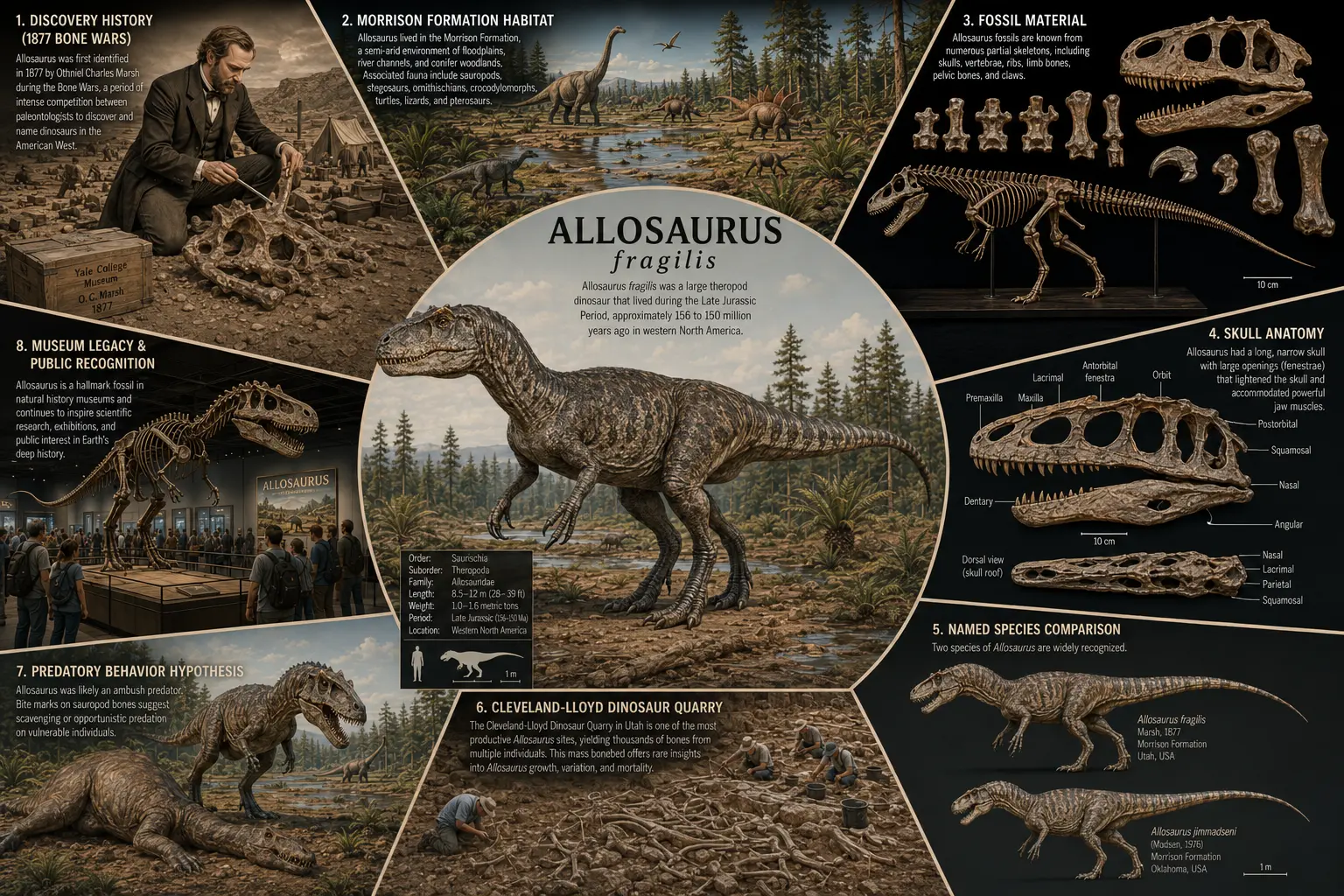
| Field | Information |
|---|---|
| Species | Allosaurus fragilis — Saurischia, Allosauridae |
| Period | Late Jurassic, 155–145 Ma |
| First described | Marsh, 1877 |
| Type locality | Morrison Formation, Colorado, USA |
| Named species | A. fragilis (1877); A. jimmadseni (2020) |
Quick Answer:Allosaurus was formally named in 1877 when paleontologist Othniel Charles Marsh described the genus from fragmentary fossil material recovered in Colorado’s Morrison Formation. Since that initial description, numerous specimens have been discovered across the Morrison Formation of the western United States, making Allosaurus fragilis one of the best-documented large theropod dinosaurs in the fossil record.

Few dinosaur genera have a specimen history as extensive as Allosaurus. From fragmentary remains described during the Bone Wars to the later discovery of exceptionally complete skeletons, the fossil record of this Late Jurassic predator has been assembled progressively over nearly 150 years. Ongoing taxonomic and anatomical research continues to refine scientific understanding of the genus.
Allosaurus Discovery: The First Specimens
Allosaurus discovery as a formally recognised genus dates to 1877, when Othniel Charles Marsh described fragmentary material from the Morrison Formation of Colorado under the name Allosaurus fragilis. The material was limited — vertebrae and partial limb elements — but sufficient to establish the genus. Marsh’s description came during the period of intense rivalry with Edward Drinker Cope, known as the Bone Wars, which drove rapid expansion of North American dinosaur taxonomy throughout the 1870s and 1880s.
Earlier Material and Naming History
Fragmentary theropod material attributable to Allosaurus was known before Marsh formally named the genus in 1877. In 1873, Joseph Leidy described vertebral remains from Colorado under the name Antrodemus valens. Later taxonomic studies debated the relationship between Antrodemus and Allosaurus, with some authors historically treating the names as synonymous. However, modern usage overwhelmingly recognises Allosaurus fragilis as the valid name for the well-known Morrison Formation theropod, while the nomenclatural history remains historically complex.
Key Specimens and Their Significance
Allosaurus fragilis — The Cleveland-Lloyd Material
The Cleveland-Lloyd Dinosaur Quarry in Utah has produced one of the largest known accumulations of Allosaurus remains, with thousands of recovered bones representing numerous individuals. This exceptional assemblage has provided a major anatomical foundation for understanding Allosaurus skeletal morphology, growth variation, and population structure. Because of the unusually high abundance of Allosaurus material at the site, Cleveland-Lloyd remains central to scientific study of the genus. The ecological interpretation of this bonebed is discussed separately in the post on what Allosaurus ate.
Big Al — Specimen MOR 693
One of the most famous Allosaurus specimens is MOR 693, informally known as “Big Al,” discovered in Montana in 1991. This exceptionally well-preserved subadult skeleton has provided rare insight into individual life history, pathology, and locomotor biology. Estimated at approximately 7.5 metres (24.6 ft) in length, Big Al preserves extensive skeletal material and shows evidence of multiple injuries and infections, including healed trauma and stress-related damage. These pathologies provide direct evidence of the physical stresses experienced by a large predatory dinosaur during life.
Big Al Two — Specimen BHI 6230
A second major specimen from the same general region, informally known as “Big Al Two” (BHI 6230), has further improved the anatomical understanding of Allosaurus. Its excellent preservation has helped researchers refine interpretations of skeletal proportions and anatomical variation within the genus. Together, the Big Al specimens rank among the most intensively studied individual theropod skeletons and remain important reference material for Allosaurus research.
Named Species Within Allosaurus
Allosaurus fragilis
Allosaurus fragilis is the type species, described by Marsh in 1877 and validated through the extensive Morrison Formation specimen record. It is the best-represented large theropod of the Late Jurassic and forms the basis for most published anatomical and biomechanical studies of the genus.
Allosaurus jimmadseni
In 2020, Daniel Chure and Mark Loewen formally described Allosaurus jimmadseni as a second recognised species within the genus based on well-preserved material from the lower Morrison Formation. The species is distinguished from Allosaurus fragilis by differences in cranial anatomy, including features of the lacrimal crest and aspects of skull morphology. Species-level taxonomy within Allosaurus remains an active area of research, and interpretations may continue to evolve as additional material is described and existing specimens are re-examined.
Other Taxonomic Names and Debated Assignments
Several names have historically been applied to large Morrison Formation theropod material associated with or compared to Allosaurus. Some, such as Epanterias amplexus, have often been treated as synonymous with Allosaurus fragilis, although interpretations have varied over time. Others, including Saurophaganax maximus, remain taxonomically debated, with some researchers recognising them as distinct genera and others proposing closer relationships with Allosaurus. The taxonomy of large Jurassic theropods from the Morrison Formation remains an area of ongoing scientific discussion.
Where Were Allosaurus Fossils First Found?
Allosaurus was first formally described from fossil material recovered in Colorado and published by Othniel Charles Marsh in 1877. These remains came from the Morrison Formation, the Late Jurassic geological unit that has yielded the majority of known Allosaurus specimens. Major later discovery sites include the Cleveland-Lloyd Dinosaur Quarry in Utah, Dinosaur National Monument on the Utah–Colorado border, and Montana localities associated with the Big Al specimens.
Related and Contemporary Species
- Allosaurus jimmadseni — a second recognised species within the genus, formally described in 2020 from lower Morrison Formation material
- Saurophaganax maximus — a large Late Jurassic theropod from the Morrison Formation whose taxonomic status remains debated
- Ceratosaurus nasicornis — a contemporary large theropod from the Morrison ecosystem, recovered from several localities also yielding Allosaurus
- Torvosaurus tanneri — a large contemporary megalosaurid theropod that shared the Morrison ecosystem with Allosaurus
- Marshosaurus bicentesimus — a smaller theropod from the Morrison Formation, including material from Cleveland-Lloyd Dinosaur Quarry alongside Allosaurus remains
Publishable version:
Frequently Asked Questions
Where were Allosaurus fossils first found?
Allosaurus was first formally described from fossil material recovered in Colorado’s Morrison Formation and published by Othniel Charles Marsh in 1877. Since then, important discoveries have come from several major Morrison Formation sites, including the Cleveland-Lloyd Dinosaur Quarry in Utah, Dinosaur National Monument, and Montana localities associated with the Big Al specimens.
Who discovered Allosaurus?
Allosaurus was formally named and described by paleontologist Othniel Charles Marsh in 1877 based on fragmentary fossil material from Colorado. Earlier theropod remains later discussed in relation to Allosaurus had been described by Joseph Leidy in 1873 under a different name, but Marsh’s publication established Allosaurus as the recognised genus.
How many Allosaurus species are there?
Two species are commonly recognised within the genus: Allosaurus fragilis, described by Marsh in 1877, and Allosaurus jimmadseni, formally described by Chure and Loewen in 2020. However, species-level taxonomy within Allosaurus remains an active area of research, and future revisions are possible as additional material is studied.
Note: Species-level taxonomy within Allosaurus, the status of taxa such as Saurophaganax and Epanterias, and the interpretation of early Morrison Formation theropod material remain subjects of ongoing scientific research.
Conclusion
The discovery history of Allosaurus spans nearly 150 years, from Marsh’s initial 1877 description to modern taxonomic revisions and continued anatomical research. Exceptional fossil material, including the Cleveland-Lloyd assemblage and well-preserved specimens such as Big Al, has made Allosaurus one of the best-documented large predatory dinosaurs in the fossil record, while ongoing study continues to refine scientific understanding of the genus.
References
A. Primary Taxonomic Sources
Marsh, O.C. 1877. Notice of new dinosaurian reptiles from the Jurassic formation. American Journal of Science and Arts, Series 3, 14: 514–516.
Chure, D.J., & Loewen, M.A. 2020. Cranial anatomy of Allosaurus jimmadseni, a new species from the lower part of the Morrison Formation (Upper Jurassic) of Western North America. PeerJ, 8: e7803. https://doi.org/10.7717/peerj.7803
B. Peer-Reviewed Literature
Madsen, J.H. Jr. 1976. Allosaurus fragilis: A Revised Osteology. Utah Geological and Mineral Survey Bulletin 109. Salt Lake City, Utah.
Rayfield, E.J., Norman, D.B., Horner, C.C., Horner, J.R., Smith, P.M., Thomason, J.J., & Upchurch, P. 2001. Cranial design and function in a large theropod dinosaur. Nature, 409: 1033–1037. https://doi.org/10.1038/35059070
Turner, C.E., & Peterson, F. 2004. Reconstruction of the Upper Jurassic Morrison Formation extinct ecosystem—a synthesis. Sedimentary Geology, 167(3–4): 309–355. https://doi.org/10.1016/j.sedgeo.2004.01.009
Hanna, R.R. 2002. Multiple injury and infection in a sub-adult theropod dinosaur, Allosaurus fragilis, with comparisons to allosaur pathology in the Cleveland-Lloyd Dinosaur Quarry collection. Journal of Vertebrate Paleontology, 22(1): 76–90. https://doi.org/10.1671/0272-4634(2002)022[0076:MIAIAS]2.0.CO;2
C. Books and Technical References
Foster, J.R. 2007. Jurassic West: The Dinosaurs of the Morrison Formation and Their World. Indiana University Press, Bloomington.
Paul, G.S. 2016. The Princeton Field Guide to Dinosaurs. 2nd ed. Princeton University Press, Princeton.
D. Databases and Institutional Resources
Paleobiology Database. Allosaurus fragilis taxonomic and occurrence records. https://paleobiodb.org
National Park Service. Dinosaur National Monument: Paleontological resources. https://www.nps.gov/dino
Utah Geological Survey. Cleveland-Lloyd Dinosaur Quarry research resources. https://geology.utah.gov
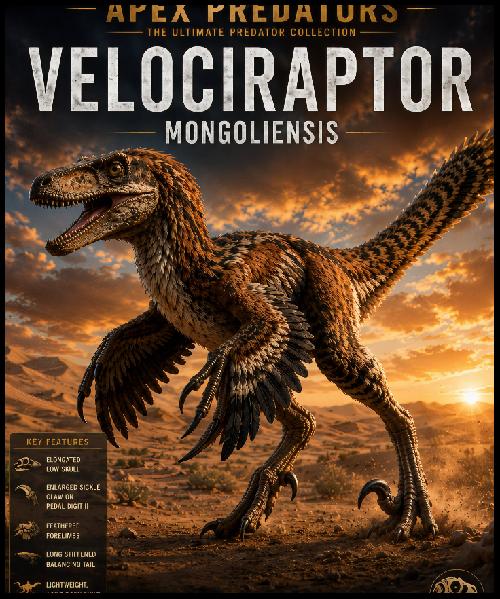
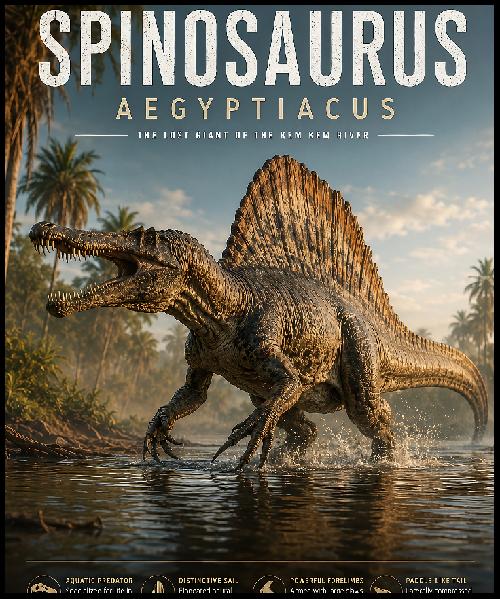
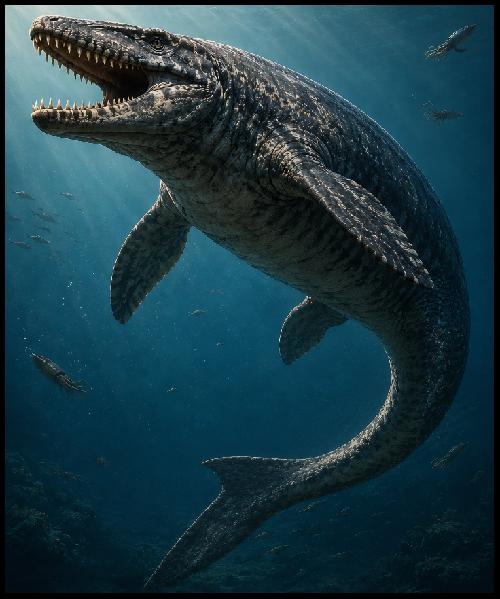
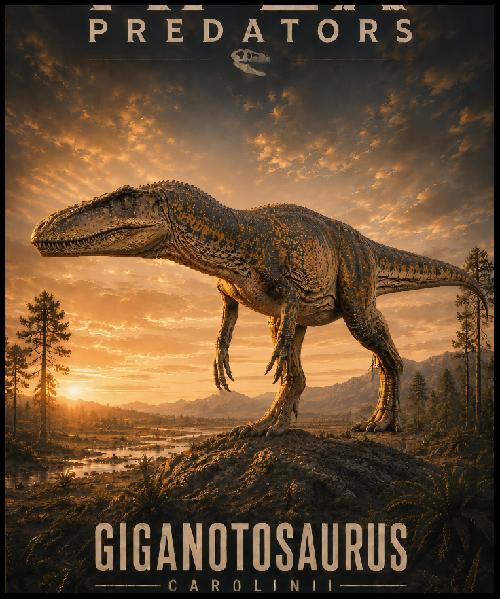
Featured Museum Collections
Museum-quality paleoart and educational poster
collections based on evidence-informed prehistoric
Life reconstructions.