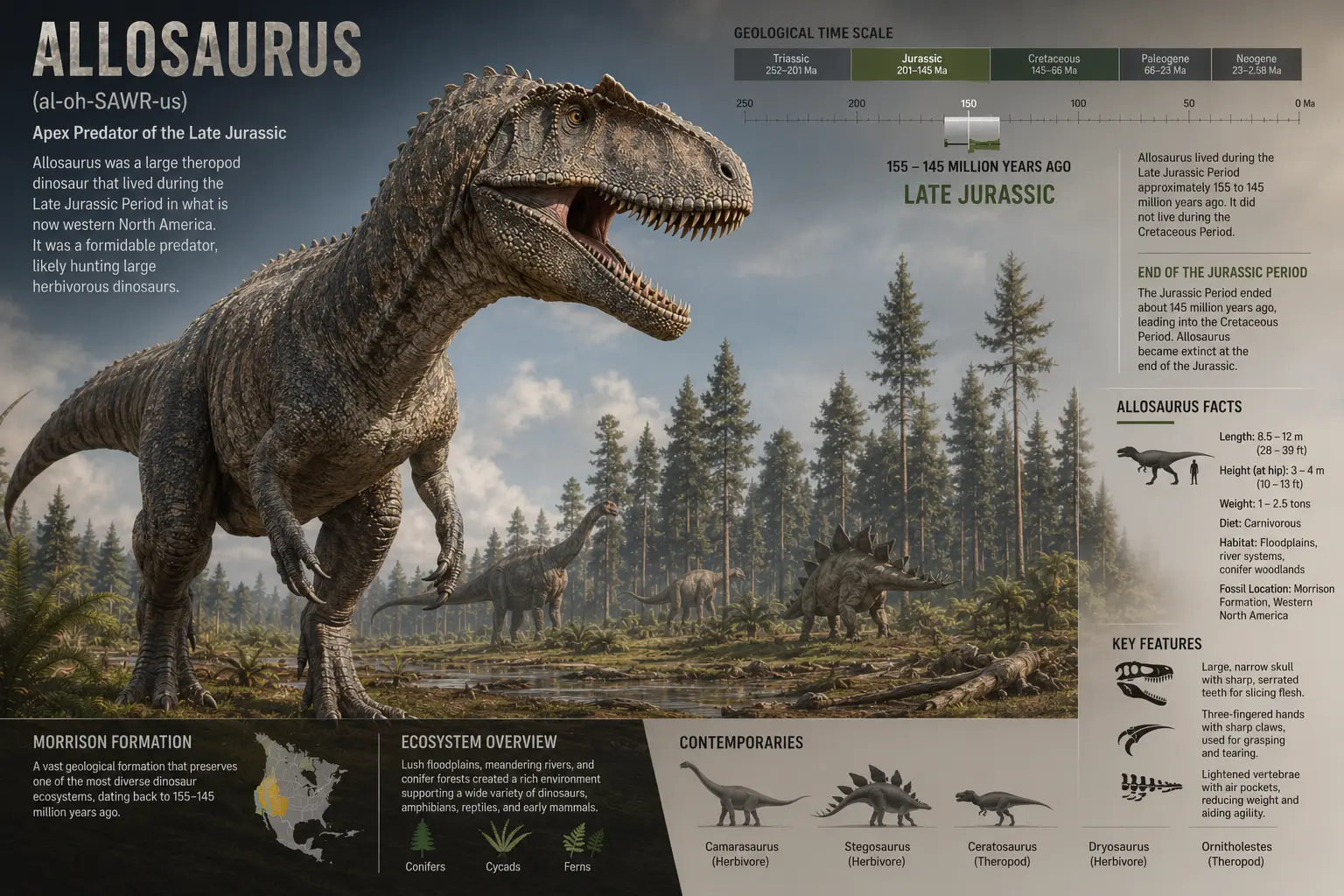
| Field | Information |
|---|---|
| Species | Allosaurus (best-documented species: Allosaurus fragilis) — Saurischia, Allosauridae |
| Period | Late Jurassic, approximately 155–145 million years ago (Ma) |
| Stage range | Primarily Kimmeridgian to Tithonian |
| Extinction | Extinct by the end of the Jurassic fossil record; no confirmed survival into the Cretaceous |
Quick Answer:Allosaurus lived during the Late Jurassic, approximately 155 to 145 million years ago, primarily during the Kimmeridgian and Tithonian stages. It was one of the dominant large terrestrial predators of the Morrison Formation ecosystem in western North America. Allosaurus lived roughly 75–90 million years before Tyrannosaurus rex, meaning the two animals were separated by a vast span of geological time and never coexisted.

One of the most common misconceptions about Allosaurus is that it shared the world with Tyrannosaurus rex. Fossil evidence clearly shows this is incorrect. Allosaurus is known from Late Jurassic deposits, while T. rex lived in the very end of the Late Cretaceous, approximately 68–66 million years ago. The temporal gap between them exceeds the entire time elapsed since the extinction of the non-avian dinosaurs.
When Did Allosaurus Live?
Fossil evidence places Allosaurus in the Late Jurassic, primarily during the Kimmeridgian and Tithonian stages, approximately 155 to 145 million years ago (Ma). The overwhelming majority of known Allosaurus material comes from the Morrison Formation of western North America, whose radiometrically dated sediments provide the principal chronological framework for the genus. These deposits represent a vast network of floodplains, river channels, and seasonal environments that supported one of the best-documented terrestrial ecosystems of the Jurassic.
The Late Jurassic World
The Late Jurassic was characterised by generally warm global climates, elevated sea levels, and extensive shallow epicontinental seas in some regions. The Morrison ecosystem occupied a broad subtropical to seasonally semi-arid landscape in western North America, with evidence for fluctuating wet and dry conditions across its depositional history.
By this time, the supercontinent Pangaea had been fragmenting for tens of millions of years, reshaping global geography and influencing dinosaur biogeography. Faunal distributions between continents were changing as landmasses separated, though the exact connectivity patterns between Jurassic North America and Europe remain an active area of palaeobiogeographic research.
Temporal Range Precision
Allosaurus fragilis is best documented from Kimmeridgian–Tithonian Morrison Formation deposits, but the exact temporal limits of the genus remain subject to refinement as stratigraphic and radiometric datasets improve.
A second named species, Allosaurus jimmadseni, formally described in 2020, is currently known from older Morrison Formation strata than most A. fragilis material, suggesting chronological as well as anatomical differentiation between the two taxa. However, the detailed temporal distribution of Allosaurus species remains an active area of research, and future revisions are possible.
Did Allosaurus and T. rex Live at the Same Time?
Allosaurus and T. rex did not live at the same time. Fossil evidence places Allosaurus in the Late Jurassic, approximately 155–145 Ma, while T. rex is documented from the very end of the Late Cretaceous, approximately 68–66 Ma. The two genera are separated by roughly 80 million years — a temporal gap longer than the span between T. rex and the present day. Any direct comparison of the two as contemporaries is therefore a thought experiment, not a scenario with any basis in the fossil record. A full anatomical comparison is covered in the dedicated post on Allosaurus vs T. rex.
The Jurassic–Cretaceous Boundary and Allosaurus Extinction
What Happened at the End of the Jurassic?
The Jurassic–Cretaceous boundary, approximately 145 million years ago, was not marked by a single catastrophic mass extinction event comparable to the end-Cretaceous asteroid impact. Instead, fossil evidence indicates substantial faunal turnover across many terrestrial ecosystems, though the timing, geographic extent, and underlying causes remain subjects of ongoing research.
In western North America, the Morrison Formation preserves the ecosystems in which Allosaurus lived during the Late Jurassic. Many characteristic Morrison taxa—including several large sauropods and stegosaurs—disappear from the fossil record by the end of the formation, reflecting a major ecological transition rather than a sudden globally synchronous extinction event.
Why Did Allosaurus Go Extinct?
The precise cause of Allosaurus extinction is unknown. Fossil evidence confirms that Allosaurus is restricted to Late Jurassic deposits, with no confirmed Cretaceous occurrences.
Its disappearance likely formed part of the broader ecological restructuring that occurred between the Late Jurassic and Early Cretaceous, when terrestrial faunas changed significantly in composition. Proposed contributing factors include environmental shifts, climatic change, habitat reorganisation, and alterations in prey communities, but no direct fossil evidence identifies a single extinction mechanism specific to Allosaurus.
Is Allosaurus Still Alive?
Allosaurus is extinct. The genus is known only from Jurassic fossil deposits, with no evidence that it survived into the Cretaceous.
Like all non-avian allosauroids, Allosaurus left no living descendants. Although birds are the surviving lineage of theropod dinosaurs as a whole, they did not descend from Allosaurus specifically.
Allosaurus in Deep Time: A Perspective
Allosaurus existed for approximately 10 million years — a substantial duration for a large-bodied apex predator. Comparison with other large theropod genera suggests this longevity was not unusual; many dominant predators of the Mesozoic maintained apex positions over similarly long intervals before faunal turnover replaced them. The approximately 80-million-year gap between Allosaurus and T. rex underscores how much the terrestrial predator guild changed between the Jurassic and the end of the Cretaceous.
Related and Contemporary Species
- Allosaurus jimmadseni — a second named species from the lower Morrison Formation, suggesting the genus spanned most of the formation’s depositional history
- Stegosaurus stenops — a co-occurring Morrison Formation herbivore whose temporal range closely parallels that of Allosaurus
- Diplodocus longus — a large sauropod contemporary with a temporal range overlapping the peak of Allosaurus abundance
- Ceratosaurus nasicornis — a smaller theropod contemporary whose temporal range within the Morrison Formation overlaps substantially with that of Allosaurus
- Tyrannosaurus rex — not a contemporary; separated from Allosaurus by approximately 80 million years; any comparison is a thought experiment
Frequently Asked Questions
Is Allosaurus still alive?
No. Allosaurus is extinct and is known only from Late Jurassic fossil deposits, with no confirmed record extending into the Cretaceous. Like other non-avian allosauroid theropods, it left no living descendants. Although birds are the surviving lineage of theropod dinosaurs as a whole, they are not descendants of Allosaurus specifically.
What period did Allosaurus live in?
Allosaurus lived during the Late Jurassic, primarily in the Kimmeridgian and Tithonian stages, approximately 155 to 145 million years ago. It was one of the best-known large theropod predators of the Morrison Formation ecosystem in western North America, and lived tens of millions of years before iconic Late Cretaceous predators such as Tyrannosaurus rex.
What was the biggest predator Allosaurus faced?
Several large predatory theropods shared the Morrison ecosystem with Allosaurus, including Torvosaurus and Ceratosaurus. Among these, Torvosaurus is generally considered the most comparable in maximum body size and may have rivalled large adult Allosaurus individuals. However, direct evidence of competitive or predatory interactions between these genera is lacking, so any ecological relationship remains inferential.
Note: The precise temporal ranges of named Allosaurus species, their stratigraphic distributions within the Morrison Formation, and broader Late Jurassic faunal turnover patterns remain active areas of palaeontological research.
Conclusion
Allosaurus lived approximately 155 to 145 million years ago during the Late Jurassic, where it was among the principal large terrestrial predators of the Morrison ecosystem. Its fossil record ends with the Jurassic, marking the disappearance of one of North America’s best-known Jurassic theropods long before the rise of giant Cretaceous predators such as Tyrannosaurus rex.
References
A. Primary Taxonomic Sources
Chure DJ, Loewen MA. 2020. Cranial anatomy of Allosaurus jimmadseni, a new species from the lower part of the Morrison Formation (Upper Jurassic) of western North America. PeerJ. 8:e7803. https://doi.org/10.7717/peerj.7803
B. Peer-Reviewed Literature
Gradstein FM, Ogg JG, Schmitz MD, Ogg GM (eds). 2012. The Geologic Time Scale 2012. Amsterdam: Elsevier.
Turner CE, Peterson F. 2004. Reconstruction of the Upper Jurassic Morrison Formation extinct ecosystem—a synthesis. Sedimentary Geology. 167(3–4):309–355. https://doi.org/10.1016/j.sedgeo.2004.01.009
Tennant JP, Mannion PD, Upchurch P. 2016. Evolutionary rates in early mammals, reptiles, and dinosaurs do not support a common driver of Mesozoic biodiversity dynamics. Nature Communications. 7:11184. https://doi.org/10.1038/ncomms11184
C. Monographs, Books, and Technical Works
Foster JR. 2007. Jurassic West: The Dinosaurs of the Morrison Formation and Their World. Bloomington: Indiana University Press.
D. Databases and Online Resources
Paleobiology Database. 2026. Allosaurus fragilis occurrence records. Available at: https://paleobiodb.org (accessed 20 May 2026).
Featured Museum Collections
Museum-quality paleoart and educational poster
collections based on evidence-informed prehistoric
Life reconstructions.