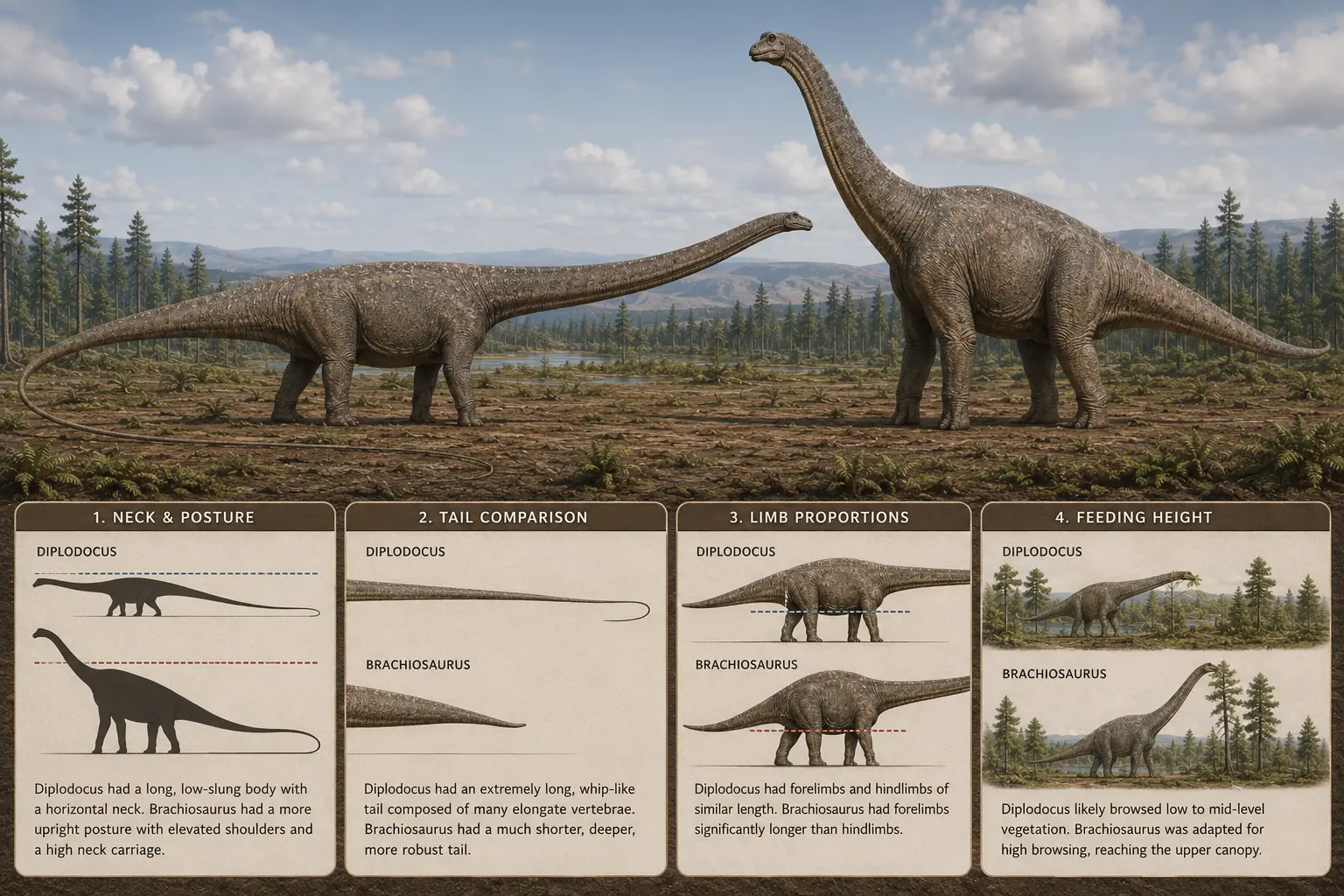
| Feature | Diplodocus longus | Brachiosaurus altithorax |
|---|---|---|
| Order / Family | Sauropoda, Diplodocidae | Sauropoda, Brachiosauridae |
| Period | Late Jurassic, approximately 154–149 Ma | Late Jurassic, approximately 154–150 Ma |
| Estimated length | 24–26 m (79–85 ft) | 20–23 m (66–75 ft) |
| Estimated mass | 10,000–16,000 kg (22,000–35,300 lb) | Approximately 28,000–50,000 kg (62,000–110,000 lb) |
| Shoulder height | ~3–4 m (10–13 ft) | ~6 m (20 ft) |
| Neck posture | Generally low to moderately elevated | Steeply inclined |
| Tail | Very long, whip-like | Shorter, tapering |
| Did they meet? | Yes — Morrison Formation, western North America | Yes — Morrison Formation, western North America |
Quick Answer
Diplodocus and Brachiosaurus were both Late Jurassic sauropods from the Morrison Formation, but they belonged to different families and possessed markedly different body plans. Diplodocus was longer and more lightly built, with a near-horizontal posture and an exceptionally elongated tail. Brachiosaurus was substantially heavier, with longer forelimbs, elevated shoulders, and a steeply inclined neck adapted for feeding at greater heights. Although they coexisted within the same ecosystem, they likely exploited different portions of the available vegetation.

Two of the most recognisable dinosaurs in any natural history museum, Diplodocus and Brachiosaurus, are often grouped simply because of their enormous size. In reality, they represent distinct sauropod lineages with markedly different anatomies, feeding strategies, and evolutionary histories.
Diplodocus vs Brachiosaurus: Key Differences
The clearest difference between Diplodocus and Brachiosaurus is the body plan. Diplodocus was built long and low, with a nearly level back and a tail that accounted for roughly half its total length. Brachiosaurus was built tall and heavy, with forelimbs longer than the hindlimbs, producing elevated shoulders and a neck that rose steeply above the body.
Body mass represents one of the most significant differences between the two genera. Published estimates generally place Brachiosaurus substantially heavier than Diplodocus, although exact values vary among studies and reconstruction methods. This difference likely had important implications for energy requirements, locomotion, feeding range, and ecological role.
Both genera are currently regarded as valid and distinct at the family level. Diplodocidae and Brachiosauridae diverged early in sauropod evolution and represent separate evolutionary lineages that independently achieved enormous body size, illustrating a broader pattern of convergent gigantism within Sauropoda.
What Dinosaur Is Similar to Diplodocus?
The dinosaurs most similar to Diplodocus belong to the family Diplodocidae. This group includes Apatosaurus, Barosaurus, and Supersaurus—all characterised by elongated necks, whip-like tails, bifurcated neural spines, and a generally low, horizontal body profile. Diplodocidae forms part of the larger clade Diplodocoidea, which also includes more specialised relatives such as Dicraeosaurus and Nigersaurus.
Brachiosaurus, by contrast, is more closely related to other brachiosaurids such as Giraffatitan (formerly classified as Brachiosaurus brancai) and Lusotitan. These sauropods share a tall-shouldered body plan, proportionally longer forelimbs, and a steeply inclined neck. They belong to Macronaria, a separate sauropod lineage from the diplodocoids.
Diplodocus vs Apatosaurus
Diplodocus and Apatosaurus were closely related members of Diplodocidae and coexisted within the Morrison Formation. Apatosaurus was more robustly built, with a shorter neck and substantially greater body mass despite a somewhat shorter overall length. Although the two genera are sometimes confused in popular media, their skeletal proportions differ sufficiently that well-preserved specimens are readily distinguishable.
Diplodocus vs Barosaurus
Barosaurus was among the closest known relatives of Diplodocus. The two genera shared many anatomical similarities, but Barosaurus possessed proportionally longer cervical vertebrae and a relatively longer neck. Whether these differences translated into distinct feeding heights or ecological roles remains uncertain, as neck posture and feeding behaviour in diplodocids continue to be actively researched.
Did Diplodocus and Brachiosaurus Live at the Same Time?
Yes. Diplodocus and Brachiosaurus coexisted in the Morrison Formation during the Late Jurassic. Fossil evidence places both genera within the same geological formation across multiple regions of western North America, including present-day Colorado, Utah, and Wyoming. Their temporal and geographic overlap is well established.
Whether they regularly occupied the same local habitats is less certain. Ecological interpretations suggest that differences in body structure and feeding height may have reduced direct competition for food resources. Some researchers have proposed that Brachiosaurus specialised on higher vegetation while Diplodocus focused on lower browsing levels, although this remains an inference based on anatomy and ecosystem structure rather than direct fossil evidence.
Phylogenetic Relationship Between Diplodocus and Brachiosaurus
Diplodocus and Brachiosaurus belong to separate major sauropod lineages within Neosauropoda. Diplodocus is a member of Diplodocidae within Diplodocoidea, whereas Brachiosaurus belongs to Brachiosauridae within Macronaria. Although both were large Late Jurassic sauropods, they inherited their distinctive body plans from different evolutionary branches that diverged long before either genus appeared in the fossil record.
Phylogenetic relationships within Sauropoda continue to be refined as new specimens are described and analytical methods improve. However, the distinction between diplodocoids and macronarians is well supported and remains one of the fundamental divisions within neosauropod evolution.
Related and Contemporary Species
- Apatosaurus — a closely related diplodocid from the Morrison Formation, distinguished by a more robust skeleton and greater body mass.
- Barosaurus — another diplodocid closely related to Diplodocus, notable for its proportionally longer neck and elongated cervical vertebrae.
- Camarasaurus — one of the most abundant Morrison Formation sauropods; a macronarian with a shorter neck, more robust body, and different feeding adaptations.
- Giraffatitan — an African brachiosaurid formerly classified as Brachiosaurus brancai, now recognised as a separate genus by most researchers.
- Supersaurus — a giant diplodocid known from more fragmentary remains, with some reconstructions suggesting total lengths that may have exceeded those of Diplodocus.
Frequently Asked Questions
Which was heavier, Diplodocus or Brachiosaurus?
Brachiosaurus was substantially heavier than Diplodocus. Published mass estimates generally place Brachiosaurus at approximately 28–50 metric tonnes, compared with roughly 10–16 metric tonnes for Diplodocus. Exact figures vary among studies because mass estimation in large sauropods depends heavily on reconstruction and modelling methods.
Are Diplodocus and Brachiosaurus related?
Yes. Diplodocus and Brachiosaurus are both sauropod dinosaurs within the clade Neosauropoda. However, they belong to separate families—Diplodocidae and Brachiosauridae, respectively—and are not considered close relatives within sauropod evolutionary history.
Note
Sauropod phylogeny, body-mass estimation, and functional anatomy remain active areas of research. Interpretations presented here reflect widely accepted current evidence but may be refined as discoveries and analytical methods become available.
Conclusion
Diplodocus and Brachiosaurus shared the same Late Jurassic ecosystem but differed substantially in anatomy, evolutionary history, and likely feeding ecology. Comparing these two iconic sauropods highlights the remarkable diversity of body plans that evolved within Sauropoda and provides insight into how multiple giant herbivores coexisted within the Morrison Formation ecosystem.
References
A. Primary Taxonomic Sources
Marsh, O.C., 1878. Principal characters of American Jurassic dinosaurs. Part I. American Journal of Science and Arts, Series 3, 16(95), pp.411–416.
Riggs, E.S., 1903. Brachiosaurus altithorax, the largest known dinosaur. American Journal of Science, Series 4, 15(88), pp.299–306.
B. Scientific Literature
Carrano, M.T., 2005. The evolution of sauropod locomotion. In: Curry Rogers, K.A. and Wilson, J.A. (eds.) The Sauropods: Evolution and Paleobiology. Berkeley: University of California Press, pp.229–249.
Taylor, M.P., 2009. A re-evaluation of Brachiosaurus altithorax Riggs 1903 (Dinosauria, Sauropoda) and its generic separation from Giraffatitan brancai. Journal of Vertebrate Paleontology, 29(3), pp.787–806. https://doi.org/10.1671/039.029.0309
Tschopp, E., Mateus, O. and Benson, R.B.J., 2015. A specimen-level phylogenetic analysis and taxonomic revision of Diplodocidae (Dinosauria, Sauropoda). PeerJ, 3:e857. https://doi.org/10.7717/peerj.857
C. Books and Reference Works
Curry Rogers, K.A. and Wilson, J.A. (eds.), 2005. The Sauropods: Evolution and Paleobiology. University of California Press, Berkeley.
Paul, G.S., 2016. The Princeton Field Guide to Dinosaurs. 2nd ed. Princeton University Press.
Fastovsky, D.E. and Weishampel, D.B., 2016. Dinosaurs: A Concise Natural History. 3rd ed. Cambridge University Press.
D. Databases and Online Resources
Paleobiology Database, 2026. Diplodocus and Brachiosaurus occurrence data. Available at: https://paleobiodb.org [Accessed 19 May 2026].
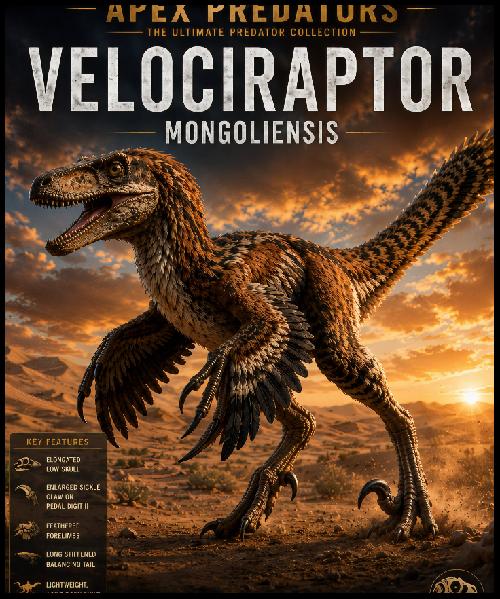
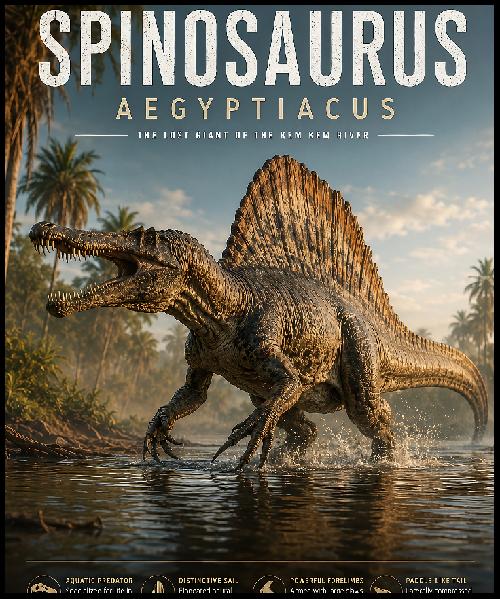
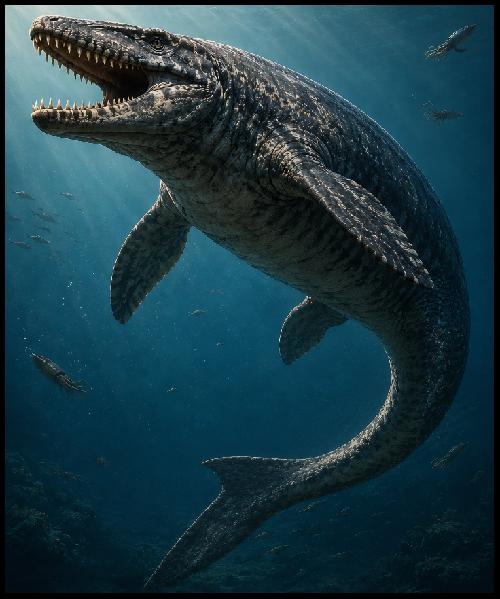
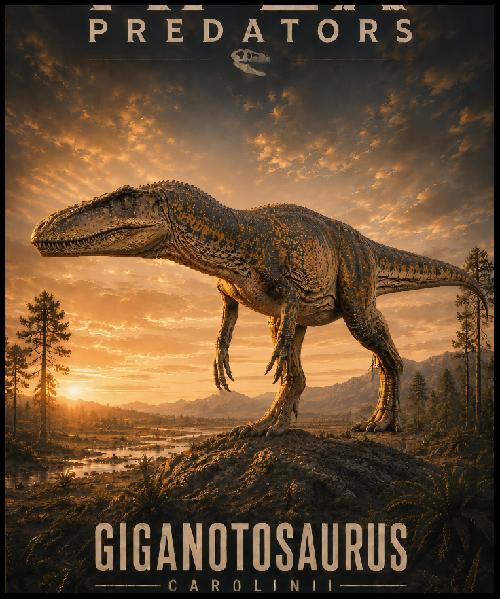
Featured Museum Collections
Museum-quality paleoart and educational poster
collections based on evidence-informed prehistoric
Life reconstructions.