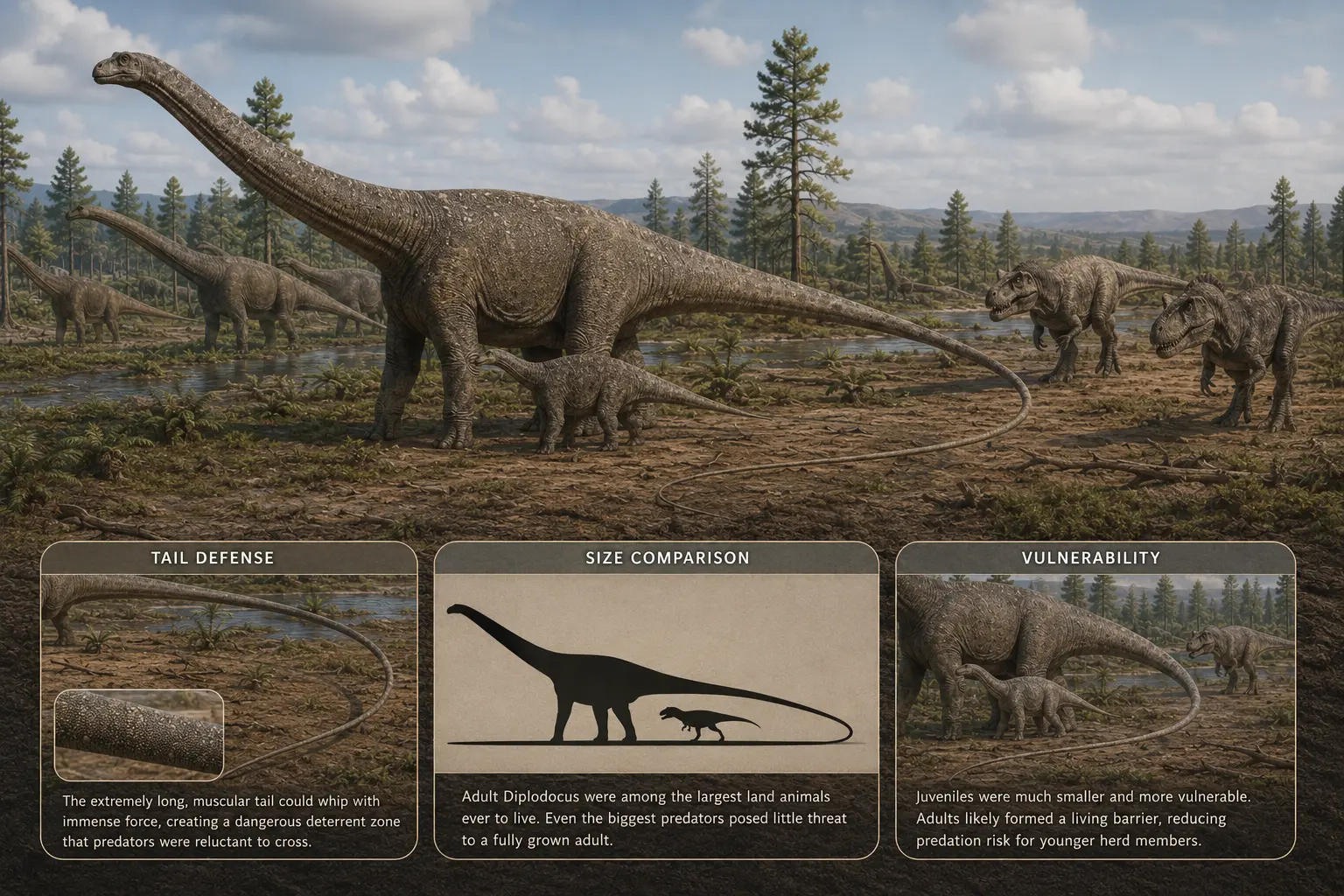
| Field | Information |
|---|---|
| Species | Diplodocus longus — Sauropoda, Diplodocidae |
| Period | Late Jurassic (Kimmeridgian–early Tithonian), approximately 154–149 million years ago |
| Known predators | Allosaurus, Ceratosaurus, Torvosaurus |
| Primary defence | Large body size; tail as a potential active deterrent |
| Social behaviour | Possible gregarious behaviour — debated |
Quick Answer
Yes. Diplodocus lived alongside several large predatory theropods in the Morrison Formation, most notably Allosaurus. Fossil evidence from Morrison deposits includes tooth-marked sauropod bones attributed to large theropods, demonstrating feeding interactions between predators and giant herbivores. Defence likely relied on body size, tail use, and possibly social behaviour, although the details remain uncertain.

The largest land predators of the Late Jurassic were formidable animals, yet even they faced prey that outweighed them many times over. How Diplodocus defended itself, and how frequently it faced predation, are questions only partially answered by the fossil record.
Did Diplodocus Have Any Predators?
Diplodocus almost certainly faced predation pressure during its lifetime. The Morrison Formation ecosystem contained several large theropod dinosaurs capable of attacking sauropods:
- Allosaurus fragilis — the most abundant large theropod in the Morrison Formation and the predator most frequently associated with feeding traces on Morrison sauropod bones.
- Torvosaurus tanneri — a large megalosaurid theropod that shared the same ecosystem, although it is less common in the fossil record than Allosaurus.
- Ceratosaurus nasicornis — a smaller theropod contemporary that may have posed a threat to juvenile, injured, or otherwise vulnerable Diplodocus individuals.
- Marshosaurus bicentesimus — a comparatively smaller Morrison theropod that was more likely to have preyed upon juveniles than fully grown adults.
Direct fossil evidence for feeding interactions between large theropods and sauropods in the Morrison Formation exists in the form of tooth-marked bones. These traces demonstrate that large carnivorous dinosaurs fed on sauropod carcasses or attacked living animals, although the fossil evidence does not always allow researchers to distinguish confidently between active predation and scavenging.
Adult Diplodocus would have represented a formidable target. Its large body size alone would have reduced vulnerability to most predators, making juveniles and subadults the most likely targets of attack. As with many modern large herbivores, predation pressure was probably concentrated on younger, smaller, injured, or otherwise weakened individuals rather than healthy adults.
How Did Diplodocus Defend Itself?
Diplodocus likely relied primarily on its large body size and, potentially, its tail for defence. Several lines of anatomical evidence and biomechanical interpretation inform this view, although many aspects of sauropod defensive behaviour remain uncertain.
Body Size as Passive Defence
The most obvious defensive advantage of an adult Diplodocus was its sheer size. With published mass estimates generally ranging from 10,000–16,000 kg (22,000–35,300 lb), a healthy adult would have represented a challenging and potentially dangerous target for even the largest Morrison Formation predators. Comparisons with modern large herbivores suggest that predators typically focus on juveniles, injured individuals, or otherwise vulnerable animals rather than healthy adults. By analogy, juvenile Diplodocus were likely considerably more vulnerable to predation than fully grown individuals.
The Tail as a Defensive Weapon
The tail of Diplodocus has long been considered a potential defensive structure. Biomechanical modelling by Myhrvold and Currie (1997) proposed that the whip-like distal portion of the tail could, under certain conditions, have achieved extremely high tip velocities, potentially producing a crack similar to that of a modern bullwhip. This hypothesis attracted considerable attention and remains one of the most widely discussed aspects of diplodocid biomechanics.
Subsequent studies have questioned whether the delicate vertebrae at the extreme tail tip could repeatedly withstand the stresses implied by true supersonic motion. As a result, some researchers have favoured interpretations in which the tail functioned as a powerful subsonic striking structure rather than a literal supersonic whip. The issue remains unresolved, and neither interpretation should be regarded as established consensus.
What the fossil evidence does demonstrate is that the tail was exceptionally long, flexible, and heavily muscled at its base. These anatomical features indicate that it was capable of generating substantial movement and force. Whether this capability was routinely used in defence, display, or other behaviours remains a matter of interpretation.
Herding and Group Behaviour
Evidence for herding behaviour in Diplodocus is indirect. Some Morrison Formation sites have yielded multiple diplodocid individuals in association, a pattern that has been interpreted by some researchers as possible evidence of gregarious behaviour. Comparisons with modern large herbivores suggest that group living can provide anti-predator advantages through increased vigilance and reduced individual risk.
Whether Diplodocus formed structured herds, loose aggregations, or simply gathered around shared resources cannot currently be determined from fossil evidence alone. Consequently, herding behaviour should be regarded as a plausible but unconfirmed interpretation rather than a fact.
Was Diplodocus Friendly?
The question of whether Diplodocus was “friendly” reflects a common interest in dinosaur behaviour, but temperament cannot be directly determined from fossil evidence. Like all non-avian dinosaurs, Diplodocus cannot be assessed for personality or social disposition in the way living animals can. Comparisons with modern large herbivores suggest that adult individuals were unlikely to have been persistently aggressive toward other species under normal circumstances, although such comparisons remain ecological inference rather than direct evidence.
Behaviour between Diplodocus individuals is similarly difficult to reconstruct. Some researchers have suggested that the long tail may have served functions beyond defence, potentially including display or signalling, but no fossil evidence directly confirms these behaviours. As with many aspects of dinosaur social behaviour, interpretations remain tentative.
Related and Contemporary Species
- Allosaurus — the dominant large theropod of the Morrison Formation and the predator most commonly associated with feeding traces on Morrison sauropod bones.
- Torvosaurus — a large contemporary theropod that may have posed a threat to juvenile or vulnerable Diplodocus individuals.
- Ceratosaurus — a smaller Morrison Formation predator and a plausible threat to young sauropods.
- Apatosaurus — a closely related diplodocid that shared the same ecosystem and likely faced similar predation pressures.
- Stegosaurus — a contemporary herbivore equipped with specialised defensive structures, providing a useful comparison for understanding predator-prey dynamics within the Morrison ecosystem.
Frequently Asked Questions
Could Diplodocus Kill an Allosaurus?
Direct fossil evidence cannot determine whether Diplodocus killed attacking theropods. However, a defensive strike from the tail of a large adult may have been capable of causing serious injury. Biomechanical studies indicate that the tail was capable of generating substantial force, particularly near its heavily muscled base. Whether such strikes were commonly used in defence remains unknown.
Did Diplodocus Travel in Herds for Protection?
The possibility of herding behaviour in Diplodocus is inferred rather than directly demonstrated. Some Morrison Formation sites have yielded multiple diplodocid individuals in association, and comparisons with modern large herbivores support the plausibility of group living as an anti-predator strategy. However, whether these associations represent organised herds, temporary aggregations, or repeated use of the same habitats remains unresolved.
Note
Diplodocus tail biomechanics, the defensive role of the tail, and sauropod social behaviour remain active areas of scientific research. Interpretations presented here reflect current evidence but may be refined as discoveries and analytical methods become available.
Conclusion
Diplodocus lived alongside some of the largest terrestrial predators of the Jurassic, and fossil evidence confirms that large theropods interacted with sauropods within the Morrison Formation ecosystem. Its principal defences likely included immense body size, a powerful tail, and possibly some form of social behaviour. While many details remain uncertain, these adaptations would have helped one of the world’s longest dinosaurs coexist with formidable predators throughout the Late Jurassic.
References
Peer-Reviewed Literature
Myhrvold, N.P. and Currie, P.J., 1997. Supersonic sauropods? Tail dynamics in the diplodocids. Paleobiology, 23(4), pp.393–409.
Carpenter, K., 1998. Evidence of predatory behavior by carnivorous dinosaurs. Gaia, 15, pp.135–144.
Roach, B.T. and Brinkman, D.L., 2007. A reevaluation of cooperative pack hunting and gregariousness in Deinonychus antirrhopus and other non-avian theropod dinosaurs. Bulletin of the Peabody Museum of Natural History, 48(1), pp.103–138. https://doi.org/10.3374/0079-032X(2007)48[103:AROCPA]2.0.CO;2
Databases and Online Resources
Paleobiology Database, 2026. Allosaurus and Diplodocus occurrence data. Available at: https://paleobiodb.org [Accessed 19 May 2026].
Featured Museum Collections
Museum-quality paleoart and educational poster
collections based on evidence-informed prehistoric
Life reconstructions.