Species Quick Info
| Field | Information |
|---|---|
| Species | Diplodocus longus — Saurischia, Diplodocidae |
| Period | Late Jurassic (Kimmeridgian–early Tithonian), approximately 154–149 million years ago |
| Estimated top speed | Approximately 6–12 km/h (4–7.5 mph) — biomechanical modelling |
| Limb type | Graviportal — columnar limbs adapted primarily for weight-bearing |
Quick Answer
How fast: Diplodocus could move is estimated at approximately 6–12 km/h (4–7.5 mph) based on biomechanical modelling and sauropod trackway evidence. A true running gait was likely impossible given its immense body mass and limb structure. Speed estimates vary among studies and should be regarded as approximations rather than fixed values.

Introduction
A fully grown Diplodocus weighed roughly as much as several modern elephants and supported that mass on four columnar limbs. Speed was not its primary adaptation. Understanding how it moved requires evidence from fossil trackways, biomechanical modelling, and comparisons with other large terrestrial animals, all of which indicate a locomotor strategy centred on stability and energetic efficiency rather than rapid movement.
How Fast Could Diplodocus Move?
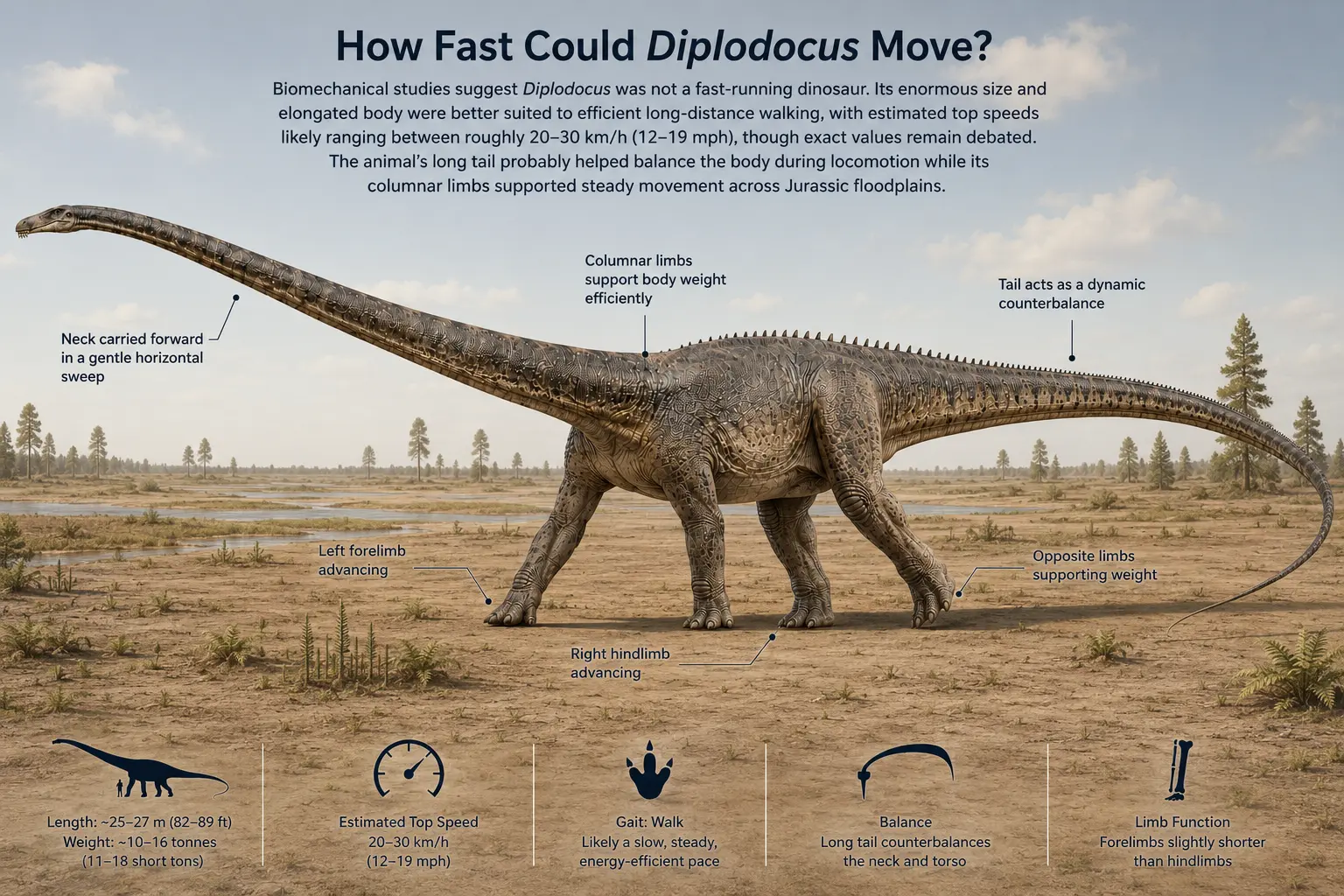
Biomechanical studies suggest that Diplodocus typically moved at approximately 6–12 km/h (4–7.5 mph), with the lower end of that range likely representing more sustainable travel speeds. Computer models of sauropod locomotion indicate that animals of this size were physically constrained from achieving a true running gait, defined as a locomotor pattern in which all feet leave the ground simultaneously. Fossil trackways attributed to large sauropods support walking as the primary mode of locomotion.
The limbs of Diplodocus were graviportal, meaning they were held nearly vertically beneath the body and functioned primarily as weight-bearing supports rather than as limbs specialised for speed. Forelimb and hindlimb proportions produced a relatively level body posture, contributing to stable and efficient movement. Comparisons with modern large-bodied terrestrial animals suggest that economical long-distance travel was likely more important to Diplodocus than rapid acceleration or high speed.
Speed estimates for large sauropods vary among studies because they depend on assumptions about muscle mass, joint mobility, body mass, and stride mechanics. While some models have proposed higher maximum speeds, many researchers favour more conservative estimates. As a result, all published speed figures should be regarded as approximate rather than definitive.
What Do Fossil Trackways Reveal About Sauropod Movement?
Fossil trackways provide the most direct evidence of how large sauropods moved in life. Sauropod trackways commonly show relatively narrow-gauge footprints, with the hind feet positioned close to the trackway midline. These track patterns are consistent with an upright, columnar limb posture and provide strong evidence that sauropods walked with their limbs positioned beneath the body rather than in a sprawling stance.
Stride lengths preserved in sauropod trackways are consistent with walking locomotion. No confirmed sauropod trackways exhibit the stride patterns expected of a true running gait. Trackway evidence has played an important role in overturning older reconstructions that portrayed sauropods as sluggish, swamp-dwelling animals incapable of efficient terrestrial movement. Instead, fossil footprints demonstrate that sauropods were fully terrestrial and capable of sustained locomotion across a variety of environments.
Some trackway sites preserve only forefoot impressions, prompting debate about their origin. Earlier interpretations suggested that such trackways might reflect partially buoyant animals moving through shallow water. However, many researchers now interpret these unusual track patterns as the result of substrate conditions affecting footprint preservation, with differences in sediment consistency influencing the depth and visibility of forefoot and hindfoot impressions. Although alternative explanations have been proposed, the evidence supports fully terrestrial quadrupedal locomotion as the normal mode of movement in sauropods.
Limb Anatomy and Gait
Forelimbs and Hindlimbs
Diplodocus had slightly longer hindlimbs than forelimbs, which is typical for diplodocids and contributed to the characteristic near-horizontal body posture with a gently downward-sloping back. The forefeet were horseshoe-shaped and lacked large claws on most digits, though the innermost digit of the hindfoot bore a single large recurved claw on each foot. Biomechanical interpretations generally indicate that the hindlimbs contributed most of the propulsive force during locomotion, while the forelimbs primarily supported body weight.
Tail Counterbalance
The long tail served a mechanical role in locomotion as well as defence. Biomechanical modelling indicates the tail acted as a counterbalance to the neck, helping to distribute the animal’s mass more evenly across all four limbs during movement. Concept note: tail anatomy and vertebral count are covered in full on the size and anatomy post.
Related and Contemporary Species
- Apatosaurus — a fellow diplodocid from the Morrison Formation, broadly similar in body plan but more robustly built, providing a useful comparison for locomotion studies.
- Barosaurus — a close diplodocid relative with an even longer neck, whose limb proportions and inferred movement capabilities were similar to Diplodocus.
- Camarasaurus — a macronarian sauropod sharing the Morrison Formation, with shorter and proportionally heavier limbs, likely producing a somewhat different gait.
- Brachiosaurus — a contemporaneous Morrison sauropod whose distinctive forelimb-dominated body proportions likely influenced locomotor mechanics differently from those of Diplodocus.
Frequently Asked Questions
Could Diplodocus gallop or run?
Diplodocus almost certainly could not gallop or sustain a running gait. Biomechanical modelling indicates that animals of its mass — estimated at 10,000–16,000 kg (22,000–35,300 lb) — could not achieve the simultaneous aerial phase that defines a true run. All available evidence points to walking as its only locomotive mode.
How does Diplodocus speed compare to other large sauropods?
Diplodocus speed estimates are broadly similar to those proposed for other large sauropods. Speed estimates for Morrison Formation sauropods generally converge on a walking range of 4–12 km/h (2.5–7.5 mph), with differences between species reflecting body mass and limb proportions rather than any fundamental difference in locomotor strategy.
Note: Biomechanical speed estimates for large sauropods and sauropod trackway attribution are active areas of research. Details reflect current scientific consensus but may be revised as new evidence emerges.
Conclusion
Diplodocus was a slow-moving animal constrained by mass and limb anatomy to a walking gait. Biomechanical modelling places its speed at approximately 6–12 km/h (4–7.5 mph), trackways confirm an upright columnar posture, and true running was almost certainly beyond its physical capability. Locomotion in Diplodocus was built around endurance and efficiency, not speed.
References
Peer-Reviewed Literature
Carrano, M.T., 1999. What, if anything, is a cursor? Categories versus continua for determining locomotor habit in mammals and dinosaurs. Journal of Zoology, 247(1), pp.29–42.
Henderson, D.M., 2006. Burly gaits: centres of mass, stability, and the trackways of sauropod dinosaurs. Journal of Vertebrate Paleontology, 26(4), pp.907–921.
Sellers, W.I., Margetts, L., Coria, R.A. and Manning, P.L., 2013. March of the titans: the locomotor capabilities of sauropod dinosaurs. PLOS ONE, 8(10):e78733. https://doi.org/10.1371/journal.pone.0078733
Alexander, R.McN., 1976. Estimates of the speeds of dinosaurs. Nature, 261, pp.129–130. https://doi.org/10.1038/261129a0
Featured Museum Collections
Museum-quality paleoart and educational poster
collections based on evidence-informed prehistoric
Life reconstructions.