Quick Info
| Field | Information |
|---|---|
| Species | Giganotosaurus carolinii — Saurischia, Carcharodontosauridae |
| Period | Late Cretaceous (Cenomanian), approximately 99–97 million years ago |
| Discovery Year | 1993 |
| Discoverer | Rubén Dario Carolini (amateur fossil hunter) |
| Holotype Specimen | MUCPv-Ch1 |
| Discovery Location | El Chocón area, Neuquén Province, Patagonia, Argentina |
Quick Answer
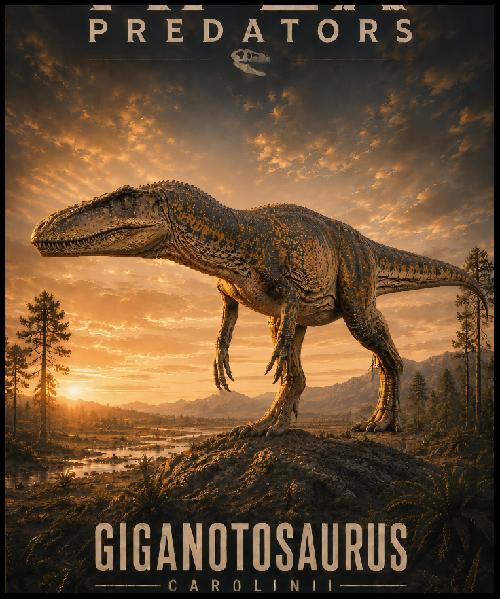
Giganotosaurus carolinii was discovered in 1993 by amateur fossil hunter Rubén Dario Carolini near El Chocón in Neuquén Province, Patagonia, Argentina. The holotype specimen was formally described by palaeontologists Rodolfo Coria and Leonardo Salgado in 1995 and quickly became one of the most significant theropod discoveries ever made in South America.

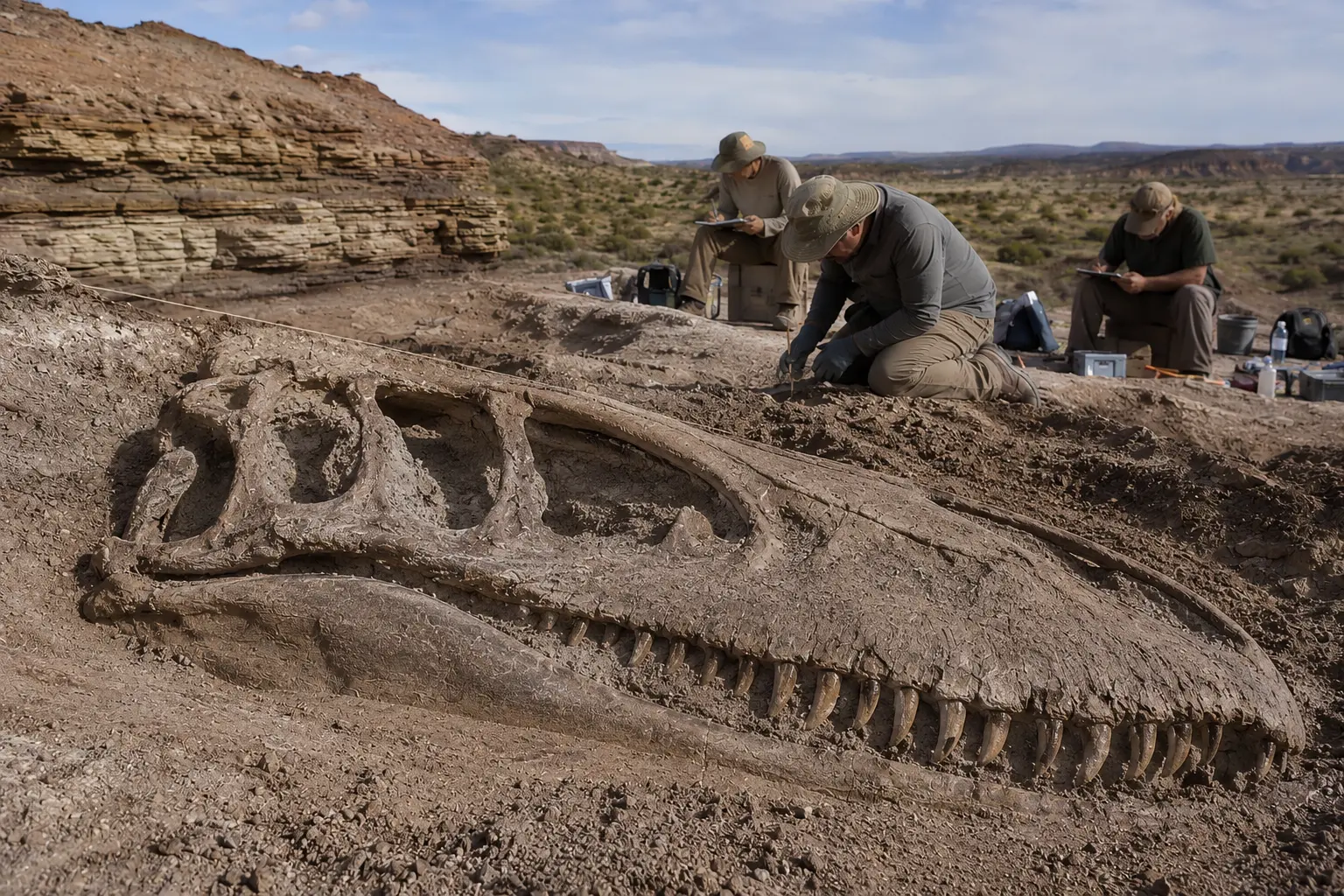
According to accounts of the discovery, Carolini noticed fossil bones eroding from exposed rock in the Patagonian landscape and reported the find to the Museo Municipal Carmen Funes in Plaza Huincul. Professional excavation followed, revealing the remains of a giant predatory dinosaur previously unknown to science. The species name, carolinii, was chosen in honour of its discoverer.
How Was Giganotosaurus Discovered?
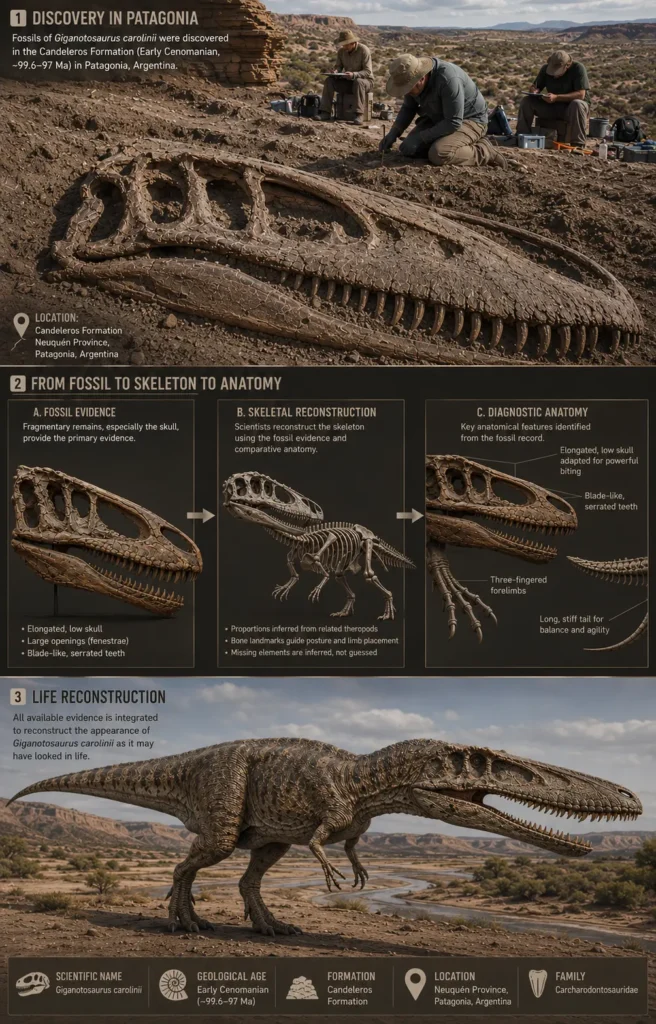
Giganotosaurus carolinii was discovered in 1993 by Rubén Dario Carolini, an amateur fossil enthusiast and racing-car mechanic from the Villa El Chocón region of Neuquén Province, Argentina. While exploring exposures of the Candeleros Formation, Carolini encountered large fossil bones weathering out of the surrounding sedimentary rock and recognised their potential significance.
After reporting the discovery to the Museo Municipal Carmen Funes in Plaza Huincul, a professional team began excavating the site. The recovered remains proved to belong to a previously unknown species of giant theropod dinosaur. The find was particularly important because large predatory dinosaurs from South America were still relatively poorly known compared with those from North America and Asia.
The specimen was formally described in 1995 by Argentine palaeontologists Rodolfo Coria and Leonardo Salgado in the journal Nature. Their study identified the animal as a new genus and species, Giganotosaurus carolinii. The discovery attracted international attention because the preserved skull and skeletal remains indicated an exceptionally large predator, comparable in size to the largest known theropod dinosaurs.
The specific name carolinii honours Rubén Dario Carolini, whose discovery led to the recognition of one of the most famous carcharodontosaurid dinosaurs ever described.
The Holotype Specimen
The holotype specimen of Giganotosaurus carolinii, catalogued as MUCPv-Ch1, is housed at the Museo Municipal Carmen Funes in Plaza Huincul, Neuquén Province, Argentina. This specimen remains the principal source of anatomical information for the species and forms the foundation for nearly all scientific reconstructions of Giganotosaurus.
The fossil material includes substantial portions of the skull and lower jaw, sections of the vertebral column, elements of the pelvis, and parts of both the forelimbs and hindlimbs. Together, these remains provide a detailed picture of the animal’s anatomy and confirm its status as one of the largest known predatory dinosaurs.
The skull is particularly important because it preserves many of the features used to diagnose the species and determine its relationships within Carcharodontosauridae. Reconstructed skull length exceeds 1.5 metres (5 feet), placing it among the largest theropod skulls known. Combined with the preserved postcranial material, the specimen allows researchers to estimate body size, proportions, and aspects of locomotion, although such estimates inevitably involve some degree of reconstruction.
Skeletal Completeness and What It Means
Understanding what is preserved—and what is missing—is important when evaluating claims about the size and biology of Giganotosaurus. Although the holotype is one of the most informative giant theropod specimens from South America, the skeleton is incomplete. As a result, estimates of total body length, mass, and certain anatomical proportions require extrapolation from preserved elements and comparisons with related species.
Consequently, measurements commonly reported for Giganotosaurus should be regarded as scientific estimates rather than direct measurements. While the preserved bones provide a strong foundation for reconstruction, some uncertainty remains regarding the animal’s exact dimensions. A detailed discussion of these estimates is provided in the size and dimensions article.
Additional Specimens and New Material
A second specimen, catalogued as MUCPv-95, has been referred to Giganotosaurus carolinii. Although considerably less complete than the holotype, the preserved material suggests that it may have belonged to an individual somewhat larger than MUCPv-Ch1. Because the specimen is fragmentary, however, both its exact size and its referral to Giganotosaurus are subject to greater uncertainty than those of the holotype.
At present, no additional complete or near-complete specimens of Giganotosaurus carolinii have been formally described. Ongoing research in the Neuquén Basin continues to yield new carcharodontosaurid material, and future discoveries may help clarify variation within the species and refine current anatomical interpretations.
Current State of the Fossil Record
The fossil record of Giganotosaurus remains relatively limited, with the holotype specimen providing the overwhelming majority of anatomical information available to researchers. This restricted sample size means that some aspects of the animal’s biology remain uncertain.
Features such as soft-tissue appearance, skin covering, colouration, growth patterns, and aspects of locomotor performance cannot be observed directly from the known fossils and must instead be inferred from related carcharodontosaurids, broader theropod anatomy, and biomechanical analysis. As additional material is discovered and studied, scientific understanding of Giganotosaurus will continue to evolve.
Where Are the Fossils Held?
The holotype specimen of Giganotosaurus carolinii (MUCPv-Ch1) is housed at the Museo Municipal Carmen Funes in Plaza Huincul, Neuquén Province, Argentina. This institution serves as the primary repository for the known Giganotosaurus material and remains an important centre for the study and curation of Patagonian dinosaur fossils.
The holotype is the most scientifically significant specimen of the species and forms the basis for its anatomical description and classification. Casts of the skeleton have been displayed at various museums and exhibitions around the world, allowing researchers and the public to study and appreciate one of the largest known predatory dinosaurs without moving the original fossil material.
Today, the Museo Municipal Carmen Funes continues to preserve and curate the specimen, ensuring its availability for future scientific research.
Related and Contemporary Species
- Mapusaurus roseae — a closely related carcharodontosaurid from the younger Huincul Formation of Patagonia. The discovery of multiple individuals preserved together has made this species central to discussions of possible social behaviour in giant carcharodontosaurids.
- Carcharodontosaurus saharicus — a large North African carcharodontosaurid that shared many anatomical similarities with Giganotosaurus and helps illustrate the widespread distribution of giant apex predators during the Cretaceous.
- Argentinosaurus huinculensis — one of the largest known titanosaurs and an example of the enormous herbivorous dinosaurs that evolved in Cretaceous Patagonia.
- Andesaurus delgadoi — a titanosaur from the Candeleros Formation, the same geological formation that produced Giganotosaurus. It represents a more directly contemporary large herbivore within the ecosystem inhabited by Giganotosaurus.
Frequently Asked Questions
Where was the first Giganotosaurus fossil found?
The first known fossil of Giganotosaurus carolinii was discovered near El Chocón in Neuquén Province, Patagonia, Argentina, in 1993. The remains were found weathering from rocks of the Candeleros Formation, part of the Neuquén Group. The discovery was made by amateur fossil hunter Rubén Dario Carolini, who reported the site to the Museo Municipal Carmen Funes, leading to its scientific excavation.
Who discovered Giganotosaurus?
Giganotosaurus carolinii was discovered by Rubén Dario Carolini in 1993. The species was later named in his honour by palaeontologists Rodolfo Coria and Leonardo Salgado.
When was Giganotosaurus formally described?
The species was formally described in 1995 in the journal Nature by Rodolfo Coria and Leonardo Salgado, who recognised the specimen as a previously unknown giant theropod dinosaur.
How many Giganotosaurus specimens are known?
Giganotosaurus is currently known from a small number of specimens. The holotype specimen (MUCPv-Ch1) remains by far the most complete and scientifically important source of information about the species, while additional referred material is considerably less complete.
Conclusion
Giganotosaurus carolinii was discovered by chance in the Patagonian desert in 1993 and formally described two years later. The discovery provided one of the most important giant theropod specimens ever found in South America and significantly improved scientific understanding of carcharodontosaurid dinosaurs. Although the known fossil record remains limited, the holotype continues to serve as the foundation for research on this remarkable predator. Ongoing discoveries from the Neuquén Basin may further refine our understanding of its anatomy, evolution, and ecological role.
References
A. Primary Taxonomic Sources
Coria, R.A. & Salgado, L. (1995). A new giant carnivorous dinosaur from the Cretaceous of Patagonia. Nature, 377, 224–226. https://doi.org/10.1038/377224a0
B. Peer-Reviewed Literature
Calvo, J.O. & Coria, R.A. (1998). A new specimen of Giganotosaurus carolinii (Coria and Salgado, 1995), supports it as the largest theropod ever found. Gaia, 15, 117–122.
C. Books and Reference Works
Novas, F.E. (2009). The Age of Dinosaurs in South America. Indiana University Press.
D. Scientific Databases and Museums
Paleobiology Database — occurrence and taxonomy records for Giganotosaurus carolinii.
Natural History Museum — educational overview and specimen information.
Natural History Museum Website
Featured Museum Collections
Museum-quality paleoart and educational poster
collections based on evidence-informed prehistoric
Life reconstructions.