Species Quick Info
| Field | Information |
|---|---|
| Scientific Name | Carnotaurus sastrei |
| Topic | Fossils and Discovery |
| Discovery Year | 1984 |
| Formal Description | 1985 |
| Naming Authority | José F. Bonaparte |
| Holotype | MACN-CH 894 |
| Formation | La Colonia Formation (commonly cited; stratigraphic interpretation remains discussed) |
| Location | Chubut Province, Patagonia, Argentina |
| Fossil Completeness | Exceptional |
| Evidence Strength | Direct Evidence |
Quick Answer
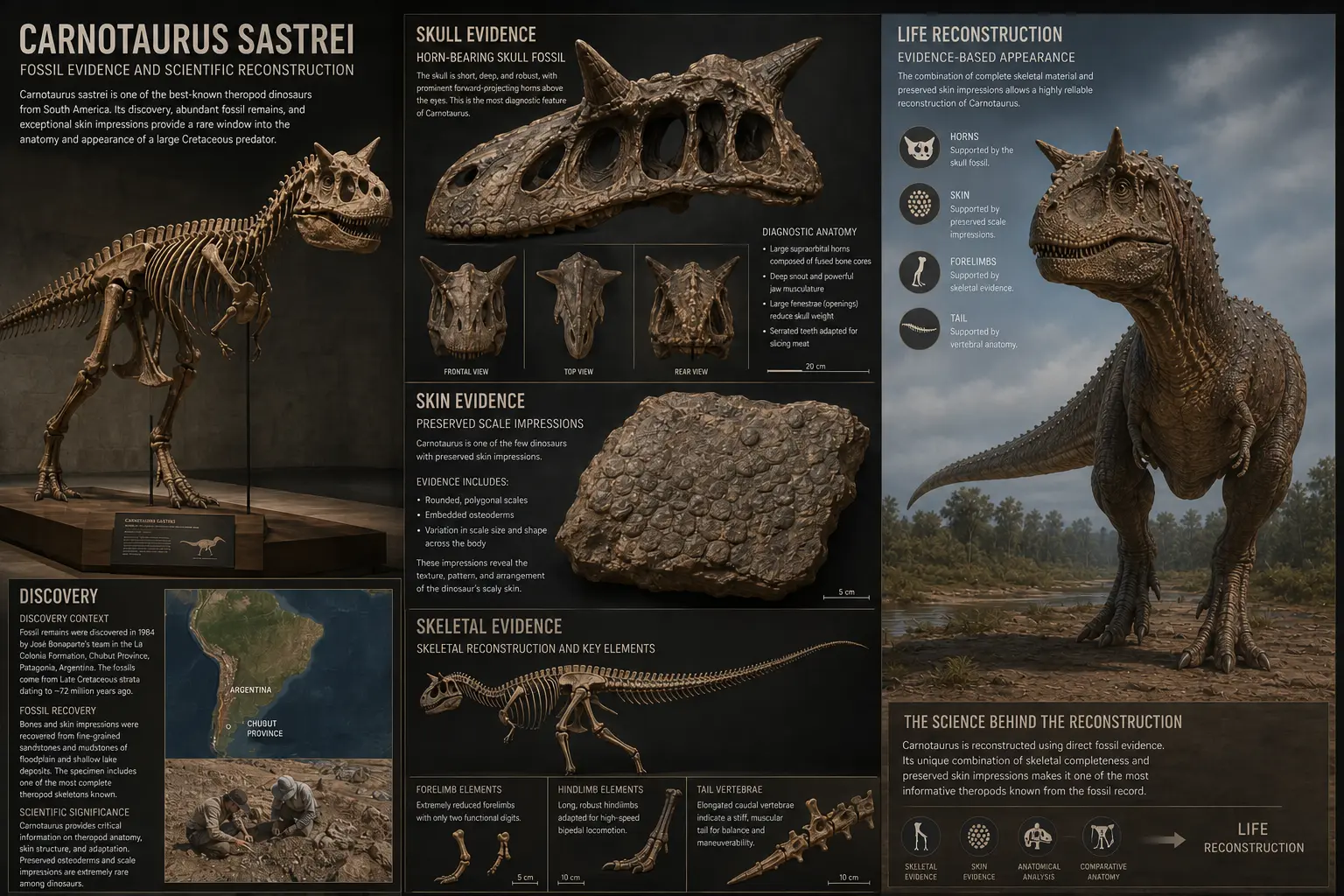
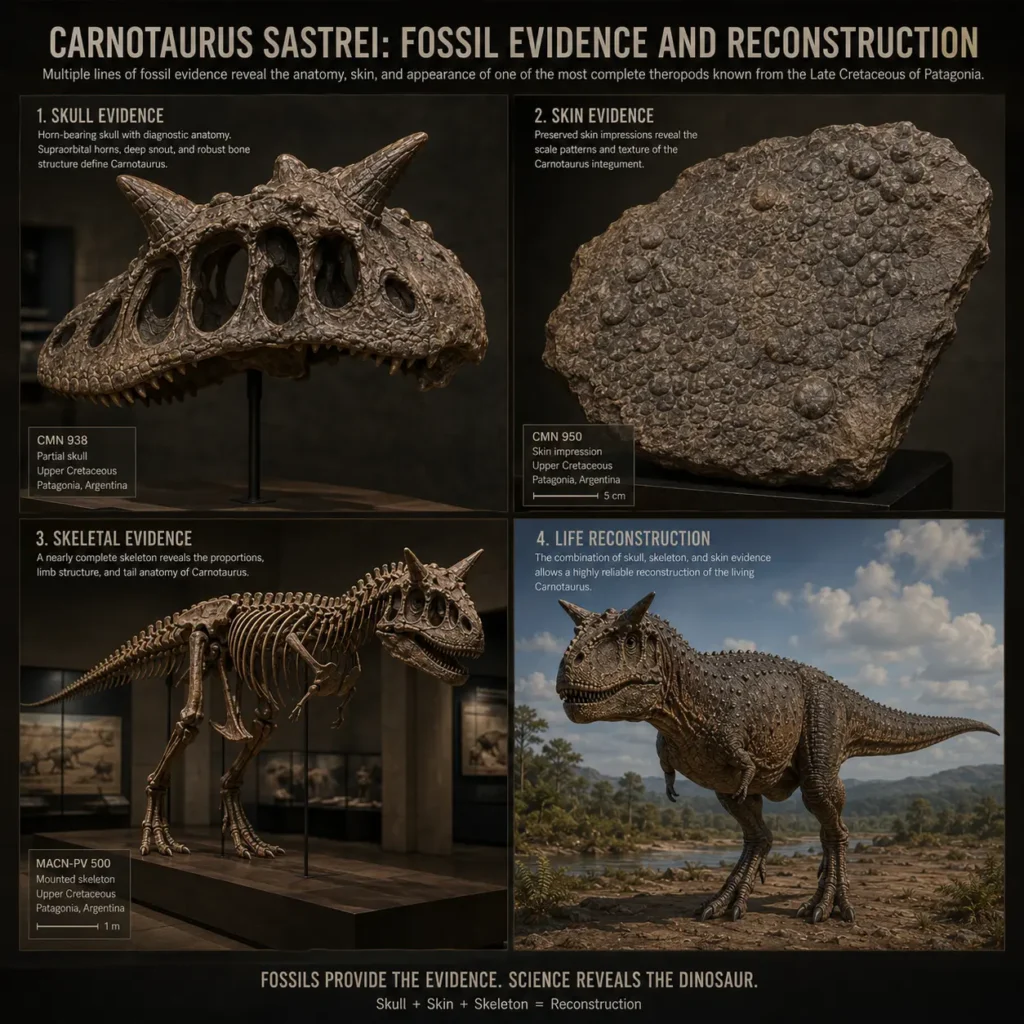
Carnotaurus sastrei is known primarily from a single exceptionally preserved skeleton discovered in Patagonia, Argentina, during the 1980s. The specimen includes an almost complete skull, most of the skeleton, and extensive skin impressions. Because of its remarkable preservation, Carnotaurus is one of the most scientifically important abelisaurid dinosaurs and provides some of the best direct evidence for the anatomy and external appearance of large predatory dinosaurs from the Southern Hemisphere.

Summary
| Topic | Current Understanding |
|---|---|
| Discovery Location | Chubut Province, Argentina |
| Discovery Year | 1984 |
| Scientific Description | 1985 |
| Holotype | MACN-CH 894 |
| Skeleton Completeness | Near Complete |
| Skull Preservation | Exceptional |
| Skin Impressions | Extensive |
| Evidence Strength | Direct Evidence |
Introduction
The scientific significance of Carnotaurus sastrei stems not only from its distinctive horns and unusual anatomy but also from the extraordinary quality of its fossil preservation.
Many large theropod dinosaurs are known from incomplete skeletons or isolated bones. In contrast, Carnotaurus is represented by one of the most complete abelisaurid skeletons ever discovered. The specimen preserves nearly the entire skull, much of the vertebral column, the limbs, and extensive impressions of the skin.
This exceptional preservation allows researchers to study the anatomy, appearance, and evolution of Carnotaurus with a degree of confidence rarely possible for large predatory dinosaurs.
Discovery History
The holotype of Carnotaurus was discovered in Patagonia, Argentina, on land owned by the Sastre family, whose surname later became part of the species name.
Discovery Timeline
| Event | Date |
|---|---|
| Fossil Discovery | 1984 |
| Scientific Description | 1985 |
| Naming Authority | José F. Bonaparte |
| Species Name Published | Carnotaurus sastrei |
Bonaparte formally described the new dinosaur in 1985 and recognized it as a previously unknown theropod possessing unique cranial horns and unusual skeletal features.
The genus name means “meat-eating bull,” referring to the prominent horns above the eyes, while the species name honors Ángel Sastre, whose ranch contained the fossil locality.
Evidence Strength
Direct Evidence
The discovery history is documented directly through scientific publications and specimen records.
The Holotype Specimen
The holotype specimen remains the most important source of information about Carnotaurus.
Holotype Summary
| Feature | Information |
|---|---|
| Specimen Number | MACN-CH 894 |
| Repository | Argentine Museum collections |
| Preservation | Exceptional |
| Taxonomic Importance | Holotype |
| Scientific Significance | Primary reference specimen |
A holotype serves as the name-bearing specimen for a species and forms the basis of all future taxonomic comparisons.
Because Carnotaurus is primarily known from this specimen, MACN-CH 894 remains central to virtually all scientific studies involving the species.
Skeletal Preservation
One reason Carnotaurus is so important scientifically is the completeness of its skeleton.
Preserved Material
| Anatomical Region | Preservation Status |
|---|---|
| Skull | Nearly Complete |
| Vertebral Column | Extensive |
| Tail | Extensive |
| Pelvis | Preserved |
| Hind Limbs | Preserved |
| Forelimbs | Preserved |
| Skin Impressions | Extensive |
The specimen preserves the distinctive horns, unusually reduced forelimbs, and specialized hind-limb anatomy that characterize the species.
The completeness of the skull is particularly valuable because cranial anatomy often provides important taxonomic and functional information.
Evidence Strength
Direct Evidence
The preserved anatomy can be examined directly from the fossil material.
Skin Impressions
One of the most remarkable aspects of the Carnotaurus holotype is the preservation of extensive skin impressions.
Skin Preservation Summary
| Feature | Observation |
|---|---|
| Skin Impressions | Present |
| Scale Preservation | Extensive |
| Large Feature Scales | Present |
| Feather Evidence | Absent |
| Preservation Quality | Exceptional |
The preserved skin reveals a covering of non-overlapping scales distributed across much of the body. Larger conical scales were scattered among smaller scales, creating a textured external appearance.
These impressions provide rare direct evidence of integument in a large theropod dinosaur and are among the best-preserved skin impressions known from Abelisauridae.
Evidence Strength
Direct Evidence
The skin impressions are preserved directly alongside the skeleton.
What the Fossils Reveal About Carnotaurus
The exceptional preservation of the holotype allows researchers to study aspects of Carnotaurus biology that remain poorly known in many other theropods.
Scientific Contributions
| Topic | Contribution |
|---|---|
| Skull Anatomy | Exceptional detail |
| Horn Structure | Direct preservation |
| Limb Anatomy | Nearly complete |
| Integument | Extensive skin evidence |
| Body Proportions | Highly reliable reconstruction |
| Abelisaurid Evolution | Major reference specimen |
Carnotaurus has become one of the most important reference taxa for understanding the evolution of abelisaurid theropods and the broader diversity of Gondwanan predators.
Additional Fossil Material
Despite the scientific importance of Carnotaurus, surprisingly little additional fossil material has been confidently assigned to the species.
Current Fossil Record
| Topic | Status |
|---|---|
| Holotype | Known |
| Referred Skeletons | None universally accepted |
| Additional Complete Specimens | None known |
| Isolated Material | Limited |
| Population Sample | Extremely Small |
This limited sample size creates important scientific constraints.
Although the holotype is exceptionally complete, researchers have only limited information about variation between individuals, growth stages, or sexual dimorphism.
Evidence Strength
Direct Evidence
The known fossil record can be documented directly.
Scientific Importance
Carnotaurus occupies a unique position within dinosaur paleontology because of the combination of exceptional preservation and unusual anatomy.
Scientific Value Assessment
| Topic | Importance |
|---|---|
| Taxonomy | High |
| Anatomy | Exceptional |
| Integument Research | Exceptional |
| Abelisaurid Evolution | High |
| Functional Morphology | High |
Few large theropods provide such a comprehensive anatomical dataset from a single specimen.
For this reason, Carnotaurus frequently serves as a benchmark for studies involving abelisaurid anatomy, locomotion, skull function, and integumentary evolution.
Evidence Assessment
Fossil Evidence Overview
| Topic | Evidence Strength |
|---|---|
| Discovery History | Direct Evidence |
| Holotype Identification | Direct Evidence |
| Skeletal Anatomy | Direct Evidence |
| Skin Impressions | Direct Evidence |
| Species Validity | Direct Evidence |
| Population Variation | Limited Evidence |
| Growth Series | Limited Evidence |
The exceptional quality of the holotype provides extremely strong anatomical evidence. Most remaining uncertainties stem from the lack of additional specimens rather than deficiencies in preservation.
Remaining Scientific Uncertainties
| Topic | Current Status |
|---|---|
| Number of Individuals Known | Extremely Limited |
| Growth Variation | Poorly Known |
| Juvenile Anatomy | Poorly Known |
| Sexual Dimorphism | Unknown |
| Population-Level Variation | Unknown |
| Geographic Range | Incompletely Understood |
Future discoveries of additional specimens would significantly improve understanding of variation within the species.
At present, Carnotaurus is simultaneously one of the best-preserved abelisaurids and one of the least sampled at the population level.
FAQ
When was Carnotaurus discovered?
The holotype was discovered in 1984 and formally described in 1985.
Where was Carnotaurus found?
The fossil was discovered in Chubut Province, Patagonia, Argentina.
How complete is the Carnotaurus skeleton?
The holotype is exceptionally complete and preserves most of the skull and skeleton along with extensive skin impressions.
Did Carnotaurus have feathers?
No feather impressions are known. Preserved skin impressions show a scaly integument.
Why is Carnotaurus scientifically important?
Its combination of exceptional preservation, extensive skin impressions, and distinctive anatomy makes it one of the most informative abelisaurid dinosaurs known.
Current Scientific Understanding
The fossil record of Carnotaurus sastrei is dominated by a single exceptionally preserved holotype specimen, MACN-CH 894. This specimen provides direct evidence for the species’ anatomy, horn structure, body proportions, forelimb reduction, and external skin texture.
The preservation quality is among the best known for any large abelisaurid theropod and allows researchers to reconstruct many aspects of the animal with considerable confidence. The extensive skin impressions are particularly important because they provide rare direct evidence of integument in a large predatory dinosaur.
The primary limitation of the fossil record is not preservation quality but sample size. Additional specimens are needed to understand variation, growth, and population-level characteristics. Nevertheless, the existing fossil evidence makes Carnotaurus one of the most scientifically informative theropods from the Southern Hemisphere.
References
A. Primary Taxonomic Sources
Bonaparte, J.F. 1985. A horned Cretaceous carnosaur from Patagonia. National Geographic Research 1(2):149–151.
Bonaparte, J.F., Novas, F.E., and Coria, R.A. 1990. Carnotaurus sastrei Bonaparte, the horned, lightly built carnosaur from the Middle Cretaceous of Patagonia. Contributions in Science 416:1–42.
B. Scientific Literature
Bonaparte, J.F. 1990. Additional anatomical studies of Carnotaurus sastrei and related abelisaurids.
Delcourt, R. 2018. Ceratosaur palaeobiology: New insights on evolution and ecology of the southern rulers. Scientific Reports 8:9730.
Canale, J.I., Scanferla, C.A., Agnolín, F.L., and Novas, F.E. 2009. New carnivorous dinosaur from the Late Cretaceous of Patagonia and the evolution of Abelisauridae. Naturwissenschaften 96:409–414.
C. Books and Reference Works
Holtz, T.R. Jr. 2011. Dinosaurs: The Most Complete, Up-to-Date Encyclopedia for Dinosaur Lovers of All Ages.
Paul, G.S. 2016. The Princeton Field Guide to Dinosaurs. 2nd Edition. Princeton University Press.
D. Databases and Online Resources
Paleobiology Database. Taxonomic and occurrence data for Carnotaurus sastrei.
Featured Museum Collections
Museum-quality paleoart and educational poster
collections based on evidence-informed prehistoric
Life reconstructions.