Species Quick Info
| Field | Information |
|---|---|
| Scientific Name | Carnotaurus sastrei |
| Topic | Speed and Locomotion |
| Taxonomic Group | Abelisauridae |
| Geological Age | Late Cretaceous (72–69.9 Ma) |
| Locomotion Type | Bipedal |
| Hind Limb Development | Highly Specialized |
| Scientific Status | Active Research Topic |
| Evidence Strength | Moderate |
Quick Answer
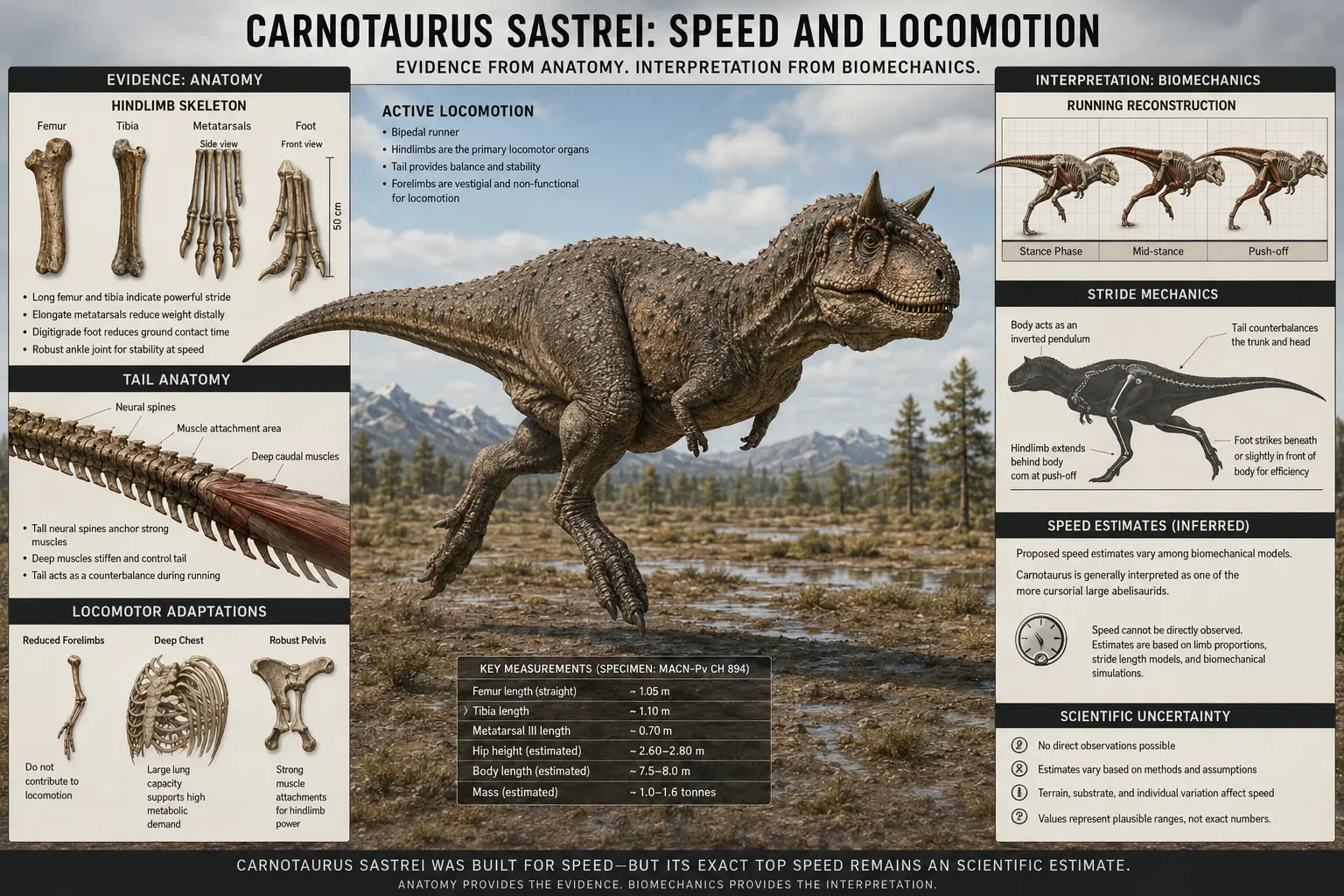
Carnotaurus sastrei was a bipedal theropod dinosaur with anatomical features that suggest efficient locomotion and potentially strong running performance. Its long hind limbs, powerful tail musculature, and relatively lightweight body have led some researchers to propose that it was among the fastest large abelisaurids. However, no direct evidence allows scientists to determine its exact maximum speed. Current evidence supports strong cursorial (running) adaptations, but precise speed estimates remain debated.

Summary
| Topic | Current Understanding |
|---|---|
| Locomotion Type | Bipedal |
| Hind Limb Adaptations | Present |
| Tail Musculature | Highly Developed |
| Running Ability | Likely Strong |
| Maximum Speed | Uncertain |
| Evidence Strength | Limited Evidence |
Introduction
Locomotion is one of the most actively studied aspects of Carnotaurus biology. Unlike anatomy, speed does not fossilize directly. Researchers must instead infer locomotor performance from skeletal proportions, muscle attachment sites, biomechanical modeling, and comparisons with living animals.
Speed Evidence Strength
| Topic | Confidence |
|---|---|
| Bipedal Locomotion | High |
| Hind Limb Anatomy | High |
| Tail Anatomy | High |
| Muscle Reconstruction | Moderate |
| Running Ability | Moderate |
| Maximum Speed | Low |
| Hunting Implications | Low |
Because the Carnotaurus holotype preserves much of the skeleton, it provides an unusually complete dataset for locomotor analysis. Studies of the hind limbs and tail have suggested that Carnotaurus possessed several features associated with efficient running.
Despite these findings, scientists continue to debate exactly how fast the animal could move and how those adaptations influenced its ecology.
Evidence for Bipedal Locomotion
Like all known large abelisaurids, Carnotaurus moved on two legs.
Locomotion Evidence
| Feature | Locomotor Significance |
|---|---|
| Long hind limbs | Increased stride |
| Enlarged tail musculature | Greater propulsion |
| Reduced forelimbs | Reduced anterior mass |
| Deep caudal musculature | Acceleration potential |
Locomotor Anatomy Summary
| Feature | Interpretation |
|---|---|
| Hind Limbs | Primary locomotor structures |
| Forelimbs | Extremely reduced |
| Tail | Major muscle attachment region |
| Pelvis | Supports bipedal stance |
| Center of Mass | Consistent with bipedal locomotion |
The anatomy of the pelvis, hind limbs, and tail clearly indicates habitual bipedal movement. The forelimbs were so reduced that they likely played little or no role in locomotion.
Evidence Strength
Direct Evidence
The locomotor skeleton is preserved directly in the holotype specimen.
Hind Limb Adaptations
One reason Carnotaurus attracts attention from biomechanical researchers is its hind-limb anatomy.
Hind Limb Characteristics
| Feature | Potential Significance |
|---|---|
| Relatively Long Legs | Increased stride length |
| Strong Femur | Powerful locomotion |
| Elongated Lower Limb Elements | Efficient movement |
| Robust Pelvis | Supports running forces |
Compared with many large theropods, Carnotaurus exhibits proportions often associated with more efficient terrestrial locomotion.
Researchers have suggested that these features may have allowed longer strides and improved acceleration compared with some heavier-bodied predators.
Evidence Strength
Strong Inference
Functional interpretations are derived from directly preserved skeletal anatomy.
Tail Musculature and Running Performance
The tail of Carnotaurus has received considerable scientific attention.
Tail Adaptations
| Feature | Interpretation |
|---|---|
| Deep Tail Base | Large muscle attachments |
| Enlarged Caudal Structures | Increased locomotor power |
| Muscular Tail Reconstruction | Supported |
| Running Contribution | Likely Significant |
A landmark study by Persons and Currie (2011) argued that Carnotaurus possessed exceptionally enlarged tail muscles compared with many other theropods.
These muscles would have helped retract the hind limbs during locomotion and may have enhanced acceleration and running performance.
Evidence Assessment
| Topic | Assessment |
|---|---|
| Tail Preservation | Excellent |
| Muscle Attachment Evidence | Strong |
| Muscle Reconstruction | Inferred |
| Running Implications | Debated |
Evidence Strength
Strong Inference
Muscles themselves are not preserved, but attachment sites provide important clues.
How Fast Was Carnotaurus?
This is one of the most frequently asked questions about the species and one of the most difficult to answer scientifically.
Speed Assessment
| Topic | Current Status |
|---|---|
| Exact Maximum Speed | Unknown |
| Running Adaptations | Supported |
| Fast Locomotion | Likely |
| Consensus Speed Estimate | None |
No direct fossil evidence records the top speed of Carnotaurus. Researchers therefore rely on biomechanical models that incorporate body mass, limb proportions, muscle reconstructions, and assumptions about movement.
Different modeling approaches produce different results.
Why Precise Speed Estimates Are Difficult
| Challenge | Impact |
|---|---|
| Soft Tissues Not Preserved | Muscle mass uncertain |
| Modeling Assumptions | Different outcomes |
| Unknown Physiology | Performance limits uncertain |
| Lack of Trackways | No direct speed evidence |
For these reasons, any specific speed value should be treated as a hypothesis rather than a fact.
Scientific Restriction
No definitive maximum speed estimate is currently supported by direct evidence.
Evidence Strength
Limited Evidence
Was Carnotaurus One of the Fastest Large Theropods?
Some researchers have suggested that Carnotaurus may have ranked among the faster large predatory dinosaurs.
Comparative Assessment
| Feature | Carnotaurus |
|---|---|
| Body Build | Relatively lightweight |
| Hind Limb Length | Favorable for running |
| Tail Musculature | Highly developed |
| Locomotor Specialization | Strong |
The argument is based primarily on body proportions and reconstructed musculature rather than direct performance evidence.
However, not all researchers agree on the degree of specialization. Some studies emphasize that large body size imposes mechanical limitations regardless of anatomical adaptations.
Evidence Strength
Strong Inference
Locomotion Compared With Other Theropods
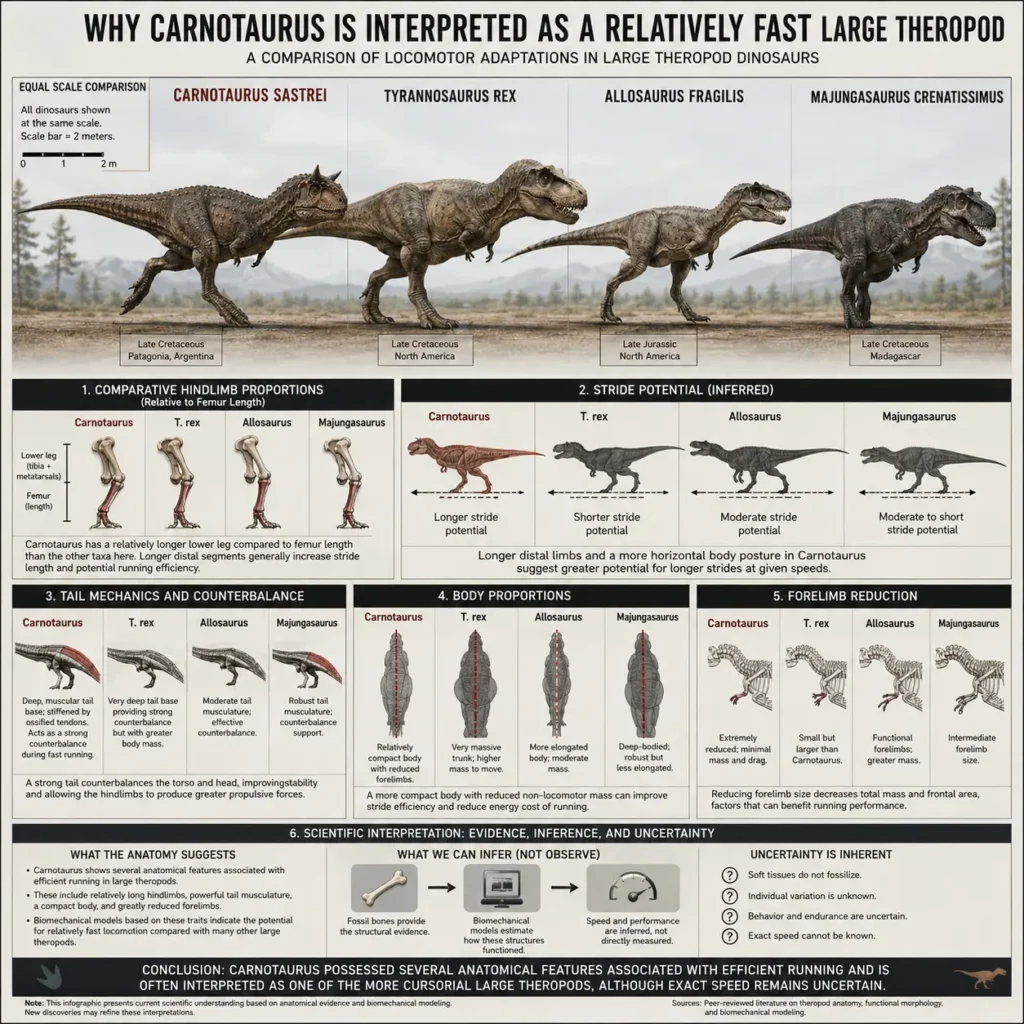
Selected Theropod Comparison
| Taxon | Relative Specialization |
|---|---|
| Carnotaurus | High |
| Majungasaurus | Moderate |
| Allosaurus | Moderate |
| Tyrannosaurus rex | Moderate |
| Giganotosaurus | Moderate |
These comparisons are based on anatomy rather than observed performance.
As a result, they should be interpreted cautiously.
Locomotion and Hunting
The relationship between locomotion and hunting behavior remains uncertain.
Current Evidence
| Topic | Status |
|---|---|
| Active Pursuit Hunting | Possible |
| Ambush Predation | Possible |
| Specialized Chase Predator | Uncertain |
| Direct Behavioral Evidence | None |
Although running adaptations may have influenced hunting strategy, behavior cannot be reconstructed with confidence from anatomy alone.
Consequently, locomotion should not be used as proof of a specific hunting style.
Scientific Restriction
Behavioral interpretations remain speculative and require uncertainty controls.
Evidence Strength
Limited Evidence
Evidence Assessment
Locomotion Evidence Overview
| Topic | Evidence Strength |
|---|---|
| Bipedal Locomotion | Direct Evidence |
| Hind Limb Anatomy | Direct Evidence |
| Tail Anatomy | Direct Evidence |
| Muscle Reconstruction | Strong Inference |
| Running Ability | Strong Inference |
| Maximum Speed | Limited Evidence |
| Hunting Implications | Limited Evidence |
The strongest evidence concerns anatomical structures directly involved in locomotion. Confidence decreases substantially when attempting to estimate performance or behavior.
Remaining Scientific Uncertainties
| Topic | Current Status |
|---|---|
| Maximum Speed | Unknown |
| Acceleration Capability | Uncertain |
| Endurance Capacity | Unknown |
| Preferred Hunting Strategy | Unknown |
| Performance Relative to Other Theropods | Debated |
| Muscle Mass Reconstruction | Under Investigation |
Most uncertainties stem from the inability to observe movement directly and from the absence of preserved soft tissues.
Future biomechanical modeling and new fossil discoveries may help refine interpretations of Carnotaurus locomotion.
FAQ
How fast could Carnotaurus run?
Scientists do not currently know its exact top speed. Evidence supports strong running ability, but precise estimates remain uncertain.
Was Carnotaurus faster than Tyrannosaurus rex?
Possibly, but the comparison depends heavily on biomechanical assumptions and remains debated.
Why is Carnotaurus often described as fast?
Its long hind limbs and reconstructed tail musculature suggest adaptations associated with efficient running.
Did Carnotaurus chase prey?
It may have, but there is no direct evidence demonstrating a specific hunting strategy.
Are there fossil trackways from Carnotaurus?
No trackways have been conclusively attributed to the species.
Current Scientific Understanding
Current evidence indicates that Carnotaurus sastrei possessed anatomical adaptations consistent with efficient bipedal locomotion. Its hind limbs, pelvis, and especially its reconstructed tail musculature suggest that it was a capable runner compared with many other large theropods.
However, important limitations remain. Exact speed estimates depend on biomechanical assumptions, soft-tissue reconstructions, and physiological variables that cannot be observed directly in fossils. Consequently, no precise maximum speed can be considered scientifically established.
The most evidence-supported conclusion is that Carnotaurus was a highly specialized abelisaurid with strong locomotor adaptations, while the exact extent of its running performance remains an active area of scientific research.
References
A. Primary Taxonomic Sources
Bonaparte, J.F. 1985. A horned Cretaceous carnosaur from Patagonia. National Geographic Research 1(2):149–151.
Bonaparte, J.F., Novas, F.E., and Coria, R.A. 1990. Carnotaurus sastrei Bonaparte, the horned, lightly built carnosaur from the Middle Cretaceous of Patagonia. Contributions in Science 416:1–42.
B. Scientific Literature
Mazzetta, G.V., Fariña, R.A., and Vizcaíno, S.F. 1998. On the palaeobiology of Carnotaurus sastrei Bonaparte. Gaia 15:185–192.
Persons, W.S. IV and Currie, P.J. 2011. Dinosaur speed demon: The caudal musculature of Carnotaurus sastrei and implications for the evolution of South American abelisaurids. PLOS ONE 6(10):e25763.
Delcourt, R. 2018. Ceratosaur palaeobiology: New insights on evolution and ecology of the southern rulers. Scientific Reports 8:9730.
C. Books and Reference Works
Paul, G.S. 2016. The Princeton Field Guide to Dinosaurs. 2nd Edition. Princeton University Press.
Holtz, T.R. Jr. 2011. Dinosaurs: The Most Complete, Up-to-Date Encyclopedia for Dinosaur Lovers of All Ages.
D. Databases and Online Resources
Paleobiology Database. Taxonomic and occurrence data for Carnotaurus sastrei.
Featured Museum Collections
Museum-quality paleoart and educational poster
collections based on evidence-informed prehistoric
Life reconstructions.