
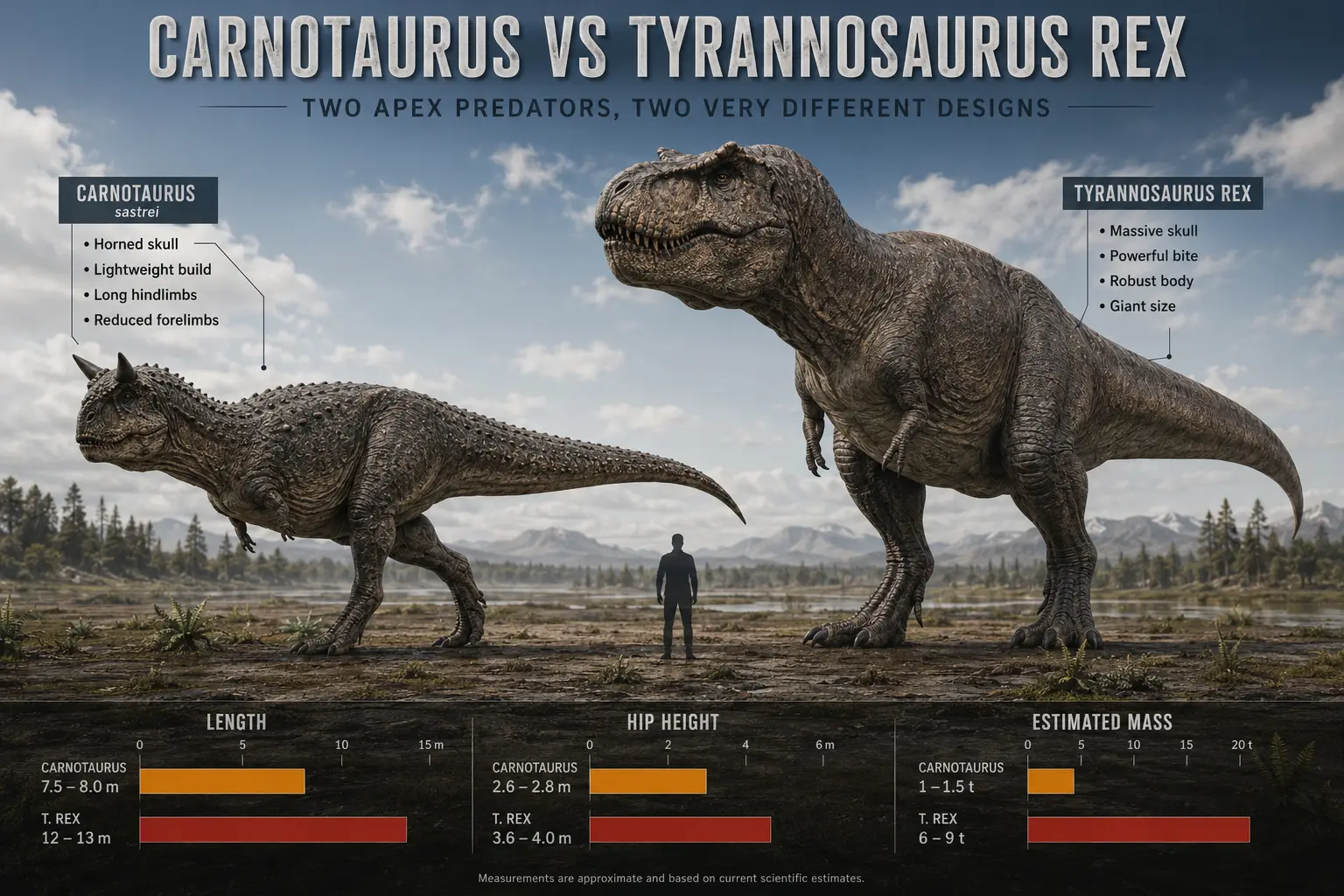
Comparison Quick Info
| Field | Carnotaurus | Tyrannosaurus rex |
|---|---|---|
| Scientific Name | Carnotaurus sastrei | Tyrannosaurus rex |
| Family | Abelisauridae | Tyrannosauridae |
| Geological Age | Late Cretaceous (72–69.9 Ma) | Late Cretaceous (68–66 Ma) |
| Location | South America | North America |
| Length | 7.5–9 m | 12–13 m |
| Weight | 1.3–2.1 tonnes | 8–10+ tonnes |
| Locomotion | Bipedal | Bipedal |
| Evidence Quality | Exceptional single specimen | Extensive specimen record |
| Scientific Confidence | High | Very High |
Quick Answer
Tyrannosaurus rex was substantially larger, heavier, and more powerfully built than Carnotaurus sastrei. Carnotaurus, however, possessed a lighter body, proportionally longer hind limbs, and anatomical features that may have favored greater agility and running efficiency. Current evidence strongly supports T. rex as the more powerful predator, while Carnotaurus likely possessed superior maneuverability. Because the two species lived on different continents and at slightly different times, they never encountered one another in nature.

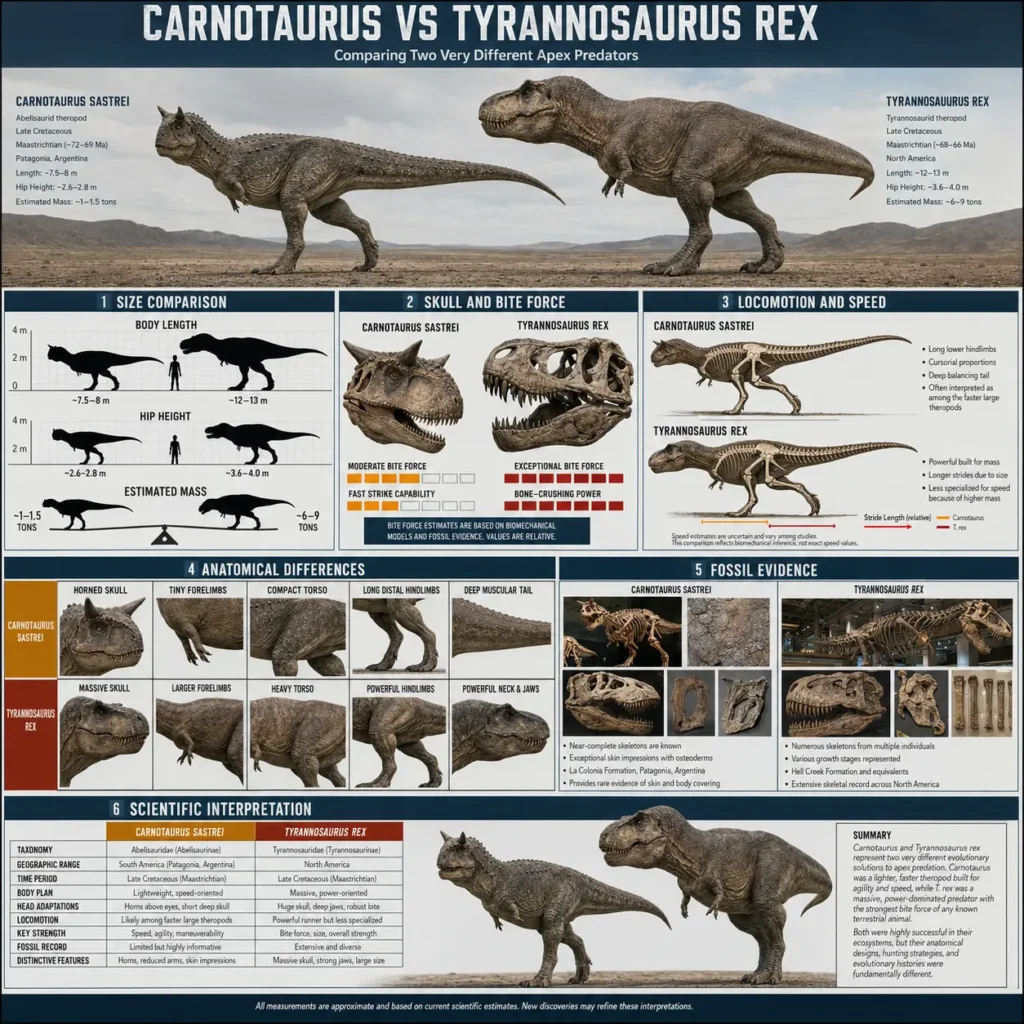
Summary
| Category | Carnotaurus | Tyrannosaurus rex |
|---|---|---|
| Length | 7.5–9 m | 12–13 m |
| Weight | 1.3–2.1 tonnes | 8–10+ tonnes |
| Skull Type | Short and deep | Massive and robust |
| Bite Force | Moderate | Extremely high |
| Horns | Present | Absent |
| Forelimbs | Extremely reduced | Reduced but functional |
| Running Adaptations | Strong | Debated |
| Fossil Sample Size | Very limited | Extensive |
| Evidence Strength | High | Very High |
Comparison Evidence Strength
| Category | Confidence |
|---|---|
| Size | High |
| Skull Anatomy | High |
| Forelimbs | High |
| Fossil Record | High |
| Locomotion | Moderate |
| Agility | Low |
| Hunting Behavior | Low |
Introduction
Carnotaurus sastrei and Tyrannosaurus rex are among the most recognizable predatory dinosaurs ever discovered. Both were large bipedal theropods that occupied apex-predator roles within their respective ecosystems, yet they evolved on different continents and followed dramatically different evolutionary pathways.
Carnotaurus represents the highly specialized abelisaurid lineage that dominated many southern landmasses during the Late Cretaceous. Tyrannosaurus rex represents the culmination of tyrannosaur evolution in North America.
Although popular culture often portrays dinosaur matchups as direct contests, the scientific value of this comparison lies in understanding how two large predators evolved different solutions to similar ecological challenges.
Classification Comparison
Taxonomic Overview
| Rank | Carnotaurus | Tyrannosaurus rex |
|---|---|---|
| Clade | Theropoda | Theropoda |
| Family | Abelisauridae | Tyrannosauridae |
| Subgroup | Ceratosauria | Coelurosauria |
| Region | Gondwana | Laurasia |
Despite superficial similarities, these dinosaurs were only distantly related within Theropoda.
Evidence Strength
Direct Evidence
Classification is based on directly preserved anatomical characteristics.
Size Comparison
The most obvious difference between the two predators is body size.
Size Metrics
| Measurement | Carnotaurus | Tyrannosaurus rex |
|---|---|---|
| Length | 7.5–9 m | 12–13 m |
| Weight | 1.3–2.1 tonnes | 8–10+ tonnes |
| Hip Height | ~2.5–3 m | ~3.5–4 m |
| Skull Length | ~60 cm | ~1.4–1.5 m |
Tyrannosaurus rex outweighed Carnotaurus several times and possessed one of the largest skulls of any terrestrial predator.
Size Winner
Tyrannosaurus rex
The difference is substantial rather than marginal.
Evidence Strength
Direct Evidence
Both species are known from sufficiently complete material to support reliable size estimates.
Skull and Bite Comparison
The skulls of these dinosaurs evolved for different functional purposes.
Skull Characteristics
| Feature | Carnotaurus | Tyrannosaurus rex |
|---|---|---|
| Skull Shape | Short and deep | Massive and broad |
| Horns | Present | Absent |
| Bite Force | Moderate | Extremely high |
| Bone-Crushing Ability | Limited | Exceptional |
Tyrannosaurus possessed one of the most powerful bite forces known among terrestrial vertebrates.
Carnotaurus likely relied more on rapid head movements and repeated bites rather than crushing power.
Bite Force Assessment
| Category | Winner |
|---|---|
| Bite Force | Tyrannosaurus rex |
| Skull Ornamentation | Carnotaurus |
| Bone Processing | Tyrannosaurus rex |
Evidence Strength
Strong Inference
Biomechanical analyses support these interpretations.
Forelimb Comparison
Both species are famous for reduced forelimbs, but the degree of reduction differs dramatically.
Arm Comparison
| Feature | Carnotaurus | Tyrannosaurus rex |
|---|---|---|
| Arm Length | Extremely reduced | Reduced |
| Finger Count | Extremely reduced digits | Two functional digits |
| Mobility | Very limited | Significant |
| Functional Capacity | Minimal | Retained |
Carnotaurus possessed some of the most reduced forelimbs known among large theropods.
Forelimb Assessment
Tyrannosaurus rex
Although often mocked for short arms, the forelimbs of T. rex were substantially larger and more functional than those of Carnotaurus.
Evidence Strength
Direct Evidence
Forelimb anatomy is preserved directly in fossils.
Speed and Locomotion Comparison
Locomotion represents one of the most debated aspects of this comparison.
Locomotor Characteristics
| Feature | Carnotaurus | Tyrannosaurus rex |
|---|---|---|
| Body Build | Relatively lightweight | Extremely robust |
| Hind Limb Proportions | Favorable for running | Efficient but massive |
| Tail Musculature | Highly developed | Highly developed |
| Running Specialization | Strong | Debated |
Research on Carnotaurus suggests pronounced locomotor adaptations, particularly in the tail and hind limbs.
Tyrannosaurus possessed efficient locomotor anatomy but was constrained by much greater body mass.
Speed Assessment
| Category | Current Interpretation |
|---|---|
| Maximum Speed | Uncertain |
| Acceleration | Uncertain |
| Agility | Carnotaurus likely favored |
| Raw Power | Tyrannosaurus favored |
Evidence Strength
Limited Evidence
Neither species has a scientifically established top speed.
Hunting Adaptations
Predatory Characteristics
| Feature | Carnotaurus | Tyrannosaurus rex |
|---|---|---|
| Bite Strategy | Slashing bites | Crushing bites |
| Skull Strength | High | Exceptional |
| Body Mass | Moderate | Massive |
| Predatory Style | Uncertain | Uncertain |
Both species were apex predators, but they likely captured and processed prey differently.
Carnotaurus may have emphasized speed and maneuverability, whereas Tyrannosaurus relied heavily on its powerful skull and jaws.
Scientific Restriction
Detailed hunting behavior remains uncertain for both species.
Evidence Strength
Limited Evidence
Behavioral interpretations rely on inference.
Fossil Evidence Comparison
Fossil Record Quality
| Topic | Carnotaurus | Tyrannosaurus rex |
|---|---|---|
| Complete Skeletons | Very Limited | Numerous |
| Skin Evidence | Extensive | Limited but Present |
| Growth Series | Poorly Known | Well Documented |
| Population Variation | Poorly Known | Well Studied |
Carnotaurus benefits from exceptional preservation but suffers from a very small sample size.
Tyrannosaurus possesses a much larger fossil record that supports more detailed biological analyses.
Fossil Evidence Winner
Tyrannosaurus rex
The quantity of available material is substantially greater.
Evidence Assessment
Comparison Overview
| Category | Current Winner |
|---|---|
| Size | Tyrannosaurus rex |
| Weight | Tyrannosaurus rex |
| Bite Force | Tyrannosaurus rex |
| Forelimb Function | Tyrannosaurus rex |
| Agility | Carnotaurus (hypothesized) |
| Running Adaptations | Carnotaurus (supported hypothesis) |
| Fossil Record | Tyrannosaurus rex |
| Skull Ornamentation | Carnotaurus |
The comparison illustrates two very different evolutionary approaches to large-predator ecology.
Remaining Scientific Uncertainties
| Topic | Current Status |
|---|---|
| Exact Carnotaurus Top Speed | Unknown |
| Exact T. rex Top Speed | Unknown |
| Relative Agility | Under Investigation |
| Comparative Acceleration | Uncertain |
| Hunting Strategies | Debated |
| Behavioral Ecology | Incompletely Understood |
The largest uncertainties concern locomotion and behavior, where direct fossil evidence is unavailable.
FAQ
Which dinosaur was bigger?
Tyrannosaurus rex was substantially larger and heavier.
Which dinosaur had the stronger bite?
Tyrannosaurus rex possessed one of the strongest bite forces known among terrestrial animals.
Was Carnotaurus faster?
Possibly, but current evidence does not allow a definitive answer.
Did Carnotaurus and Tyrannosaurus rex ever meet?
No. They lived on different continents and at slightly different times.
Which dinosaur would win in a fight?
Scientific comparisons focus on anatomy and evidence rather than hypothetical combat scenarios. Current evidence indicates that Tyrannosaurus rex possessed major advantages in size, mass, and bite force, but direct combat scenarios cannot be tested scientifically.
Current Scientific Understanding
Carnotaurus sastrei and Tyrannosaurus rex represent two highly specialized but fundamentally different evolutionary solutions to large-predator ecology. Tyrannosaurus achieved enormous size, exceptional bite force, and a highly robust body plan, while Carnotaurus evolved a lighter frame, distinctive cranial horns, extremely reduced forelimbs, and locomotor adaptations that may have favored agility.
The strongest evidence supports Tyrannosaurus as the larger and more powerful animal. Carnotaurus, however, appears to have possessed anatomical features associated with efficient running and maneuverability. Because locomotor performance cannot be measured directly from fossils, the precise extent of those advantages remains uncertain.
Rather than identifying a single “better” predator, the comparison highlights how different theropod lineages evolved distinct anatomical strategies while occupying similar ecological roles on separate continents during the Late Cretaceous.
References
A. Primary Taxonomic Sources
Bonaparte, J.F. 1985. A horned Cretaceous carnosaur from Patagonia. National Geographic Research 1(2):149–151.
Osborn, H.F. 1905. Tyrannosaurus and other Cretaceous carnivorous dinosaurs. Bulletin of the American Museum of Natural History 21:259–265.
B. Scientific Literature
Bonaparte, J.F., Novas, F.E., and Coria, R.A. 1990. Carnotaurus sastrei Bonaparte, the horned, lightly built carnosaur from the Middle Cretaceous of Patagonia. Contributions in Science 416:1–42.
Persons, W.S. IV and Currie, P.J. 2011. Dinosaur speed demon: The caudal musculature of Carnotaurus sastrei and implications for the evolution of South American abelisaurids. PLOS ONE 6(10):e25763.
Bates, K.T., Manning, P.L., Hodgetts, D., and Sellers, W.I. 2009. Estimating locomotor performance in large theropods.
Hutchinson, J.R., Ng-Thow-Hing, V., and Anderson, F.C. 2007. Biomechanical constraints on theropod locomotion.
C. Books and Reference Works
Paul, G.S. 2016. The Princeton Field Guide to Dinosaurs. 2nd Edition. Princeton University Press.
Holtz, T.R. Jr. 2011. Dinosaurs: The Most Complete, Up-to-Date Encyclopedia for Dinosaur Lovers of All Ages.
D. Databases and Online Resources
Paleobiology Database. Taxonomic and occurrence data for Carnotaurus sastrei and Tyrannosaurus rex.
Recommended Paleontology & Natural History Books
As an Amazon Associate, Extinct Atlas may earn from qualifying purchases.
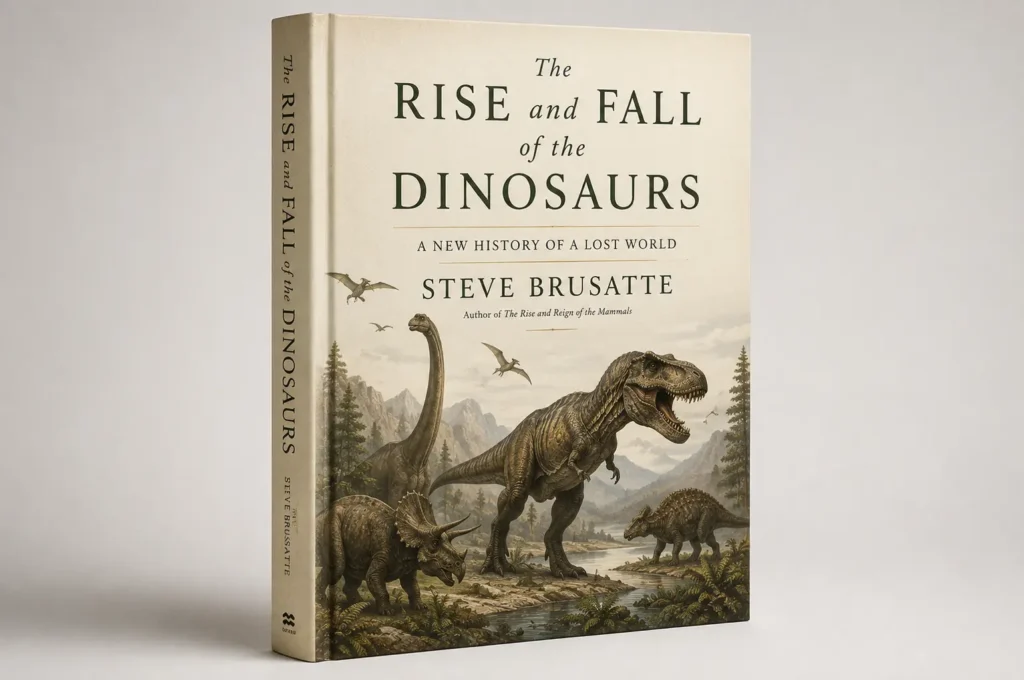
The Rise and Fall of the Dinosaurs
A compelling history of dinosaurs, tracing their origins, diversification, 200-million-year reign, extinction, and enduring legacy.
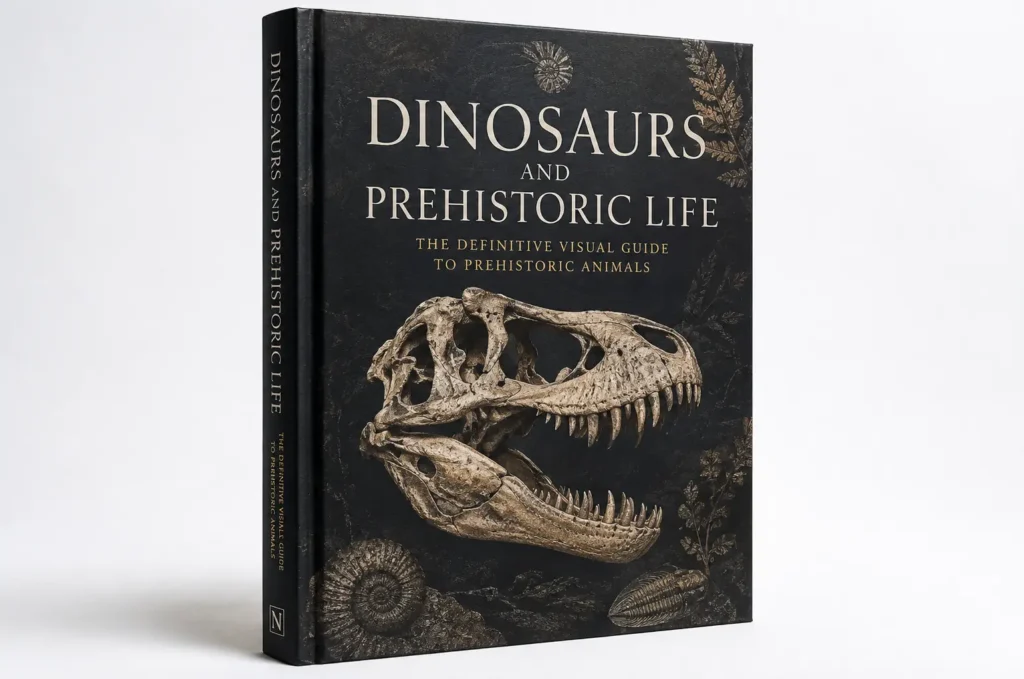
Dinosaurs and Prehistoric Life
A richly illustrated visual reference exploring dinosaurs, fossils, evolution, and prehistoric life across geological time.
Encyclopedia Prehistorica: Dinosaurs
An interactive dinosaur book featuring spectacular three-dimensional pop-ups, particularly suited to young readers and families.
The Rise and Reign of the Mammals
A sweeping history of mammalian evolution, from their origins alongside dinosaurs through the Cenozoic and the emergence of humans.