
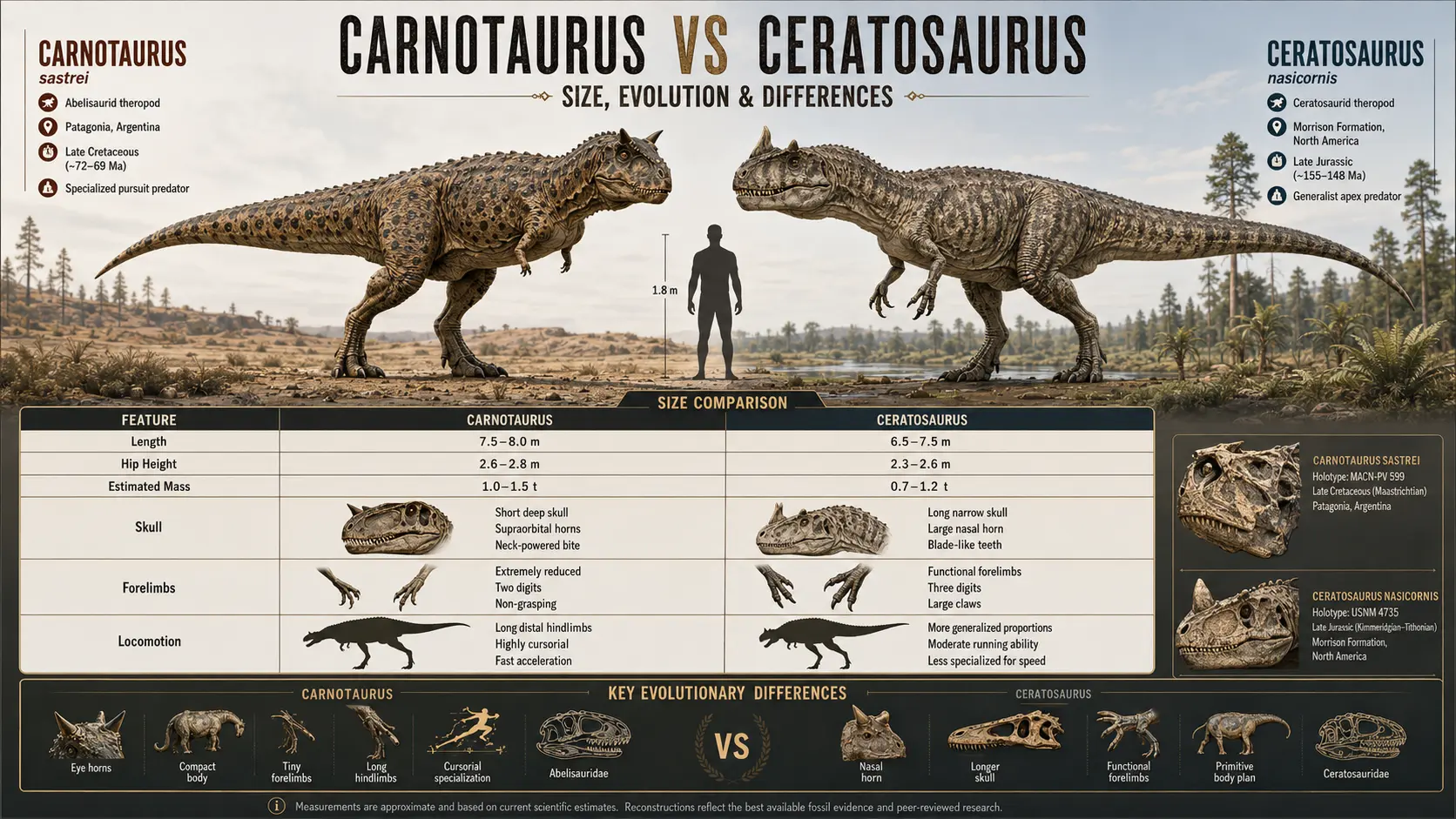
Comparison Quick Info
| Field | Carnotaurus | Ceratosaurus |
|---|---|---|
| Scientific Name | Carnotaurus sastrei | Ceratosaurus nasicornis |
| Family | Abelisauridae | Ceratosauridae |
| Major Group | Ceratosauria | Ceratosauria |
| Geological Age | Late Cretaceous (72–69.9 Ma) | Late Jurassic (155–148 Ma) |
| Location | South America | North America, Europe, Africa |
| Length | 7.5–9 m | 5.5–7.5 m |
| Weight | 1.3–2.1 tonnes | 500–1,000 kg |
| Locomotion | Bipedal | Bipedal |
| Scientific Importance | Derived Abelisaurid | Basal Ceratosaur |
Quick Answer
Carnotaurus sastrei and Ceratosaurus nasicornis belonged to the same major theropod lineage, Ceratosauria, but were separated by approximately 80 million years of evolution. Ceratosaurus represents a relatively early ceratosaur with a generalized theropod body plan, while Carnotaurus represents one of the most specialized ceratosaurs ever discovered. Comparing them reveals how ceratosaurs evolved from moderately built Jurassic predators into the highly distinctive abelisaurids that dominated many southern ecosystems during the Late Cretaceous.

Summary Table
| Category | Carnotaurus | Ceratosaurus |
|---|---|---|
| Length | 7.5–9 m | 5.5–7.5 m |
| Weight | 1.3–2.1 tonnes | 0.5–1 tonne |
| Geological Age | Late Cretaceous | Late Jurassic |
| Skull Shape | Short and deep | Long and narrow |
| Horns | Paired orbital horns | Single nasal horn |
| Forelimbs | Extremely reduced | Functional |
| Evolutionary Position | Highly derived | Basal |
| Fossil Record | Limited | Moderate |
Evidence Strength by Category
| Category | Confidence |
|---|---|
| Classification | High |
| Size | High |
| Skull Anatomy | High |
| Forelimbs | High |
| Locomotion | Moderate |
| Ecology | Moderate |
| Behavior | Low |
Introduction
Among all theropod comparisons, Carnotaurus and Ceratosaurus provide one of the clearest examples of long-term dinosaur evolution.
Both belonged to Ceratosauria, a major theropod lineage that originated during the Jurassic. However, they occupied opposite ends of that lineage’s evolutionary history. Ceratosaurus lived during the Late Jurassic and retained many features common among early large theropods. Carnotaurus lived near the end of the Age of Dinosaurs and evolved one of the most specialized body plans known among predatory dinosaurs.
This comparison is particularly important because it demonstrates how evolutionary change accumulated across tens of millions of years within a single major dinosaur group.
Classification Comparison
Taxonomic Overview
| Rank | Carnotaurus | Ceratosaurus |
|---|---|---|
| Clade | Theropoda | Theropoda |
| Major Group | Ceratosauria | Ceratosauria |
| Family | Abelisauridae | Ceratosauridae |
| Evolutionary Position | Derived Ceratosaur | Basal Ceratosaur |
Ceratosaurus is often considered representative of early ceratosaur evolution.
Carnotaurus represents one of the most specialized descendants of the ceratosaur lineage.
Evolutionary Relationship
| Topic | Assessment |
|---|---|
| Shared Major Lineage | Yes |
| Close Relative | No |
| Common Ancestor | Yes |
| Time Separation | ~80 million years |
Evidence Strength
Direct Evidence
Phylogenetic relationships are supported by preserved skeletal anatomy.
Size Comparison
Carnotaurus was generally larger and substantially heavier.
Size Metrics
| Measurement | Carnotaurus | Ceratosaurus |
|---|---|---|
| Length | 7.5–9 m | 5.5–7.5 m |
| Weight | 1.3–2.1 tonnes | 500–1,000 kg |
| Skull Length | ~60 cm | ~70–80 cm |
| Hip Height | ~2.5–3 m | ~2–2.5 m |
Although Ceratosaurus possessed a relatively long skull, Carnotaurus carried considerably more body mass.
Size Winner
Carnotaurus
Evidence Strength
Direct Evidence
Skull Comparison
The skulls of these dinosaurs reveal how dramatically ceratosaur evolution changed through time.
Skull Characteristics
| Feature | Carnotaurus | Ceratosaurus |
|---|---|---|
| Skull Shape | Short and deep | Long and narrow |
| Horn Type | Paired orbital horns | Single nasal horn |
| Facial Ornamentation | Extensive | Moderate |
| Bite Architecture | Compact | Elongated |
Ceratosaurus retained a skull shape closer to that of many Jurassic theropods.
Carnotaurus evolved an unusually shortened and deepened skull, unlike that of almost any other large predator.
Ornamentation Comparison
| Category | Assessment |
|---|---|
| Horn Development | Both present |
| Most Elaborate Ornamentation | Carnotaurus |
| Most Primitive Condition | Ceratosaurus |
Evidence Strength
Direct Evidence
Forelimb Comparison
One of the most striking evolutionary differences involves the forelimbs.
Arm Anatomy
| Feature | Carnotaurus | Ceratosaurus |
|---|---|---|
| Relative Arm Size | Extremely reduced | Functional |
| Grasping Ability | Minimal | Significant |
| Finger Function | Highly reduced | Well developed |
| Evolutionary Condition | Derived | Primitive |
Ceratosaurus retained forelimbs capable of grasping and manipulation.
Carnotaurus evolved some of the most reduced forelimbs known among large theropods.
Forelimb Assessment
Ceratosaurus
The functional difference is dramatic.
Evidence Strength
Direct Evidence
Locomotion Comparison
Carnotaurus appears to have evolved more specialized locomotor adaptations.
Locomotor Characteristics
| Feature | Carnotaurus | Ceratosaurus |
|---|---|---|
| Hind Limb Specialization | Strong | Moderate |
| Tail Musculature | Highly developed | Well developed |
| Cursorial Adaptations | Pronounced | Moderate |
| Body Build | Streamlined | More robust |
Ceratosaurus was certainly an active predator, but it lacks many of the extreme locomotor specializations observed in Carnotaurus.
Locomotion Assessment
| Category | Current Interpretation |
|---|---|
| Running Adaptations | Carnotaurus |
| Locomotor Specialization | Carnotaurus |
| General Mobility | Both capable |
Evidence Strength
Strong Inference
Evolution of Ceratosauria
This is the most scientifically important aspect of the comparison.
Evolutionary Trends
| Trait | Ceratosaurus | Carnotaurus |
|---|---|---|
| Skull Depth | Moderate | Extreme |
| Horn Development | Moderate | Extensive |
| Forelimb Reduction | Limited | Extreme |
| Body Specialization | Moderate | Extreme |
The transition from Ceratosaurus-like ancestors to Carnotaurus-like abelisaurids illustrates a major evolutionary trend within Ceratosauria.
Across tens of millions of years, ceratosaurs developed:
- Deeper skulls
- Greater cranial ornamentation
- Increasing forelimb reduction
- More specialized body proportions
Carnotaurus represents the culmination of many of these trends.
Scientific Significance
Carnotaurus is often regarded as one of the most derived ceratosaurs known.
Evidence Strength
Direct Evidence
Supported by phylogenetic and anatomical studies.
Ecological Comparison
Ecosystem Differences
| Topic | Carnotaurus | Ceratosaurus |
|---|---|---|
| Age | Late Cretaceous | Late Jurassic |
| Continent | South America | North America |
| Dominant Herbivores | Titanosaurs | Sauropods and stegosaurs |
| Predator Community | Abelisaurids | Allosaurids and others |
The two species occupied very different ecosystems separated by both geography and time.
Evidence Strength
Direct Geological Evidence
Fossil Evidence Comparison
Fossil Record Quality
| Topic | Carnotaurus | Ceratosaurus |
|---|---|---|
| Skeleton Completeness | Exceptional | |
| Skin Preservation | Extensive | |
| Number of Specimens | Limited | |
| Growth Series | Limited |
Carnotaurus provides superior preservation of external anatomy.
Ceratosaurus benefits from a somewhat broader fossil sample.
Evidence Assessment
| Category | Winner |
|---|---|
| Preservation Quality | Carnotaurus |
| Sample Size | Ceratosaurus |
| Integument Evidence | Carnotaurus |
Evidence Assessment
Comparison Overview
| Category | Current Winner |
|---|---|
| Size | Carnotaurus |
| Weight | Carnotaurus |
| Forelimb Function | Ceratosaurus |
| Locomotor Specialization | Carnotaurus |
| Skull Ornamentation | Carnotaurus |
| Fossil Sample Size | Ceratosaurus |
| Preservation Quality | Carnotaurus |
| Evolutionary Significance | Both |
This comparison is less about competition and more about evolutionary transformation.
Remaining Scientific Uncertainties
| Topic | Current Status |
|---|---|
| Relative Running Performance | Unknown |
| Feeding Differences | Under Investigation |
| Behavioral Comparisons | Uncertain |
| Evolutionary Drivers | Actively Studied |
| Ecological Equivalence | Debated |
Most unresolved questions concern behavior and evolutionary mechanisms rather than anatomy.
FAQ
Are Carnotaurus and Ceratosaurus related?
Yes. Both belong to Ceratosauria, although they are separated by tens of millions of years of evolution.
Which dinosaur was bigger?
Carnotaurus was generally larger and considerably heavier.
Did both dinosaurs have horns?
Yes, but the horns differed. Ceratosaurus possessed a prominent nasal horn, while Carnotaurus had paired horns above the eyes.
Which dinosaur had larger arms?
Ceratosaurus had much larger and more functional forelimbs.
Why is this comparison scientifically important?
It shows how ceratosaurs evolved from relatively generalized Jurassic predators into highly specialized Late Cretaceous abelisaurids.
Current Scientific Understanding
Carnotaurus sastrei and Ceratosaurus nasicornis represent two important stages in ceratosaur evolution. Ceratosaurus preserves a relatively early form of the lineage, characterized by a more generalized theropod anatomy, functional forelimbs, and a traditional skull shape. Carnotaurus represents a highly derived abelisaurid that evolved extensive cranial ornamentation, extreme forelimb reduction, and specialized locomotor adaptations.
The strongest evidence supports the view that Carnotaurus was larger, heavier, and more specialized, while Ceratosaurus retained many ancestral characteristics. Their comparison provides one of the clearest examples of large-scale evolutionary change within a major dinosaur lineage and illustrates how ceratosaurs transformed over approximately 80 million years of evolutionary history.
References
A. Primary Taxonomic Sources
Bonaparte, J.F. 1985. A horned Cretaceous carnosaur from Patagonia. National Geographic Research 1(2):149–151.
Marsh, O.C. 1884. Original description and naming of Ceratosaurus nasicornis.
Bonaparte, J.F., Novas, F.E., and Coria, R.A. 1990. Carnotaurus sastrei Bonaparte, the horned, lightly built carnosaur from the Middle Cretaceous of Patagonia. Contributions in Science 416:1–42.
B. Scientific Literature
Persons, W.S. IV and Currie, P.J. 2011. Dinosaur speed demon: The caudal musculature of Carnotaurus sastrei and implications for the evolution of South American abelisaurids. PLOS ONE 6(10):e25763.
Delcourt, R. 2018. Ceratosaur palaeobiology: New insights on evolution and ecology of the southern rulers. Scientific Reports 8:9730.
Rauhut, O.W.M. 2003. The interrelationships and evolution of basal theropod dinosaurs. Special Papers in Palaeontology 69: 1–213.
Carrano, M.T., Sampson, S.D., and Forster, C.A. 2002. The osteology of Masiakasaurus knopfleri, a small abelisauroid (Dinosauria: Theropoda) from the Late Cretaceous of Madagascar. Journal of Vertebrate Paleontology 22(3): 510–534.
C. Books and Reference Works
Paul, G.S. 2016. The Princeton Field Guide to Dinosaurs. 2nd Edition. Princeton University Press.
Holtz, T.R. Jr. 2011. Dinosaurs: The Most Complete, Up-to-Date Encyclopedia for Dinosaur Lovers of All Ages.
D. Databases and Online Resources
Paleobiology Database. Taxonomic and occurrence data for Carnotaurus sastrei and Ceratosaurus nasicornis.
Recommended Paleontology & Natural History Books
As an Amazon Associate, Extinct Atlas may earn from qualifying purchases.
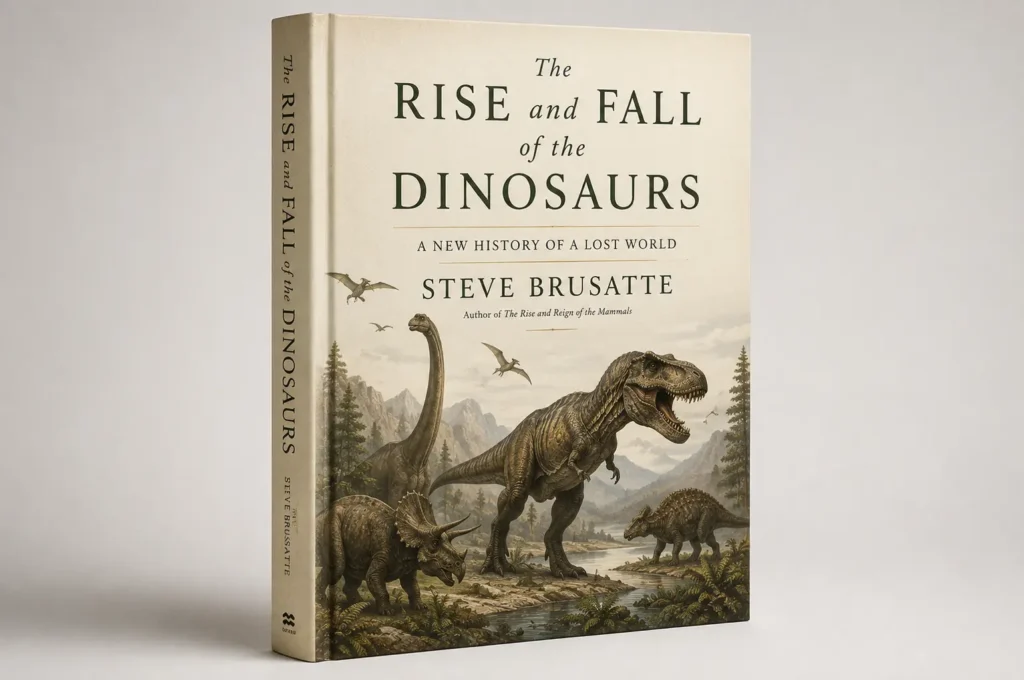
The Rise and Fall of the Dinosaurs
A compelling history of dinosaurs, tracing their origins, diversification, 200-million-year reign, extinction, and enduring legacy.
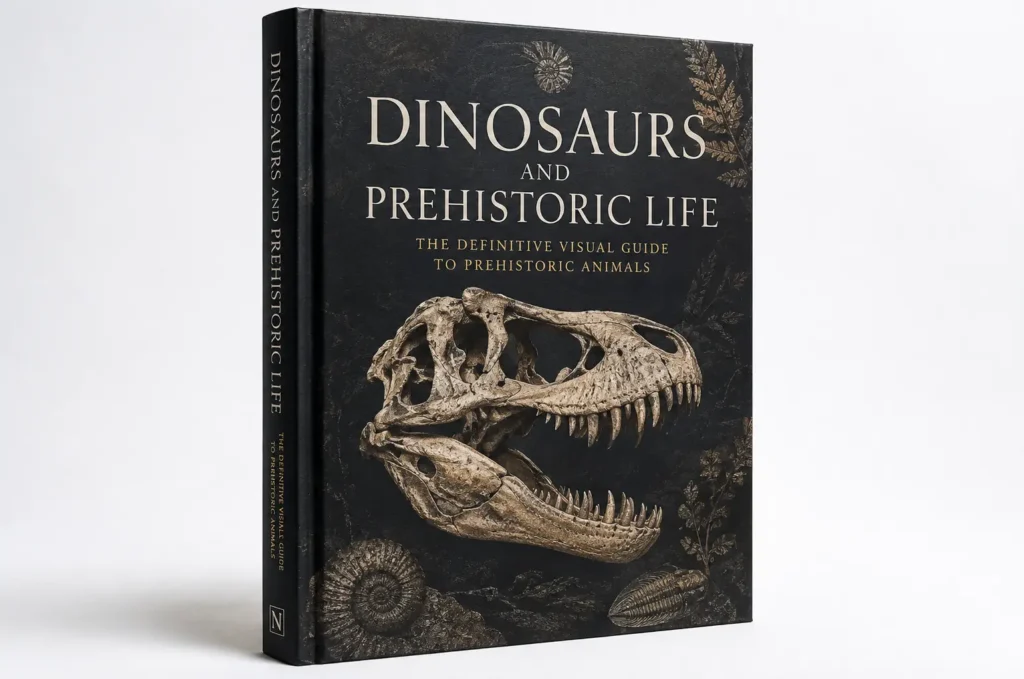
Dinosaurs and Prehistoric Life
A richly illustrated visual reference exploring dinosaurs, fossils, evolution, and prehistoric life across geological time.
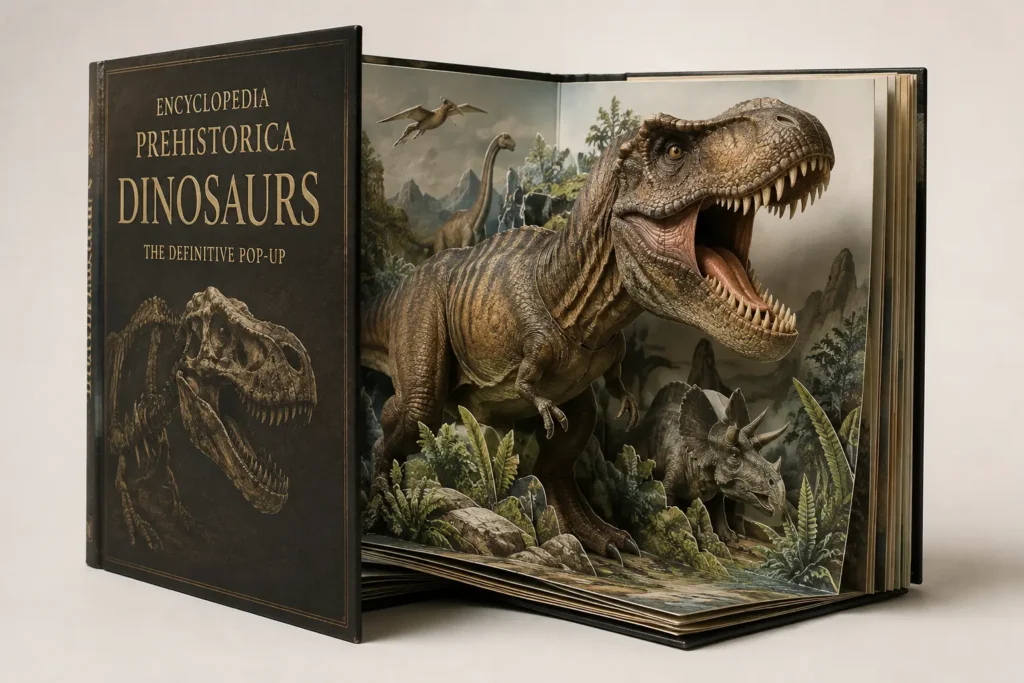
Encyclopedia Prehistorica: Dinosaurs
An interactive dinosaur book featuring spectacular three-dimensional pop-ups, particularly suited to young readers and families.
The Rise and Reign of the Mammals
A sweeping history of mammalian evolution, from their origins alongside dinosaurs through the Cenozoic and the emergence of humans.