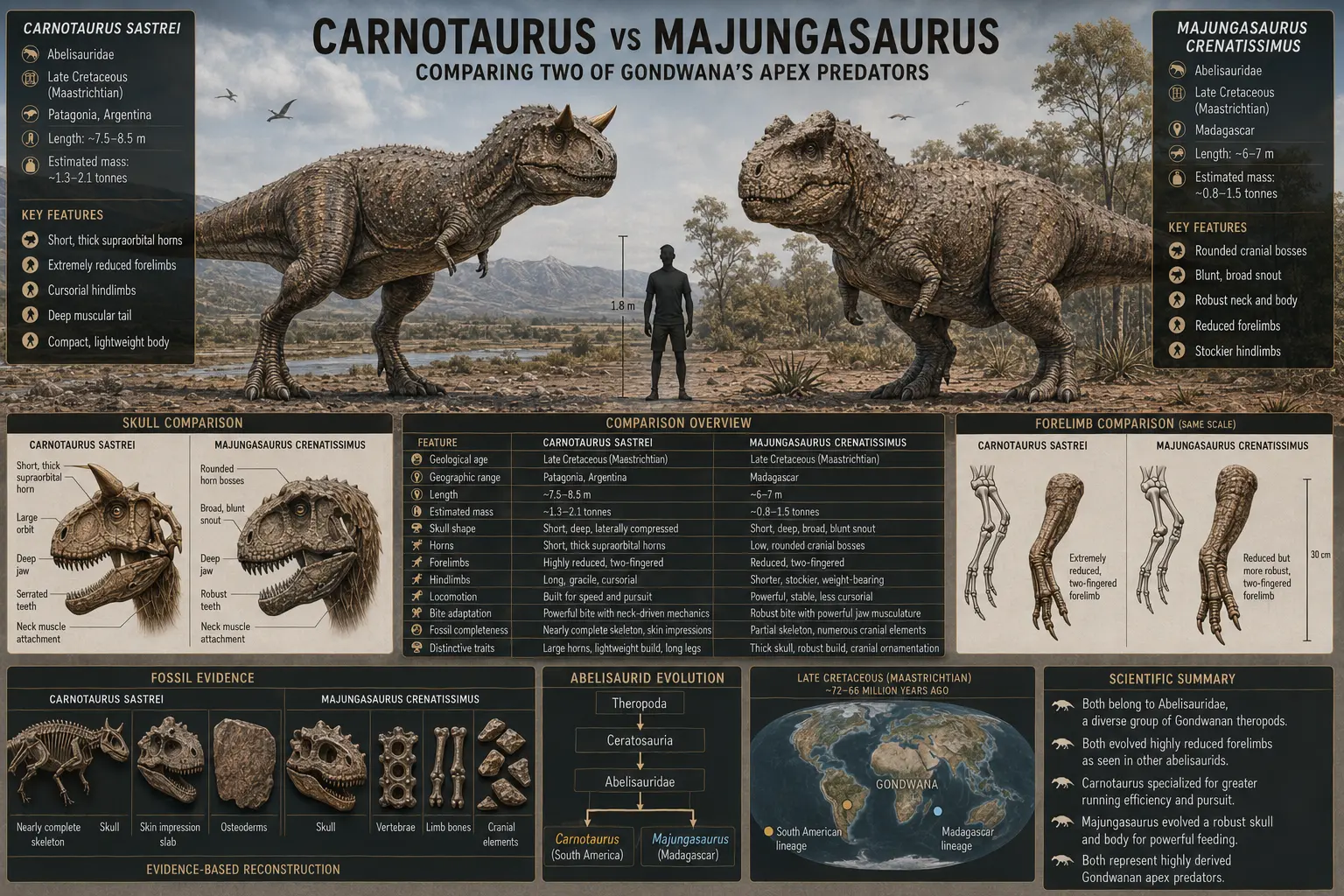
Comparison Quick Info
| Field | Carnotaurus | Majungasaurus |
|---|---|---|
| Scientific Name | Carnotaurus sastrei | Majungasaurus crenatissimus |
| Family | Abelisauridae | Abelisauridae |
| Geological Age | Late Cretaceous (72–69.9 Ma) | Late Cretaceous (70–66 Ma) |
| Location | Argentina | Madagascar |
| Length | 7.5–9 m | 6–7 m |
| Weight | 1.3–2.1 tonnes | 750–1,200 kg |
| Locomotion | Bipedal | Bipedal |
| Skull Ornamentation | Paired horns | Single cranial dome/horn |
| Fossil Record | Limited but exceptional | Extensive |
| Scientific Confidence | High | High |
Quick Answer
Carnotaurus sastrei and Majungasaurus crenatissimus were closely related abelisaurid theropods that lived during the Late Cretaceous on different parts of the southern supercontinent Gondwana. Carnotaurus was generally larger, more lightly built, and possessed distinctive paired horns above its eyes. Majungasaurus had a shorter, more robust skull with a single cranial ornament and is known from a much larger fossil sample. Together, these dinosaurs provide some of the best evidence for the evolution, anatomy, and ecology of Abelisauridae.

Summary Table
| Category | Carnotaurus | Majungasaurus |
|---|---|---|
| Length | 7.5–9 m | 6–7 m |
| Weight | 1.3–2.1 tonnes | 0.75–1.2 tonnes |
| Family | Abelisauridae | Abelisauridae |
| Skull Ornamentation | Paired orbital horns | Single cranial dome |
| Forelimbs | Extremely reduced | Reduced |
| Fossil Sample Size | Small | Large |
| Skin Evidence | Extensive | Limited |
| Evidence Strength | High | High |
Introduction
Among abelisaurid dinosaurs, few comparisons are as scientifically valuable as those between Carnotaurus and Majungasaurus. Unlike many dinosaur comparisons that involve distantly related predators, these species were close evolutionary relatives and shared numerous anatomical features.
Both belonged to Abelisauridae, a group of theropods that became dominant predators across many southern landmasses during the Late Cretaceous. However, they evolved in different geographic regions after Gondwana fragmented, creating an opportunity to examine how related predators adapted to different environments.
For paleontologists, Carnotaurus and Majungasaurus are among the most important abelisaurids because each is represented by relatively complete material and provides unique insights into the group’s biology.
Classification Comparison
Taxonomic Overview
| Rank | Carnotaurus | Majungasaurus |
|---|---|---|
| Clade | Theropoda | Theropoda |
| Major Group | Ceratosauria | Ceratosauria |
| Family | Abelisauridae | Abelisauridae |
| Subfamily | Carnotaurinae | Majungasaurinae |
These dinosaurs shared a common abelisaurid ancestry but belonged to different branches within the family.
Shared Abelisaurid Traits
| Feature | Present |
|---|---|
| Deep Skull | Yes |
| Reduced Forelimbs | Yes |
| Cranial Ornamentation | Yes |
| Short Facial Region | Yes |
| Bipedal Locomotion | Yes |
Evidence Strength
Direct Evidence
Size Comparison
Carnotaurus was generally the larger animal.
Size Metrics
| Measurement | Carnotaurus | Majungasaurus |
|---|---|---|
| Length | 7.5–9 m | 6–7 m |
| Weight | 1.3–2.1 tonnes | 750–1,200 kg |
| Skull Length | ~60 cm | ~60–70 cm |
| Hip Height | ~2.5–3 m | ~2–2.5 m |
Although the skulls were comparable in size, Carnotaurus possessed a longer and more lightly built body.
Size Winner
Carnotaurus
Evidence Strength
Direct Evidence
Skull and Horn Comparison
The skulls of these dinosaurs illustrate different approaches to abelisaurid ornamentation.
Skull Characteristics
| Feature | Carnotaurus | Majungasaurus |
|---|---|---|
| Skull Shape | Short and deep | Very deep and robust |
| Primary Ornament | Paired horns | Single cranial dome |
| Facial Rugosity | Extensive | Extensive |
| Ornament Position | Above eyes | Midline skull |
Carnotaurus possessed the most dramatic paired horns known among large theropods.
Majungasaurus instead developed a thickened cranial structure on the top of the skull.
Ornamentation Assessment
| Category | Winner |
|---|---|
| Largest Horns | Carnotaurus |
| Most Robust Skull | Majungasaurus |
| Visual Distinctiveness | Carnotaurus |
Evidence Strength
Direct Evidence
Forelimb Comparison
Both species are famous for reduced forelimbs.
Arm Anatomy
| Feature | Carnotaurus | Majungasaurus |
|---|---|---|
| Relative Arm Size | Extremely reduced | Extremely reduced |
| Finger Function | Minimal | Minimal |
| Mobility | Very limited | Very limited |
| Reduction Level | Extreme | Extreme |
The forelimbs of both animals were dramatically smaller than those of earlier theropods.
Carnotaurus may represent the more extreme condition, but both species demonstrate the characteristic abelisaurid trend toward forelimb reduction.
Assessment
Broadly Similar
Evidence Strength
Direct Evidence
Feeding Adaptations
Majungasaurus and Carnotaurus appear to have differed somewhat in feeding mechanics.
Feeding Comparison
| Feature | Carnotaurus | Majungasaurus |
|---|---|---|
| Skull Build | Relatively lighter | More robust |
| Neck Strength | Strong | Strong |
| Bite Adaptations | Moderate | Strong |
| Cranial Reinforcement | High | Very High |
Biomechanical studies frequently suggest that Majungasaurus possessed a particularly robust skull capable of handling substantial feeding stresses.
Carnotaurus appears somewhat more lightly constructed.
Evidence Strength
Strong Inference
Fossil Evidence Comparison
This is one of the most scientifically interesting aspects of the comparison.
Fossil Record Quality
| Topic | Carnotaurus | Majungasaurus |
|---|---|---|
| Complete Skeletons | Exceptional | |
| Number of Specimens | Limited | Numerous |
| Growth Series | Poorly Known | Well Documented |
| Population Variation | Poorly Known | Better Understood |
| Skin Impressions | Extensive | Limited |
Carnotaurus provides exceptional anatomical preservation, including extensive skin impressions.
Majungasaurus benefits from a much larger sample size, allowing researchers to study growth, variation, and population-level characteristics.
Fossil Evidence Assessment
| Category | Winner |
|---|---|
| Preservation Quality | Carnotaurus |
| Sample Size | Majungasaurus |
| Growth Data | Majungasaurus |
| Skin Evidence | Carnotaurus |
Paleobiology Comparison
Biological Evidence
| Topic | Carnotaurus | Majungasaurus |
|---|---|---|
| Direct Skin Evidence | Yes | |
| Bone Histology | Limited | |
| Growth Studies | Limited | |
| Feeding Studies | Moderate | |
| Cannibalism Evidence | None known | Present |
One of the most famous discoveries involving Majungasaurus is evidence suggesting intraspecific feeding, commonly interpreted as cannibalism.
No comparable evidence has been documented for Carnotaurus.
Evidence Strength
Direct Fossil Evidence for feeding traces in Majungasaurus.
Gondwanan Evolution
This comparison highlights regional diversification within Abelisauridae.
Geographic Comparison
| Topic | Carnotaurus | Majungasaurus |
|---|---|---|
| Continent | South America | Madagascar |
| Paleogeographic Region | Patagonia | Isolated island landmass |
| Abelisaurid Branch | Carnotaurinae | Majungasaurinae |
Despite geographic separation, both species retained many characteristic abelisaurid features.
Their similarities provide evidence for common ancestry, while their differences reveal regional evolutionary specialization.
Scientific Importance
Carnotaurus and Majungasaurus are among the most important taxa for understanding abelisaurid evolution.
Evidence Assessment
Comparison Overview
| Category | Current Winner |
|---|---|
| Size | Carnotaurus |
| Weight | Carnotaurus |
| Skull Robustness | Majungasaurus |
| Horn Development | Carnotaurus |
| Fossil Sample Size | Majungasaurus |
| Growth Data | Majungasaurus |
| Skin Preservation | Carnotaurus |
| Abelisaurid Specialization | Both |
This comparison is best viewed as a study of two highly successful abelisaurid predators rather than a contest between unrelated dinosaurs.
Remaining Scientific Uncertainties
| Topic | Current Status |
|---|---|
| Relative Running Performance | Unknown |
| Comparative Bite Force | Under Investigation |
| Social Behavior | Poorly Known |
| Ecological Differences | Incompletely Understood |
| Regional Adaptations | Active Research Area |
Most uncertainties concern ecology and behavior rather than anatomy.
FAQ
Are Carnotaurus and Majungasaurus related?
Yes. Both belong to Abelisauridae and are among the best-known members of the family.
Which dinosaur was larger?
Carnotaurus was generally longer and heavier.
Which dinosaur had bigger horns?
Carnotaurus possessed the more prominent horns.
Which species has the better fossil record?
Majungasaurus has a larger sample size, while Carnotaurus has more exceptional preservation.
Is there evidence of cannibalism in either species?
Evidence of intraspecific feeding has been documented in Majungasaurus. Comparable evidence is not currently known for Carnotaurus.
Why This Comparison Matters
For Majungasaurus:
Carnotaurus and Majungasaurus are among the best-preserved abelisaurids and provide key evidence for how abelisaurids diversified across Gondwana.
Current Scientific Understanding
Carnotaurus sastrei and Majungasaurus crenatissimus represent two of the most important abelisaurid dinosaurs known to science. Their close evolutionary relationship allows researchers to study how abelisaurids diversified across Gondwana during the Late Cretaceous.
Current evidence indicates that Carnotaurus was generally larger, more lightly built, and possessed more dramatic cranial ornamentation. Majungasaurus, in contrast, appears to have had a more robust skull and is known from a much larger fossil sample. As a result, Majungasaurus provides valuable information about growth, variation, and population biology, while Carnotaurus offers exceptional evidence for anatomy and external appearance.
Together, these species form the foundation of modern scientific understanding of Abelisauridae and demonstrate both the shared characteristics and regional diversity of this successful group of southern predatory dinosaurs.
References
A. Primary Taxonomic Sources
Bonaparte, J.F. 1985. A horned Cretaceous carnosaur from Patagonia. National Geographic Research 1(2):149–151.
Depéret, C. 1896. Original description of material later assigned to Majungasaurus.
Bonaparte, J.F., Novas, F.E., and Coria, R.A. 1990. Carnotaurus sastrei Bonaparte, the horned, lightly built carnosaur from the Middle Cretaceous of Patagonia. Contributions in Science 416:1–42.
Sampson, S.D., Witmer, L.M., Forster, C.A., Krause, D.W., O’Connor, P.M., Dodson, P., and Ravoavy, F. 1998. Redescription and diagnosis of Majungasaurus crenatissimus.
B. Scientific Literature
Sampson, S.D., and Witmer, L.M. 2007. Cranial anatomy and systematics of Majungasaurus crenatissimus. Society of Vertebrate Paleontology Memoir 8.
Rogers, R.R., Krause, D.W., and Curry Rogers, K. Multiple studies on the paleobiology and growth of Majungasaurus.
Persons, W.S. IV and Currie, P.J. 2011. Dinosaur speed demon: The caudal musculature of Carnotaurus sastrei and implications for the evolution of South American abelisaurids. PLOS ONE 6(10):e25763.
Delcourt, R. 2018. Ceratosaur palaeobiology: New insights on evolution and ecology of the southern rulers. Scientific Reports 8:9730.
C. Books and Reference Works
Paul, G.S. 2016. The Princeton Field Guide to Dinosaurs. 2nd Edition. Princeton University Press.
Holtz, T.R. Jr. 2011. Dinosaurs: The Most Complete, Up-to-Date Encyclopedia for Dinosaur Lovers of All Ages.
D. Databases and Online Resources
Paleobiology Database. Taxonomic and occurrence data for Carnotaurus sastrei and Majungasaurus crenatissimus.
Featured Museum Collections
Museum-quality paleoart and educational poster
collections based on evidence-informed prehistoric
Life reconstructions.