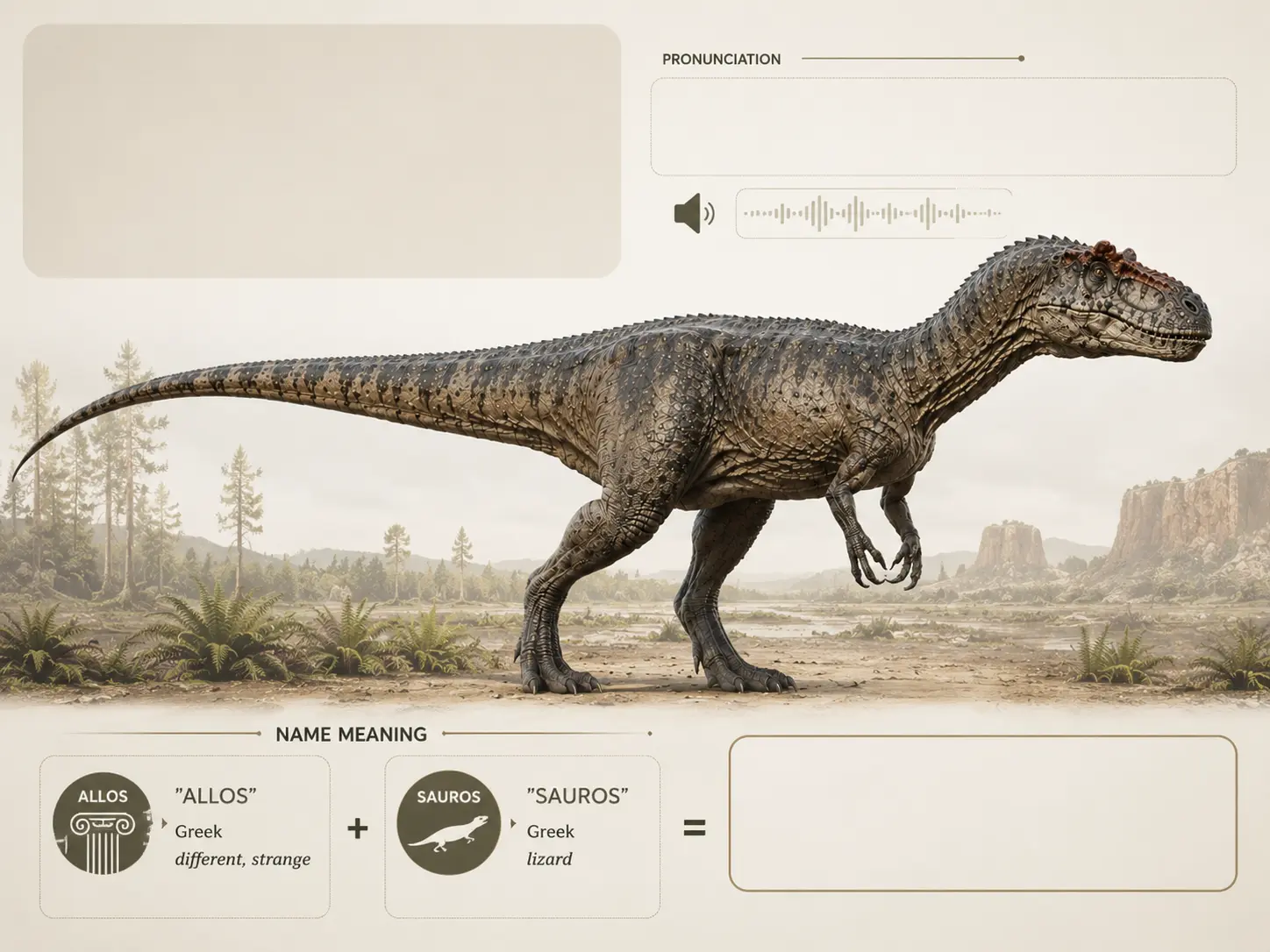
| Field | Information |
|---|---|
| Species | Allosaurus fragilis — Saurischia, Allosauridae |
| Pronunciation | AL-oh-SORE-us |
| Name meaning | “Different lizard” — from Greek allos (different) and sauros (lizard) |
| Named by | Othniel Charles Marsh, 1877 |
Quick Answer: Allosaurus pronunciation is AL-oh-SORE-us, with the stress falling on the first and third syllables. The name combines the Greek words allos, meaning “different,” and sauros, meaning “lizard.” Marsh chose the name in 1877 to reflect the distinctive vertebral anatomy that set this dinosaur apart from other genera known at the time.

The name Allosaurus has been spoken in classrooms, museums, and documentaries for nearly 150 years — but the correct stress pattern and the reasoning behind the name itself are less widely known than the animal that carries it.
How Do You Pronounce Allosaurus?
In modern English usage, Allosaurus is most commonly pronounced AL-oh-SORE-us, following a four-syllable pattern. The primary stress typically falls on the first syllable, with the remaining syllables spoken in the familiar English rendering used for many dinosaur names ending in -saurus.
Syllable-by-Syllable Breakdown
- AL — as in the name “Al.”
- Oh — a short connecting vowel
- SORE — rhymes with “more.”
- us — a short unstressed ending, as in many English scientific name pronunciations
Pronunciation of scientific names can vary somewhat across English-speaking regions and institutions, but AL-oh-SORE-us is the most widely recognised modern English pronunciation.
What Does the Name Allosaurus Mean?
The name Allosaurus means “different lizard,” derived from the Ancient Greek allos (ἄλλος), meaning “different” or “other,” and sauros (σαῦρος), meaning “lizard.” Othniel Charles Marsh introduced the name in 1877 to reflect vertebral anatomy he considered distinct from that of other dinosaur genera known at the time. The specific anatomical interpretation has been refined since the original description, but the etymology remains well established.
Why “Different”?
The choice of allos — “different” — reflects the taxonomic conventions of the 1870s, when vertebral morphology was a primary diagnostic feature for distinguishing dinosaur genera. Fossil evidence from the type material showed vertebral construction that Marsh considered sufficiently distinct to warrant a new genus name. The specific epithet fragilis — meaning “fragile” or “slender” — was added to reflect the relatively lightweight construction of the bones, which showed extensive pneumatisation.
The Specific Epithet: fragilis
The full scientific name Allosaurus fragilis combines the genus name with a Latin species epithet. Fragilis derives from the Latin for “fragile” or “easily broken.” The name is generally interpreted as referring to the relatively lightly built nature of the fossil material compared with the more massive bone construction seen in some other large reptiles known at the time. As with many 19th-century species names, the exact authorial rationale was not always explained in detail in the original description.
Common Alternative Pronunciations
English pronunciation of scientific names often varies in informal and regional usage. Alternative pronunciations of Allosaurus sometimes include:
- al-oh-SAWR-us
- AL-uh-SORE-us
- al-oh-SOR-us
These variants are widely recognisable in context, though AL-oh-SORE-us remains the most commonly used modern English pronunciation.
How Allosaurus Fits Into Dinosaur Naming Conventions
The suffix -saurus, derived from the Greek sauros (“lizard”), is one of the most familiar elements in dinosaur nomenclature. It appears in many dinosaur genus names, including Tyrannosaurus, Ceratosaurus, Megalosaurus, Stegosaurus, and Ankylosaurus. The prefix allo-, from the Greek allos (“different” or “other”), is less common and reflects the etymological basis of Allosaurus itself. The family name Allosauridae is derived directly from the genus name, following standard zoological naming conventions.
Here is the publication-safe revised version:
Related and Contemporary Species
- Allosaurus jimmadseni — the second formally recognised species of Allosaurus, named in honour of paleontologist James H. Madsen Jr., whose work on Morrison Formation theropods was highly influential
- Ceratosaurus nasicornis — a contemporary Morrison Formation theropod; the name means “horned lizard,” with the species epithet referring to its distinctive nasal horn
- Torvosaurus tanneri — a large contemporary theropod; the genus name means “savage lizard,” with the species name honouring N. Eldon Tanner
- Diplodocus longus — a large Morrison Formation sauropod; the genus name means “double beam,” referring to the distinctive chevron bones
- Tyrannosaurus rex — one of the most widely recognised dinosaur names; the genus means “tyrant lizard,” while rex is Latin for “king.”
Frequently Asked Questions
What does the name Allosaurus mean?
The name Allosaurus means “different lizard,” derived from the Greek allos (“different” or “other”) and sauros (“lizard”). Marsh introduced the name in 1877 to reflect vertebral anatomy he considered distinct from that of other dinosaur genera known at the time. The species name fragilis is generally interpreted as referring to the relatively lightly built nature of the fossil material.
Is Allosaurus pronounced with four syllables?
In modern English usage, Allosaurus is most commonly pronounced AL-oh-SORE-us, with four syllables. Pronunciation of scientific names can vary across English-speaking regions, but this remains the most widely recognised rendering.
Why did Marsh name it Allosaurus?
Marsh named Allosaurus (“different lizard”) because the vertebral anatomy of the original material appeared distinct from that of other dinosaurs known in the late 19th century. His naming reflected comparative skeletal morphology rather than external appearance or behaviour.
Conclusion
Allosaurus is most commonly pronounced AL-oh-SORE-us in modern English. Its name means “different lizard,” a reference to anatomical features that Marsh considered distinctive when he described the genus in 1877. Nearly 150 years later, it remains one of the most recognisable names in dinosaur paleontology.
References
Primary Taxonomic Sources
Chure, D.J. and Loewen, M.A., 2020. Cranial anatomy of Allosaurus jimmadseni, a new species from the lower part of the Morrison Formation (Upper Jurassic) of western North America. PeerJ, 8:e7803. https://doi.org/10.7717/peerj.7803
Marsh, O.C., 1877. Notice of new dinosaurian reptiles from the Jurassic formation. American Journal of Science and Arts, Series 3, 14, pp.514–516.
Osborn, H.F., 1905. Tyrannosaurus and other Cretaceous carnivorous dinosaurs. Bulletin of the American Museum of Natural History, 21, pp.259–265.
Monographs and Reference Works
Fastovsky, D.E. and Weishampel, D.B., 2016. Dinosaurs: A Concise Natural History. 3rd ed. Cambridge University Press.
Madsen, J.H., 1976. Allosaurus fragilis: A Revised Osteology. Utah Geological and Mineral Survey Bulletin 109. Salt Lake City, Utah.
Paul, G.S., 2016. The Princeton Field Guide to Dinosaurs. 2nd ed. Princeton University Press.
Databases and Online Resources
Paleobiology Database, 2026. Allosaurus fragilis taxonomic entry and occurrence data. Available at: https://paleobiodb.org [Accessed 19 May 2026].
International Commission on Zoological Nomenclature (ICZN), 1999. International Code of Zoological Nomenclature. 4th ed. Available at: https://www.iczn.org/the-code/ [Accessed 19 May 2026].
Featured Museum Collections
Museum-quality paleoart and educational poster
collections based on evidence-informed prehistoric
Life reconstructions.