
Quick Info
| Field | Information |
|---|---|
| Species | Ankylosaurus magniventris — Ornithischia, Ankylosauridae |
| Time Period | Late Cretaceous, approximately 68–66 million years ago |
| Common English Pronunciation | an-KY-loh-SOR-us |
| Approximate IPA | /ˌæŋ.kɪ.loʊˈsɔːr.əs/ (common English rendering) |
| Name Origin | Greek ankylos + sauros |
| Species Epithet Meaning | magniventris = Latin for “large-bellied” |
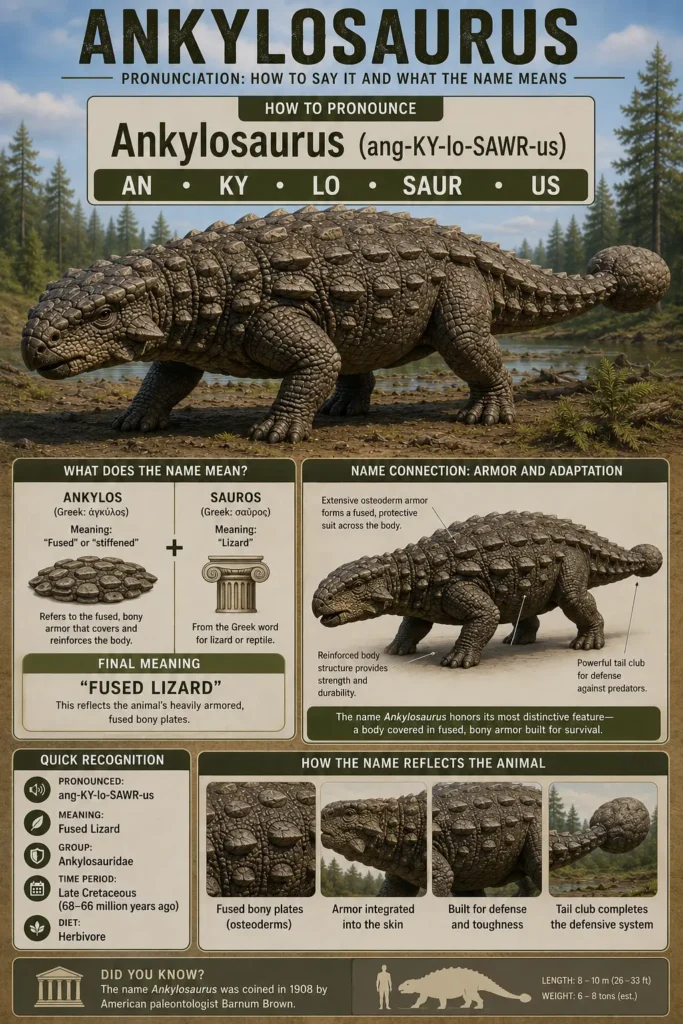
Quick Answer: Ankylosaurus is commonly pronounced an-KY-loh-SOR-us. The genus name derives from Greek roots meaning roughly “stiffened lizard” or “fused lizard,” referring to the animal’s heavily armored anatomy. The full species name, Ankylosaurus magniventris, means approximately “large-bellied stiffened lizard.”

How to Pronounce Ankylosaurus
The standard English pronunciation is:
an-KY-loh-SOR-us
Broken into syllables:
- an → short opening syllable
- KY → primary stress (rhymes with “sky”)
- loh → unstressed middle syllable
- SOR → secondary stress in many English pronunciations
- us → short final ending
Approximate phonetic rendering:
ang-kih-loh-SOR-us
Minor pronunciation differences exist between speakers, institutions, and dialects, but the above form is the most widely recognized in English-language scientific communication.
It would be too strong to claim a single universally “correct” spoken pronunciation, since scientific Latinized names are conventionally adapted into modern languages rather than preserved with one fixed ancient pronunciation.
What Does Ankylosaurus Mean?
The genus name comes from Ancient Greek:
- ἀγκύλος (ankylos) — meaning “crooked,” “bent,” “curved,” or “stiffened”
- σαῦρος (sauros) — meaning “lizard”
Together, the name is commonly interpreted as:
“stiffened lizard” or “fused lizard”
“Stiffened lizard” is generally closer to the original etymological meaning than the simpler “fused lizard,” though both appear in educational literature.
The name reflects the animal’s heavily armored skeleton, especially the rigidly reinforced body and extensive dermal ossification.
Historical Naming Context
The genus Ankylosaurus was formally named by paleontologist Barnum Brown in 1908.
The name reflected the unusual armored anatomy visible in the fossil material, though the original interpretation was based on the anatomical understanding available at the time. Modern reconstructions provide a much clearer picture of ankylosaur skeletal specialization.
What Does Magniventris Mean?
The species epithet magniventris is Latin:
- magni- = large
- ventris = belly/abdomen
So the full binomial name translates approximately as:
“Large-bellied stiffened lizard.”
This refers to the animal’s broad, massive body proportions rather than a specific soft-tissue anatomical feature.
What does Ankylosaurus magniventris Mean in Full?
The full scientific name Ankylosaurus magniventris combines a Greek genus name with a Latin species epithet, following standard zoological naming convention.
Genus: Ankylosaurus
- from Greek ἀγκύλος (ankylos) = crooked, bent, stiffened, or fused
- from Greek σαῦρος (sauros) = lizard
Common translation:
“stiffened lizard” (preferred)
or more loosely:
“Fused lizard”
Species epithet: magniventris
- from Latin magnus = large / great
- from Latin venter (ventris in declined form) = belly/abdomen
Translation:
“large-bellied”
Combined, the full name is best rendered as:
“Large-bellied stiffened lizard”
Or, less formally:
“The stiffened lizard with the large belly.”
The species epithet likely reflects the broad, deep-bodied proportions inferred from the original fossil material, though species epithets do not always correspond perfectly to modern anatomical interpretation.
In formal scientific writing:
- genus name capitalized: Ankylosaurus
- species epithet lowercase: magniventris
- full binomial italicized: Ankylosaurus magniventris
This formatting is standard for all zoological binomial nomenclature.
How to Remember the Pronunciation
A simple English mnemonic is:
an + SKY + low + SORE + us
This naturally approximates the common pronunciation:
an-KY-loh-SOR-us
Helpful anchors:
- KY rhymes with sky
- SOR sounds like sore
- The ending resembles other familiar dinosaur names ending in -saurus
This is a pronunciation aid rather than a formal linguistic reconstruction, but it works well for general educational use.
Related Name Comparisons
- Euoplocephalus tutus — another ankylosaurid with a more complex Greek-derived name; useful as a contrast in dinosaur nomenclature complexity.
- Tyrannosaurus rex shares the Greek sauros suffix and follows a familiar English pronunciation pattern.
- Stegosaurus armatus — another classic dinosaur genus using the same naming structure.
Frequently Asked Questions
Is it “Ankylosaurus” or something else?
The correct scientific spelling is:
Ankylosaurus
Letter by letter:
A-n-k-y-l-o-s-a-u-r-u-s
Common misspellings include:
- Anchylosaurus
- Ankylosauras
- Ankylosauruss
- phonetic variants such as Ankilosaurus
The accepted spelling derives from the original taxonomic name established in the scientific literature and has remained stable in formal zoological usage.
How do you pronounce Ankylosaurus magniventris?
A common English pronunciation is:
an-KY-loh-SOR-us mag-nih-VEN-triss
Approximate breakdown:
- Ankylosaurus → an-KY-loh-SOR-us
- magniventris → mag-nih-VEN-triss
As with many Latinized scientific names, minor pronunciation variation exists between speakers, institutions, and dialects.
In most general educational contexts, the genus name alone (Ankylosaurus) is what people use.
Who named Ankylosaurus, and when?
Ankylosaurus magniventris was formally named by paleontologist Barnum Brown in 1908.
The original description appeared in the Bulletin of the American Museum of Natural History.
Brown established:
- The genus Ankylosaurus
- the species Ankylosaurus magniventris
- The family Ankylosauridae
The genus name remains valid today, although scientific understanding of ankylosaur relationships has evolved substantially since the original description.
Conclusion
Ankylosaurus is commonly pronounced an-KY-loh-SOR-us, and its name derives from Greek roots meaning approximately “stiffened lizard.”
The full species name, Ankylosaurus magniventris, adds the Latin meaning “large-bellied,” producing the approximate translation “large-bellied stiffened lizard.”
It is a scientifically stable name that has remained in use since Barnum Brown formally described the animal in 1908.
References
Primary Taxonomic Source
Brown, B. (1908). The Ankylosauridae, a new family of armored dinosaurs from the Upper Cretaceous. Bulletin of the American Museum of Natural History, 24, 187–201.
Peer-Reviewed Literature
Arbour, V.M. & Currie, P.J. (2016). Systematics, phylogeny, and palaeobiogeography of the ankylosaurid dinosaurs. Journal of Systematic Palaeontology, 14(5), 385–444. https://doi.org/10.1080/14772019.2015.1059985
Arbour, V.M. & Mallon, J.C. (2017). Redescription of the ankylosaurid dinosaur Ankylosaurus magniventris Brown 1908 (Ankylosauridae) from the Upper Cretaceous Hell Creek and Lance formations of western North America. PeerJ, 5, e2805. https://doi.org/10.7717/peerj.2805
Reference Works
Weishampel, D.B., Dodson, P. & Osmólska, H. (Eds.). (2004). The Dinosauria (2nd ed.). University of California Press.
Liddell, H.G. & Scott, R. (1940). A Greek-English Lexicon (revised and augmented by H.S. Jones & R. McKenzie). Clarendon Press.
Featured Museum Collections
Museum-quality paleoart and educational poster
collections based on evidence-informed prehistoric
Life reconstructions.