
At a Glance
| Field | Q. northropi | Q. lawsoni |
|---|---|---|
| Clade / Family | Pterosauria / Azhdarchidae | Pterosauria / Azhdarchidae |
| Geological age | Late Cretaceous (Maastrichtian), approximately 68–66 million years ago | Late Cretaceous (Maastrichtian), approximately 68–66 million years ago |
| Estimated wingspan | Approximately 10–11 m (33–36 ft) | Approximately 4.5–5.5 m (15–18 ft) |
| Estimated mass | Commonly modeled at approximately 180–250 kg (400–550 lb), depending on reconstruction | Approximately 20–35 kg (44–77 lb), model dependent |
| Reconstructed standing head height | Approximately 5–6 m (16–20 ft), highly reconstruction dependent | Approximately 2 m (6.5 ft), reconstruction based |
| Size evidence basis | Fragmentary giant wing remains with biomechanical reconstruction | Better-preserved comparative material with scaled reconstruction |
Quick Answer: The size of Quetzalcoatlus depended on the species. The giant Quetzalcoatlus northropi is commonly estimated at a wingspan of approximately 10–11 metres (33–36 feet), placing it among the largest known flying animals, while the smaller Q. lawsoni reached approximately 4.5–5.5 metres (15–18 feet). All size figures are reconstruction-based estimates rather than direct fossil measurements.
Introduction
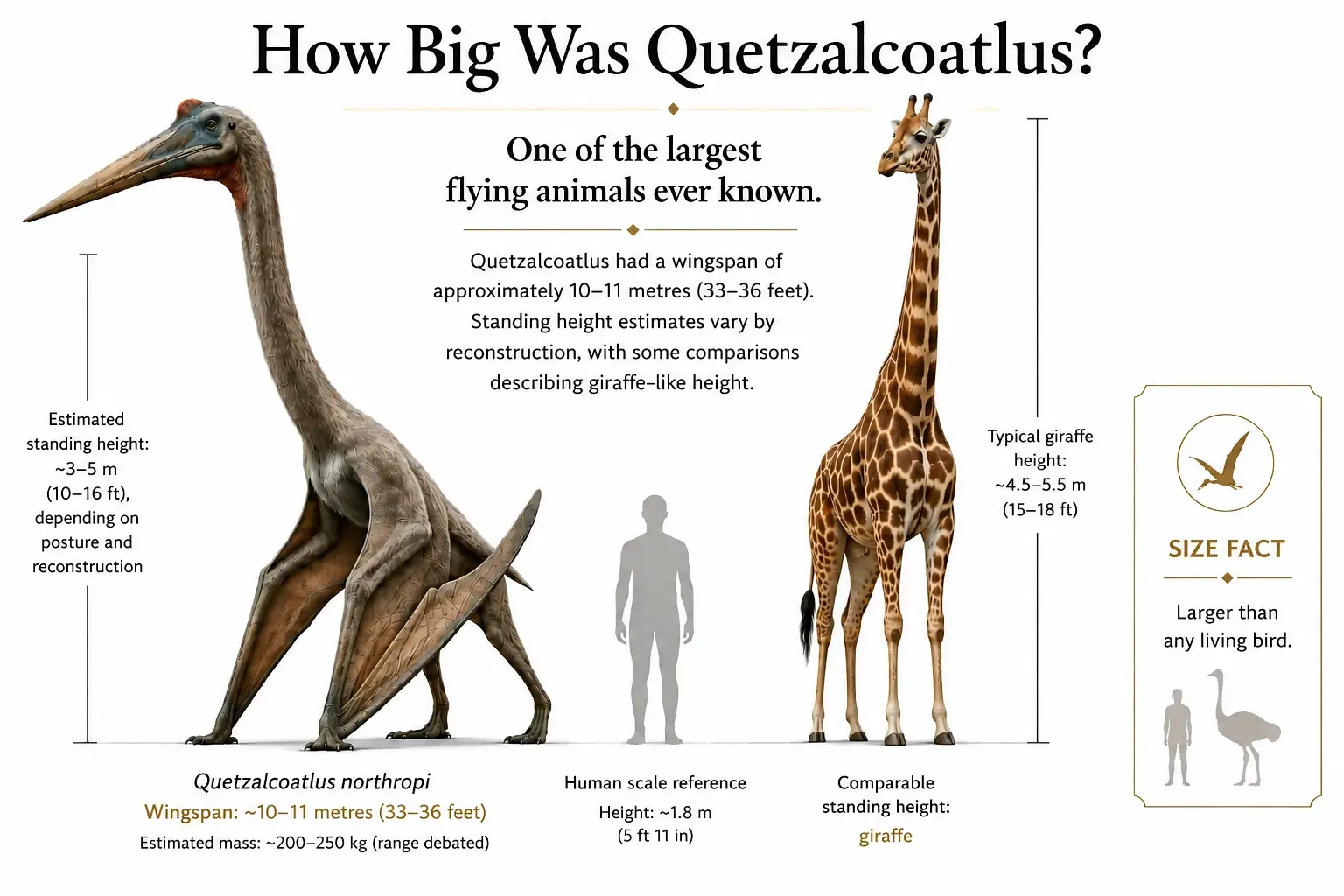
The scale of Quetzalcoatlus remains extraordinary even by prehistoric standards. Reconstructed estimates suggest that Quetzalcoatlus northropi may have stood at a head height comparable to a modern giraffe and possessed a wingspan similar to that of a small light aircraft.
No living flying animal approaches this scale, and giant azhdarchid pterosaurs such as Quetzalcoatlus remain among the largest flying vertebrates currently known from the fossil record.
How Big Was Quetzalcoatlus?
This remains an active area of paleontological research, and size estimates may continue to be refined as new fossil evidence and biomechanical analyses become available.
Current biomechanical reconstructions commonly estimate Quetzalcoatlus northropi at a wingspan of approximately 10–11 metres (33–36 feet), placing it among the largest known flying vertebrates. Estimated body mass is more uncertain and varies substantially between models, with many reconstructions placing the giant species in the approximate range of 180–250 kilograms (400–550 pounds).
These figures are inherently model-dependent. The Q. northropi holotype consists of incomplete fossil material, primarily fragmentary wing remains, with no associated skull or complete skeleton. As a result, overall body dimensions are reconstructed through comparative scaling using better-preserved azhdarchid material, including specimens assigned to Quetzalcoatlus lawsoni and other related taxa. No single exact measurement can be considered definitive.
Comparative Size Estimates
| Measurement | Q. northropi (reconstructed estimate) | Q. lawsoni (reconstructed estimate) |
|---|---|---|
| Wingspan | Approximately 10–11 m (33–36 ft) | Approximately 4.5–5.5 m (15–18 ft) |
| Estimated mass | Approximately 180–250 kg (400–550 lb), model dependent | Approximately 20–35 kg (44–77 lb), model dependent |
| Approximate body length | Reconstruction-based; commonly estimated at roughly 5–6 m (16–20 ft) | Roughly 2–2.5 m (6.5–8 ft) |
| Reconstructed standing head height | Approximately 5–6 m (16–20 ft), highly speculative | Approximately 2 m (6.5 ft), reconstruction based |
All values above are reconstruction-based estimates rather than direct fossil measurements.
Why Do Size Estimates Vary?
Size estimates for Quetzalcoatlus northropi vary because they depend on multiple layers of reconstruction. First, scientists must extrapolate from incomplete fossil remains—primarily partial wing elements—to estimate full wingspan. Second, body mass must be inferred using biomechanical and aerodynamic models based on assumptions about skeletal proportions, soft tissue distribution, and flight mechanics.
Different modeling approaches produce different results. Historically, published wingspan estimates for Q. northropi have ranged from approximately 9 metres (30 feet) to 13 metres (43 feet), though more conservative modern reconstructions commonly cluster around the 10–11 metre (33–36 foot) range.
Because of these uncertainties, no single numerical estimate should be treated as exact; Quetzalcoatlus’s size is best understood as a scientifically informed reconstruction rather than a directly measurable fact.
How Does Quetzalcoatlus Size Compare to Other Animals?
Compared to Modern Flying Animals
No living flying animal approaches the reconstructed size of giant azhdarchid pterosaurs such as Quetzalcoatlus northropi. The wandering albatross (Diomedea exulans), generally regarded as the living bird with the greatest wingspan, reaches approximately 3.5–3.7 metres (11.5–12 feet)—roughly one third of the commonly reconstructed Q. northropi wingspan.
By body mass, living flying birds also fall far below giant pterosaur estimates. Even the heaviest extant flying birds are substantially lighter than modeled mass estimates for Quetzalcoatlus.
Compared to Modern Aircraft
A reconstructed wingspan of approximately 10–11 metres (33–36 feet) places Quetzalcoatlus northropi in a range broadly comparable to the wingspan of a small light aircraft such as a Cessna 172.
This comparison is useful purely as a visual scale reference. Pterosaur wing anatomy, flight mechanics, tissue structure, and aerodynamic behavior were fundamentally different from those of engineered aircraft.
Compared to Other Pterosaurs
Quetzalcoatlus northropi ranks among the largest pterosaurs currently known. The giant Romanian azhdarchid Hatzegopteryx thambema is the most frequently cited size comparison, with reconstructed estimates that broadly overlap the upper size range proposed for Quetzalcoatlus.
Other large azhdarchids, including Arambourgiania philadelphiae and Cryodrakon boreas, were substantial pterosaurs but are generally reconstructed as smaller, although exact size estimates remain uncertain because of incomplete fossil material.
The smaller Quetzalcoatlus lawsoni, with a reconstructed wingspan of approximately 4.5–5.5 metres (15–18 feet), was itself a large pterosaur by general standards.
Was Quetzalcoatlus the Biggest Flying Animal Ever?
Based on currently available fossil evidence, Quetzalcoatlus northropi is regarded as one of the largest known flying vertebrates, alongside giant azhdarchids such as Hatzegopteryx thambema. Because giant pterosaur fossils are often incomplete and reconstructions remain model-dependent, assigning a single undisputed “largest” title should be done cautiously.
No living flying animal approaches the reconstructed upper size range of these giant pterosaurs. However, the fossil record remains incomplete, and future discoveries could alter current interpretations.
Related and Comparative Species
- Hatzegopteryx thambema — Giant Romanian azhdarchid with reconstructed size estimates overlapping those of Quetzalcoatlus.
- Arambourgiania philadelphiae — Large Middle Eastern azhdarchid known from fragmentary remains and frequently included in giant pterosaur size comparisons.
- Cryodrakon boreas — Giant Canadian azhdarchid representing another major North American member of the family, generally reconstructed as smaller than Q. northropi.
- Pteranodon longiceps — Large North American pterosaur that, despite impressive size, was substantially smaller than giant azhdarchids.
- Diomedea exulans (wandering albatross) — The largest living flying bird by wingspan, useful as a modern biological scale comparison.
Frequently Asked Questions
How big was Quetzalcoatlus?
The size of Quetzalcoatlus depended on the species. The giant Quetzalcoatlus northropi is commonly reconstructed with a wingspan of approximately 10–11 metres (33–36 feet), with model-dependent body mass estimates often placed in the approximate range of 180–250 kilograms (400–550 pounds). These are biomechanical reconstructions based on incomplete fossil material rather than direct measurements. The smaller Q. lawsoni is estimated to have reached a wingspan of approximately 4.5–5.5 metres (15–18 feet).
What was the wingspan of Quetzalcoatlus?
The giant species Quetzalcoatlus northropi is commonly estimated to have had a wingspan of approximately 10–11 metres (33–36 feet) based on biomechanical reconstruction of fragmentary fossil remains. Historical estimates have ranged both lower and higher depending on methodology, but this range reflects commonly cited modern reconstructions. The smaller Q. lawsoni is estimated at approximately 4.5–5.5 metres (15–18 feet).
Conclusion
Quetzalcoatlus northropi ranks among the largest known flying vertebrates, with reconstructed wingspan estimates commonly placed at approximately 10–11 metres (33–36 feet). Because these figures are derived from incomplete fossil material and biomechanical modeling, they remain subject to refinement as research progresses.
The 2021 recognition of Quetzalcoatlus lawsoni clarified that the genus included more than one species, revealing a substantial size range within Quetzalcoatlus itself. Even with the uncertainties inherent in reconstruction, giant azhdarchid pterosaurs remain among the most extraordinary flying animals currently known from the fossil record.
References
Primary Taxonomic / Species Sources
Lawson, D. A. (1975).
Pterosaur from the latest Cretaceous of West Texas: Discovery of the largest flying creature.
Science, 187(4180), 947–948.
https://doi.org/10.1126/science.187.4180.947
Jacobs, M. L., Ferguson, K. M., Polcyn, M. J., & Winkler, D. A. (2021).
A new species of Quetzalcoatlus (Pterosauria: Azhdarchidae) from the Upper Cretaceous Javelina Formation of Texas.
Journal of Vertebrate Paleontology, 41(sup1), 203–217.
https://doi.org/10.1080/02724634.2020.1907587
Biomechanics / Flight / Mass Estimation
Witton, M. P., & Habib, M. B. (2010).
On the size and flight diversity of giant pterosaurs, the use of birds as pterosaur analogues, and comments on pterosaur flightlessness.
PLoS ONE, 5(11), e13982.
https://doi.org/10.1371/journal.pone.0013982
Habib, M. B. (2008).
Comparative evidence for quadrupedal launch in pterosaurs.
Zitteliana B, 28, 161–168.
Comparative Giant Pterosaur References
Buffetaut, E., Grigorescu, D., & Csiki, Z. (2002).
A new giant pterosaur with a robust skull from the latest Cretaceous of Romania.
Naturwissenschaften, 89, 180–184.
https://doi.org/10.1007/s00114-002-0307-1
Hone, D. W. E., Habib, M. B., & Therrien, F. (2019).
Cryodrakon boreas, gen. et sp. nov., a Late Cretaceous Canadian azhdarchid pterosaur.
Journal of Vertebrate Paleontology, 39(3), e1649681.
https://doi.org/10.1080/02724634.2019.1649681
General Pterosaur Reference
Witton, M. P. (2013).
Pterosaurs: Natural History, Evolution, Anatomy.
Princeton University Press.
Recommended Paleontology & Natural History Books
As an Amazon Associate, Extinct Atlas may earn from qualifying purchases.
The Rise and Fall of the Dinosaurs
A compelling history of dinosaurs, tracing their origins, diversification, 200-million-year reign, extinction, and enduring legacy.
Dinosaurs and Prehistoric Life
A richly illustrated visual reference exploring dinosaurs, fossils, evolution, and prehistoric life across geological time.
Encyclopedia Prehistorica: Dinosaurs
An interactive dinosaur book featuring spectacular three-dimensional pop-ups, particularly suited to young readers and families.
The Rise and Reign of the Mammals
A sweeping history of mammalian evolution, from their origins alongside dinosaurs through the Cenozoic and the emergence of humans.