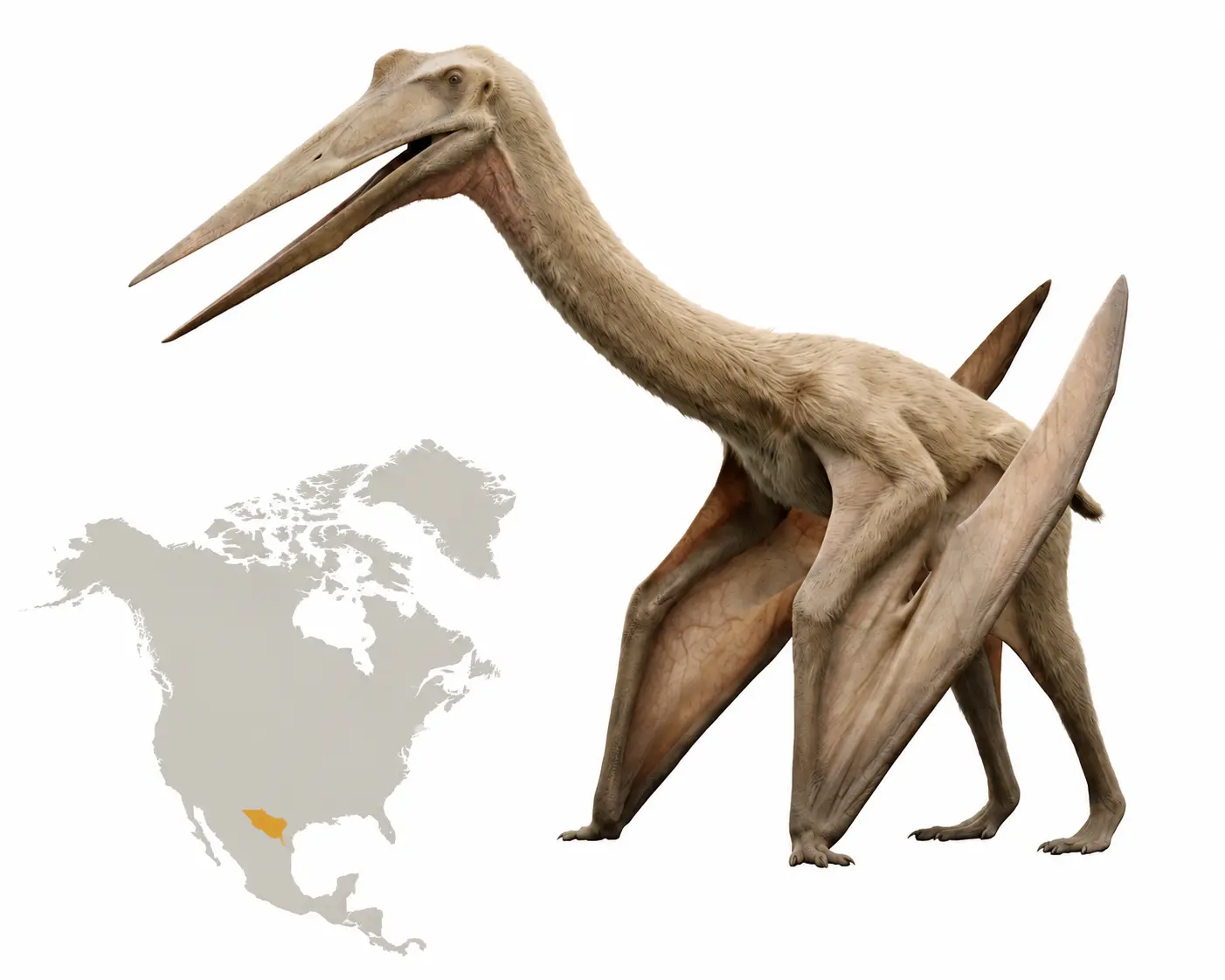
At a Glance
| Field | Information |
|---|---|
| Genus | Quetzalcoatlus |
| Recognized species | Quetzalcoatlus northropi, Quetzalcoatlus lawsoni |
| Clade | Pterosauria |
| Family | Azhdarchidae |
| Period | Late Cretaceous (Maastrichtian), approximately 68–66 million years ago |
| Discovery site | Big Bend National Park, Brewster County, Texas, USA |
| Geological formation | Javelina Formation |
| First discovered by | Douglas A. Lawson (1971) |
| Genus named by | Douglas A. Lawson (1975) |
Quick Answer: Quetzalcoatlus was discovered in Big Bend National Park, Texas, USA, in 1971 by geology graduate student Douglas A. Lawson. Fossil material comes from the Javelina Formation, a Late Cretaceous inland fluvial deposit. Lawson formally named the genus in 1975, and a second species, Quetzalcoatlus lawsoni, was formally described in 2021 from additional material recovered from the same formation.
Introduction
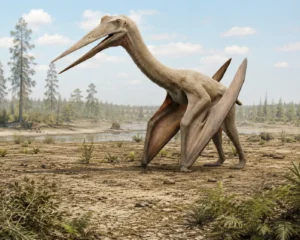
The discovery of Quetzalcoatlus began in 1971 when geology graduate student Douglas A. Lawson recovered fragmentary fossil material from Big Bend National Park in Texas. That discovery would ultimately identify one of the largest known flying animals in Earth’s history and substantially expand scientific understanding of the upper size limits of powered vertebrate flight.
Research on Quetzalcoatlus has continued for decades as additional fossil material, anatomical reassessments, and taxonomic revisions have refined scientific interpretations of the genus. The formal recognition of a second species, Quetzalcoatlus lawsoni, in 2021 further clarified the diversity of giant azhdarchid pterosaurs in Late Cretaceous North America.
Where Was Quetzalcoatlus Found?
Quetzalcoatlus fossil material has been recovered exclusively from Big Bend National Park in Brewster County, Texas, USA. All confirmed specimens originate from the Javelina Formation, a Maastrichtian-age geological unit representing inland fluvial environments, including ancient river channels and floodplains of the Late Cretaceous.
The inland, non-marine depositional setting is important for interpreting the paleoecology of Quetzalcoatlus. Unlike many earlier large pterosaurs commonly associated with coastal or marine environments, Quetzalcoatlus was recovered from a terrestrial ecosystem, a context that has contributed to interpretations of ground-based foraging behaviour, although ecological reconstructions remain inferential.
The Javelina Formation dates to approximately 68–66 million years ago, placing Quetzalcoatlus within the final stage of the Cretaceous Period shortly before the end-Cretaceous mass extinction. Fossils from the same formation indicate a diverse terrestrial fauna that included hadrosaurs, ceratopsians, and the giant titanosaur sauropod Alamosaurus, situating Quetzalcoatlus within one of the last major dinosaur-dominated ecosystems of North America.
Who Discovered Quetzalcoatlus?
Douglas A. Lawson, then a geology graduate student at the University of Texas at Austin, discovered the first Quetzalcoatlus material in 1971 during fieldwork in Big Bend National Park. Lawson formally described and named the genus in 1975, designating Quetzalcoatlus northropi as the type species. The species epithet northropi honours John Knudsen Northrop, founder of Northrop Corporation, in recognition of his work on large tailless flying-wing aircraft — an apt reference for a creature of this wingspan.
Why Is Quetzalcoatlus Named Quetzalcoatlus?
The genus name Quetzalcoatlus derives from Quetzalcóatl, the feathered serpent deity of Aztec mythology. Douglas A. Lawson selected the name when formally describing the genus in 1975, likely as a reference to the animal’s immense size and dramatic flying appearance.
The name is strictly etymological and does not imply any biological relationship to birds, snakes, or mythological creatures. Quetzalcoatlus was a pterosaur — an extinct flying reptile within Pterosauria — not a bird, dinosaur, or serpent.
The 2021 Species Revision
This remains an active area of paleontological research, and interpretations may continue to evolve as additional fossil material and analytical work become available.
For several decades, fossil material attributed to Quetzalcoatlus was generally referred to the single species Quetzalcoatlus northropi, the type species described by Douglas A. Lawson in 1975. In 2021, Jacobs and colleagues formally described a second species, Quetzalcoatlus lawsoni, based on additional fossil material from the same Javelina Formation deposits in Texas.
Quetzalcoatlus lawsoni represents a substantially smaller species than the giant Q. northropi. Current estimates place Q. lawsoni at approximately 4.5–5.5 metres (15–18 feet) in wingspan, whereas Q. northropi is commonly reconstructed at roughly 10–11 metres (33–36 feet), although estimates for the larger species remain subject to uncertainty because of its fragmentary fossil record.
The recognition of two species indicates that multiple azhdarchid body sizes were present within the same Late Cretaceous ecosystem, with both species currently understood to have coexisted in the Javelina Formation.
What Fossils Have Been Found?
The fossil record of Quetzalcoatlus is incomplete but scientifically important. Material attributed to the genus ranges from fragmentary remains of the giant type species, Quetzalcoatlus northropi, to more informative associated specimens assigned to the smaller species, Quetzalcoatlus lawsoni.
The holotype of Q. northropi consists primarily of fragmentary wing material, including elongated limb elements characteristic of giant azhdarchid pterosaurs. Because the type specimen lacks an associated skull or complete skeleton, anatomical reconstruction and size estimates for this species retain a degree of uncertainty.
Additional fossil material from the Javelina Formation, later assigned to Q. lawsoni, includes more extensive remains such as cranial material, vertebrae, and limb elements. These specimens provide a clearer anatomical basis for understanding Quetzalcoatlus morphology and have informed comparative reconstructions of the much larger Q. northropi.
No complete skeleton of either recognized species has been recovered, meaning many aspects of anatomy, proportions, and life appearance remain partially inferential.
Related and Contemporary Species
- Alamosaurus sanjuanensis — A giant titanosaur sauropod known from the Late Cretaceous of North America, including the Javelina Formation. It was a direct faunal associate of Quetzalcoatlus within the same terrestrial ecosystem.
- Tyrannosaurus rex — A large apex theropod from other late Maastrichtian formations in North America. Although not a confirmed faunal associate from the Javelina Formation, it provides a broader ecological context for predator-dominated Late Cretaceous continental ecosystems.
- Cryodrakon boreas — A giant Canadian azhdarchid pterosaur described from the Dinosaur Park Formation of Alberta. As another large North American azhdarchid, it is important for understanding the diversity and biogeography of giant pterosaurs on the continent.
- Hatzegopteryx thambema — A giant Romanian azhdarchid notable for its exceptionally robust skull and heavily built anatomy. It represents one of the closest known size comparisons to Quetzalcoatlus, while illustrating that giant azhdarchids evolved different structural adaptations.
- Pteranodon longiceps — A well-known large North American pterosaur from the earlier Late Cretaceous. Although not closely comparable ecologically, it provides useful evolutionary context for understanding the diversity and progression of large pterosaur forms before the emergence of giant azhdarchids like Quetzalcoatlus.
Frequently Asked Questions
Where was Quetzalcoatlus found?
Quetzalcoatlus was discovered in Big Bend National Park, Brewster County, Texas, USA. All confirmed fossil material assigned to the genus comes from the Javelina Formation, a Late Cretaceous inland fluvial geological unit dating to the Maastrichtian.
When was Quetzalcoatlus discovered?
The first Quetzalcoatlus fossil material was discovered in 1971 by geology graduate student Douglas A. Lawson during fieldwork in Big Bend National Park. The genus was formally described and named in 1975.
Why is Quetzalcoatlus named after Quetzalcóatl?
The name Quetzalcoatlus derives from Quetzalcóatl, the feathered serpent deity of Aztec mythology. Douglas A. Lawson selected the name when describing the genus in 1975, likely in reference to the animal’s enormous size and striking flying form. The name is etymological only and does not imply any biological relationship to birds, snakes, or mythological creatures.
Conclusion
The discovery of Quetzalcoatlus in 1971 significantly expanded scientific understanding of the upper size limits of powered vertebrate flight. Although the fossil record remains incomplete, continued research has transformed Quetzalcoatlus from a giant fragmentary pterosaur known from limited remains into a more clearly defined genus containing multiple recognized species. Big Bend National Park remains the only confirmed source of Quetzalcoatlus fossil material.
References
Primary Scientific Literature
Lawson, D. A. (1975). Pterosaur from the latest Cretaceous of West Texas: Discovery of the largest flying creature. Science, 187(4180), 947–948. https://doi.org/10.1126/science.187.4180.947
Jacobs, M. L., Ferguson, K. M., Polcyn, M. J., & Winkler, D. A. (2021). A new species of Quetzalcoatlus (Pterosauria: Azhdarchidae) from the Upper Cretaceous Javelina Formation of Texas. Journal of Vertebrate Paleontology, 41(sup1), 203–217. https://doi.org/10.1080/02724634.2020.1907587
Lehman, T. M. (1985). Paleoecology of the latest Cretaceous Javelina Formation, Big Bend National Park, Texas. Geological Society of America Bulletin, 96(6), 747–762. https://doi.org/10.1130/0016-7606(1985)96<747:POTLCJ>2.0.CO;2
Comparative / Contextual Literature
Witton, M. P., & Naish, D. (2008). A reappraisal of azhdarchid pterosaur functional morphology and paleoecology. PLoS ONE, 3(5), e2271. https://doi.org/10.1371/journal.pone.0002271
Longrich, N. R., Martill, D. M., & Andres, B. (2018). Late Maastrichtian pterosaurs from North Africa and mass extinction of Pterosauria at the Cretaceous–Paleogene boundary. PLoS Biology, 16(3), e2001663. https://doi.org/10.1371/journal.pbio.2001663
Witton, M. P. (2013). Pterosaurs: Natural History, Evolution, Anatomy. Princeton University Press.
Taxonomic / Comparative Species References
Currie, P. J., & Russell, D. A. (1982). A juvenile specimen of Tarbosaurus bataar from the Judith River Formation of Alberta. [Not needed unless using comparative tyrannosaur context]
Hone, D. W. E., Habib, M. B., & Therrien, F. (2019). Cryodrakon boreas, gen. et sp. nov., a Late Cretaceous Canadian azhdarchid pterosaur. Journal of Vertebrate Paleontology, 39(3), e1649681. https://doi.org/10.1080/02724634.2019.1649681
Buffetaut, E., Grigorescu, D., & Csiki, Z. (2002). A new giant pterosaur with a robust skull from the latest Cretaceous of Romania. Naturwissenschaften, 89, 180–184. https://doi.org/10.1007/s00114-002-0307-1
Featured Museum Collections
Museum-quality paleoart and educational poster
collections based on evidence-informed prehistoric
Life reconstructions.