
At a Glance
| Field | Information |
|---|---|
| Genus | Quetzalcoatlus |
| Recognized species | Quetzalcoatlus northropi, Quetzalcoatlus lawsoni |
| Clade | Pterosauria |
| Family | Azhdarchidae |
| Geological age | Late Cretaceous (Maastrichtian), approximately 68–66 million years ago |
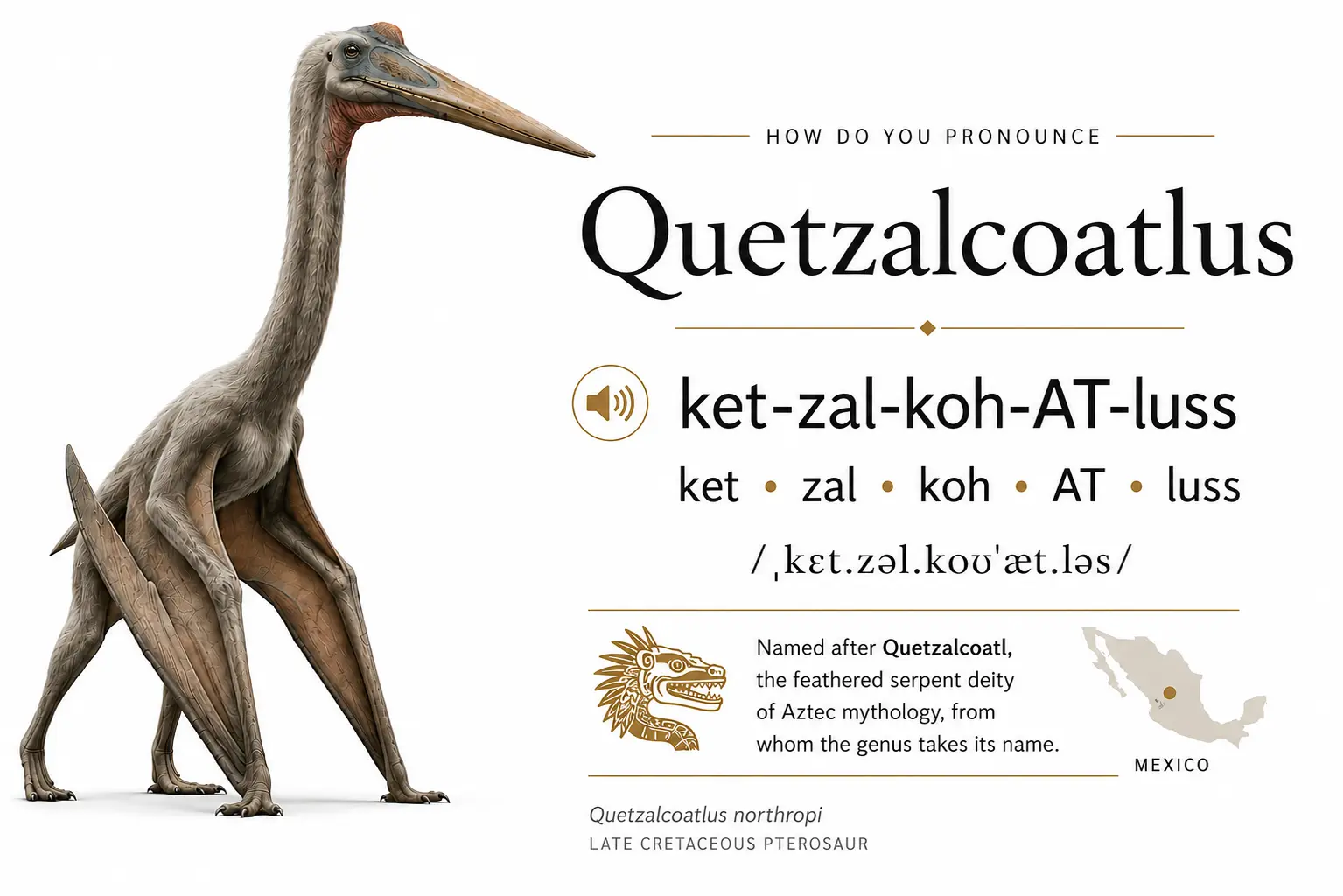
| Common English pronunciation | ket-sal-KOH-at-lus |
| Syllable count | 5 |
| Name origin | Derived from Quetzalcóatl, the feathered serpent deity of Aztec mythology |
Quick Answer: A commonly used English pronunciation of Quetzalcoatlus is ket-sal-KOH-at-lus, spoken in five syllables with primary stress on the third syllable. The genus name derives from Quetzalcóatl, and while pronunciation varies slightly by speaker and accent, this is the form most commonly used in English-language paleontological discussion.

Introduction
Few prehistoric animal names appear as visually intimidating to English speakers as Quetzalcoatlus. Its unusual spelling reflects the linguistic origin of the name rather than conventional English phonetics, which is why it often looks harder to pronounce than it actually is.
Once divided into manageable syllables and understood in the context of its linguistic origin, the pronunciation becomes much more approachable.
How to Pronounce Quetzalcoatlus
A commonly accepted English pronunciation of Quetzalcoatlus is:
ket — sal — KOH — at — lus
The word is typically spoken in five syllables, with primary stress on the third syllable (KOH). In common English usage, the opening “Q” is usually pronounced with a hard K sound rather than the typical English “kw” sound, reflecting the name’s derivation from Quetzalcóatl.
A useful pronunciation shortcut is to think of the first portion as sounding somewhat like “pretzel” without the “pr”, followed by “KOH-at-lus.” While not a strict phonetic rendering, this mnemonic helps many readers approximate the commonly used pronunciation.
Common mispronunciations include forms such as “kwet-za-KOH-at-lus” (adding a “w” sound) or “kwet-za-KOT-lus” (compressing the middle syllables), both of which reflect attempts to apply standard English spelling rules to a non-English-derived scientific name.
Syllable-by-Syllable Guide
| Syllable | Approximate Sound | Note |
|---|---|---|
| Quet- | ket | Typically pronounced with a hard K sound in English usage |
| -zal- | sal | Short vowel sound |
| -co- | KOH | Primary stressed syllable |
| -at- | at | Short vowel sound |
| -lus | lus | Commonly rhymes with “bus” in English pronunciation |
Full pronunciation: ket-sal-KOH-at-lus
Where Does the Name Come From?
The genus name Quetzalcoatlus derives from Quetzalcóatl, the feathered serpent deity of Aztec mythology. Douglas A. Lawson chose the name when formally describing the genus in 1975, likely in reference to the animal’s immense size and dramatic flying appearance.
The source name Quetzalcóatl comes from the Nahuatl language and is traditionally interpreted as a compound involving quetzal, referring to the resplendent quetzal (Pharomachrus mocinno), and coātl, meaning serpent. The scientific genus name Quetzalcoatlus is a Latinized taxonomic adaptation of this mythological name rather than a direct linguistic transcription.
How to Remember the Pronunciation
A useful mnemonic for English speakers is:
“Pretzel-coat-us”
This is not a strict phonetic transcription, but it provides a practical approximation of the commonly used pronunciation. Removing the “pr” from “pretzel,” replacing it with a hard K sound, and emphasizing the “KOH” syllable helps many readers remember the structure of the word.
Because the name derives from a non-English linguistic source, its spelling appears less intuitive to English readers than many classical scientific names.
Is There More Than One Accepted Pronunciation?
Minor variation in English pronunciation is common. Some speakers pronounce the final syllable with a short vowel (“-lus”), while others use a more neutral unstressed vowel depending on regional accent and speaking style.
The most consistently recognizable features in English usage are the five-syllable structure, primary stress on the third syllable (KOH), and the common hard K pronunciation at the beginning. Small vowel differences between accents do not materially affect comprehension.
Related Pronunciation Notes
- Hatzegopteryx — commonly rendered approximately as hat-ZEG-op-ter-iks
- Pteranodon — commonly pronounced teh-RAN-oh-don, with a silent initial P
- Azhdarchidae — commonly approximated as az-DAR-ki-dee in English paleontological usage
- Arambourgiania — commonly rendered approximately as ah-ram-boor-zhee-AH-nee-ah
- Cryodrakon — commonly pronounced kry-oh-DRAY-kon
These pronunciations may vary slightly between speakers, institutions, and regional English accents.
Frequently Asked Questions
How do you pronounce Quetzalcoatlus?
A commonly used English pronunciation of Quetzalcoatlus is ket-sal-KOH-at-lus, spoken in five syllables with primary stress on the third syllable. In common English usage, the opening sound is typically rendered as a hard K rather than “kw.” A useful pronunciation mnemonic is “Pretzel-coat-us,” which offers a practical approximation for English speakers.
Why is Quetzalcoatlus so hard to pronounce?
The name appears difficult primarily because its spelling derives from a Nahuatl source rather than familiar English or Greco-Latin naming conventions. As a result, English readers often try to apply standard English phonetic expectations to a word that follows a different linguistic pattern. Once divided into five syllables—ket-sal-KOH-at-lus—it becomes much easier to pronounce consistently.
What does Quetzalcoatlus mean?
Quetzalcoatlus is named after Quetzalcóatl, the feathered serpent deity of Aztec mythology. The scientific genus name is a Latinized adaptation of that mythological name rather than a strict literal translation. Douglas A. Lawson selected the name when formally describing the genus in 1975, likely in reference to the animal’s immense size and striking flying appearance.
Conclusion
Quetzalcoatlus is a name that appears more intimidating in print than it is in speech. In commonly used English pronunciation, it is spoken as ket-sal-KOH-at-lus, with five syllables and stress on the third syllable.
Understanding the linguistic origin of the name helps explain its unusual spelling and makes pronunciation easier to remember. Like the animal itself, the name is distinctive, memorable, and rooted in a fascinating historical and cultural reference.
References
Primary Scientific Source
Lawson, D. A. (1975).
Pterosaur from the latest Cretaceous of West Texas: Discovery of the largest flying creature.
Science, 187(4180), 947–948.
https://doi.org/10.1126/science.187.4180.947
Modern Taxonomic Reference
Jacobs, M. L., Ferguson, K. M., Polcyn, M. J., & Winkler, D. A. (2021).
A new species of Quetzalcoatlus (Pterosauria: Azhdarchidae) from the Upper Cretaceous Javelina Formation of Texas.
Journal of Vertebrate Paleontology, 41(sup1), 203–217.
https://doi.org/10.1080/02724634.2020.1907587
Etymology / Linguistic Naming Reference
Miller, M., & Taube, K. (1993).
The Gods and Symbols of Ancient Mexico and the Maya: An Illustrated Dictionary of Mesoamerican Religion.
Thames & Hudson.
General Pterosaur Reference
Witton, M. P. (2013).
Pterosaurs: Natural History, Evolution, Anatomy.
Princeton University Press.
Recommended Paleontology & Natural History Books
As an Amazon Associate, Extinct Atlas may earn from qualifying purchases.

The Rise and Fall of the Dinosaurs
A compelling history of dinosaurs, tracing their origins, diversification, 200-million-year reign, extinction, and enduring legacy.
Dinosaurs and Prehistoric Life
A richly illustrated visual reference exploring dinosaurs, fossils, evolution, and prehistoric life across geological time.

Encyclopedia Prehistorica: Dinosaurs
An interactive dinosaur book featuring spectacular three-dimensional pop-ups, particularly suited to young readers and families.
The Rise and Reign of the Mammals
A sweeping history of mammalian evolution, from their origins alongside dinosaurs through the Cenozoic and the emergence of humans.