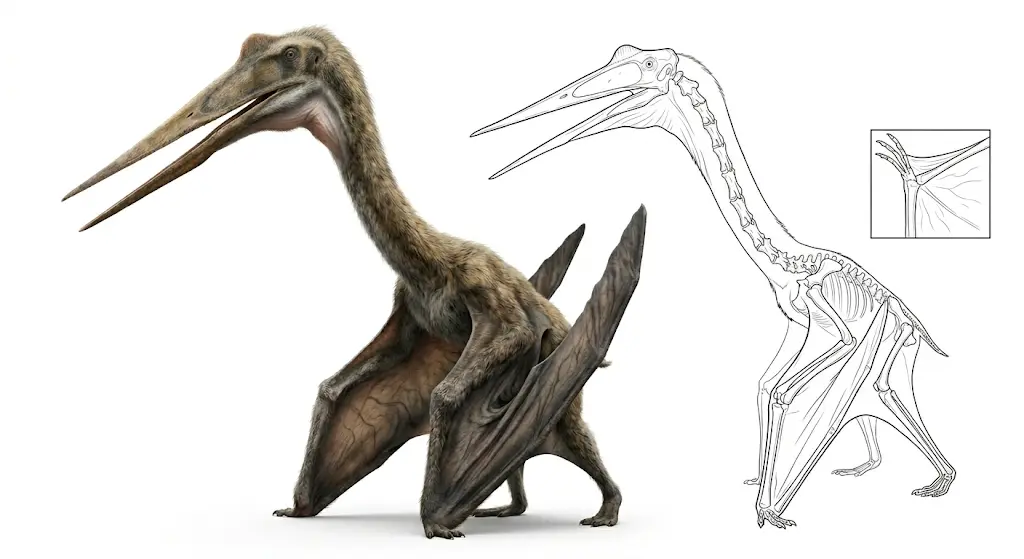
At a Glance
| Field | Information |
|---|---|
| Genus | Quetzalcoatlus Lawson, 1975 |
| Recognized species | Quetzalcoatlus northropi (Lawson, 1975); Quetzalcoatlus lawsoni (Jacobs et al., 2021) |
| Clade | Pterosauria |
| Subclade | Pterodactyloidea |
| Family | Azhdarchidae |
| Geological age | Late Cretaceous (Maastrichtian), approximately 68–66 million years ago |
Quick Answer: Quetzalcoatlus is a giant azhdarchid pterosaur classified within Pterosauria, the subclade Pterodactyloidea, and the family Azhdarchidae. Two species are currently recognized: Quetzalcoatlus northropi, the giant type species described in 1975, and Quetzalcoatlus lawsoni, a smaller species formally described in 2021. Its precise phylogenetic relationships within Azhdarchidae remain an active area of research.
Introduction
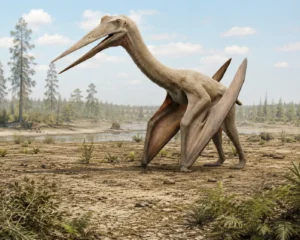
For decades, Quetzalcoatlus was understood as a genus represented by a single giant species, Quetzalcoatlus northropi, known from fragmentary fossil material recovered in Texas. The formal description of a second species in 2021 substantially refined scientific understanding of the genus, demonstrating that multiple Quetzalcoatlus species coexisted within the Late Cretaceous ecosystem of North America.
Although Quetzalcoatlus remains one of the most iconic giant pterosaurs ever discovered, aspects of its taxonomy, anatomy, and phylogenetic relationships continue to be refined as new analyses and fossil interpretations emerge.
Quetzalcoatlus Classification: Full Taxonomy
This remains an active area of paleontological research, and classification may be refined as additional fossil evidence becomes available. The currently accepted classification of Quetzalcoatlus is:
- Domain: Eukaryota
- Kingdom: Animalia
- Phylum: Chordata
- Clade: Archosauria
- Clade: Pterosauria
- Subclade: Pterodactyloidea
- Family: Azhdarchidae
- Genus: Quetzalcoatlus Lawson, 1975
- Species:
- Quetzalcoatlus northropi (Lawson, 1975) — giant type species, known primarily from fragmentary wing remains.
- Quetzalcoatlus lawsoni (Jacobs et al., 2021) — smaller species represented by more informative cranial and postcranial material
For many years, Quetzalcoatlus was treated as a monospecific genus containing only Q. northropi. The recognition of Q. lawsoni in 2021 revised that interpretation, and the genus is currently understood to contain two recognized species. Future refinements remain possible as additional fossil material from Big Bend National Park is studied.
The 2021 Species Revision
For several decades, fossil material attributed to Quetzalcoatlus from the Javelina Formation was generally assigned to the giant type species, Quetzalcoatlus northropi, despite clear differences in specimen size and preservation quality. In 2021, Jacobs and colleagues formally revised this interpretation by describing the smaller Big Bend specimens as a distinct second species, Quetzalcoatlus lawsoni, named in honour of Douglas A. Lawson, who discovered the genus.
The two currently recognized species are understood to have coexisted within the same Late Cretaceous ecosystem. Quetzalcoatlus lawsoni is estimated to have had a wingspan of approximately 4.5–5.5 metres (15–18 feet), substantially smaller than the giant Q. northropi, which is commonly reconstructed at roughly 10–11 metres (33–36 feet), although estimates for the larger species remain subject to uncertainty because of its fragmentary fossil record.
The significance of this revision extends beyond nomenclature. Fossil material assigned to Q. lawsoni includes better-preserved cranial and postcranial remains, providing a stronger anatomical basis for reconstructing the morphology of the genus as a whole, including comparative interpretations of the much larger Q. northropi.
What Did the 2021 Revision Change?
The 2021 revision materially changed the scientific interpretation of Quetzalcoatlus in two important ways. First, it established the genus as containing at least two morphologically distinct recognized species rather than a single giant form. Second, it significantly improved the anatomical evidence available for understanding the genus, because Q. lawsoni preserves skeletal elements absent from the fragmentary Q. northropi holotype.
As a result, anatomical reconstructions and general biological interpretations published before the 2021 revision should be considered in the context of the more limited fossil evidence available at that time.
Where Does Quetzalcoatlus Sit Within Azhdarchidae?
Azhdarchidae is a family of large to giant pterodactyloid pterosaurs characterized by elongated neck vertebrae, long toothless jaws, proportionally long limbs, and adaptations associated with terrestrial locomotion. Quetzalcoatlus is one of the best-known giant members of this family and remains among the most iconic azhdarchid taxa ever described.
Phylogenetic analyses consistently place Quetzalcoatlus within Azhdarchidae, although its precise evolutionary relationship to other giant azhdarchids—including Hatzegopteryx, Arambourgiania, and Cryodrakon—varies between published studies. The fragmentary nature of the Q. northropi holotype limits the number of anatomical characters available for comparison, contributing to ongoing uncertainty in detailed phylogenetic placement.
Because of these limitations, claims about exact placement within the family should be treated as provisional pending additional fossil evidence.
What Is a Pterosaur? (Classification Context)
Quetzalcoatlus was a pterosaur, belonging to the clade Pterosauria — the first known vertebrates to achieve powered flight. Pterosaurs were flying reptiles that evolved independently of birds and bats, representing a distinct evolutionary lineage of archosaurs.
As archosaurs, pterosaurs share a broader evolutionary ancestry with dinosaurs, modern birds, and crocodilians. However, pterosaurs were not dinosaurs, nor were they direct ancestors of birds. Instead, they represent a separate branch of archosaur evolution that developed powered flight independently.
Related and Comparative Species
- Cryodrakon boreas — A giant Canadian azhdarchid pterosaur described in 2019, important for understanding the diversity and biogeography of North American giant azhdarchids.
- Hatzegopteryx thambema — A giant Romanian azhdarchid notable for its robust skull and unusually heavy build, providing an important comparison with the more gracile giant Quetzalcoatlus.
- Arambourgiania philadelphiae — A large Middle Eastern azhdarchid known from Jordan, frequently included in comparative discussions of giant azhdarchid anatomy and phylogeny.
- Zhejiangopterus linhaiensis — A Chinese azhdarchid represented by relatively informative fossil material, valuable for reconstructing general azhdarchid skeletal structure and proportions.
- Montanazhdarcho minor — A smaller North American azhdarchid from the Campanian, illustrating the broad size diversity present within Azhdarchidae.
Frequently Asked Questions
What is the classification of Quetzalcoatlus?
Quetzalcoatlus is classified within the clade Pterosauria, subclade Pterodactyloidea, and family Azhdarchidae. Two species are currently recognized: Quetzalcoatlus northropi and Quetzalcoatlus lawsoni. Its precise phylogenetic position within Azhdarchidae remains subject to ongoing study.
How many species of Quetzalcoatlus are there?
Two species are currently recognized: the giant type species Quetzalcoatlus northropi, described by Douglas A. Lawson in 1975, and the smaller Quetzalcoatlus lawsoni, formally described by Jacobs and colleagues in 2021. Additional taxonomic refinement remains possible if new fossil evidence becomes available.
Is Quetzalcoatlus related to birds?
Quetzalcoatlus was not closely related to birds in the sense of direct ancestry. Both birds and pterosaurs belong to the broader archosaur lineage, but they evolved flight independently and represent separate evolutionary branches. Quetzalcoatlus was neither a bird nor an ancestor of modern birds.
Conclusion
Quetzalcoatlus is securely classified within Azhdarchidae, one of the most distinctive families of giant pterodactyloid pterosaurs. While its broad classification is well established, aspects of its detailed phylogenetic placement and anatomical interpretation continue to be refined as paleontological research progresses. The recognition of two currently accepted species has significantly improved scientific understanding of the genus and its place within Late Cretaceous pterosaur diversity.
References
Primary Scientific Literature
Lawson, D. A. (1975). Pterosaur from the latest Cretaceous of West Texas: Discovery of the largest flying creature. Science, 187(4180), 947–948. https://doi.org/10.1126/science.187.4180.947
Jacobs, M. L., Ferguson, K. M., Polcyn, M. J., & Winkler, D. A. (2021). A new species of Quetzalcoatlus (Pterosauria: Azhdarchidae) from the Upper Cretaceous Javelina Formation of Texas. Journal of Vertebrate Paleontology, 41(sup1), 203–217. https://doi.org/10.1080/02724634.2020.1907587
Azhdarchid Classification / Comparative Taxonomy
Kellner, A. W. A. (2003). Pterosaur phylogeny and comments on the evolutionary history of the group. In E. Buffetaut & J.-M. Mazin (Eds.), Evolution and Palaeobiology of Pterosaurs (pp. 105–137). Geological Society Special Publication.
Andres, B., Clark, J., & Xu, X. (2014). The earliest pterodactyloid and the origin of the group. Current Biology, 24(9), 1011–1016. https://doi.org/10.1016/j.cub.2014.03.030
Witton, M. P., & Naish, D. (2008). A reappraisal of azhdarchid pterosaur functional morphology and paleoecology. PLoS ONE, 3(5), e2271. https://doi.org/10.1371/journal.pone.0002271
Comparative Azhdarchid Species
Hone, D. W. E., Habib, M. B., & Therrien, F. (2019). Cryodrakon boreas, gen. et sp. nov., a Late Cretaceous Canadian azhdarchid pterosaur. Journal of Vertebrate Paleontology, 39(3), e1649681. https://doi.org/10.1080/02724634.2019.1649681
Buffetaut, E., Grigorescu, D., & Csiki, Z. (2002). A new giant pterosaur with a robust skull from the latest Cretaceous of Romania. Naturwissenschaften, 89, 180–184. https://doi.org/10.1007/s00114-002-0307-1
Featured Museum Collections
Museum-quality paleoart and educational poster
collections based on evidence-informed prehistoric
Life reconstructions.